
The Power of Posture Presented By Dr Jana
The Power of Posture Presented By: Dr. Jana Hull, DC March 30, 2009 Renew Mind and Body Spa and Unlimited Health Chiropractic
�#1: 1: Slouching only makes me look bad -- it can't actually cause long-term damage. True or False?
�FALSE The effects of bad posture are many, and can actually be really serious. When people slouch, their heads come forward. Slouching also forces the shoulders to come forward. This leads to jaw pains and headaches, and to shoulder and back pains. Additionally, if the mechanics of your spine are not proper, it can affect your rib cage, which can damage your heart and lungs, and lead to gastrointestinal issues.
� 2: There is nothing I can do to change the effects of bad posture. True or False?
�FALSE Slouching is natural if you are not ergonomically correct, but there are exercises that you can do to counter the effects of slouching. I recommend weight workouts and stretches that focus on the neck, shoulders, and back.
� 3: Poor posture makes people look at least 15 pounds heavier and feel 10 years older. True or False?
�True. Pay attention to your own perceptions of others. From actors to politicians to average Joe- people just look and seem to feel better when they stand straight and look tall and fit.
� 4: Bad posture is genetic -- I can't change the way I slouch, especially after all this time. True or False?
�FALSE. Bad posture can be genetic, but that doesn't mean it's completely out of your hands. Tightening and strengthening your core -- that is, the center of your body, including the deep abdominal muscles and the muscles closest to the spine -- can help improve your posture, making it easier for you to sit (and stand) up straight. A good Pilates class will teach you the exercises you need to develop this core strength.
� 5: Bad posture leads to scoliosis. True or False?
�False. Most cases of scoliosis are idiopathic, meaning they stem from an unknown cause, but there is no known link between posture and scoliosis. However, scoliosis only includes side-to-side curves. There also curves in the front-to-back plane of the spine, and these can be increased or decreased as a result of hunching and slumping, so sit up straight!
� 6: Working in front of a computer all day is ruining my posture. True or False.
�TRUE! Sitting in front of a computer all day can force you to jut your neck forward and hunch your shoulders. If you're not using sound ergonomical principles, you will wind up with back and neck pain. To counter these effects, push for ergonomically designed desk chairs at work. If you spend a lot of time on the phone at work, ask for a headset, so your neck muscles will not contract unevenly. And finally, take breaks to walk around the office and stretch.
�Why is poor posture such a bad thing? �Let’s do a quick exercise that I think will really demonstrate this for you. But why? ?
�Why Fat? does Poor Posture make You look
�Two of the most common postural flaws are: �Anterior Pelvic Tilt and �Hyper-Lordosis Posture Problems
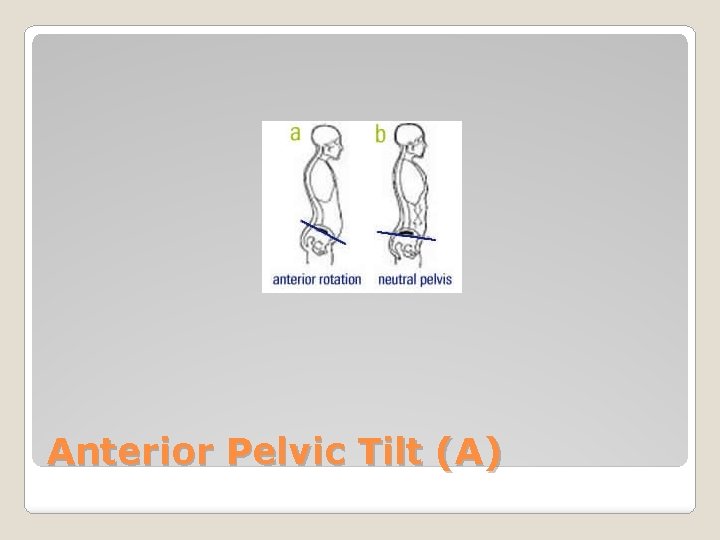
Anterior Pelvic Tilt (A)
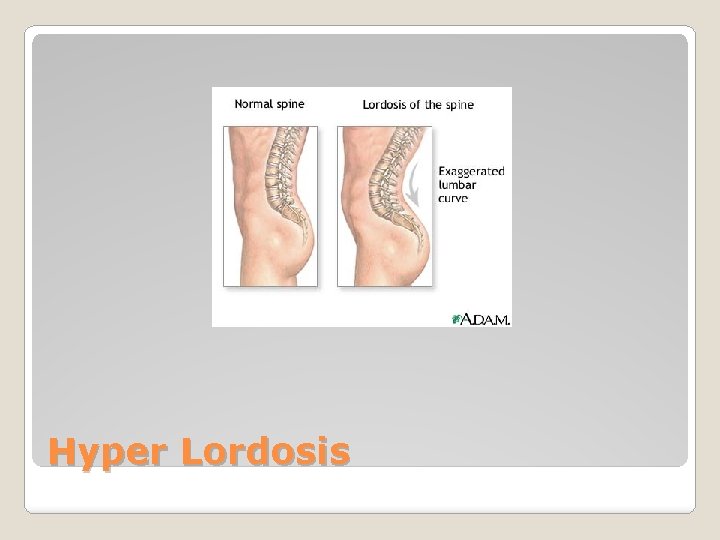
Hyper Lordosis
�Anterior Pelvic tilt & Lordosis manifest themselves as a protruding Gut and Butt.
�Another common posture problem is Hyper-Kyphosis Hyperkyphosis
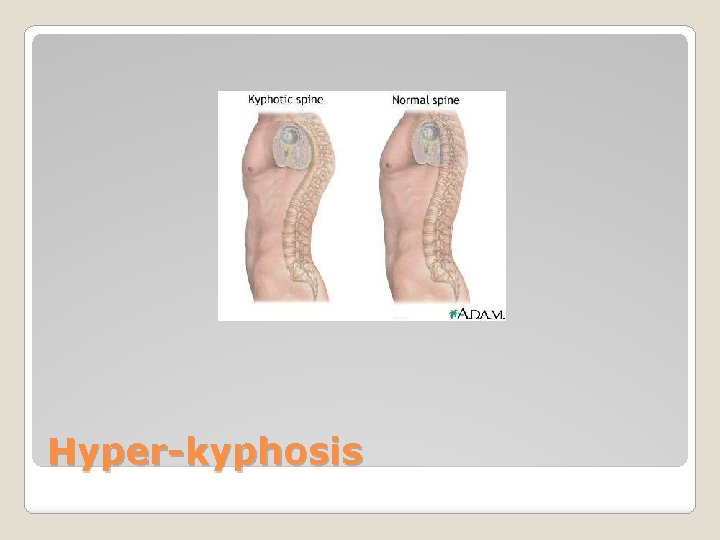
Hyper-kyphosis
�Kyphosis and a ‘forward head’ position makes you look hunched over and appear shorter.
�Along with the whole looking fat and short thing, you are likely to suffer from headaches, neck pain, bicep tendinitis, dry mouth, pain under the shoulder blades, mid back pain, lower back pain, lateral knee pain, torn knee ligaments, hamstring tears, plantar fasciitis and sciatica. A few other unpleasantries…
�Head and Neck: Your head should be balanced directly over the neck, so your ear sits directly above the center of your shoulder joint. What does good posture look like? ? ?
�Shoulders: Your shoulders should sit flat against the back of the rib cage, pulled slightly back, and relaxed down well away from your ears.
�Chest: Your front, side and back of the chest should remain slightly lifted, so your waist is lengthened, narrowed and slightly firmed.
�Abdomen: Your abdominal muscles should pull slightly inwards and upwards as they contract slightly and give support to your back.
�Pelvis lower back: Your tailbone and sitting bones should tuck slightly down and under, and your lower back should find its natural curve (not too arched, nor too slumped).
�Knees: Your knees should be pointing straight forwards. They should not be excessively pressed back and locked, but should maintain support by a gentle grip on the muscles at the back and front of your legs.
�Feet: The inner arches of your feet should remain lifted. Weight balanced evenly across the center of the heel, outside arch of the foot, little toe and big toe and balls of the feet.
�Plumb line: A vertical line should pass through the ear, center of the shoulder, hip, knee and ankle joints.
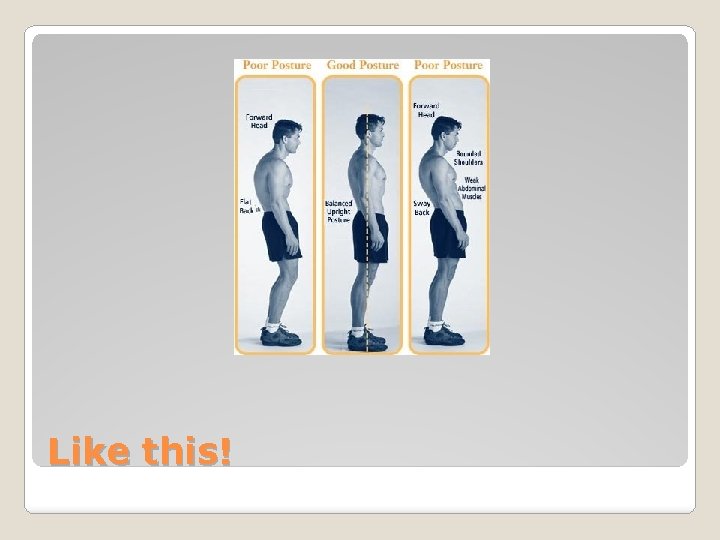
Like this!
� The first step is to know the correct posture for your head and neck, and regularly reassess your head and neck posture to ensure that correct posture becomes a habit. The correct position for your head and neck is one in which the ear-hole is directly centered over the center of the shoulder joint. The chin is level, the eyes horizontal. � A good way to check your head and neck posture is to try the old fashioned exercise of balancing a book on your head. This exercise really works! Practice it every day for 1 -2 minutes, and you will notice your posture improve. It is interesting to note that people that carry baskets on their head, such as in India and Africa, have impeccable posture as the body is forced to find its natural state of balance. #1. Awareness
�Shoulder rolls �Elbow circles �Neck flexion stretch �Neck extension stretch �Hamstring stretch �Hip flexor stretch �Abdominal crunches #2 Exercises
�Regular chiropractic adjustments improve the alignment and curvature of the spine, which is essential in achieving proper posture. A side benefit to adjustments is a decrease in muscle tension which also improves posture. #3. Chiropractic Care
�Frequent stretching helps to relieve excessive muscular tension that causes postural imbalances. #4. Stretching
� Make sure you have your workstation set � The seat height should be set so that the up correctly: angle of the knees is 90 degrees, and the feet rest comfortably on the floor. � The keyboard should be at a height just below the level of the elbows, so the angle at the elbows is 90 degrees, and the wrists rest just below the level of your elbows. � The monitor should be placed at a height that enables you to look straight forward at the screen. Your face should be about 3 feet from the screen. � The mouse should be close, so you do not have to reach out to the sides. � Sit on a good chair with back support and arm rests. #5. Ergonomics
�Short breaks of 1 -2 minutes every 30 -60 minutes help to relieve tension. On your lunch break have a walk and stretch, and find time to relax and take a break. #6. Have regular breaks at work to stretch and walk
�Exercises such as Yoga, Pilates, and Exercise ball, are great ways to promote correct posture. #7. Alternative exercise
�If you are overweight, the excess weight can put strain on lower back, knees, and feet, leading to poor posture. #8. Weight Loss
For under $50 you can purchase a brace that helps you improve your posture. � #9. Bracing
�Clasp your hands behind your back. Straighten your arms then lift your hands and chest. Take a deep breath and feel your chest expanding. You'll feel a stretch in the front of your shoulders too. Hold for 10 to 30 seconds. Chest Stretch
�Sit or stand up straight. Relax your neck and let your head bow gently forward until you feel a stretch all along the back of your neck. Without straining, try to touch your chin to your chest. Hold for 10 to 30 seconds. Forward neck stretch
�This exercise will help elevate your ribcage, allowing your shoulders to sit back naturally. In a standing position, place your hands on your hips, slightly behind you, fingertips pointing down. Pull your elbows together behind you. Feel the muscles of your middle back drawing your shoulder blades together. Squeeze for several seconds and release. Do 1 to 2 sets of 8 to 12 repetitions. Upper Back Squeeze
�Of course a change in your posture won't happen by itself. It will take reminding yourself again and again. But it's worth it. These strengthening and flexibility exercises will help -- and so will the compliments you'll get! Keep it up!
�Please feel free to come in for a tour and complimentary consultation. If you schedule this evening you’ll even receive your exam and first treatment half off. Special Invitation
- Slides: 46