
The Power of Language TOK Presentation RealLife Situation
- Slides: 39
The Power of Language TOK Presentation
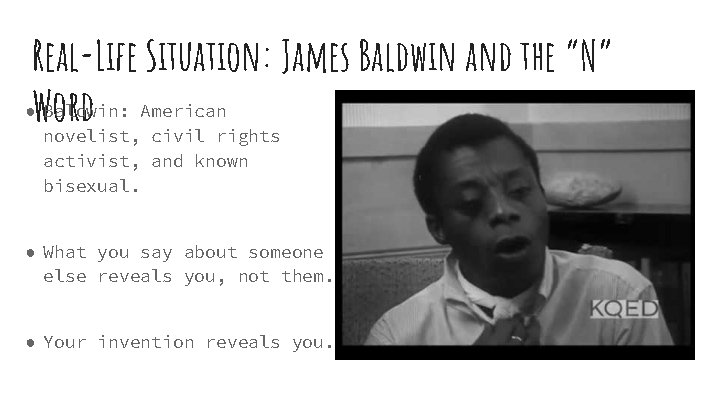
Real-Life Situation: James Baldwin and the “N” ●Word Baldwin: American novelist, civil rights activist, and known bisexual. ● What you say about someone else reveals you, not them. ● Your invention reveals you.
OUtline of this crazy presentation I. Define confusing terms: A. True Knowledge? ! B. Language!? ! II. THE ARTS III. RELIGION IV. COUNTERCLAIM: MATH
Knowledge Question: To what extent does language (key term 1) reflect true knowledge (key term 2) ?
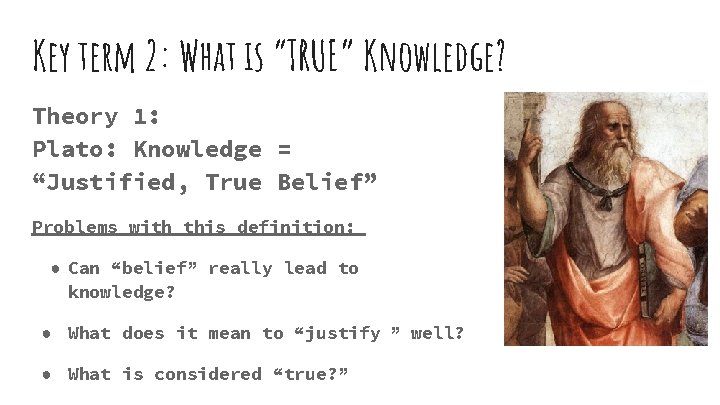
Key term 2: What is “TRUE” Knowledge? Theory 1: Plato: Knowledge = “Justified, True Belief” Problems with this definition: ● Can “belief” really lead to knowledge? ● What does it mean to “justify ” well? ● What is considered “true? ”
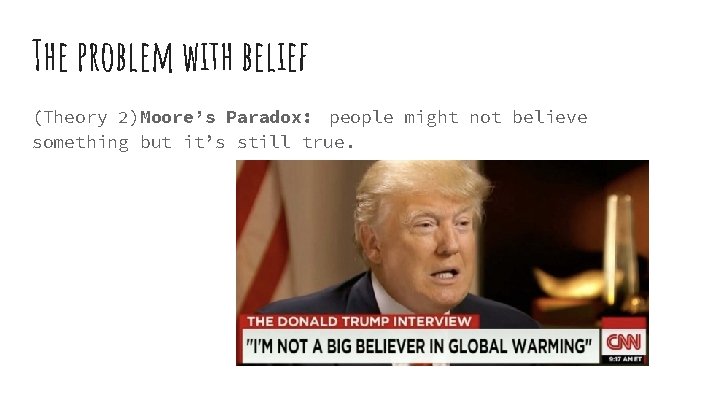
The problem with belief (Theory 2)Moore’s Paradox: people might not believe something but it’s still true.
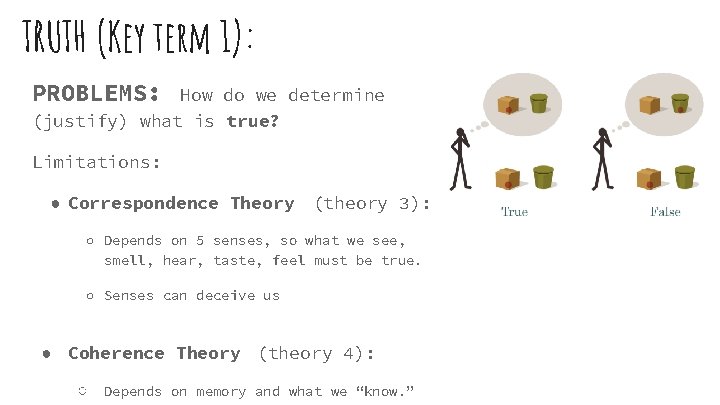
TRUTH (Key term 1): PROBLEMS: How do we determine (justify) what is true? Limitations: ● Correspondence Theory (theory 3): ○ Depends on 5 senses, so what we see, smell, hear, taste, feel must be true. ○ Senses can deceive us ● Coherence Theory (theory 4): ○ Depends on memory and what we “know. ”
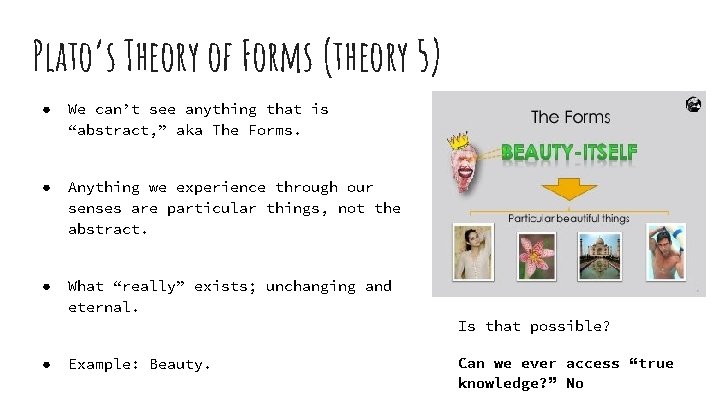
Plato’s Theory of Forms (theory 5) ● We can’t see anything that is “abstract, ” aka The Forms. ● Anything we experience through our senses are particular things, not the abstract. ● What “really” exists; unchanging and eternal. Is that possible? ● Example: Beauty. Can we ever access “true knowledge? ” No
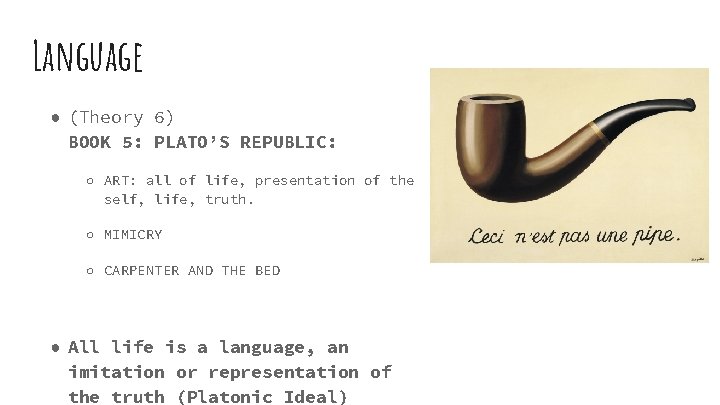
Language ● (Theory 6) BOOK 5: PLATO’S REPUBLIC: ○ ART: all of life, presentation of the self, life, truth. ○ MIMICRY ○ CARPENTER AND THE BED ● All life is a language, an imitation or representation of the truth (Platonic Ideal)
Final definitions (would be your 3 rd paragraph): Language : any form in life (images, words, numbers, etc. ) that “tracks” the truth. “True Knowledge” : Theory of Forms, but because theory of forms is nearly impossibly to see clearly, “true knowledge” refers to ideas in reality that comes closest to reflecting theory of forms. Thesis: Language--any medium through which one attempts to express reality--cannot entirely show the truth; it can mimic truth. It is, then, the closest thing we have to achieving truth.
THE ARTS 1. What is “language” in the Arts? What are its limitations? 2. What is “true knowledge” in the Arts? 3. Some kick-ass examples a. Theory and Example 1: Linguistic Determinism b. Theory and Example 2: Confirmation Bias
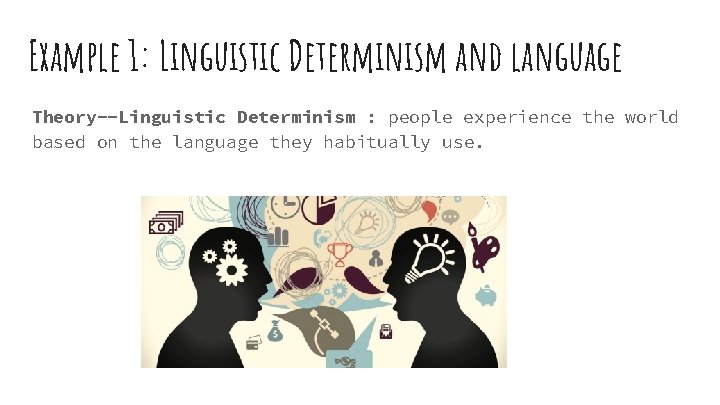
Example 1: Linguistic Determinism and language Theory--Linguistic Determinism : people experience the world based on the language they habitually use.
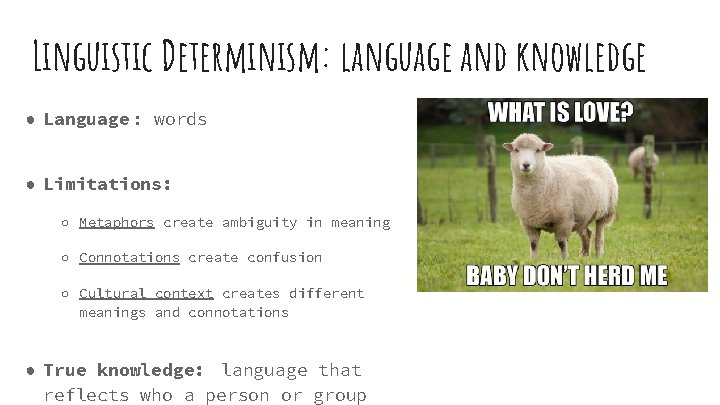
Linguistic Determinism: language and knowledge ● Language : words ● Limitations: ○ Metaphors create ambiguity in meaning ○ Connotations create confusion ○ Cultural context creates different meanings and connotations ● True knowledge: language that reflects who a person or group
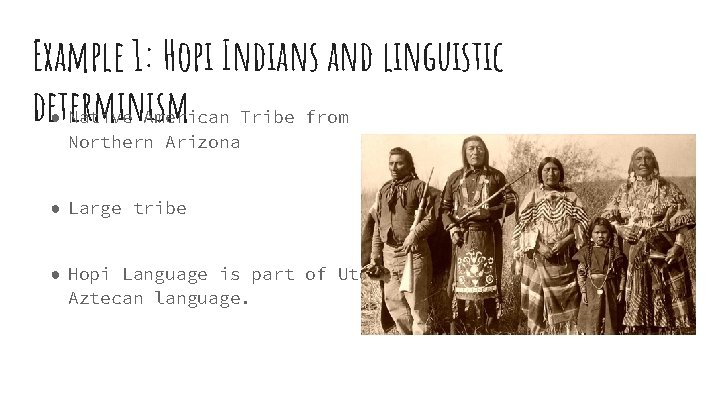
Example 1: Hopi Indians and linguistic determinism ● Native American Tribe from Northern Arizona ● Large tribe ● Hopi Language is part of Uto. Aztecan language.
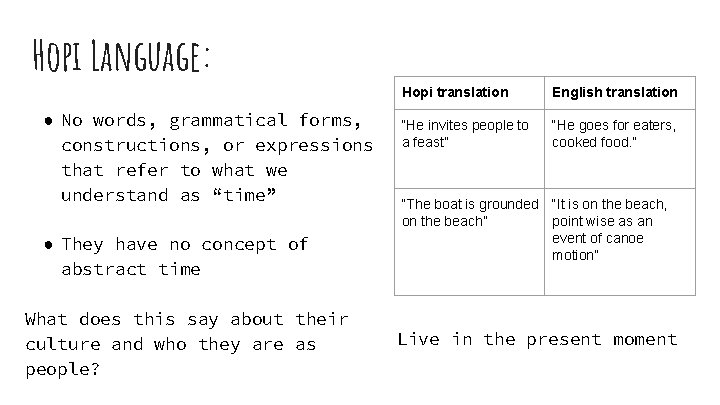
Hopi Language: ● No words, grammatical forms, constructions, or expressions that refer to what we understand as “time” ● They have no concept of abstract time What does this say about their culture and who they are as people? Hopi translation English translation “He invites people to a feast” “He goes for eaters, cooked food. ” “The boat is grounded “It is on the beach, on the beach” point wise as an event of canoe motion” Live in the present moment
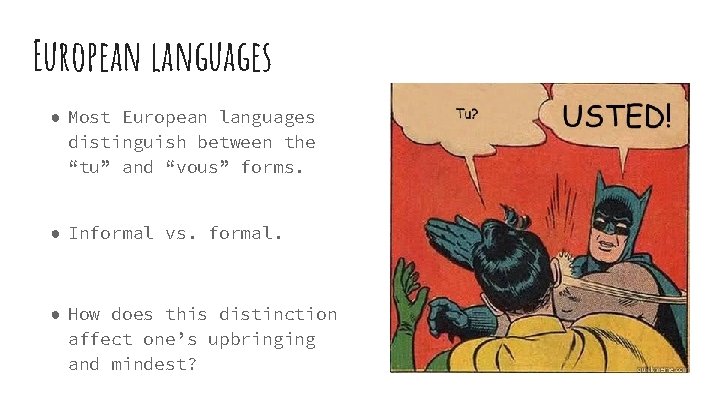
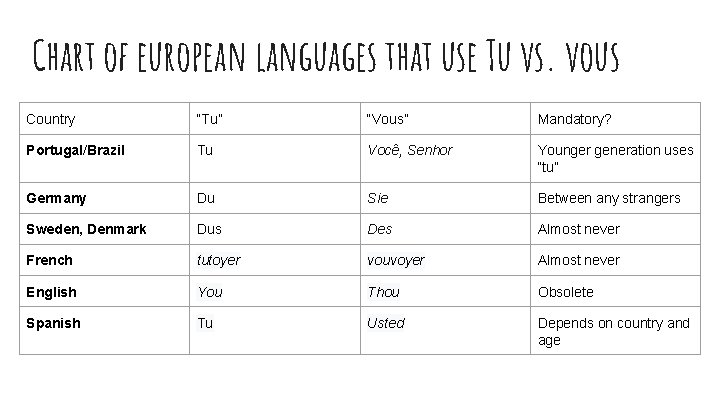
European languages ● Most European languages distinguish between the “tu” and “vous” forms. ● Informal vs. formal. ● How does this distinction affect one’s upbringing and mindest?
Chart of european languages that use Tu vs. vous Country “Tu” “Vous” Mandatory? Portugal/Brazil Tu Você, Senhor Younger generation uses “tu” Germany Du Sie Between any strangers Sweden, Denmark Dus Des Almost never French tutoyer vouvoyer Almost never English You Thou Obsolete Spanish Tu Usted Depends on country and age
Conclusion about language Determinism ● Language of a culture can create a reality for that group of people. ● But this language can also limit our own perspectives. . . and our perspectives on others. ○ Metaphors ○ Cultural context ○ Connotations ● Misunderstandings can create stereotypes
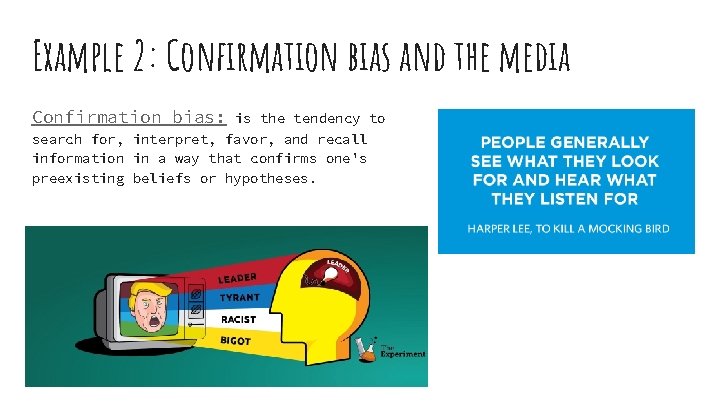
Example 2: Confirmation bias and the media Confirmation bias: is the tendency to search for, interpret, favor, and recall information in a way that confirms one's preexisting beliefs or hypotheses.
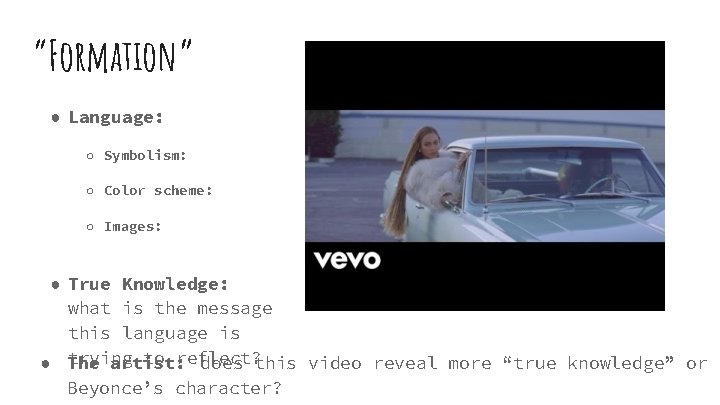
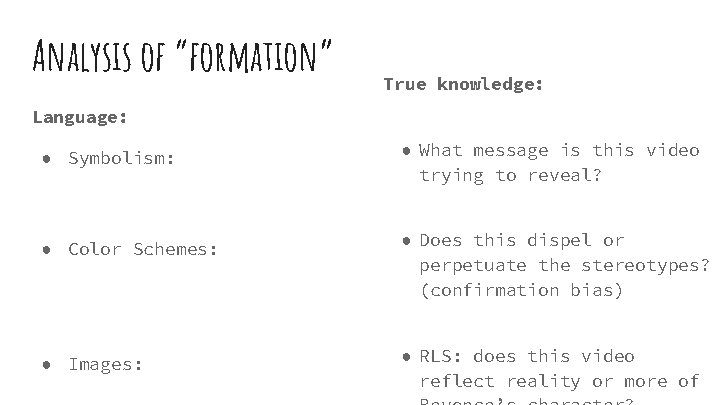
“Formation” ● Language: ○ Symbolism: ○ Color scheme: ○ Images: ● True Knowledge: what is the message this language is trying to reflect? ● The artist: does this video reveal more “true knowledge” or Beyonce’s character?
Analysis of “formation” True knowledge: Language: ● Symbolism: ● What message is this video trying to reveal? ● Color Schemes: ● Does this dispel or perpetuate the stereotypes? (confirmation bias) ● Images: ● RLS: does this video reflect reality or more of
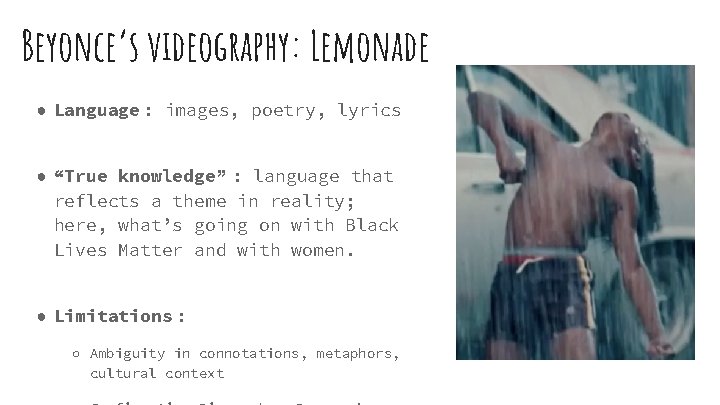
Beyonce’s videography: Lemonade ● Language : images, poetry, lyrics ● “True knowledge” : language that reflects a theme in reality; here, what’s going on with Black Lives Matter and with women. ● Limitations : ○ Ambiguity in connotations, metaphors, cultural context
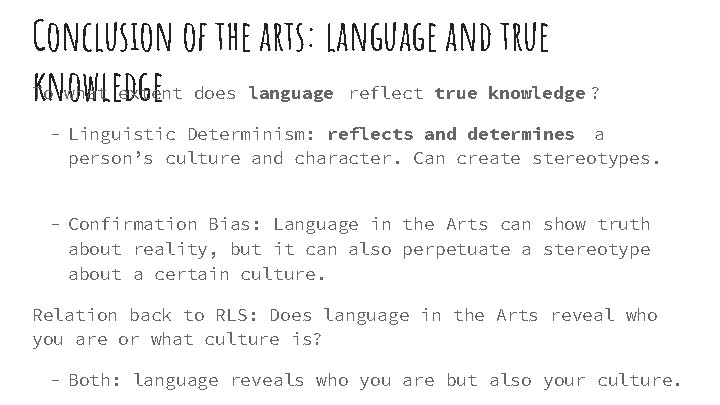
Conclusion of the arts: language and true To what extent does language reflect true knowledge ? knowledge - Linguistic Determinism: reflects and determines a person’s culture and character. Can create stereotypes. - Confirmation Bias: Language in the Arts can show truth about reality, but it can also perpetuate a stereotype about a certain culture. Relation back to RLS: Does language in the Arts reveal who you are or what culture is? - Both: language reveals who you are but also your culture.
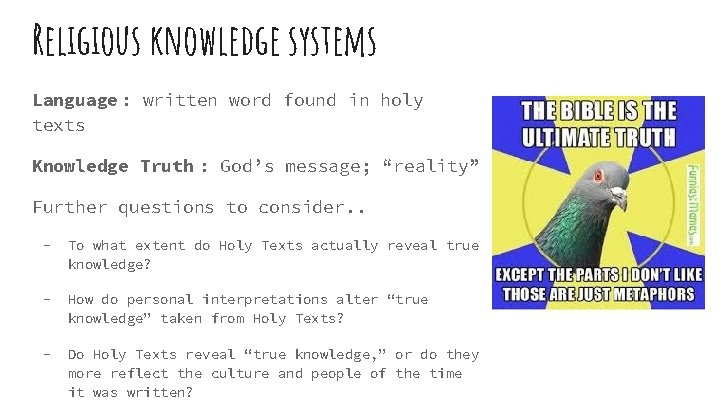
Religious knowledge systems Language : written word found in holy texts Knowledge Truth : God’s message; “reality” Further questions to consider. . - To what extent do Holy Texts actually reveal true knowledge? - How do personal interpretations alter “true knowledge” taken from Holy Texts? - Do Holy Texts reveal “true knowledge, ” or do they more reflect the culture and people of the time it was written?
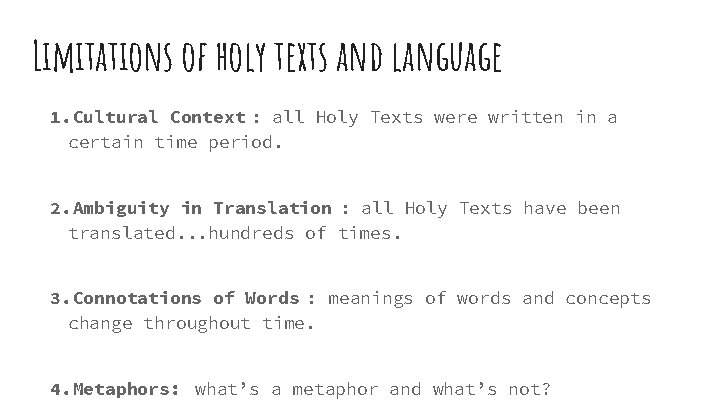
Limitations of holy texts and language 1. Cultural Context : all Holy Texts were written in a certain time period. 2. Ambiguity in Translation : all Holy Texts have been translated. . . hundreds of times. 3. Connotations of Words : meanings of words and concepts change throughout time. 4. Metaphors: what’s a metaphor and what’s not?
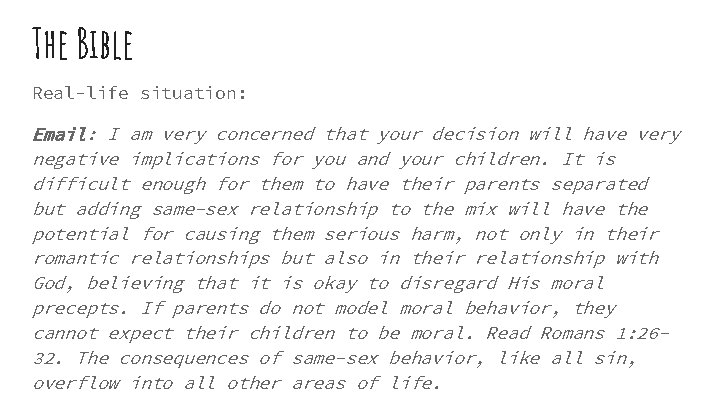
The Bible Real-life situation: Email: I am very concerned that your decision will have very negative implications for you and your children. It is difficult enough for them to have their parents separated but adding same-sex relationship to the mix will have the potential for causing them serious harm, not only in their romantic relationships but also in their relationship with God, believing that it is okay to disregard His moral precepts. If parents do not model moral behavior, they cannot expect their children to be moral. Read Romans 1: 2632. The consequences of same-sex behavior, like all sin, overflow into all other areas of life.
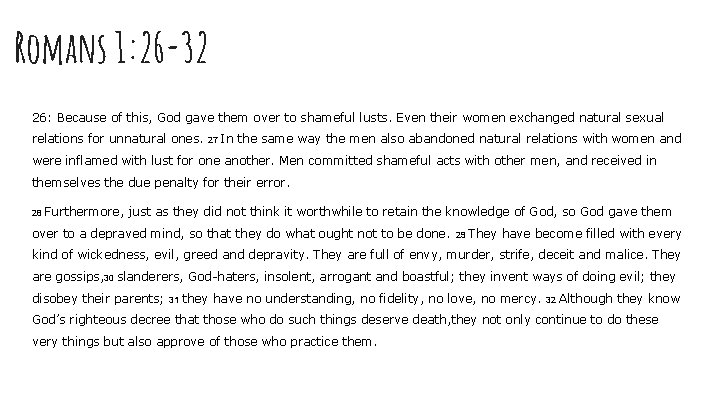
Romans 1: 26 -32 26: Because of this, God gave them over to shameful lusts. Even their women exchanged natural sexual relations for unnatural ones. 27 In the same way the men also abandoned natural relations with women and were inflamed with lust for one another. Men committed shameful acts with other men, and received in themselves the due penalty for their error. 28 Furthermore, just as they did not think it worthwhile to retain the knowledge of God, so God gave them over to a depraved mind, so that they do what ought not to be done. 29 They have become filled with every kind of wickedness, evil, greed and depravity. They are full of envy, murder, strife, deceit and malice. They are gossips, 30 slanderers, God-haters, insolent, arrogant and boastful; they invent ways of doing evil; they disobey their parents; 31 they have no understanding, no fidelity, no love, no mercy. 32 Although they know God’s righteous decree that those who do such things deserve death, they not only continue to do these very things but also approve of those who practice them.
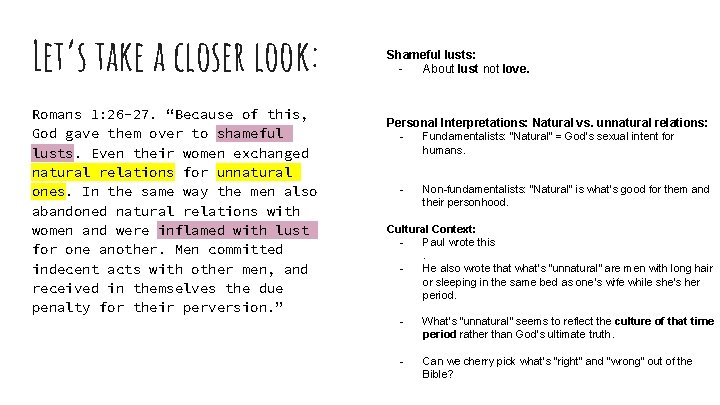
Let’s take a closer look: Romans 1: 26 -27. “Because of this, God gave them over to shameful lusts. Even their women exchanged natural relations for unnatural ones. In the same way the men also abandoned natural relations with women and were inflamed with lust for one another. Men committed indecent acts with other men, and received in themselves the due penalty for their perversion. ” Shameful lusts: About lust not love. Personal Interpretations: Natural vs. unnatural relations: Fundamentalists: “Natural” = God’s sexual intent for humans. - Non-fundamentalists: “Natural” is what’s good for them and their personhood. Cultural Context: Paul wrote this. He also wrote that what’s “unnatural” are men with long hair or sleeping in the same bed as one’s wife while she’s her period. - What’s “unnatural” seems to reflect the culture of that time period rather than God’s ultimate truth. - Can we cherry pick what’s “right” and “wrong” out of the Bible?
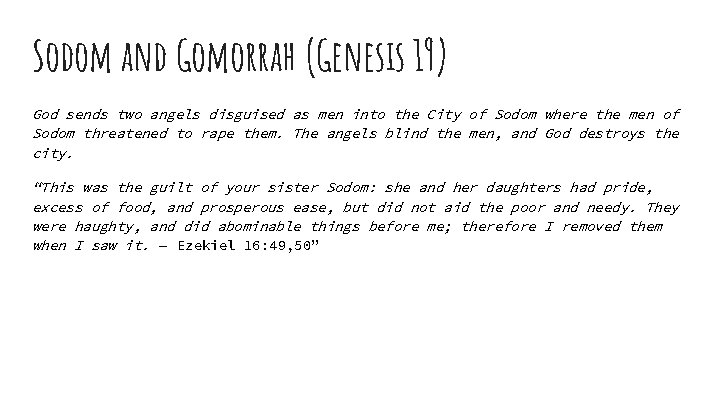
Sodom and Gomorrah (Genesis 19) God sends two angels disguised as men into the City of Sodom where the men of Sodom threatened to rape them. The angels blind the men, and God destroys the city. “This was the guilt of your sister Sodom: she and her daughters had pride, excess of food, and prosperous ease, but did not aid the poor and needy. They were haughty, and did abominable things before me; therefore I removed them when I saw it. — Ezekiel 16: 49, 50”
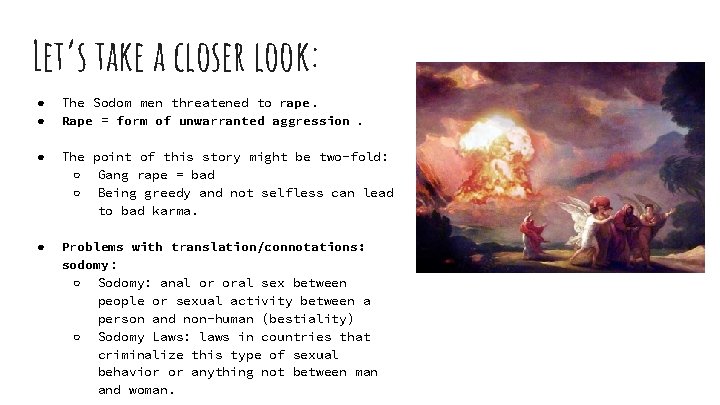
Let’s take a closer look: ● ● The Sodom men threatened to rape. Rape = form of unwarranted aggression. ● The point of this story might be two-fold: ○ Gang rape = bad ○ Being greedy and not selfless can lead to bad karma. ● Problems with translation/connotations: sodomy: ○ Sodomy: anal or oral sex between people or sexual activity between a person and non-human (bestiality) ○ Sodomy Laws: laws in countries that criminalize this type of sexual behavior or anything not between man and woman.
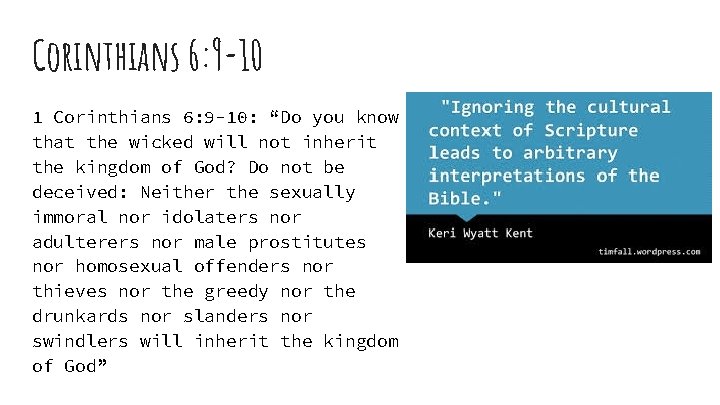
Corinthians 6: 9 -10 1 Corinthians 6: 9 -10: “Do you know that the wicked will not inherit the kingdom of God? Do not be deceived: Neither the sexually immoral nor idolaters nor adulterers nor male prostitutes nor homosexual offenders nor thieves nor the greedy nor the drunkards nor slanders nor swindlers will inherit the kingdom of God”
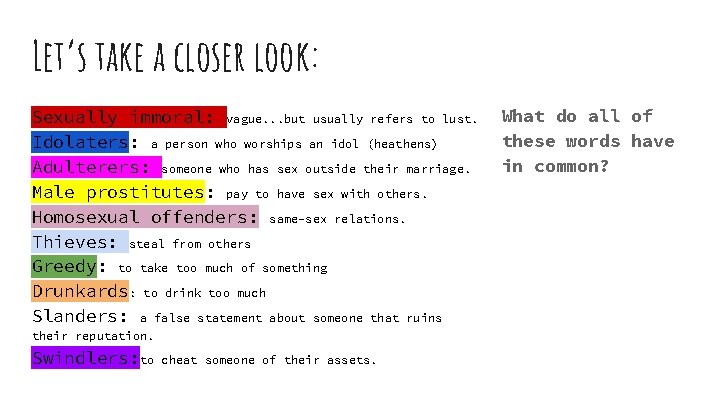
Let’s take a closer look: Sexually immoral: vague. . . but usually refers to lust. Idolaters: a person who worships an idol (heathens) Adulterers: someone who has sex outside their marriage. Male prostitutes: pay to have sex with others. Homosexual offenders: same-sex relations. Thieves: steal from others Greedy: to take too much of something Drunkards: to drink too much Slanders: a false statement about someone that ruins their reputation. Swindlers: to cheat someone of their assets. What do all of these words have in common?
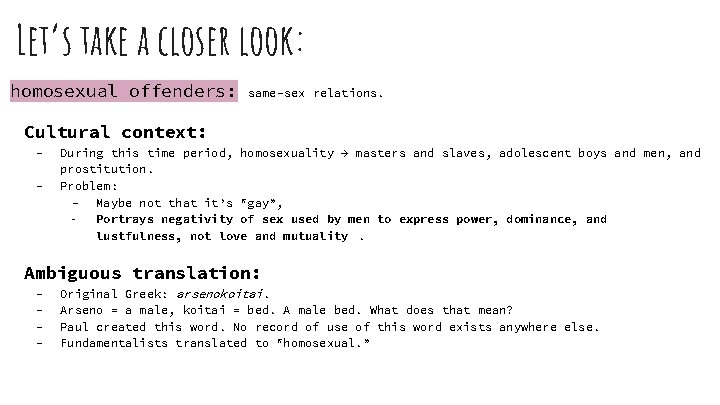
Let’s take a closer look: homosexual offenders: same-sex relations. Cultural context: - During this time period, homosexuality → masters and slaves, adolescent boys and men, and prostitution. Problem: - Maybe not that it’s “gay”, Portrays negativity of sex used by men to express power, dominance, and lustfulness, not love and mutuality. Ambiguous translation: - Original Greek: arsenokoitai. Arseno = a male, koitai = bed. A male bed. What does that mean? Paul created this word. No record of use of this word exists anywhere else. Fundamentalists translated to “homosexual. ”
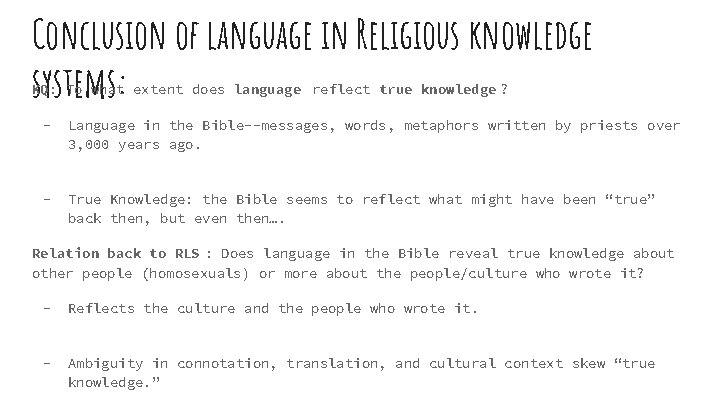
Conclusion of language in Religious knowledge systems: KQ: To what extent does language reflect true knowledge ? - Language in the Bible--messages, words, metaphors written by priests over 3, 000 years ago. - True Knowledge: the Bible seems to reflect what might have been “true” back then, but even then…. Relation back to RLS : Does language in the Bible reveal true knowledge about other people (homosexuals) or more about the people/culture who wrote it? - Reflects the culture and the people who wrote it. - Ambiguity in connotation, translation, and cultural context skew “true knowledge. ”
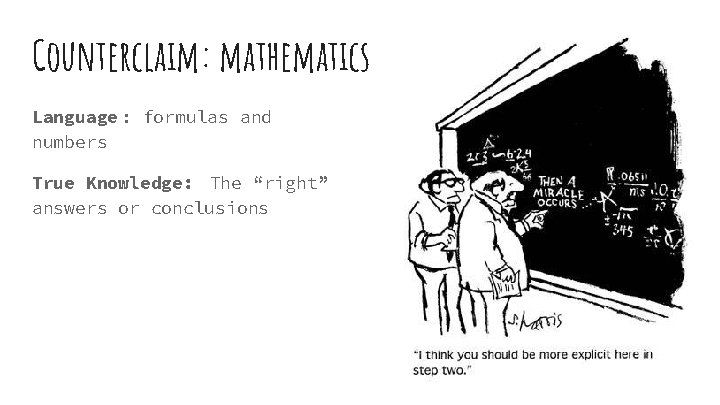
Counterclaim: mathematics Language : formulas and numbers True Knowledge: The “right” answers or conclusions
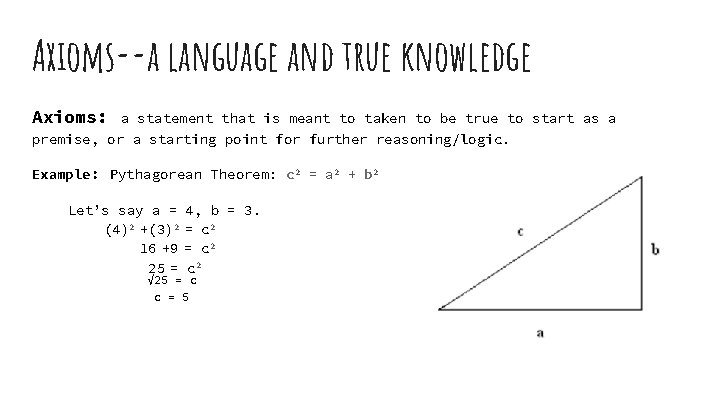
Axioms--a language and true knowledge Axioms: a statement that is meant to taken to be true to start as a premise, or a starting point for further reasoning/logic. Example: Pythagorean Theorem: c 2 = a 2 + b 2 Let’s say a = (4)2 +(3)2 16 +9 25 = 4, b = 3. = c 2 c 2 √ 25 = c c = 5
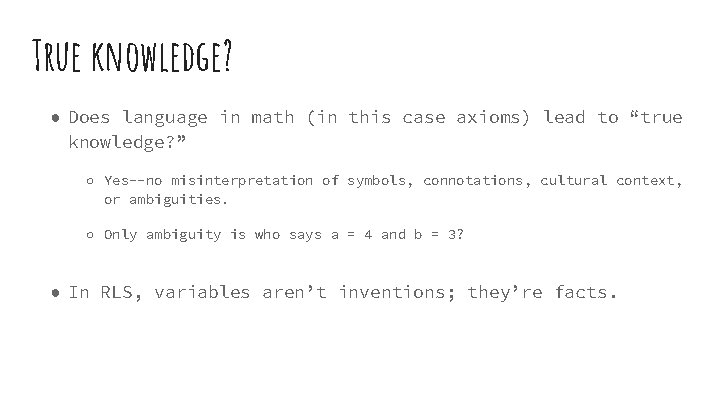
True knowledge? ● Does language in math (in this case axioms) lead to “true knowledge? ” ○ Yes--no misinterpretation of symbols, connotations, cultural context, or ambiguities. ○ Only ambiguity is who says a = 4 and b = 3? ● In RLS, variables aren’t inventions; they’re facts.
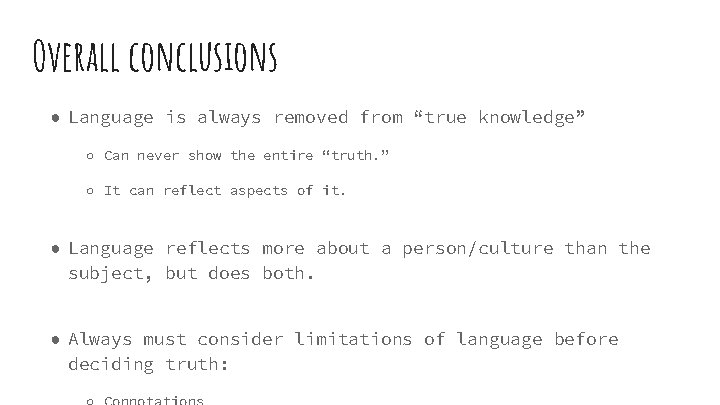
Overall conclusions ● Language is always removed from “true knowledge” ○ Can never show the entire “truth. ” ○ It can reflect aspects of it. ● Language reflects more about a person/culture than the subject, but does both. ● Always must consider limitations of language before deciding truth:
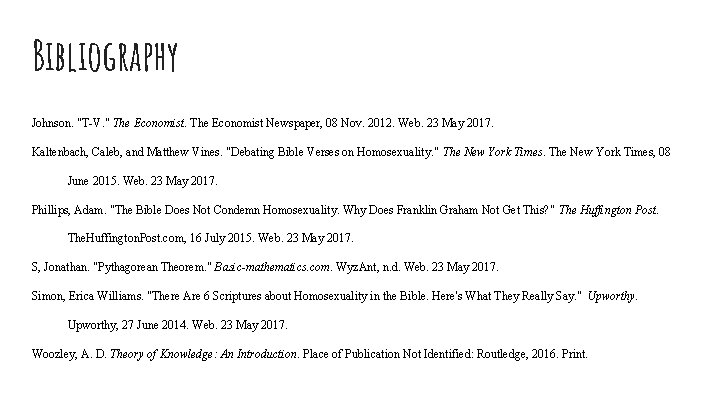
Bibliography Johnson. "T-V. " The Economist Newspaper, 08 Nov. 2012. Web. 23 May 2017. Kaltenbach, Caleb, and Matthew Vines. "Debating Bible Verses on Homosexuality. " The New York Times, 08 June 2015. Web. 23 May 2017. Phillips, Adam. "The Bible Does Not Condemn Homosexuality. Why Does Franklin Graham Not Get This? " The Huffington Post. The. Huffington. Post. com, 16 July 2015. Web. 23 May 2017. S, Jonathan. "Pythagorean Theorem. " Basic-mathematics. com. Wyz. Ant, n. d. Web. 23 May 2017. Simon, Erica Williams. "There Are 6 Scriptures about Homosexuality in the Bible. Here's What They Really Say. " Upworthy, 27 June 2014. Web. 23 May 2017. Woozley, A. D. Theory of Knowledge: An Introduction. Place of Publication Not Identified: Routledge, 2016. Print.