
The power of culture and basic assumptions The
The power of culture and basic assumptions

The power of culture
Dialogue • What is safety culture? • How do you know your organization has a strong safety culture? • What could be signs of a decline in safety culture?
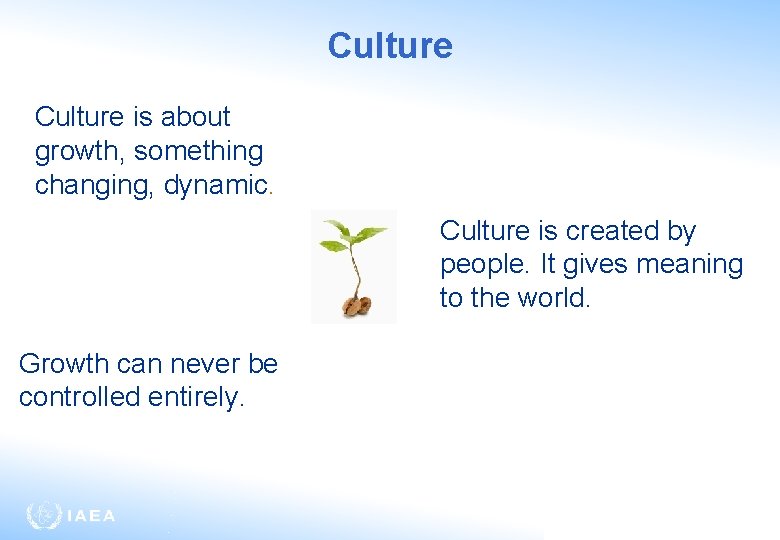
Culture is about growth, something changing, dynamic. Culture is created by people. It gives meaning to the world. Growth can never be controlled entirely.
Organizational culture: background • Compared to 20 -30 years ago, culture is nowadays seen as less of a ‘quick fix’ • It is recognized that culture can be changed, but it is also recognized that this often takes Ø time, Ø effort, and Ø does not always end up the way planned. • Culture can be seen as something we can influence, rather than something we can control
Culture cannot be completely controlled • What the concept of culture teaches us is that how people respond to actions partly depends on their culture • Our view on people’s cultural assumptions is an effect of our interpretations – and this is no exact science! • This means that the way people react, e. g. their relation to change efforts, will be to some degree impossible to predict • Thus, we cannot control culture, only influence it, and this only at the discretion of those influenced
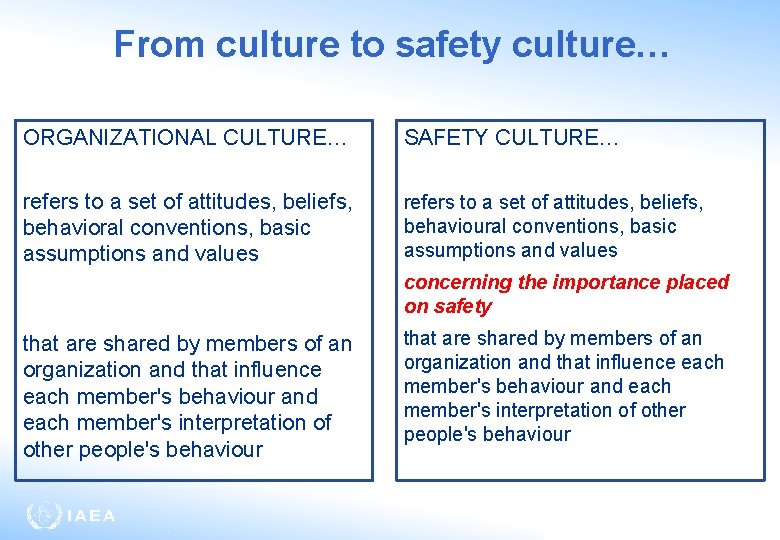
From culture to safety culture… ORGANIZATIONAL CULTURE… SAFETY CULTURE… refers to a set of attitudes, beliefs, behavioral conventions, basic assumptions and values refers to a set of attitudes, beliefs, behavioural conventions, basic assumptions and values concerning the importance placed on safety that are shared by members of an organization and that influence each member's behaviour and each member's interpretation of other people's behaviour
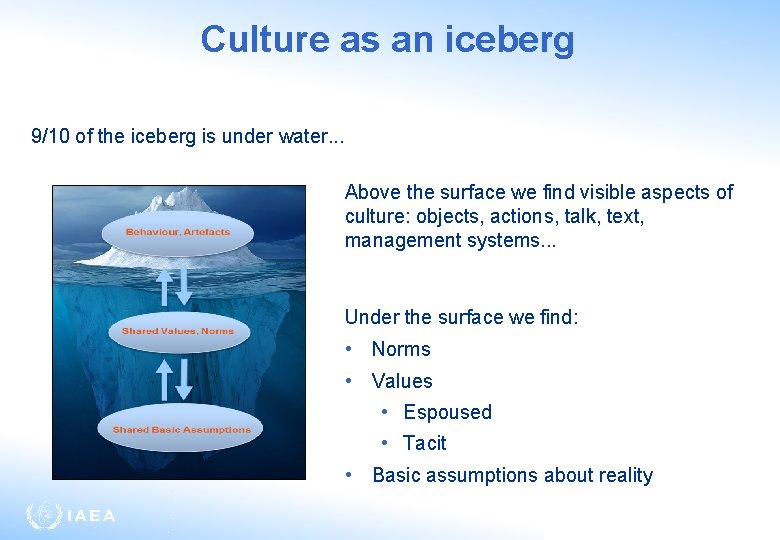
Culture as an iceberg 9/10 of the iceberg is under water. . . Above the surface we find visible aspects of culture: objects, actions, talk, text, management systems. . . Under the surface we find: • Norms • Values • Espoused • Tacit • Basic assumptions about reality

An example… Shared basic assumption: People (in this organization) are lazy and do not want to work unless they have to Shared basic assumption: People (in this organization) are competent and motivated to do a good job See person looking out in the air person is day dreaming See person looking out in the air probably pondering over a difficult task that he/she is trying to think of a solution to Person asks to work from home Approve request as the person probably wishes to be productive even if circumstances forces him/her to be home Person asks to work from home Deny request as person will probably only pretend to work at home and actually do something else
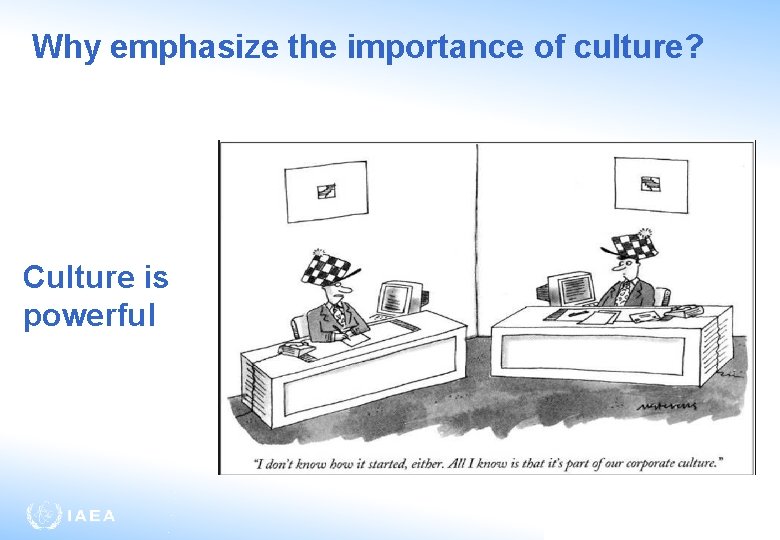
Why emphasize the importance of culture? Culture is powerful
Why is culture so powerful? • We are human beings… Ø Act upon basic assumptions • We are social human beings… Ø Conform to our surroundings Ø Imitate and listen to the people we respect / we think are respected and listened to by others Ø Influence each other through story telling, norming ALMOST ALL THE TIME, THIS HAPPENS UNCONCIOUSLY
Why is culture so powerful? People adjust to their environment… https: //www. youtube. com/watch? v=Aeg. Ld. B 7 UI 4 U 12
Dialogue: • As a manager, what part do you play when it comes to fostering a strong safety culture?
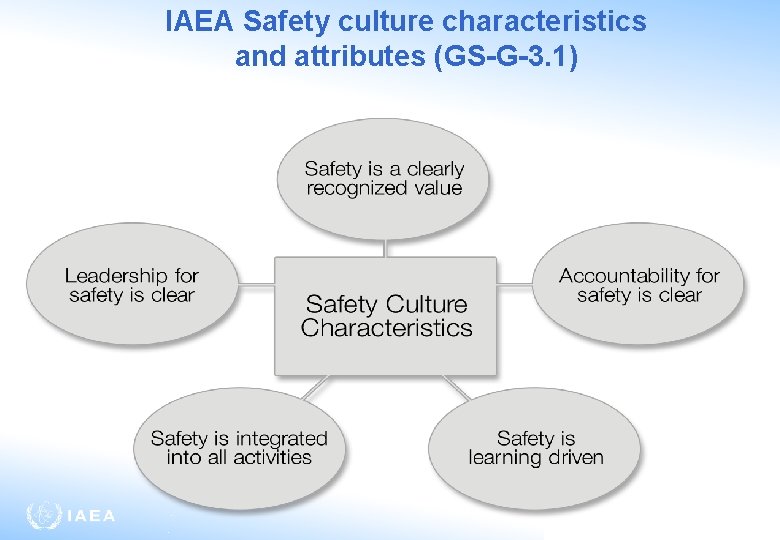
IAEA Safety culture characteristics and attributes (GS-G-3. 1)
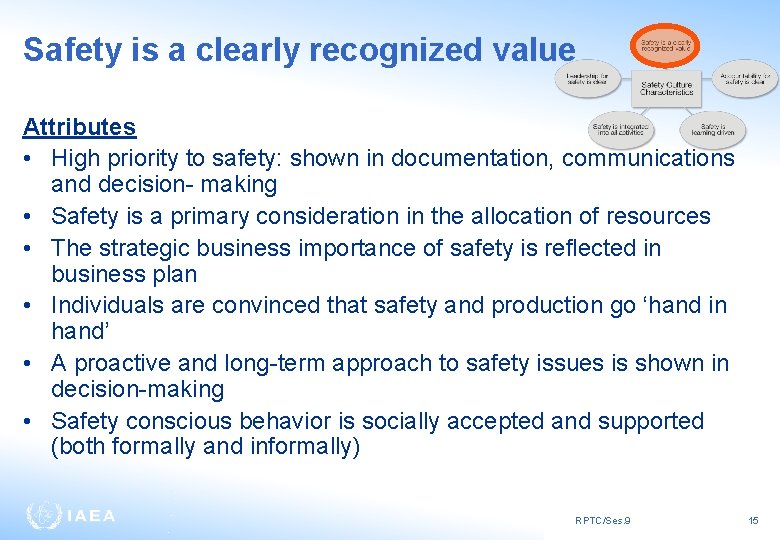
Safety is a clearly recognized value Attributes • High priority to safety: shown in documentation, communications and decision- making • Safety is a primary consideration in the allocation of resources • The strategic business importance of safety is reflected in business plan • Individuals are convinced that safety and production go ‘hand in hand’ • A proactive and long-term approach to safety issues is shown in decision-making • Safety conscious behavior is socially accepted and supported (both formally and informally) RPTC/Ses. 9 15
Dialogue If you were a part of a safety culture assessment team, what kind of information/documents/data would you gather in order to understand if safety is a primary consideration in the allocation of resources?
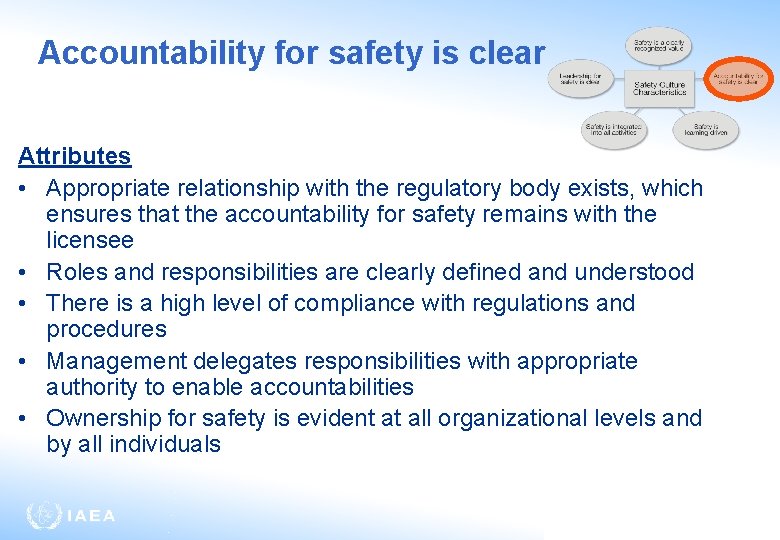
Accountability for safety is clear Attributes • Appropriate relationship with the regulatory body exists, which ensures that the accountability for safety remains with the licensee • Roles and responsibilities are clearly defined and understood • There is a high level of compliance with regulations and procedures • Management delegates responsibilities with appropriate authority to enable accountabilities • Ownership for safety is evident at all organizational levels and by all individuals
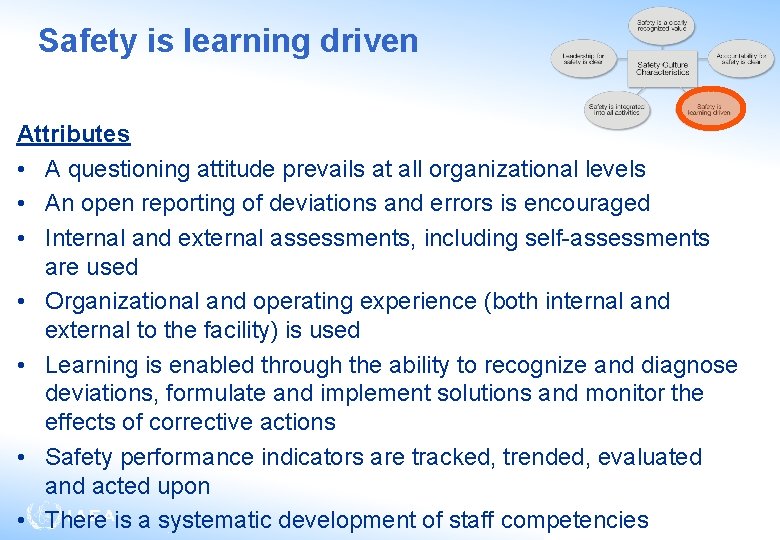
Safety is learning driven Attributes • A questioning attitude prevails at all organizational levels • An open reporting of deviations and errors is encouraged • Internal and external assessments, including self-assessments are used • Organizational and operating experience (both internal and external to the facility) is used • Learning is enabled through the ability to recognize and diagnose deviations, formulate and implement solutions and monitor the effects of corrective actions • Safety performance indicators are tracked, trended, evaluated and acted upon • There is a systematic development of staff competencies
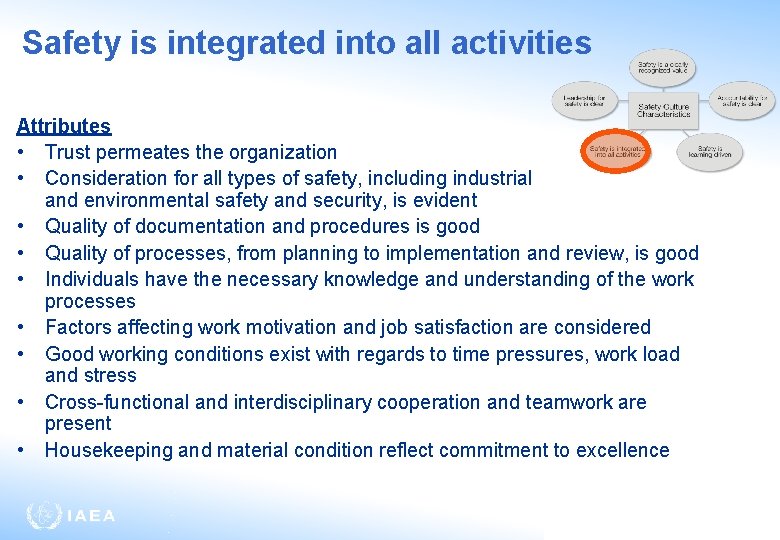
Safety is integrated into all activities Attributes • Trust permeates the organization • Consideration for all types of safety, including industrial and environmental safety and security, is evident • Quality of documentation and procedures is good • Quality of processes, from planning to implementation and review, is good • Individuals have the necessary knowledge and understanding of the work processes • Factors affecting work motivation and job satisfaction are considered • Good working conditions exist with regards to time pressures, work load and stress • Cross-functional and interdisciplinary cooperation and teamwork are present • Housekeeping and material condition reflect commitment to excellence
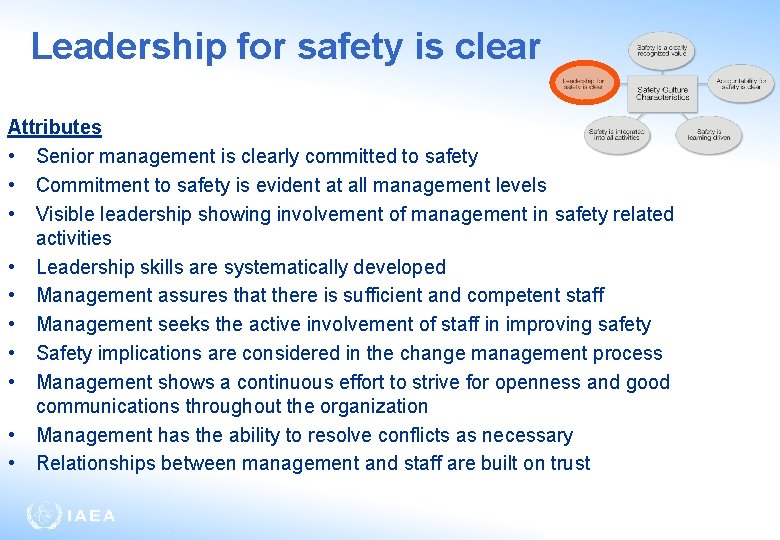
Leadership for safety is clear Attributes • Senior management is clearly committed to safety • Commitment to safety is evident at all management levels • Visible leadership showing involvement of management in safety related activities • Leadership skills are systematically developed • Management assures that there is sufficient and competent staff • Management seeks the active involvement of staff in improving safety • Safety implications are considered in the change management process • Management shows a continuous effort to strive for openness and good communications throughout the organization • Management has the ability to resolve conflicts as necessary • Relationships between management and staff are built on trust
Dialogue If you were a part of a safety culture assessment team, how would you be able to tell if leadership for safety is clear? What kind of information/documents/data would you gather in order to assess this characteristic?
Warning signs The following are typical symptoms of a decline in safety culture (GS-G-3. 5 Chapter 2. 29): (a) Lack of a systematic approach to safety — unclear accountabilities, poor decision making processes, poor risk assessment processes, lack of a change management process. (b) Procedures not being regularly reviewed and updated. (c) Incidents not analysed in depth and lessons not learned — the recurrence of a problem indicating that the fundamental cause (or causes) has (have) not been properly identified. (d) No actions taken or implemented in order to eliminate root causes. (e) Resource mismatches — excessive project slippage, excessive overtime, lack of qualified and experienced personnel, increased use of contractors to perform key organizational activities for long periods of time. (f) Increasing numbers of violations of rules — an increase in conscious deviations from rules, e. g. short cuts. (g) An increasing backlog of corrective actions — an increase in the number of corrective actions that have exceeded their target date for implementation and an increase in the length of the delay. (h) Lack of proper verification of readiness for operation — plant systems not properly verified before the startup of equipment, systems or plant after shutdowns for maintenance. (i) Safety concerns of personnel not dealt with promptly — safety concerns are ignored or have to be raised repeatedly before action is taken, e. g. lack of a process to allow or encourage individuals to raise safety concerns that results in actions being taken.
Warning signs cont’d (j) Disproportionate focus on technical issues — insufficient attention to issues of human performance, problems being perceived as technical challenges to be solved by engineering means only, without considering that the solution may involve aspects of human performance. (k) Lack of self-assessment processes — the organization not recognizing deficiencies in attitudes to safety and behaviour and being unable to adopt a philosophy of continual improvement. (l) Poor housekeeping — indicating lack of interest on the part of management and a poorly motivated workforce with little pride in the working environment. (m) Failure of corporate memory — a lack of historical data and lack of a knowledge management programme to manage staff turnover. Disproportionate number of experienced individuals leaving the organization, e. g. when reorganizing and/or downsizing. (n) Low status of individuals or units conducting assessments — lack of respect for findings of assessments, findings being ignored or not addressed in a timely manner. (o) Failure to deal with the findings of independent external safety reviews — reluctance to accept proposals for changes that were not developed internally or lack of a process to monitor progress in implementing the recommendations of external reviews. (p) Lack of corporate oversight — lack of awareness of safety issues at the corporate level, with safety issues being ignored in making business decisions. (q) Lack of ‘ownership’ of safety — lack of recognition that everyone shares a responsibility for safety. (r) Isolationism — safety practices and standards become unrelated to best practices and standards in the industry whereby the organization operates increasingly in a self-referencing mode. (s) Lack of learning — unwillingness to share knowledge and experience with others, or to use the experience of others to improve safety at the installation. Organizations become complacent and focus on the successes of the past, and are reluctant to invest in acquiring new knowledge and skills for the future.
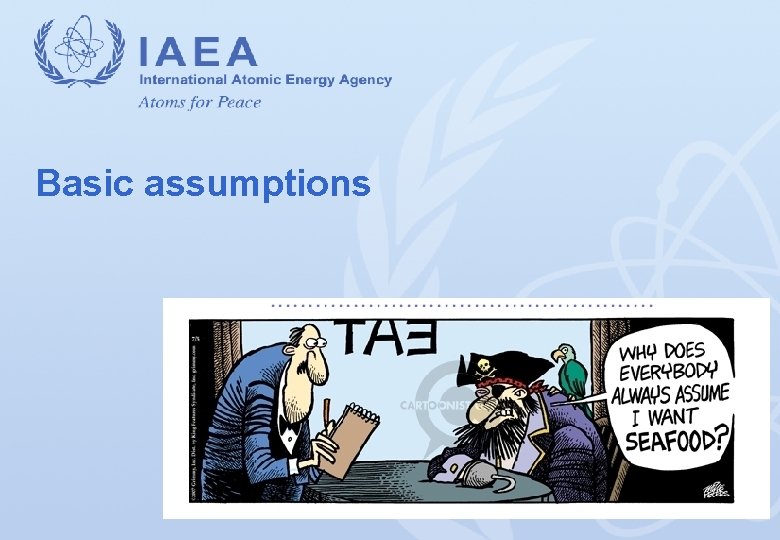
Basic assumptions
https: //www. youtube. com/watch? v=ajq 8 eag 4 Mvc
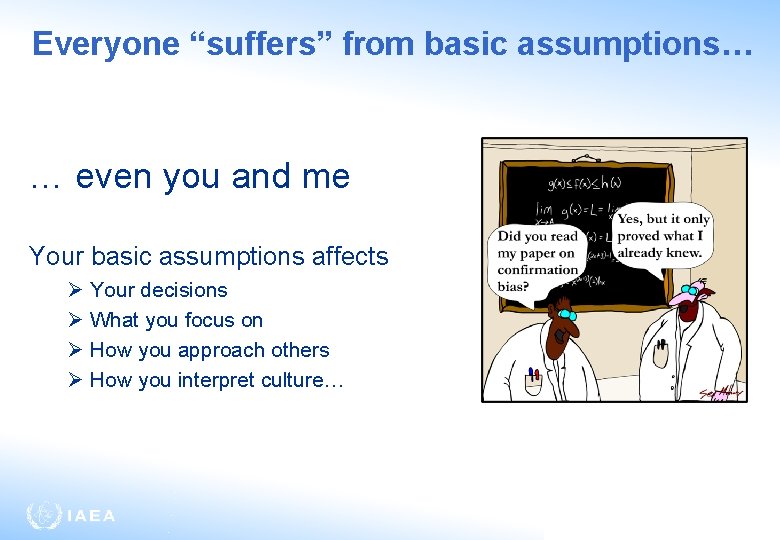
Everyone “suffers” from basic assumptions… … even you and me Your basic assumptions affects Ø Ø Your decisions What you focus on How you approach others How you interpret culture…
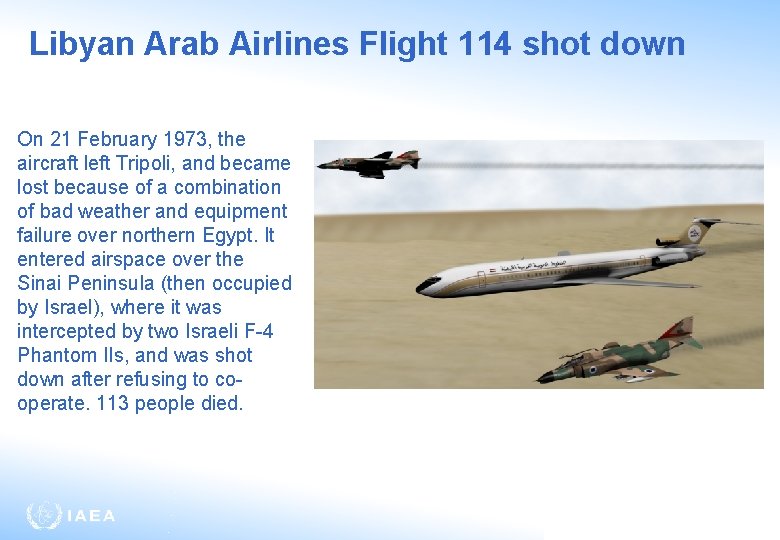
Libyan Arab Airlines Flight 114 shot down On 21 February 1973, the aircraft left Tripoli, and became lost because of a combination of bad weather and equipment failure over northern Egypt. It entered airspace over the Sinai Peninsula (then occupied by Israel), where it was intercepted by two Israeli F-4 Phantom IIs, and was shot down after refusing to cooperate. 113 people died.
Libyan Arab Airlines Flight 114 aftermath • The co-pilot, who survived, later said that the flight crew knew the Israeli jets wanted them to land but relations between Israel and Libya made them decide against following instructions. • Israel's air force perceived Flight 114 as a security threat, and that among the possible tasks it could have been undertaking was an aerial spy mission over the Israeli air base at Bir Gifgafa. • Israel's argument was that the heightened security situation and the behaviour of the jet's crew made the actions taken sensible. Israel's Defence Minister called it an "error of judgment", and Israel paid compensation to the victims' families. (Information from Wikipedia)
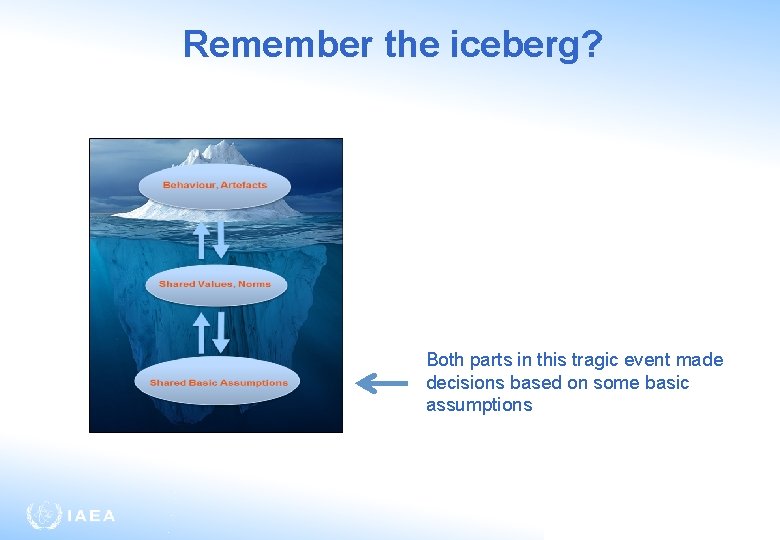
Remember the iceberg? Both parts in this tragic event made decisions based on some basic assumptions
Summary • Safety culture refers to the set of attitudes, beliefs, behavioural conventions, basic assumptions and values concerning the importance placed on safety • Culture can be changed but it takes time • A just culture is a culture of trust, learning and accountability • Human error is a symptom of something that is already wrong in the system • Be aware of yours and others basic assumptions, basic assumptions affect your culture and your decisions

Keep an open mind
- Slides: 31