
The Power of Communication Ideas to Make Life



- Slides: 30
+ The Power of Communication – Ideas to Make Life, Work and Family a Little Easier Linda (Lin) Giglio
+ #1. Great Communicators …. … take action. Contrary to popular belief, communication skills are learned.
+ #1. Take Action EFFECTIVE There & APPROPRIATE is no IDEAL way to communicate. COMPETENCE Pick is situational. your ways to learn. - Cognitive Complexity
+ #2. Great Communicators … … understand empathy.
+ #2. Empathy Three Dimensions of Empathy 1. Perspective Taking 2. Emotional Dimension 3. Genuine Concern
+ #3. Great Communicators … … use the Pillow Method. Dinner and a movie? Movie first and then dinner?
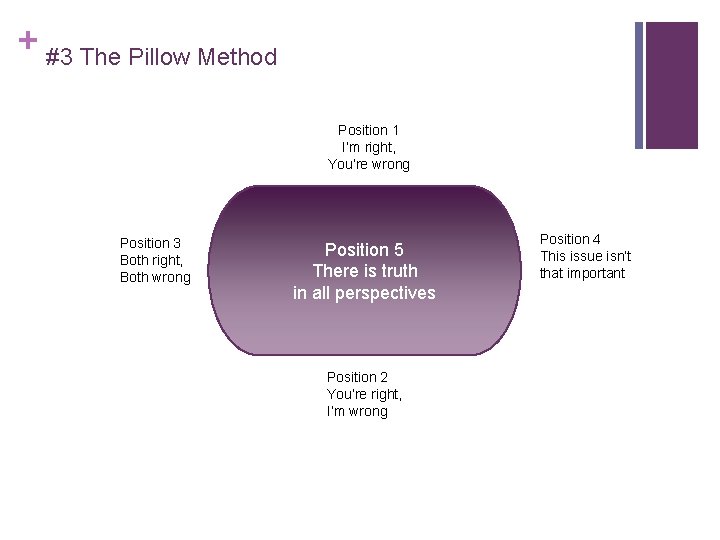
+ #3 The Pillow Method Position 1 I’m right, You’re wrong Position 3 Both right, Both wrong Position 5 There is truth in all perspectives Position 2 You’re right, I’m wrong Position 4 This issue isn’t that important
+ #4. Great Communicators understand … … introverts and extroverts.
+ #4. Introverts and Extroverts How We Get it Wrong – The world is set up for extroverts. We implement constant group work. We favor the “Man of Action” to the “Man of Contemplation. ” People follow the most dominant person in the room -- and even start to mimic them. We favor the best talker. There is ZERO co-relation between the best talker and the best ideas.
+ #4. Introverts and Extroverts What we can learn from introverts… Seek -- go off alone. Be like Buddha, Gandhi, Jesus. Stop favoring charisma over quality. Lead like an introvert. Listen more, talk less. Think before you speak. Be comfortable being alone.
+ #4. Introverts and Extroverts GET RID OF THE WORD SHY
+ #4. Introverts and Extroverts What we need to know about shyness A behavioral style reflecting awkwardness or apprehension that some people constantly feel when in the company of others. Some people cannot tolerant the anxiety that comes with human interaction. Their inclination to turn inward can prevent them from developing relationships. 40 – 50 percent of Americans consider themselves shy.
+ #5 Great Communications … … understand noise. External Physiological Psychological
+ # 6. Great Communicators … LISTEN
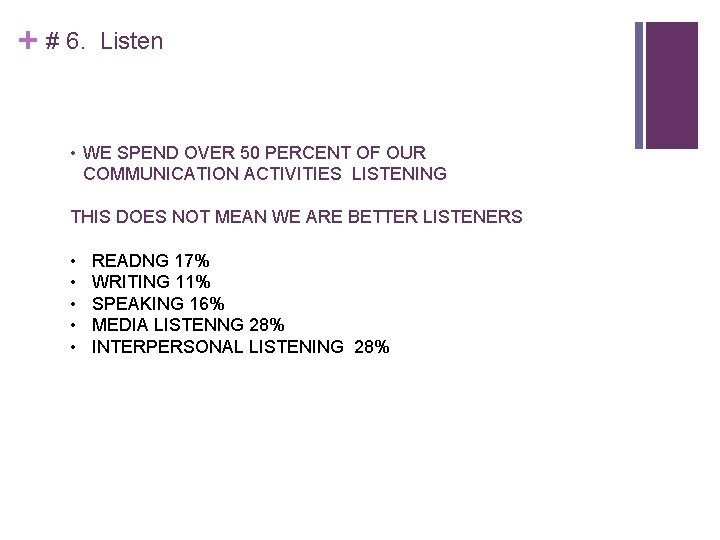
+ # 6. Listen • WE SPEND OVER 50 PERCENT OF OUR COMMUNICATION ACTIVITIES LISTENING THIS DOES NOT MEAN WE ARE BETTER LISTENERS • • • READNG 17% WRITING 11% SPEAKING 16% MEDIA LISTENNG 28% INTERPERSONAL LISTENING 28%
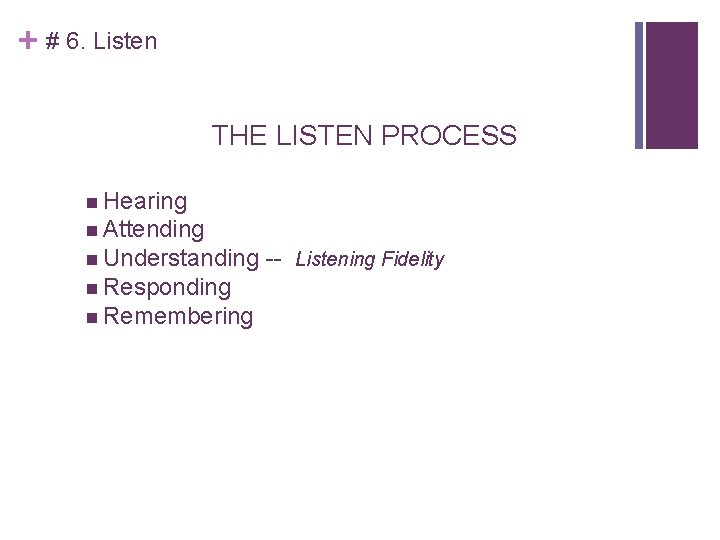
+ # 6. Listen THE LISTEN PROCESS Hearing Attending Understanding Responding Remembering -- Listening Fidelity
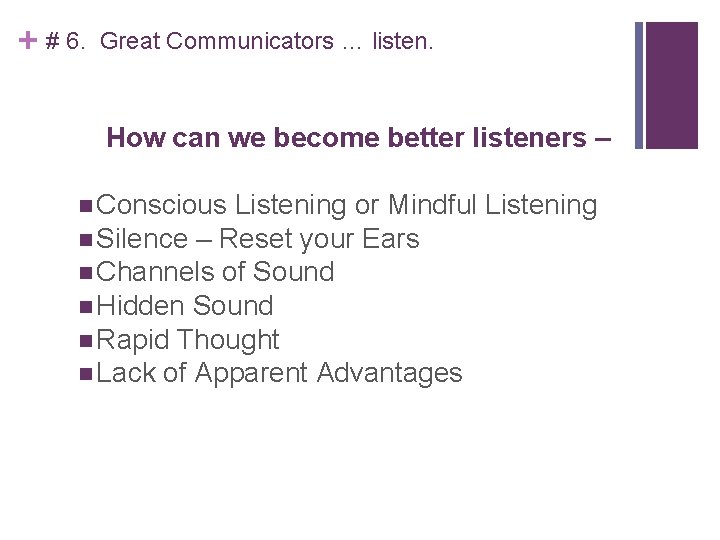
+ # 6. Great Communicators … listen. How can we become better listeners – Conscious Listening or Mindful Listening Silence – Reset your Ears Channels of Sound Hidden Sound Rapid Thought Lack of Apparent Advantages
+ # 7. Great Communicators … … respond to listening.
+ # 7. Respond to listening. RESPONDING PROMPTING QUESTIONING PARAPHRASING SUPPORTING (choose the appropriate form) ANALYZING ADVISING (helpful as often as it is unhelpful)
+ # 7. Respond to listening. RESPONDING PROMPTING QUESTIONING PARAPHRASING SUPPORTING (choose the appropriate form) ANALYZING ADVISING (helpful as often as it is unhelpful)
+ # 7. Respond to listening. ADVISING (helpful as often as it is unhelpful) Is the advice needed? Is the advice wanted? Is it given in the right sequence? Is the advice coming from an expert? Is the advisor a close or trusted person? Is the advice offered in a sensitive and face-saving manner?
+ # 7 Respond to listening. Paraphrase Restating in your own words to be sure you got it right. FACTORS TO CONSIDER – Is the issue complex enough? Do you have the necessary time and concern? Can you withhold judgement? Is your paraphrasing in proportion to other responses?
+ # 7 Respond to listening.
+ # 8 Great Communicators … … understand the emotion is sticky. EMOTIONAL CONTAGION
+ #9. Great Communicators … … understand habit. An acquired mode of behavior that has become nearly or completely involuntary. A recurrent often unconscious pattern of behavior that is acquired through frequent repetition.
+ #9. Great Communicators … … understand habit. Contrary to popular opinion, we do not break habits. Your habits are what you choose them to be. Habits encourage change by creating structures that help them flourish. Habit plays a central role in creating happiness and success -in communications and in every aspect of life.
+ # 10 Great Communicators … … take responsibility for their communication.
+ # 10. Take Responsible Self Monitor – The process of paying close attention to your behavior and your communication to shape and improve them. Reappraisal – Rethink the meaning to change the emotional impact. What is the story? Decide if the belief/story is rational or irrational? If it is irrational, write down the alternative.
+ # 10. Take Responsibility FOUR STEPS TO ACTIVATE CHANGE Have a realistic perception of your communication. Have realistic expectations. Have the will to change. Have the skills to change.
+ And a bonus … Tell me to what you pay attention and I will tell you who you are. Jose Ortega Gasset