
The Power of Asking the Best Questions for
The Power of Asking the Best Questions for Successful ADR’s February 4, 2010 Marilee Adams, Ph. D. Inquiry Institute ADR Lunchtime Series Interagency ADR Working Group Workplace Conflict Management Section Copyright © Marilee Adams, Ph. D. Lambertville, NJ 2009
Objective Empower your ability to ask questions that lead to more successful resolutions: n Highlight the power and purposes of questions n Explore the connection between questions and results n Reinforce the mediation mindset

Purposes of Questions With a partner, take turns answering these questions: n In general, how many purposes can you think of for asking questions? n In ADR’s, how many purposes can you think of for asking questions?
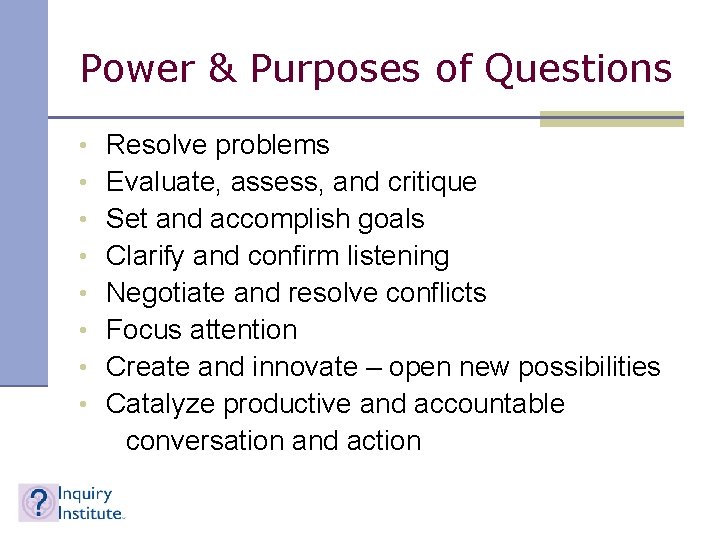
Power & Purposes of Questions • • Resolve problems Evaluate, assess, and critique Set and accomplish goals Clarify and confirm listening Negotiate and resolve conflicts Focus attention Create and innovate – open new possibilities Catalyze productive and accountable conversation and action
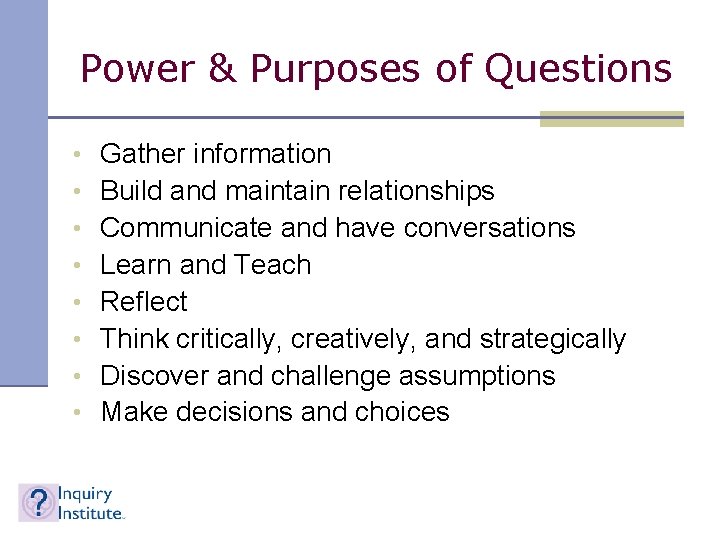
Power & Purposes of Questions • • Gather information Build and maintain relationships Communicate and have conversations Learn and Teach Reflect Think critically, creatively, and strategically Discover and challenge assumptions Make decisions and choices
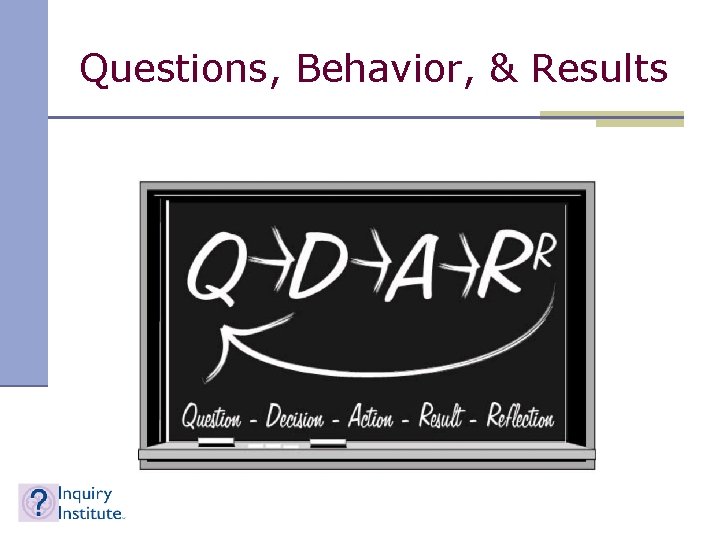
Questions, Behavior, & Results
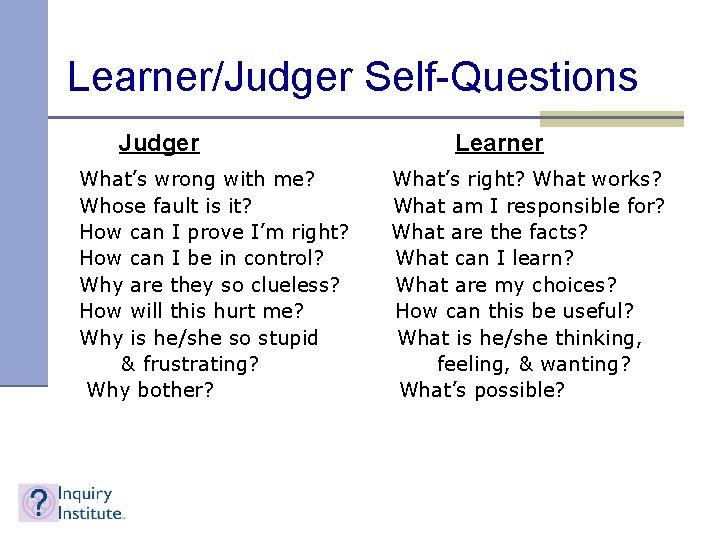
Learner/Judger Self-Questions Judger What’s wrong with me? Whose fault is it? How can I prove I’m right? How can I be in control? Why are they so clueless? How will this hurt me? Why is he/she so stupid & frustrating? Why bother? Learner What’s right? What works? What am I responsible for? What are the facts? What can I learn? What are my choices? How can this be useful? What is he/she thinking, feeling, & wanting? What’s possible?

Learner/Judger Mindsets Judger Learner n Judgmental, dismissive n Accepting, discerning n Reactive, automatic n Responsive, reflective n “Know-it-already” n Values not-knowing n Blame n Responsibility n Either/or thinking n Both/and thinking n Inflexible and rigid n Flexible and adaptive n Own point of view only n Multiple perspectives n Fears differences n Defends assumptions n Values differences n Question assumptions n Primary mood-- protective curious

Learner/Judger Relationships Judger Learner n Win-Lose relating n Win-Win relating n Separates n Connects n Listen for: n n Agree or disagree Right or wrong n n Facts/perspective Learning/usefulness n Debate n Dialogue n Feedback = rejection n Feedback = helpful n Wants to be right n Wants to understand n Seeks to attack or is n Seeks to resolve and defensive create
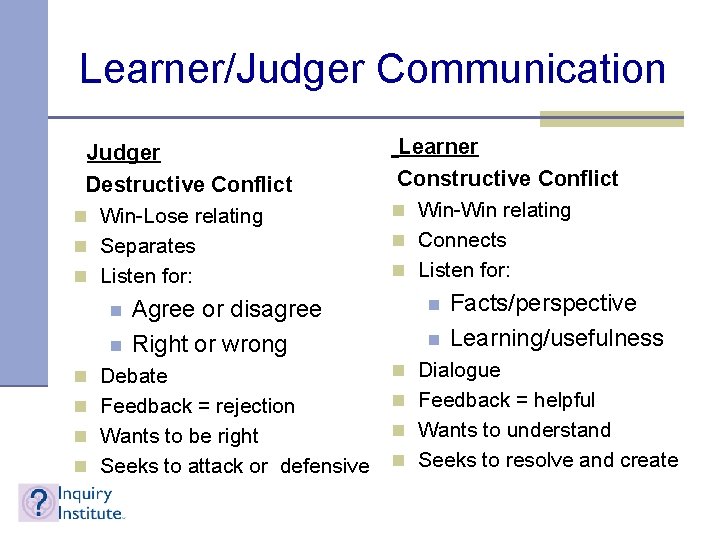
Learner/Judger Communication Judger Destructive Conflict n Win-Lose relating n Separates n Listen for: n n Agree or disagree Right or wrong Learner Constructive Conflict n Win-Win relating n Connects n Listen for: n n Facts/perspective Learning/usefulness n Debate n Dialogue n Feedback = rejection n Feedback = helpful n Wants to be right n Wants to understand n Seeks to attack or defensive n Seeks to resolve and create
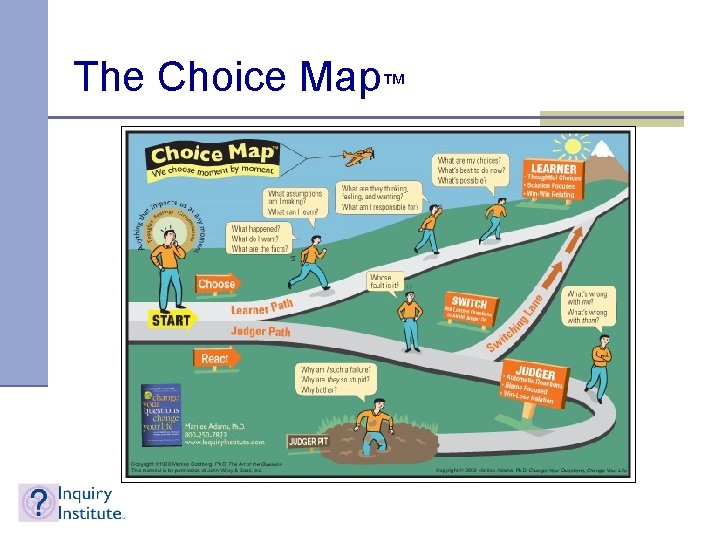
The Choice Map™
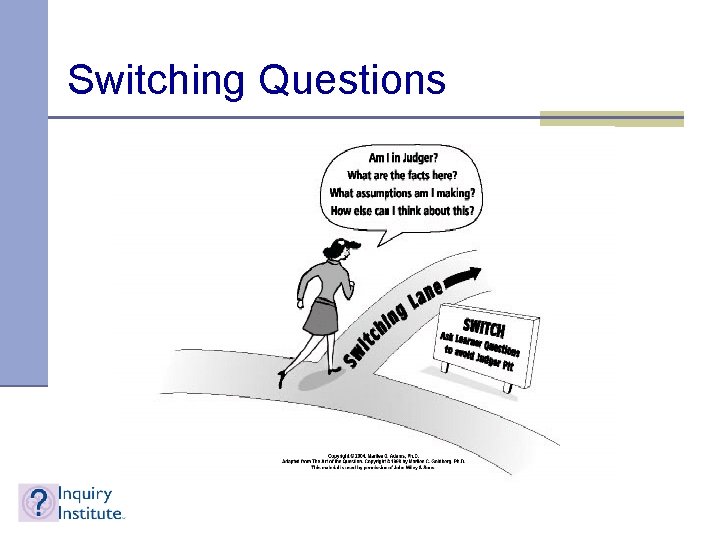
Switching Questions
Choice Map Practice How could you use the Choice Map in ADR situations?
Great results begin with great questions!
Marilee Adams, Ph. D. Inquiry Institute Marilee@Inquiry. Institute. com www. Inquiry. Institute. com 800 -250 -7823
- Slides: 15