
The Power of Applying Gradual Reveal to Nearly



























- Slides: 78
The Power of Applying Gradual Reveal to Nearly Everything We Teach in Math TODOS Live! November 11, 2020 Steve Leinwand American Institutes for Research sleinwand@air. org www. steveleinwand. com
Like every good lesson: There is no time to waste, So let’s jump right in. Are you ready? Today’s goal is to experience, explore and gain confidence with the strategy of gradual reveal of task stimuli in math so that you will be motivated to try it this week – whether virtually or face-to-face.
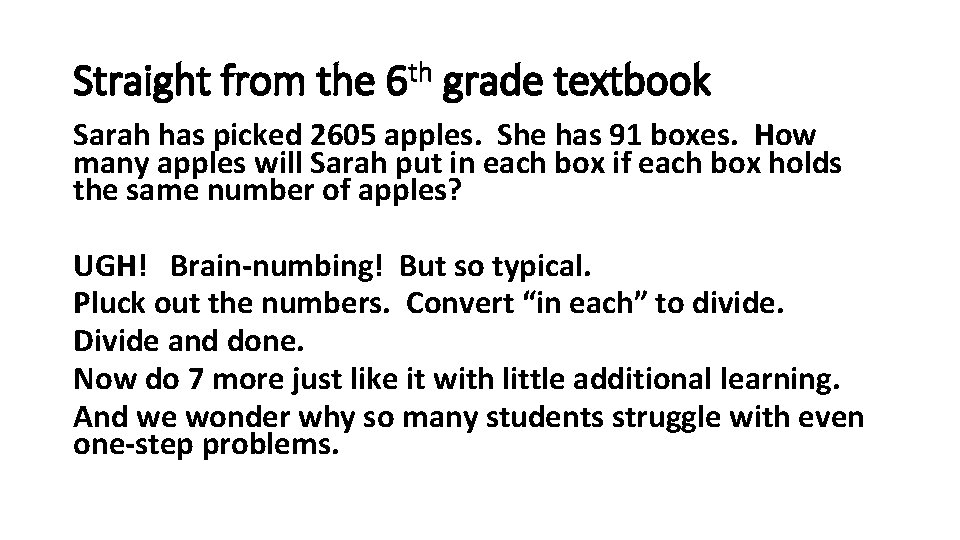
Straight from the 6 th grade textbook Sarah has picked 2605 apples. She has 91 boxes. How many apples will Sarah put in each box if each box holds the same number of apples? UGH! Brain-numbing! But so typical. Pluck out the numbers. Convert “in each” to divide. Divide and done. Now do 7 more just like it with little additional learning. And we wonder why so many students struggle with even one-step problems.
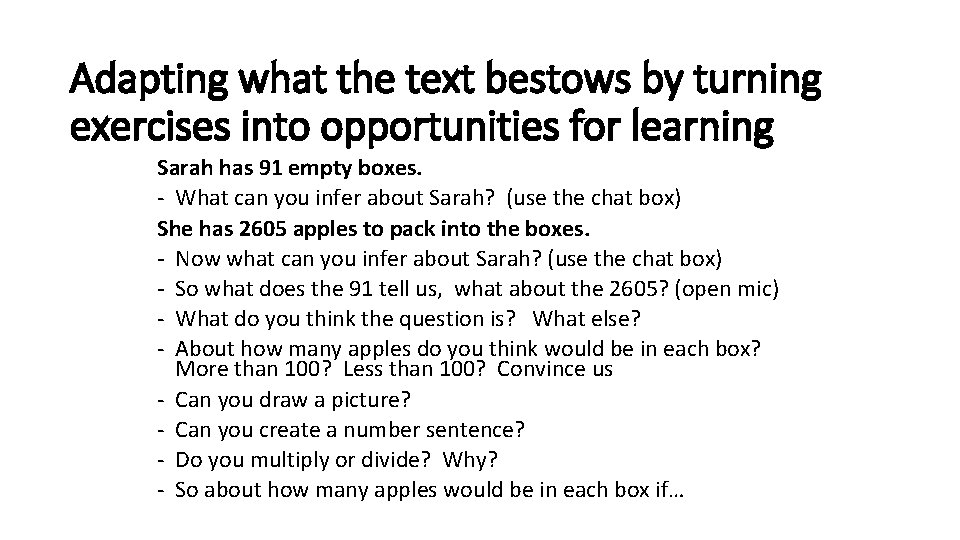
Adapting what the text bestows by turning exercises into opportunities for learning Sarah has 91 empty boxes. - What can you infer about Sarah? (use the chat box) She has 2605 apples to pack into the boxes. - Now what can you infer about Sarah? (use the chat box) - So what does the 91 tell us, what about the 2605? (open mic) - What do you think the question is? What else? - About how many apples do you think would be in each box? More than 100? Less than 100? Convince us - Can you draw a picture? - Can you create a number sentence? - Do you multiply or divide? Why? - So about how many apples would be in each box if…
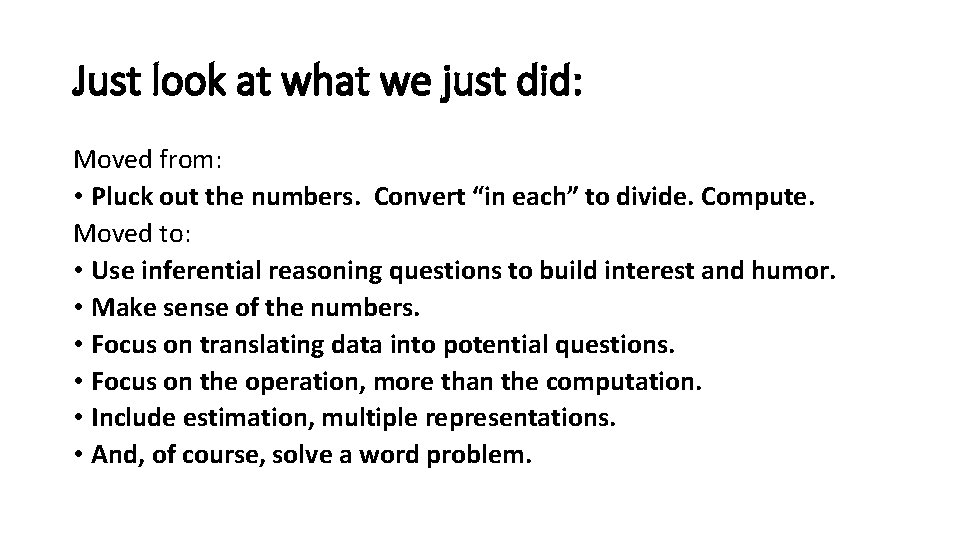
Just look at what we just did: Moved from: • Pluck out the numbers. Convert “in each” to divide. Compute. Moved to: • Use inferential reasoning questions to build interest and humor. • Make sense of the numbers. • Focus on translating data into potential questions. • Focus on the operation, more than the computation. • Include estimation, multiple representations. • And, of course, solve a word problem.
Gradual Reveal of a Stimulus Instead of bombarding students with the whole word problem, the entire graph or figure or table, use the power of Power. Point to gradually reveal the problem, graph, figure, etc. using questions to probe understanding of prior and new content.
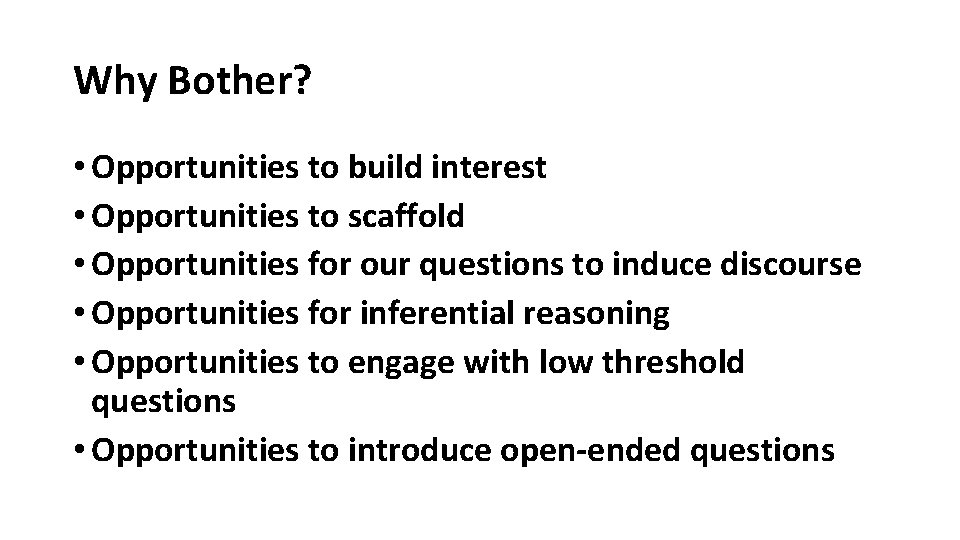
Why Bother? • Opportunities to build interest • Opportunities to scaffold • Opportunities for our questions to induce discourse • Opportunities for inferential reasoning • Opportunities to engage with low threshold questions • Opportunities to introduce open-ended questions
A tale of two approaches OR The Method to my madness I We You
A tale of two approaches I We You So simple So familiar So appealing So wrong for so many!
A tale of two approaches I You We We You I
A tale of two approaches You We I Struggle Explore Share Justify Compare Debrief Consolidate
Let’s Play Using gradual release with: - Word problems - Tables - Graphs - Patterns - Geometric figures
So let’s model a more powerful example of creating and implementing a gradual reveal approach: Thanks to Brian Bushart: Backwards and Forward to Artful Slide Decks 13
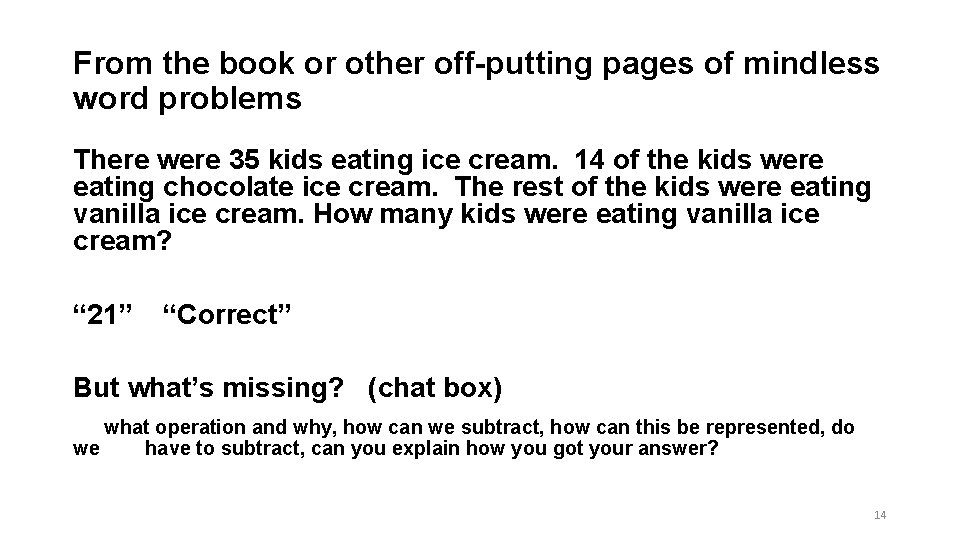
From the book or other off-putting pages of mindless word problems There were 35 kids eating ice cream. 14 of the kids were eating chocolate ice cream. The rest of the kids were eating vanilla ice cream. How many kids were eating vanilla ice cream? “ 21” “Correct” But what’s missing? (chat box) what operation and why, how can we subtract, how can this be represented, do we have to subtract, can you explain how you got your answer? 14
Hard returns to make the reading easier There were 35 kids eating ice cream. 14 of the kids were eating chocolate ice cream. The rest of the kids were eating vanilla ice cream. How many kids were eating vanilla ice cream? 15
Delete the question. There were 35 kids eating ice cream. 14 of the kids were eating chocolate ice cream. The rest of the kids were eating vanilla ice cream. 16
Delete the last line of information. There were 35 kids eating ice cream. 14 of the kids were eating chocolate ice cream. 17
Replace 14 with some There were 35 kids eating ice cream. Some of the kids were eating chocolate ice cream. 18
Delete the 2 nd sentence. There were 35 kids eating ice cream. 19
Replace 35 with some There were some kids eating ice cream. 20
And then reorder from back to front And add questions to ensure fidelity of use and to support visualization, guesses and estimation and reasoning. 21
Accessible Problem Solving There were some kids eating ice cream. Can someone read this? What are you picturing in your mind? What do we know so far? How many kids could be eating ice cream? How many kids could be eating chocolate ice cream? 22
Accessible Problem Solving There were 35 kids eating ice cream. Can someone read this? What do we know that we didn’t know before? What do we know about this number of kids eating ice cream? Do we know how many are eating chocolate ice cream? Why not? 23
Accessible Problem Solving There are 35 kids eating ice cream. Some of the kids were eating chocolate ice cream. Can someone read this? What do we know that we didn’t know before? How many kids do you think are eating chocolate ice cream? What do you think about the kids who aren’t eating chocolate ice cream? 24
Accessible Problem Solving There were 35 kids eating ice cream. 14 of the kids were eating chocolate ice cream. Can someone read this problem now? What do we know that we didn’t know before? How does this number compare to our guesses? Are all of the kids eating chocolate ice cream? What could the other kids be doing? 25
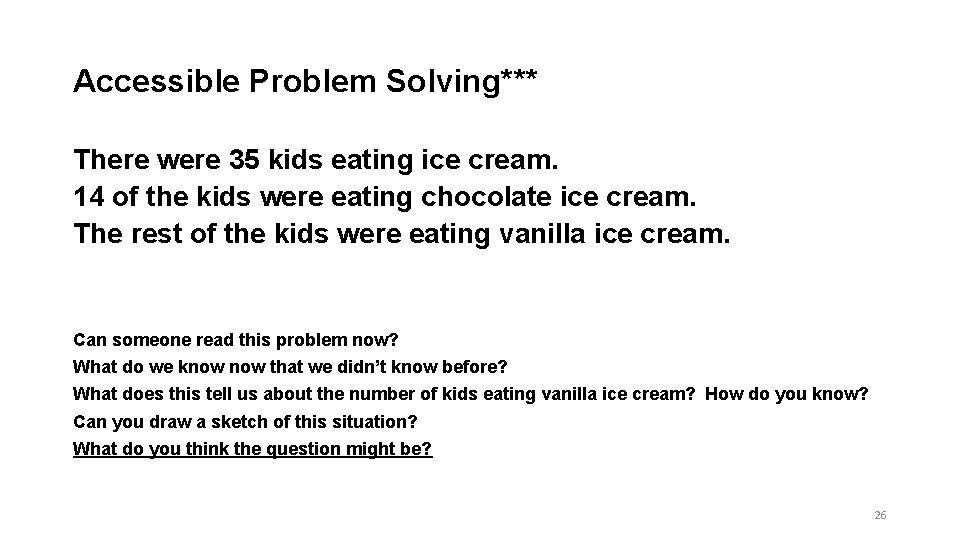
Accessible Problem Solving*** There were 35 kids eating ice cream. 14 of the kids were eating chocolate ice cream. The rest of the kids were eating vanilla ice cream. Can someone read this problem now? What do we know that we didn’t know before? What does this tell us about the number of kids eating vanilla ice cream? How do you know? Can you draw a sketch of this situation? What do you think the question might be? 26
Accessible Problem Solving There were 35 kids eating ice cream. 14 of the kids were eating chocolate ice cream. The rest of the kids were eating vanilla ice cream. How many kids were eating vanilla ice cream? And even without this question, we already have solved the problem. Please use a picture and a number sentence to show you know your answer is correct. 27
Spice it up with graphics or videos 28
Find a video to make them smile! You tube: Easy Homemade Ice Cream 29
Good morning 3 rd Graders What do you think today’s problem will be about? 30
Accessible Problem Solving There were some kids eating ice cream. Can someone read this? What are you picturing in your mind? What do we know so far? How many kids could be eating ice cream? How many kids could be eating chocolate ice cream? 31
Accessible Problem Solving There were 35 kids eating ice cream. Can someone read this? What do we know that we didn’t know before? What do we know about this number of kids eating ice cream? Do we know how many are eating chocolate ice cream? Why not? 32
Accessible Problem Solving There are 35 kids eating ice cream. Some of the kids were eating chocolate ice cream. Can someone read this? What do we know that we didn’t know before? How many kids do you think are eating chocolate ice cream? What do you think about the kids who aren’t eating chocolate ice cream? 33
Accessible Problem Solving There were 35 kids eating ice cream. 14 of the kids were eating chocolate ice cream. Can someone read this problem now? What do we know that we didn’t know before? How does this number compare to our guesses? Are all of the kids eating chocolate ice cream? What could the other kids be doing? 34
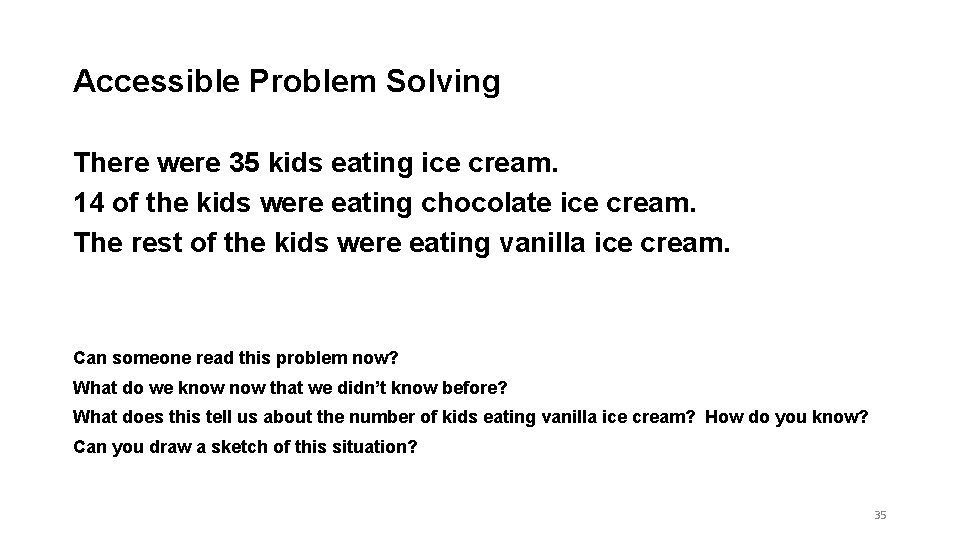
Accessible Problem Solving There were 35 kids eating ice cream. 14 of the kids were eating chocolate ice cream. The rest of the kids were eating vanilla ice cream. Can someone read this problem now? What do we know that we didn’t know before? What does this tell us about the number of kids eating vanilla ice cream? How do you know? Can you draw a sketch of this situation? 35
Accessible Problem Solving There were 35 kids eating ice cream. 14 of the kids were eating chocolate ice cream. The rest of the kids were eating vanilla ice cream. How many kids were eating vanilla ice cream? And even without this question, we already have solved the problem. Please use a picture and a number sentence to show you know your answer is correct. 36
Congratulations: 21 students were eating vanilla ice cream.
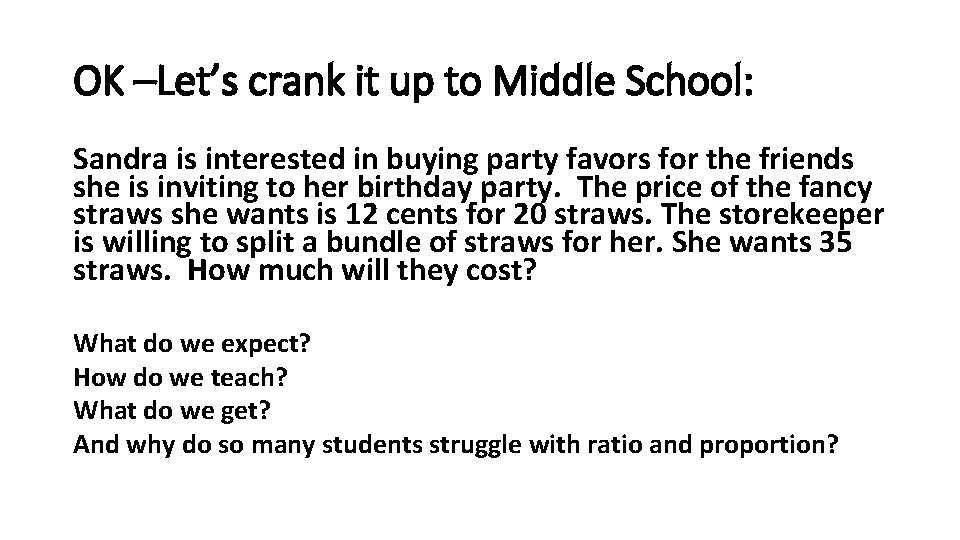
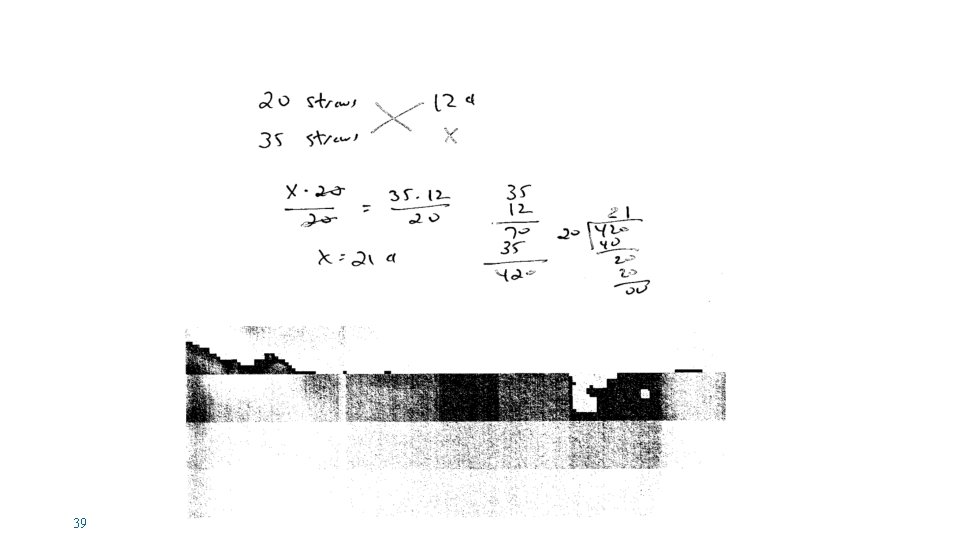
OK –Let’s crank it up to Middle School: Sandra is interested in buying party favors for the friends she is inviting to her birthday party. The price of the fancy straws she wants is 12 cents for 20 straws. The storekeeper is willing to split a bundle of straws for her. She wants 35 straws. How much will they cost? What do we expect? How do we teach? What do we get? And why do so many students struggle with ratio and proportion?
39
• So typical • So underperforming • So boring for so many • Where in the engagement? • Where is the struggle? • Where is the discourse? • Where are we giving our students a reason to care?
Your turn. Breakout Rooms. Alternatively: Talk about what you can do with this problem to maximize engagement and learning. Sandra is interested in buying party favors for the friends she is inviting to her birthday party. The price of the fancy straws she wants is 12 cents for 20 straws. The storekeeper is willing to split a bundle of straws for her. She wants 35 straws. How much will they cost?
Richer and Deeper Sandra is interested in buying party favors for the friends she is inviting to her birthday party. The price of the fancy straws she wants is some amount of money for some number of straws. She wants 100 straws. What’s the question? What additional information do you need? Why?
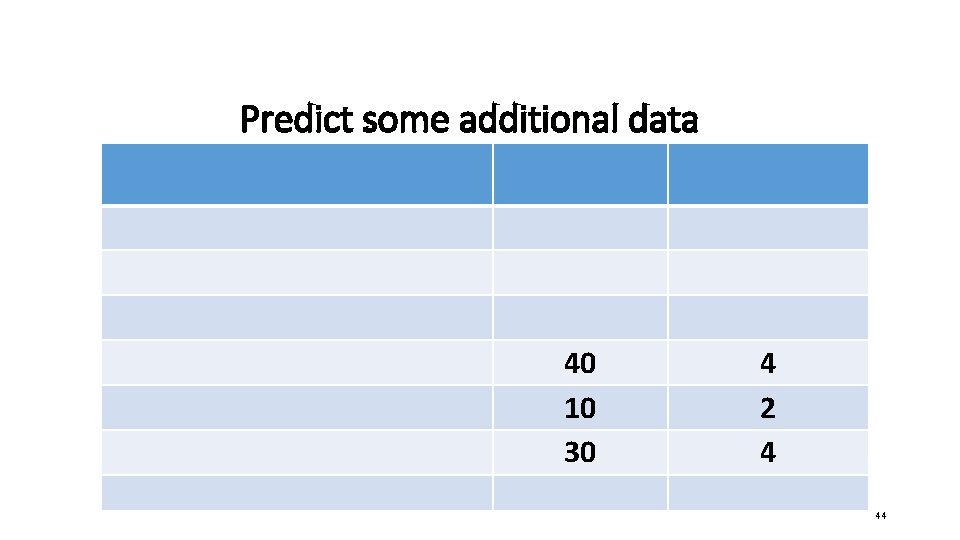
Some data. What do you see? 40 10 30 4 2 4 43
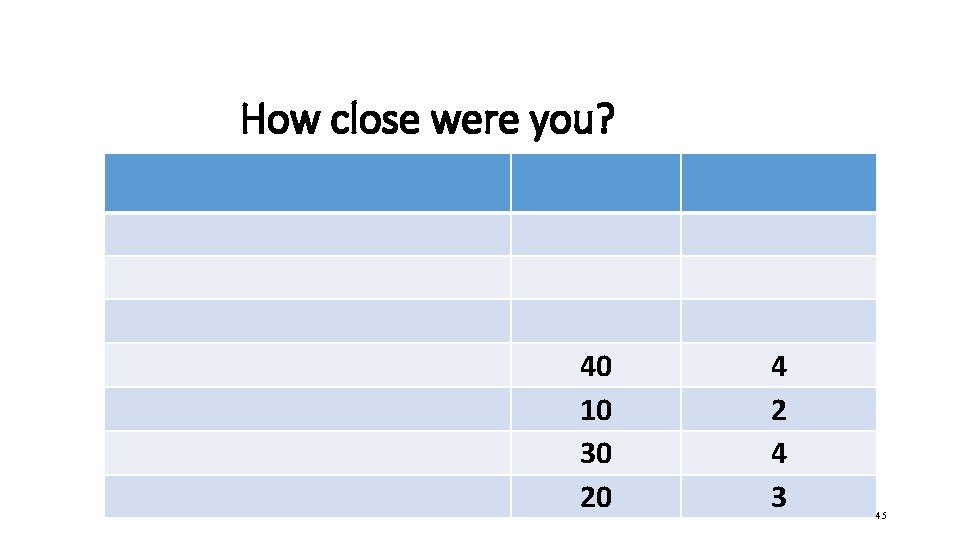
Predict some additional data 40 10 30 4 2 4 44
How close were you? 40 10 30 20 4 2 4 3 45
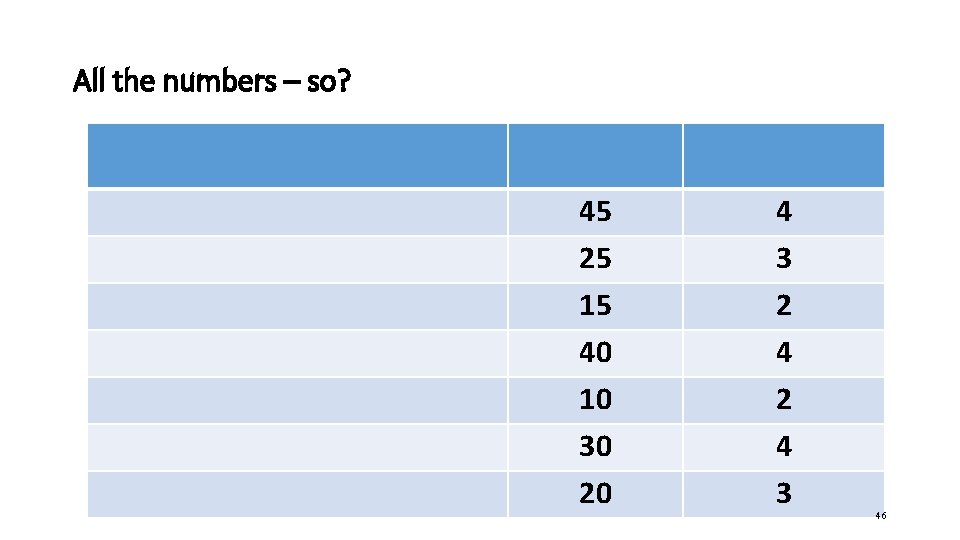
All the numbers – so? 45 25 15 40 10 30 20 4 3 2 4 3 46
A lot more information (where are you? ) Roller Coaster Ferris Wheel Bumper Cars Rocket Ride Merry-go-Round Water Slide Fun House 45 25 15 40 10 30 20 4 3 2 4 3 47
Fill in the blanks Ride ? ? ? Roller Coaster Ferris Wheel Bumper Cars Rocket Ride Merry-go-Round Water Slide 45 25 15 40 10 30 4 3 2 4 Fun House 20 3 48
At this point, it’s almost anticlimactic! 49
The amusement park Ride Time Tickets Roller Coaster 45 4 Ferris Wheel 25 3 Bumper Cars 15 2 Rocket Ride 40 4 Merry-go-Round 10 2 Water Slide 30 4 Fun House 20 3 50
The Amusement Park The 4 th and 2 nd graders in your school are going on a trip to the Amusement Park. Each 4 th grader is going to be a buddy to a 2 nd grader. Your buddy for the trip has never been to an amusement park before. Your buddy want to go on as many different rides as possible. However, there may not be enough time to go on every ride and you may not have enough tickets to go on every ride. 51
The bus will drop you off at 10: 00 a. m. and pick you up at 1: 00 p. m. Each student will get 20 tickets for rides. Use the information in the chart to write a letter to your buddy and create a plan for a fun day at the amusement park for you and your buddy. 52
Why do you think I started with these tasks? - Standards don’t teach, teachers teach - It’s the translation of the words into tasks and instruction and assessments that really matter - Processes are as important as content - We need to give kids (and ourselves) a reason to care - Difficult, unlikely, to do alone!!! 53
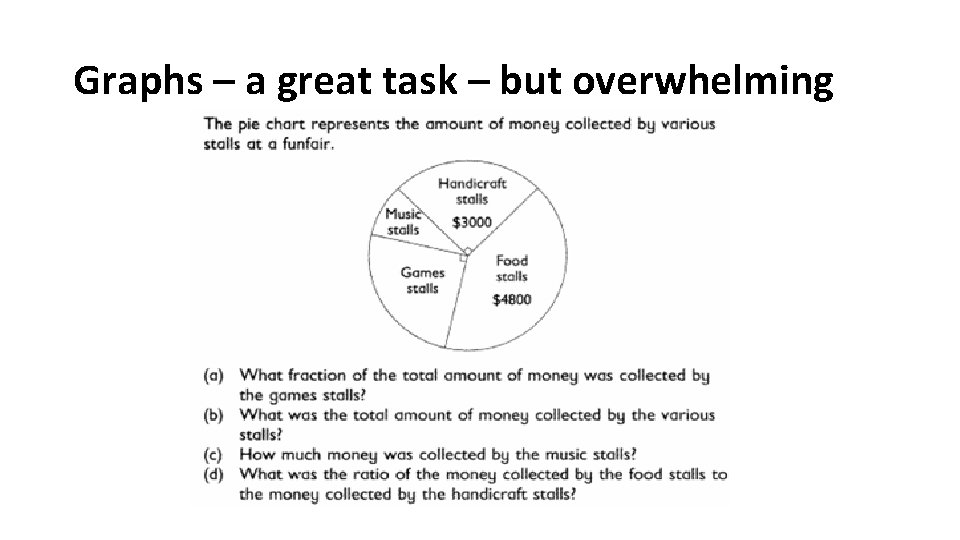
Graphs – a great task – but overwhelming
Graphs – a great task – gradually revealed What do you notice? What do you wonder?
Graphs – a great task What do you notice? What do you wonder?
Graphs – a great task What do you notice? What do you wonder?
Graphs – a great task What do you notice? What do you wonder?
Graphs – a great task What do you notice? What do you wonder?
Graphs – a great task What do you notice? What do you wonder?
What could be the story here?
Now what might be the story here? What additional information would help?
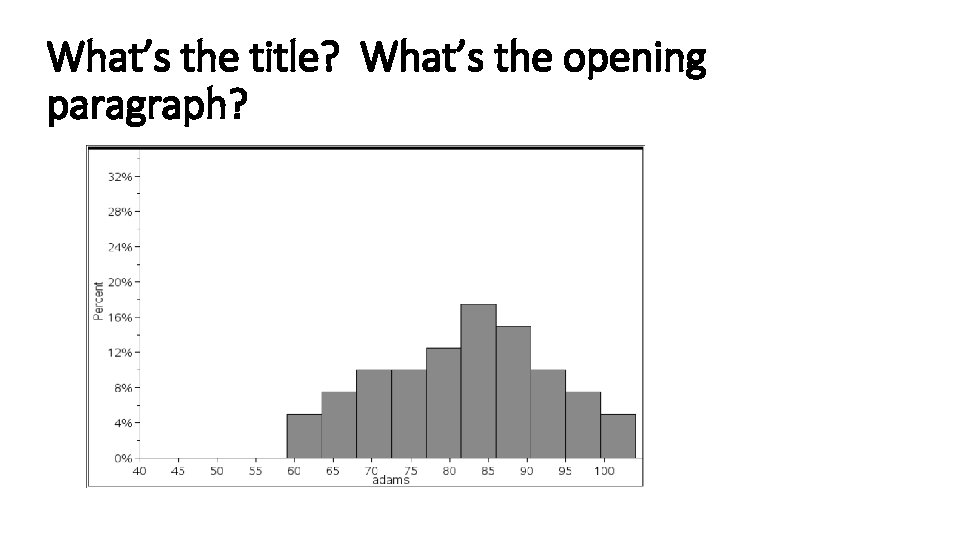
What’s the title? What’s the opening paragraph?
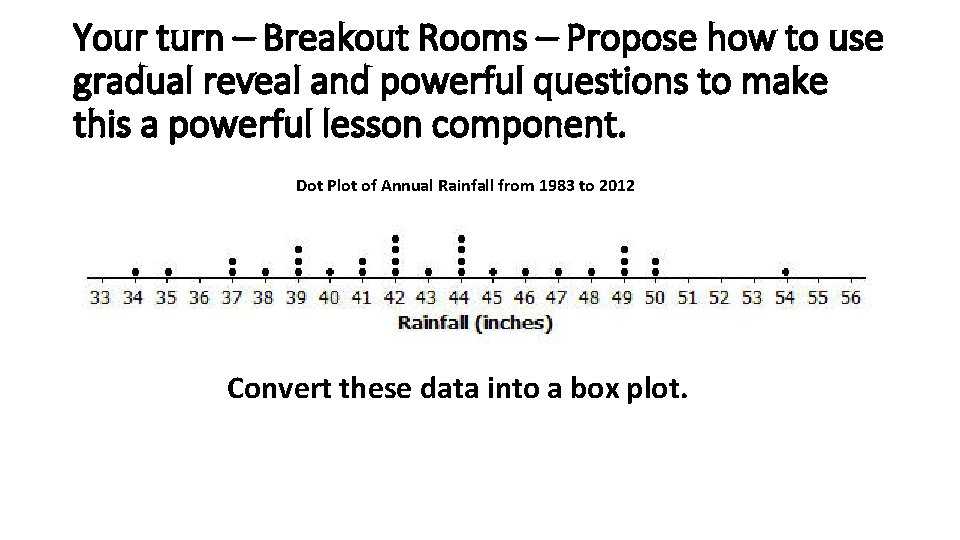
Your turn – Breakout Rooms – Propose how to use gradual reveal and powerful questions to make this a powerful lesson component. Dot Plot of Annual Rainfall from 1983 to 2012 Convert these data into a box plot.
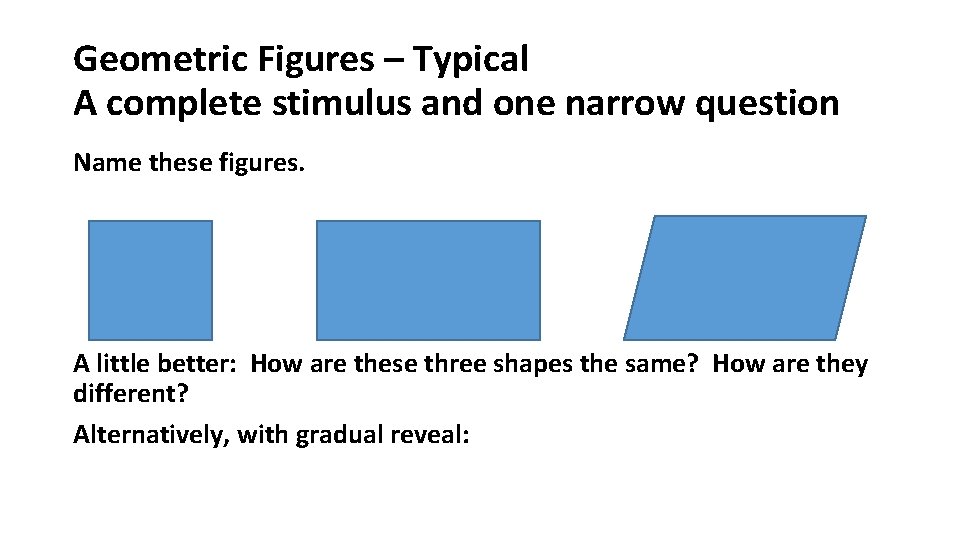
Geometric Figures – Typical A complete stimulus and one narrow question Name these figures. A little better: How are these three shapes the same? How are they different? Alternatively, with gradual reveal:
Geometric Figures – gradually revealed What do you notice?
Geometric Figures Now what do you notice? How are they the same? Different?
Geometric Figures How are these three shapes the same? How are these three shapes different? What relationships between squares, rectangles and parallelograms can you identify?
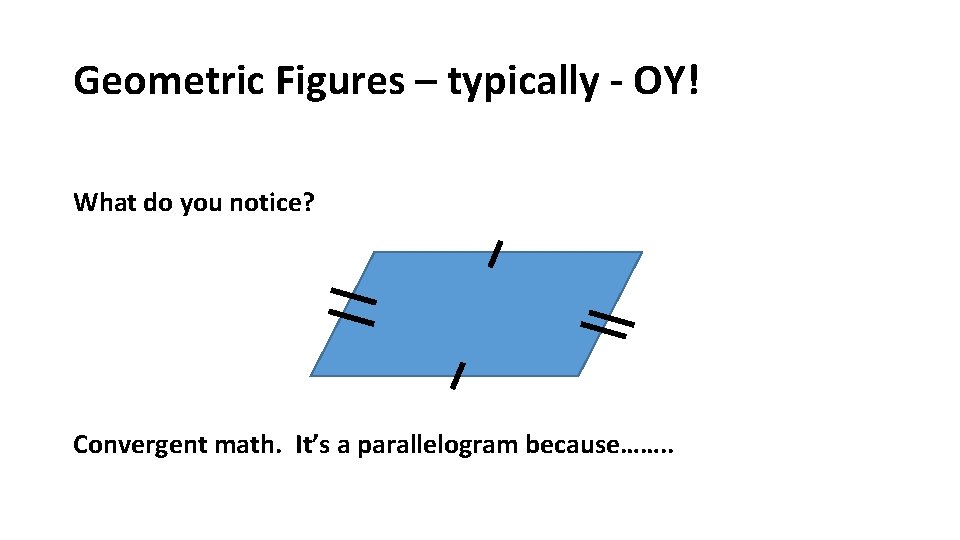
Geometric Figures – typically - OY! What do you notice? Convergent math. It’s a parallelogram because……. .
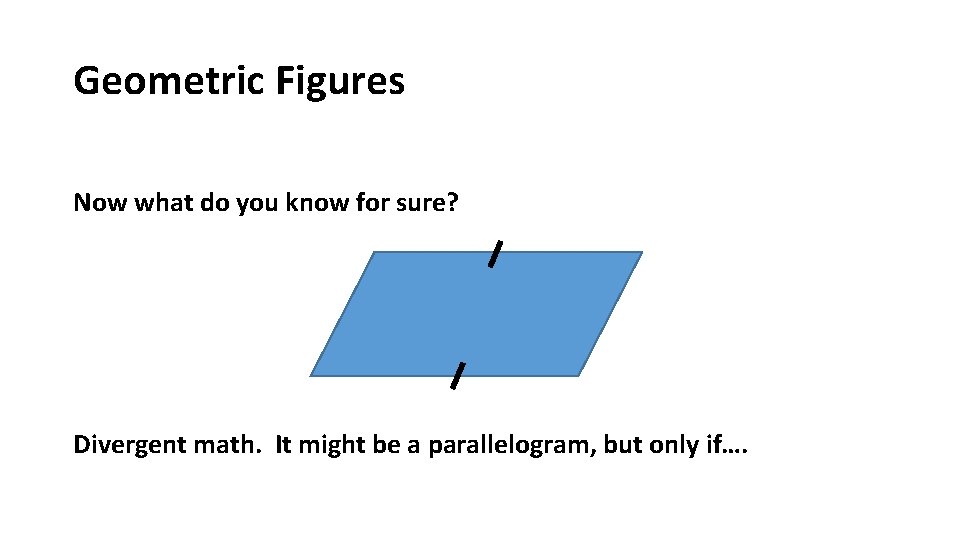
Geometric Figures – revealed gradually What do you notice and know for sure? What do you think might be true, but can’t be sure? Why not?
Geometric Figures Now what do you know for sure? Divergent math. It might be a parallelogram, but only if….
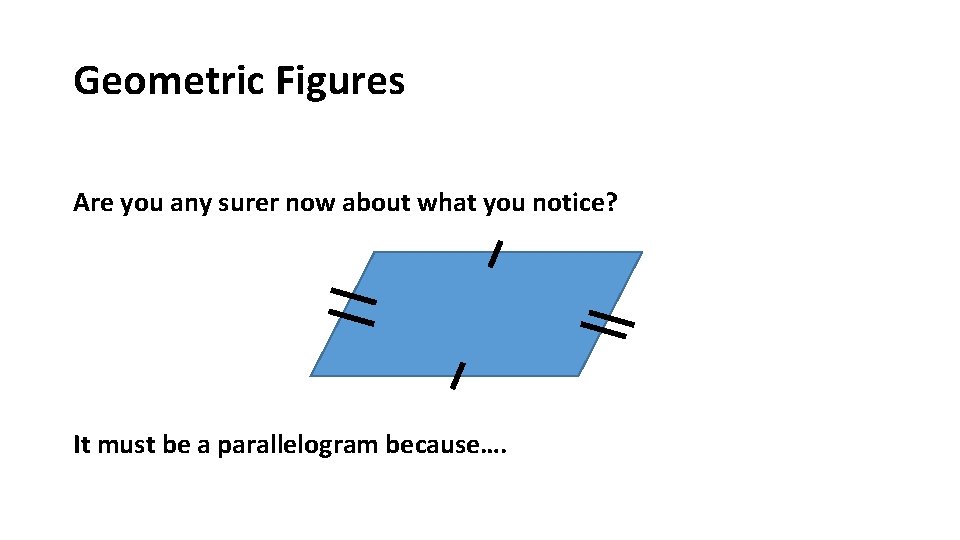
Geometric Figures Are you any surer now about what you notice? It must be a parallelogram because….
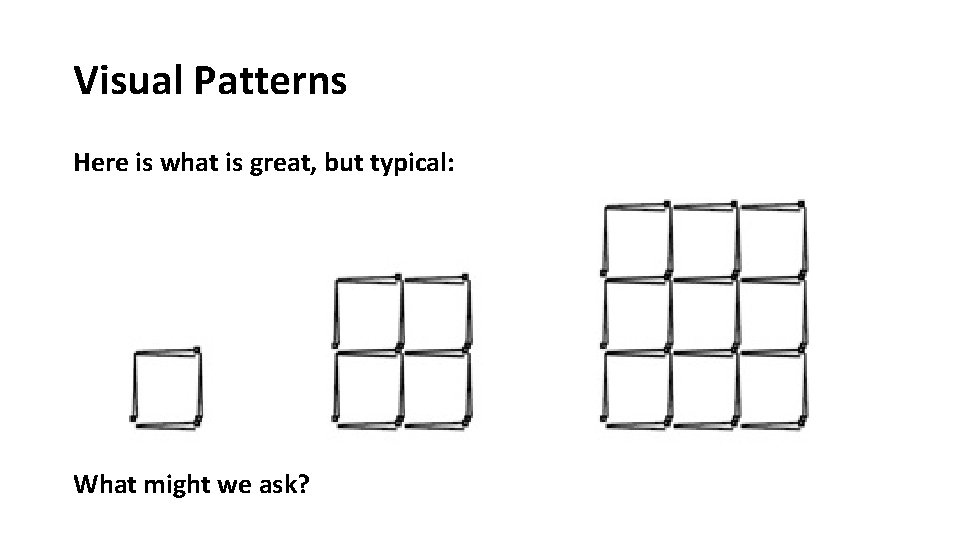
Visual Patterns Here is what is great, but typical: What might we ask?
Visual Patterns - alternatively What do you notice? See if you and your partner can find 5 things. Insert visual pattern with toothpicks If this is stage 2, draw and describe stage 1. How about stage 3?
Visual Patterns Who has this? Who has something different? What might we ask? So we get to the same place, but with greater ownership and interest.
Turn and tell your partner what you learned this evening.
3 Calls to Action: • Eliminate worksheets • Never give students more than 4 problems or tasks without a chance to check and debrief • Remember that LESS is MORE! • Find a partner. Create some animated slides (with questions) that capture gradual reveal. Try it out and debrief the experience with your partner.
Why not give gradual reveal a try? Thank you and have fun!