
The Power of Action Learning for Teacher Development





















- Slides: 38
The Power of Action Learning for Teacher Development and School Improvement LEAP Conference 30 th July 2015 Professor Stephen Dinham Chair of Teacher Education and Director of Learning and Teaching
Student learning is heavily dependent on teacher and leader learning
… an age of evidence “… teacher professional learning needs to be built upon an evidential foundation of what works in teaching, not fad, fantasy, idealism, ideology or rhetoric”. – Dinham, Stephen, (2008) Innovative and effective professional learning for student accomplishment, Curriculum Corporation conference, Melbourne, 19 June, 2008.
PROFESSIONAL LEARNING IN EDUCATION
Key Questions 1. What teacher knowledge best assists student learning? 2. What forms of professional learning are most effective? 3. What new forms are emerging? 4. What roles can leaders play?
*Dinham (2008) ACER Press http: //shop. acer. edu. au/acer-shop/product/A 4066 BK
Four Fundamentals of Student Success (Dinham, 2008)* QUALITY TEACHING FOCUS ON THE STUDENT (Learner, Person) LEADERSHIP PROFESSIONAL LEARNING
Types of Teacher Learning Traditional • Formal pre-service • ad hoc, on the job • Professional associations • Informal self-directed • Formal in-service • Formal postgraduate study
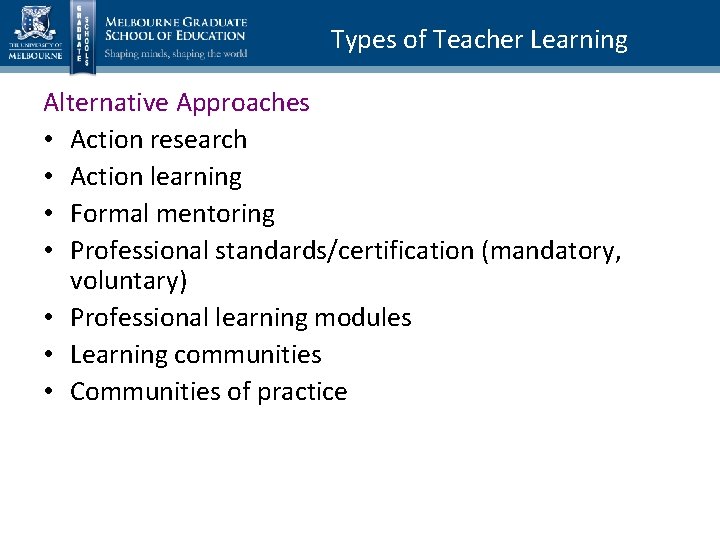
Types of Teacher Learning Alternative Approaches • Action research • Action learning • Formal mentoring • Professional standards/certification (mandatory, voluntary) • Professional learning modules • Learning communities • Communities of practice
Problems with Traditional Approaches Based on perceived system and school need Supply driven Notion of teacher as individual learner Volunteers and conscripts Ignored benefits of collaborative learning In-service ignored needs of teachers – one size model • Ignored needs of students • • •
Trends in Teacher Learning From ………… Centralised System responsibility Off the shelf Generalised Off site, apart Input Passive External expert Individual learning Theory based Transactional Changing things Learning by seeing, hearing Using research Broad focus …. …. … To Decentralised Individual, collective responsibility Tailored Contextualised On site, embedded Outcomes Interactive External partner Community learning Problem based Relational Changing people Action learning Doing research Student/learning focus
What are the effects on student learning? • Providing teachers with formative feedback: d=0. 90 • Micro teaching: d=0. 88 • Teacher professional Development: d=0. 62 • Teaching strategies: d=0. 60 • Quality of Teaching: d=0. 44 (Hattie, 2009)
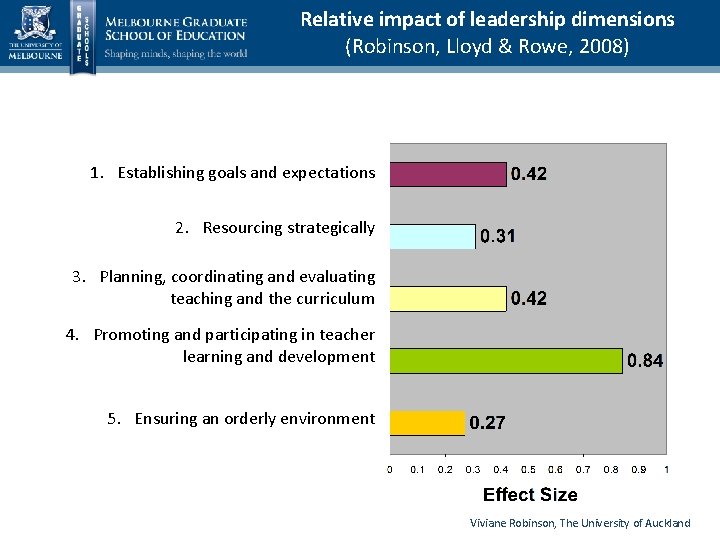
Relative impact of leadership dimensions (Robinson, Lloyd & Rowe, 2008) 1. Establishing goals and expectations 2. Resourcing strategically 3. Planning, coordinating and evaluating teaching and the curriculum 4. Promoting and participating in teacher learning and development 5. Ensuring an orderly environment Viviane Robinson, The University of Auckland
Key Points – We need to start with student assessment • What evidence do we have, what do we need, what does it tell us, what does it mean for our professional learning? – In other words, professional learning needs to be demand driven and not supply driven. – It needs to be based on problems and issues associated with student learning and evidence based, in other words action learning. • See University of Melbourne, MGSE Network of Schools – http: //education. unimelb. edu. au/community/university_of_ melbourne_network_of_schools
Master of Teaching (MGSE) • Assessment of student work as evidence of learning lies at the core Master of Teaching subjects, a key principle being that with a data-driven, evidencebased approach to teaching and learning, teachers can manipulate the learning environment and scaffold learning for every student, regardless of the student’s development or intellectual capacity. – See http: //www. youtube. com/watch? v=cfy 7 J_8 Ub. EY
Clinical Judgement for Teaching: The Melbourne approach Master of Teaching: Teaching to inspire W: masterofteachingmelbourne. edu. au © The University of Melbourne
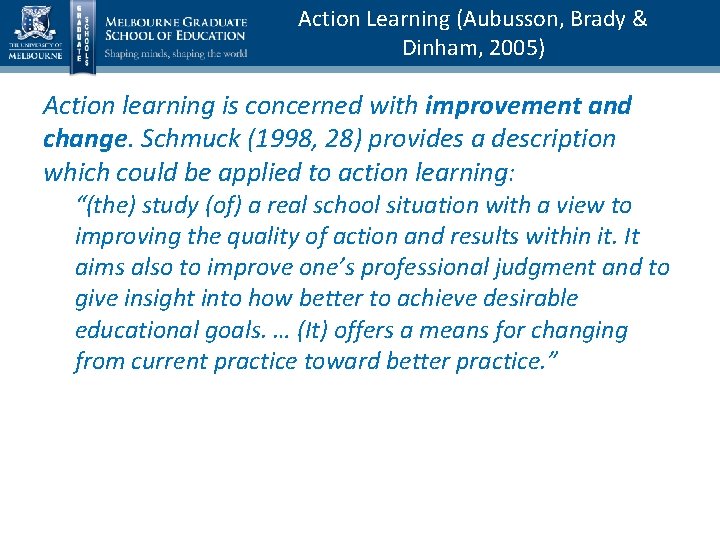
Action Learning (Aubusson, Brady & Dinham, 2005) Action learning is concerned with improvement and change. Schmuck (1998, 28) provides a description which could be applied to action learning: “(the) study (of) a real school situation with a view to improving the quality of action and results within it. It aims also to improve one’s professional judgment and to give insight into how better to achieve desirable educational goals. … (It) offers a means for changing from current practice toward better practice. ”
Action Learning (cont’d) There are several noteworthy characteristics of action learning: • It is applied so that the practitioner uses the investigation as a methodology to gain understanding about how to improve practice. • It is often both subjective and objective: it may involve selfreflective inquiry and inquiry-oriented practice directed towards obtaining meaningful data. • It most typically occurs in school-based teams and involves dialogue with significant others about the nature of practice and the process of learning. • It operates through cycles of reflecting, planning, acting, data collecting, analysing, reflecting again, re-planning, and so on.
Schools as Learning Communities “When all the definitions were pieced together the school as a learning community was perceived as a place where lifelong learning takes place for all stakeholders for their own continuous growth and development, teachers act as exemplary learners, students are prepared adequately for the future, and mistakes become agents for further learning and improvement. Furthermore, it is a place where collaboration and mutual support is nurtured, clear shared visions for the future are built, and the physical environment contributes to learning. ” (Voulalas & Sharpe, 2005, Creating schools as learning communities: obstacles and processes) http: //onlinepracticeandpedagogy. blogspot. com. au/2010/10/voulalas -z-d-and-sharpe-f-g-2005. html
The Learning Community: What did we find? What works? Case Studies: 1. 2. 3. 4. HSC Teaching Success AESOP Australian Government Quality Teaching Program NSW Quality Teaching Awards – None of these projects was about learning communities per se, but each shed light on the dynamics of the phenomenon.
The Case Studies: How Does a Learning Community Develop and Sustain Itself? The Learning Communities examined in the case studies were developed and sustained through: A. B. C. D. E. F. Focus on Teaching and Learning Individual and Collective Belief and Support Problem Solving Internal Expectations and Accountability Leadership and Outside Influence Overall Dynamics
A. Focus on Teaching and Learning 1. Learning communities have a focus on learning and a desire to learn about learning; there is use of pedagogic terminology, models and theory, coupled with a conscious effort to de-prioritise administration and management and re-prioritise learning within the group. 2. Members of learning communities see themselves and their students as going somewhere, with learning being an ongoing process; learning becomes contagious, with others catching the ‘bug’.
… Focus on Teaching and Learning 3. Within the group there is recognition that it is necessary to change the way people think if there is to be change in how they act, and thus learning, reflection and questioning are important. 4. Members of the group are concerned with establishing and maintaining upward, continuous cycles of improvement; they are not satisfied with the status quo.
B. Individual and Collective Belief and Support 5. 6. Group members possess and demonstrate belief and respect for their profession and discipline; they believe in, even love their area and communicate this to others. Members of the group pay attention to social maintenance, trying to make their school, department, or faculty a ‘good place’ (Mac. Beath, 2006); members care for each other and their students as people and social and professional relationships are important.
C. Problem Solving 7. 8. 9. There is an emphasis on problem or issue based learning and recognition of what is important, with dialogue around identified issues and potential solutions. Experimentation, risk taking and innovation in teaching and learning are encouraged and are a feature of learning communities; there is questioning rather than acceptance of constraints. Teaching and learning are context and person specific, with efforts to contextualise and modify as necessary externally derived solutions or approaches. 10. There is on-going reflection on and evaluation of existing and new measures within the learning community, coupled with data-informed decision making.
D. Internal Expectations and Accountability 11. The group creates a climate of high expectations and professionalism which members rise to, not wanting to let anyone down, not least students. 12. Members of the group empower each other to take the lead in learning, in turn enhancing individual and group leadership capacity and effectiveness. 13. Accountability is to the group, more than to externally imposed accountability measures; group accountability and self-accountability are powerful influences on the learning community’s ethos, and action.
E. Leadership and Outside Influence 14. Leadership outside and within the group is important in stimulating and facilitating the learning community. 15. While learning communities can develop without stimulus or action from above or outside, assistance, guidance, resources and encouragement from others within and in some cases outside the organisation can facilitate the learning process.
F. Overall Dynamics 16. Overall, what seems to work most effectively is a combination of external understanding, advice, assistance and recognition, coupled with a focus on internal issues, with teacher and group learning to address these through empowerment and with internal action and accountability. 17. Time, place, space and language are important elements in creating a learning community.
Implications and Conclusions • Learning communities can support teachers’ professional learning and improve student achievement. • However, learning communities cannot be mandated, built or maintained in a technical, mechanistic sense. • Rather, these need to be encouraged, nourished and sustained in the manner of an organic system.
Implications and Conclusions • Some organisations and groups suffer from learning disabilities. These need to be assessed/diagnosed in the same way we would with a student and suitable interventions adopted. • Educational leaders need to ensure that teaching and learning are central concerns of the educational organisation and that nothing is allowed to obstruct or distort this central focus.
Implications and Conclusions • There is a challenge for educational leaders to deal with situations where learning has atrophied. – Mc. Beath has noted (2006: 19): “It is hard for teachers to shed an outer skin which has calcified over many years in the classroom where dialogue is a rare commodity no matter how hard teachers strive for it, and in which ‘instruction’ is the norm”. • Building a learning community is not about ‘fixing’ teachers.
Finally, the studies showed … • Dialogue and innovation around quality teaching and learning have emerged and reinvigorated jaded teachers who are now active participants in learning communities. • Latent leadership potential has emerged and in turn facilitated further change and improvement in the groups concerned. • It is never too late to nourish the learning community. • Action learning approaches can have high impact.
Leadership for Teacher Learning “Although teachers have an undeniably large influence on student results, they are able to maximise that influence only when they are supported by school and system leaders who give them the time, the professional learning opportunities, and the respect that are essential for effective feedback to support instruction”. (Reeves, 2010)
Leadership for Teacher Learning “ … leadership is the ‘big enabler’ in successful schools. You can have good teaching without having a good school, but you can’t have a good school without good leadership … professional learning is the lever that helps leaders create the conditions in which teachers can teach effectively and students can learn. ” (Dinham, 2010)
Conclusions • It is not possible to achieve improvement in teacher, student and school performance without professional learning. • We need to be able to change what educators know, even think and value, in order for them to change their professional practice. • It is not only a matter of what an individual knows and learns however, but the engagement of educational professionals in (action) learning. • Teacher professional learning needs to start with assessment of students’ learning needs.
Practical Responses Using Action Learning: Walking the Walk • Master of Instructional Leadership (MGSE, Uo. M 2013 - ): – http: //education. unimelb. edu. au/study_with_us/professio nal_development/course_list/instructional_leadership • University of Melbourne Network of Schools (MGSE 2014 -) – http: //education. unimelb. edu. au/community/university_o f_melbourne_network_of_schools • Leading Instructional Practice (Bastow Institute for Teaching and School Leadership 2011 -) – http: //www. bastow. vic. edu. au/courses/leadinginstructional-practice
References Aubusson, P. ; Brady, L. , & Dinham, S. (2005). Action Learning: What Works? A research report prepared for the New South Wales Department of Education and Training. Sydney: University of Technology Sydney. Brady, L. ; Aubusson, P. & Dinham, S. (2006). ‘Action Learning For School Improvement', Educational Practice and Theory, 28(2), pp. 27 -39. Dinham, S. (2007). ‘The Dynamics of Creating and Sustaining Learning Communities’, Unicorn Online Refereed Article, ORA 43, pp. 1 -16. Dinham, S. (2013). ‘Connecting Instructional Leadership With Clinical Teaching Practice’, Australian Journal of Education, 57(3), pp. 220231. Dinham, S. (2008). How to Get Your School Moving and Improving An Evidence-Based Approach. Melbourne: ACER Press. Robinson, V. , Lloyd, C. , and Rowe, K. (2008). The impact of leadership on student outcomes: An analysis of the differential effects of leadership types. Educational Administration Quarterly 44(5), pp. 635 -674.
© Copyright The University of Melbourne 2011