
THE POTENTIAL OF USING AN INPUT VOUCHER SYSTEM
- Slides: 26
THE POTENTIAL OF USING AN INPUT VOUCHER SYSTEM TO INTEGRATE THE COMMERCIAL AND NON-COMMERCIAL INPUT DISTRIBUTION SYSTEMS: A CASE OF MALAWI, MOZAMBIQUE AND ZAMBIA BY Julius Mangisoni Department of Agricultural & Applied Economics, Bunda College
Background • Studies on importance & share of relief seeds were implemented by FANRPAN (Kananji and Phiri, 2006; Simfukwe, 2006). • Major findings of the studies confirmed the importance of relief seeds in countries like Mw & Zam. • 2 parallel input distrbtn channels (comm. & non comm) identified. • Such parallel markets currently not well integrated.
• Necessary to assess whether using an input voucher system would help to integrate the two markets. • Subsidies distort the market & crowd out private sector dvlpmnt. • Vouchers are less distorting, promote free market competition, allow for greater economic diversity. • Properly designed voucher system would reduce state intervention. • We therefore hypothesize that the vouchers can be used to enhance the purchasing power of the poor, and the commercial sector can redeem the vouchers and expand its distribution network.
• In Zambia (Simfukwe, 2006) reported that there was lack of information on vouchers. • The Zambia study recommended a study on voucher system to create awareness among govnt officials, relief agencies & NGOs.
OBJECTIVES The specific objectives of the study are: • To test the potential benefits of using voucher systems to integrate the commercial and noncommercial input distribution channels. • To demonstrate the potential impact of implementing a full cycle of policy research, analysis and engagement, using the case of seed and fertilizer input vouchers.
OBJECTIVES cont… • To bring about policy changes for enhancing input supplies to small farmers. • To develop training materials for policy analysts to engage in complete policy analysis cycle. • To conduct training of policy analysts at national level.
APPROACHES The study has two phases: Phase 1 (1) Each country node carried out literature review and updated country studies on relief seed trade recently conducted in Malawi, Mozambique, South Africa and Zambia. (2) A training workshop was held in Lilongwe in March this year-devped questionnaires and PRA field guide (3) Draft synthesis report on first phase developed. Phase 2 (1) Rapid field research
APPROACHES cont…. . (2) Discussions with key stakeholders. (3) Preparation of comprehensive country reports. (4) Preparation of a synthesis report. (5) Preparation of policy briefs. (6) Preparation of journal article.
Research questions-phase 2 This phase focused on getting answers to following questions: • What commitments, knowledge and skills gaps on voucher systems are present? • What distortions are visible to stakeholders with regard to relief input markets? • What are the stakeholders’ perceptions of an input voucher system? • How should vouchers be issued to small farmers and who should be issuing them?
Phase 2 cont. . • What should be the specific criteria for the voucher holders when he/she buys inputs from the supplier of her/his choice at any point throughout the country? • Who are the key private companies, agrodealers and NGOs in the input supply chain? • How should registration of competent agro-input suppliers, dealers and small farmers in the relief program be carried out to conform to the tenets of a free marketing system? • Who should be registering the small farmers?
Phase 2 cont. . • Who are the potential rural agro-dealers who can link up with private input (seed and fertilizer) companies? • What anti-fraud measures should be put in place? • Where would the holder of the voucher redeem the voucher (at wholesale, retail, etc? ) • What system should be used by the input retailer to en-cash the vouchers to ensure prompt payment and to control irregularities?
Phase 2 cont… • How should such a marketing model be implemented? • What should be the role of government, private companies, agencies, NGOs, farmers, etc. in an input voucher system? • What are their fears and concerns about an input voucher system? • What market-friendly relief seed marketing model would be recommended by stakeholders?
Phase 2 cont. . The study will not address the following questions; • How can agro dealers be persuaded to extend their market network into rural areas? • Which categories of farmers should use flexivouchers and for what? • Are percentile coupons or vouchers more feasible? • How should the percentages in the value of the coupon or voucher be determined? • How can the Zambian Government be persuaded to shift to a voucher-based system?
PHASE 2 RESULTS • Field research shows that stakeholders have knowledge about input vouchers -key input in Zambia and Mozambique is seed via SV&F -key inputs in Malawi are hybrid seed and fertilizers used on maize (urea and 23: 21: 0+4 S) and tobacco (CAN & D compound). -smallholders in Malawi prefer OPVs • Registration of beneficiaries
PHASE 2 RESULTS • Registration of beneficiaries -stakeholders at local level to be involved -local leaders acting alone not recommended in both Malawi and Zambia -Local leaders, NGOs, donors to play a supportive role in registration -Zambian registration process more systematic and transparent than the Malawian process
Registration of beneficiaries -Evidence in Malawi and Zambia shows that some unintended beneficiaries benefited from the program due to: favoritism; selling of vouchers; selling of inputs acquired through vouchers; vouchers found with foreigners -Challenges in coordination between govt, input companies and other players led to more or fewer coupons being distributed.
Flexi-vouchers • Some farmers in Malawi and Zambia expressed desire for flexi-vouchers to extend their choices • Farmers suggested that the range of inputs covered should include groundnuts, beans, vegetables and other seeds. • Beneficiaries varied in their desired level of contribution to the cost of the input.
Distribution network • Main fertilizer and seed companies involved: ADMARC, SFFRFM, Farmers World, Kulima Gold, Chipiku Stores, NASFAM, SEEDCO. • Zambia used a tendering process. Some traders left out. • Mozambique used SEMOC. • Mozambique and Malawi reported poor quality inputs were distributed in certain cases. • Quality of inputs were quite good in Zambia. • Late delivery of inputs was common to all countries.
Distribution network • Suggested penalties for poor quality input delivery -suspension of violators -confiscation of inputs -payment of stiff fine
Potential benefits of vouchers • Impact on smallholder farmers -Two year surplus production in Malawi -Progressive increase in yield from less than a tonne to 2. 04 MT/ha -Increased use of new technologies e. g. hybrid seed. -In Zambia stakeholders noted that it has potential to to promote the development of farmers’ seed systems and allow quicker transactions between seed sellers and farmers. -In Mozambique, econometric estimation showed that emergency seed distribution is associated with 3 -22% decrease in producers’ probability of buying commercial seed.
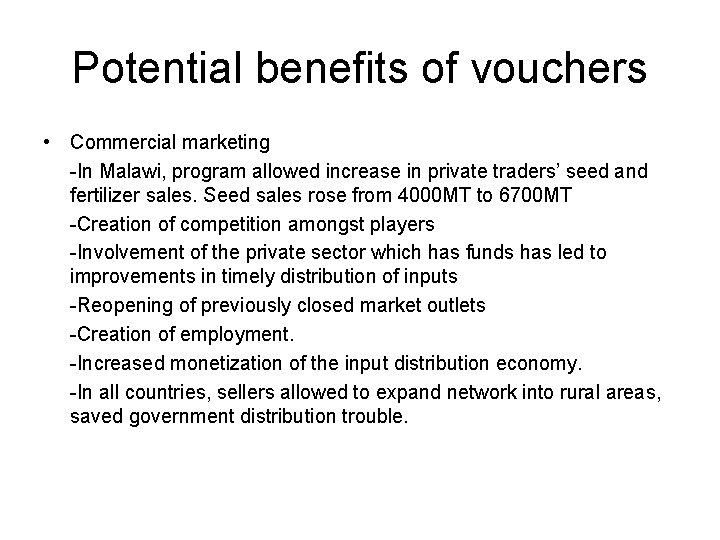
Potential benefits of vouchers • Commercial marketing -In Malawi, program allowed increase in private traders’ seed and fertilizer sales. Seed sales rose from 4000 MT to 6700 MT -Creation of competition amongst players -Involvement of the private sector which has funds has led to improvements in timely distribution of inputs -Reopening of previously closed market outlets -Creation of employment. -Increased monetization of the input distribution economy. -In all countries, sellers allowed to expand network into rural areas, saved government distribution trouble.
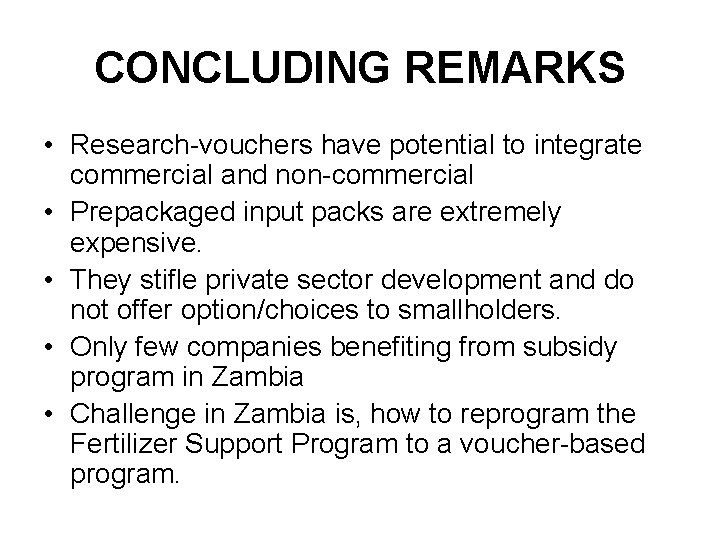
CONCLUDING REMARKS • Research-vouchers have potential to integrate commercial and non-commercial • Prepackaged input packs are extremely expensive. • They stifle private sector development and do not offer option/choices to smallholders. • Only few companies benefiting from subsidy program in Zambia • Challenge in Zambia is, how to reprogram the Fertilizer Support Program to a voucher-based program.
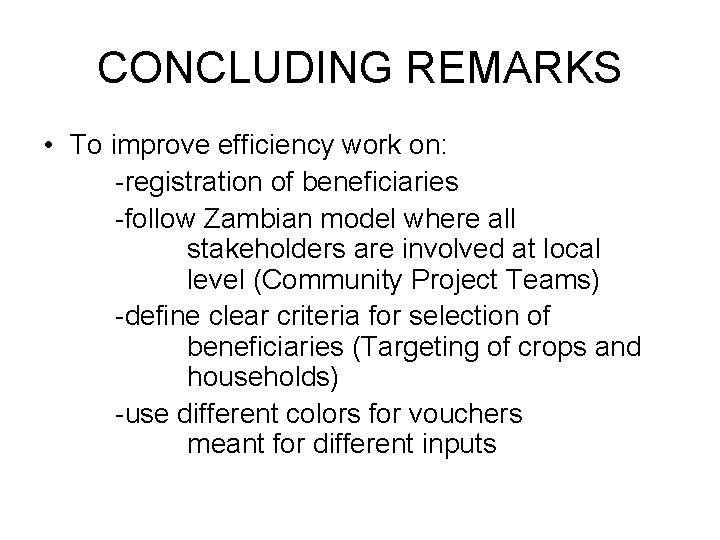
CONCLUDING REMARKS • To improve efficiency work on: -registration of beneficiaries -follow Zambian model where all stakeholders are involved at local level (Community Project Teams) -define clear criteria for selection of beneficiaries (Targeting of crops and households) -use different colors for vouchers meant for different inputs
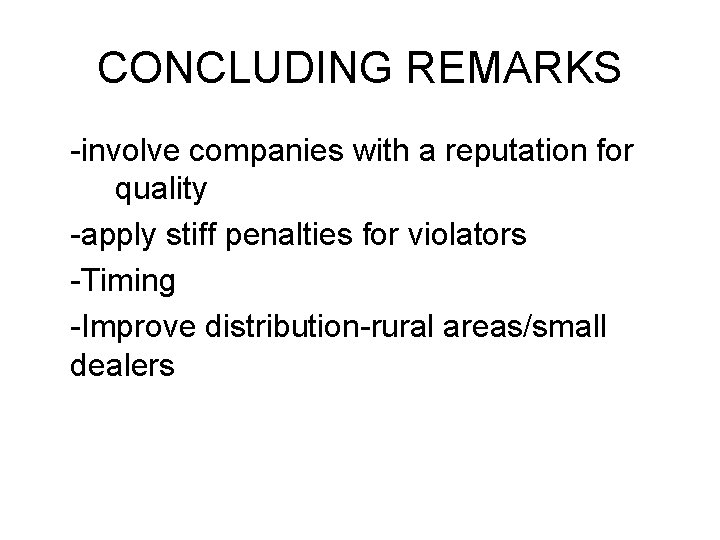
CONCLUDING REMARKS -involve companies with a reputation for quality -apply stiff penalties for violators -Timing -Improve distribution-rural areas/small dealers
RECOMMENDATION TO FANRPAN • Assess sustainability of the voucher system – Exit strategy – Link to agroforestry • Document best practices • Distribution -Rural areas -small dealers • Quantify the benefits
ACKNOWLEDGEMENT • Regional Center for Southern Africa, US Agency for International Development • FANRPAN • DR Douglas Merrey • MR R. Kachule and Mr T. Chilongo (Malawi) • Dr Emilio Tostao (Mozambique) • Dr T. Kalinda and M. Simfukwe (Zambia)