
THE POTENTIAL OF URBAN GREEN SPACES TO FACE
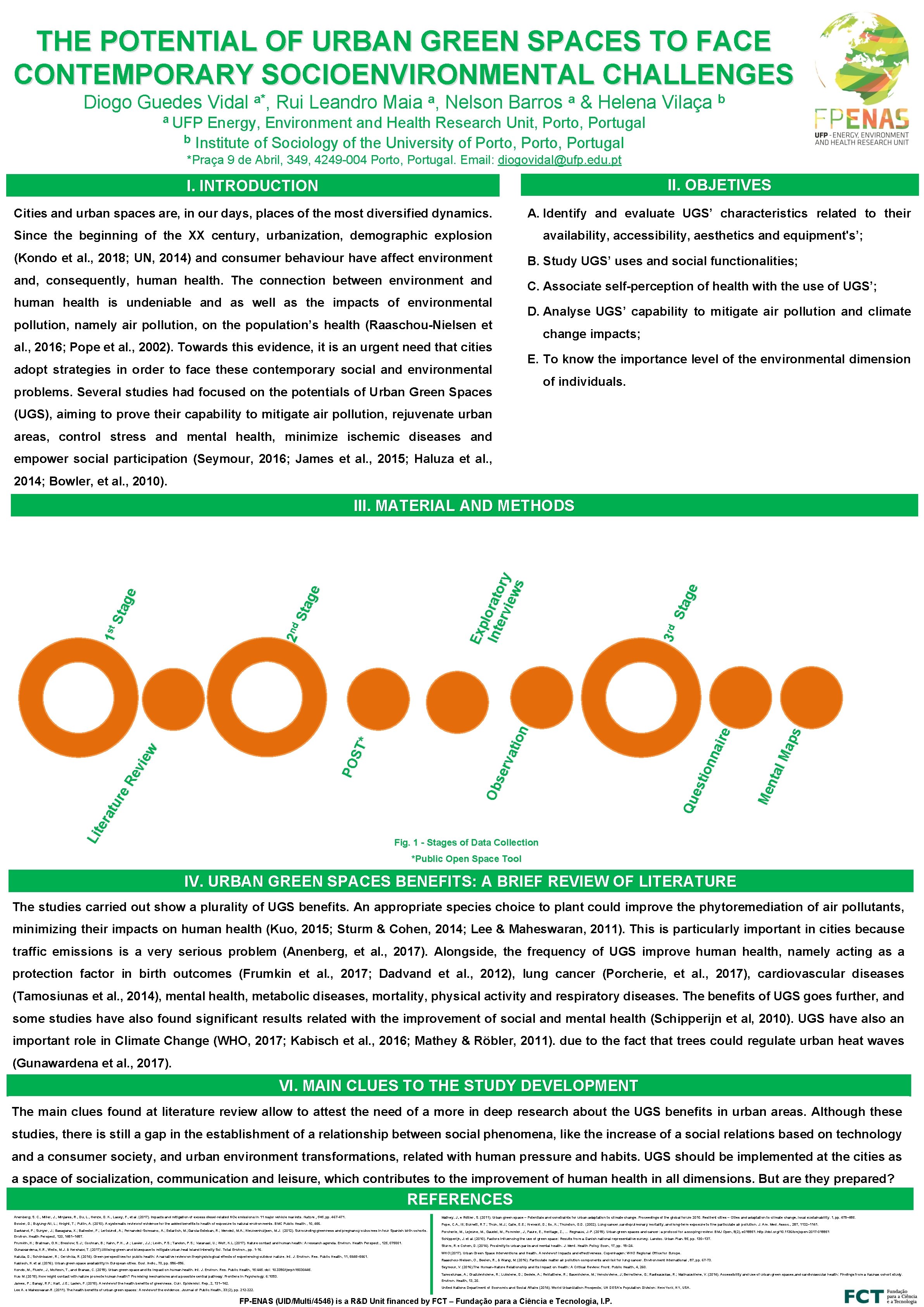
THE POTENTIAL OF URBAN GREEN SPACES TO FACE CONTEMPORARY SOCIOENVIRONMENTAL CHALLENGES Diogo Guedes Vidal a*, Rui Leandro Maia a, Nelson Barros a & Helena Vilaça b a UFP Energy, Environment and Health Research Unit, Porto, Portugal b Institute of Sociology of the University of Porto, Portugal *Praça 9 de Abril, 349, 4249 -004 Porto, Portugal. Email: diogovidal@ufp. edu. pt I. INTRODUCTION II. OBJETIVES Cities and urban spaces are, in our days, places of the most diversified dynamics. A. Identify and evaluate UGS’ characteristics related to their Since the beginning of the XX century, urbanization, demographic explosion availability, accessibility, aesthetics and equipment's’; (Kondo et al. , 2018; UN, 2014) and consumer behaviour have affect environment B. Study UGS’ uses and social functionalities; and, consequently, human health. The connection between environment and C. Associate self-perception of health with the use of UGS’; human health is undeniable and as well as the impacts of environmental pollution, namely air pollution, on the population’s health (Raaschou-Nielsen et al. , 2016; Pope et al. , 2002). Towards this evidence, it is an urgent need that cities adopt strategies in order to face these contemporary social and environmental D. Analyse UGS’ capability to mitigate air pollution and climate change impacts; E. To know the importance level of the environmental dimension problems. Several studies had focused on the potentials of Urban Green Spaces of individuals. (UGS), aiming to prove their capability to mitigate air pollution, rejuvenate urban areas, control stress and mental health, minimize ischemic diseases and empower social participation (Seymour, 2016; James et al. , 2015; Haluza et al. , 2014; Bowler, et al. , 2010). Me nta l M aps 3 rd S tag e Qu est ion nai re Ob ser vat ion Lit er atu re R ev iew PO ST * 1 st Sta ge 2 nd St age Ex plo Int rato erv r iew y s III. MATERIAL AND METHODS Fig. 1 - Stages of Data Collection *Public Open Space Tool IV. URBAN GREEN SPACES BENEFITS: A BRIEF REVIEW OF LITERATURE The studies carried out show a plurality of UGS benefits. An appropriate species choice to plant could improve the phytoremediation of air pollutants, minimizing their impacts on human health (Kuo, 2015; Sturm & Cohen, 2014; Lee & Maheswaran, 2011). This is particularly important in cities because traffic emissions is a very serious problem (Anenberg, et al. , 2017). Alongside, the frequency of UGS improve human health, namely acting as a protection factor in birth outcomes (Frumkin et al. , 2017; Dadvand et al. , 2012), lung cancer (Porcherie, et al. , 2017), cardiovascular diseases (Tamosiunas et al. , 2014), mental health, metabolic diseases, mortality, physical activity and respiratory diseases. The benefits of UGS goes further, and some studies have also found significant results related with the improvement of social and mental health (Schipperijn et al, 2010). UGS have also an important role in Climate Change (WHO, 2017; Kabisch et al. , 2016; Mathey & Röbler, 2011). due to the fact that trees could regulate urban heat waves (Gunawardena et al. , 2017). VI. MAIN CLUES TO THE STUDY DEVELOPMENT The main clues found at literature review allow to attest the need of a more in deep research about the UGS benefits in urban areas. Although these studies, there is still a gap in the establishment of a relationship between social phenomena, like the increase of a social relations based on technology and a consumer society, and urban environment transformations, related with human pressure and habits. UGS should be implemented at the cities as a space of socialization, communication and leisure, which contributes to the improvement of human health in all dimensions. But are they prepared? REFERENCES Anenberg, S. C. , Miller, J. , Minjares, R. , Du, L. , Henze, D. K. , Lacey, F. , et al. (2017). Impacts and mitigation of excess diesel-related NOx emissions in 11 major vehicle markets. Nature , 545, pp. 467 -471. Mathey, J. , e Rößler, S. (2011). Urban green space – Potentials and constraints for urban adaptation to climate change. Proceedings of the global forum 2010. Resilient cities – Cities and adaptation to climate change, local sustainability. 1, pp. 479– 485. Bowler, D. ; Buyung-Ali, L. ; Knight, T. ; Pullin, A. (2010). A systematic review of evidence for the added benefits to health of exposure to natural environments. BMC Public Health , 10, 456. Pope, C. A. , III; Burnett, R. T. ; Thun, M. J. ; Calle, E. E. ; Krewski, D. ; Ito, K. ; Thurston, G. D. (2002). Lung cancer, cardiopulmonary mortality, and long-term exposure to fine particulate air pollution. J. Am. Med. Assoc. , 287, 1132– 1141. Dadvand, P. ; Sunyer, J. ; Basagana, X. ; Ballester, F. ; Lertxundi, A. ; Fernandez-Somoano, A. ; Estarlich, M. ; Garcia-Esteban, R. ; Mendez, M. A. ; Nieuwenhuijsen, M. J. (2012). Surrounding greenness and pregnancy outcomes in four Spanish birth cohorts. Porcherie, M. , Lejeune, M. , Gaudel, M. , Pommier, J. , Faure, E. , Heritage, Z. , … Regnaux, J. -P. (2018). Urban green spaces and cancer: a protocol for a scoping review. BMJ Open, 8(2), e 018851. http: //doi. org/10. 1136/bmjopen-2017 -018851 Environ. Health Perspect, 120, 1481– 1487. Schipperijn, J. et al. (2010). Factors influencing the use of green space: Results from a Danish national representative survey. Landsc. Urban Plan. 95, pp. 130– 137. Frumkin, H. ; Bratman, G. N. ; Breslow, S. J. ; Cochran, B. ; Kahn, P. H. , Jr. ; Lawler, J. J. ; Levin, P. S. ; Tandon, P. S. ; Varanasi, U. ; Wolf, K. L. (2017). Nature contact and human health: A research agenda. Environ. Health Perspect. , 125, 075001. Gunawardena, K. R. , Wells, M. J. & Kershaw, T. (2017). Utilising green and bluespace to mitigate urban heat island intensity Sci. Total Environ. , pp. 1 -16. Haluza, D. ; Schönbauer, R. ; Cervinka, R. (2014). Green perspectives for public health: A narrative review on thephysiological effects of experiencing outdoor nature. Int. J. Environ. Res. Public Health, 11, 5445– 5461. Kabisch, N. et al. (2016). Urban green space availability in European cities. Ecol. Indic. , 70, pp. 586– 596. Kondo, M. , Fluehr, J. , Mc. Keon, T. , and Branas, C. (2018). Urban green space and its impact on human health. Int. J. Environ. Res. Public Health, 15: 445. doi: 10. 3390/ijerph 15030445. Kuo M. (2015). How might contact with nature promote human health? Promising mechanisms and a possible central pathway. Frontiers in Psychology. 6: 1093. Sturm, R. e Cohen, D. (2014). Proximity to urban parks and mental health. J. Ment. Health Policy Econ, 17, pp. 19– 24. WHO (2017). Urban Green Space Interventions and Health. A review of impacts and effectiveness. Copenhagen: WHO Regional Office for Europe. Raaschou-Nielsen, O. , Beelen, R. , & Wang, M. (2016). Particulate matter air pollution components and risk for lung cancer. Environment International , 87, pp. 67 -73. Seymour, V. (2016). The Human–Nature Relationship and its impact on Health: A Critical Review. Front. Public Health, 4, 260. Tamosiunas, A. ; Grazuleviciene, R. ; Luksiene, D. ; Dedele, A. ; Reklaitiene, R. ; Baceviciene, M. ; Vencloviene, J. ; Bernotiene, G. ; Radisauskas, R. ; Malinauskiene, V. (2014). Accessibility and use of urban green spaces, and cardiovascular health: Findings from a Kaunas cohort study. Environ. Health, 13, 20. James, P. ; Banay, R. F. ; Hart, J. E. ; Laden, F. (2015). A review of the health benefits of greenness. Curr. Epidemiol. Rep, 2, 131– 142. Lee A. e Maheswaran R. (2011). The health benefits of urban green spaces: A review of the evidence. Journal of Public Health, 33 (2), pp. 212 -222. United Nations Department of Economic and Social Affairs (2014). World Urbanization Prospects; UN DESA’s Population Division: New York, NY, USA. FP-ENAS (UID/Multi/4546) is a R&D Unit financed by FCT – Fundação para a Ciência e Tecnologia, I. P.
- Slides: 1