
The Potential of Intranasal Light Therapy for brain
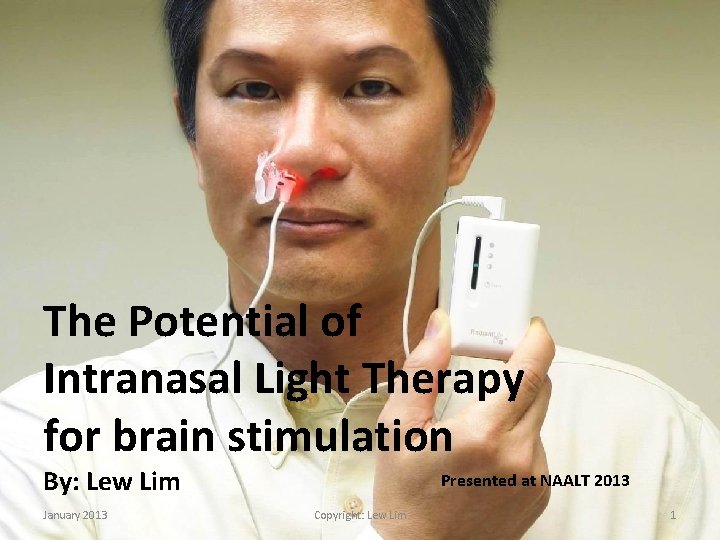
The Potential of Intranasal Light Therapy for brain stimulation By: Lew Lim January 2013 Presented at NAALT 2013 Copyright: Lew Lim 1
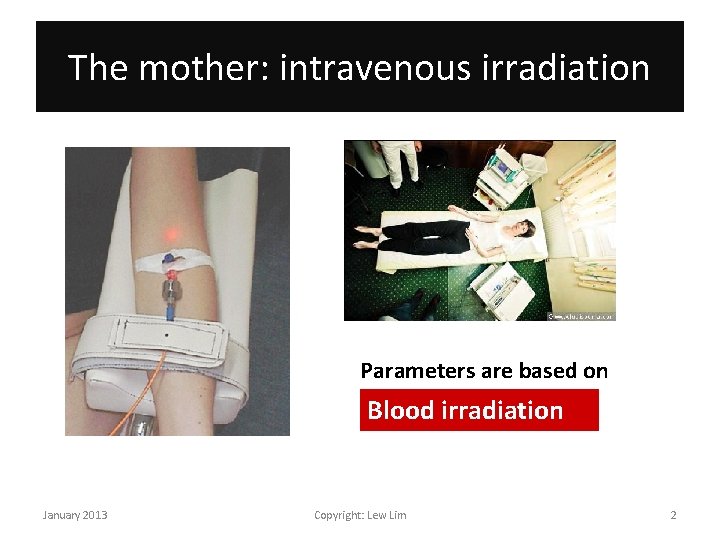
The mother: intravenous irradiation Parameters are based on Blood irradiation January 2013 Copyright: Lew Lim 2
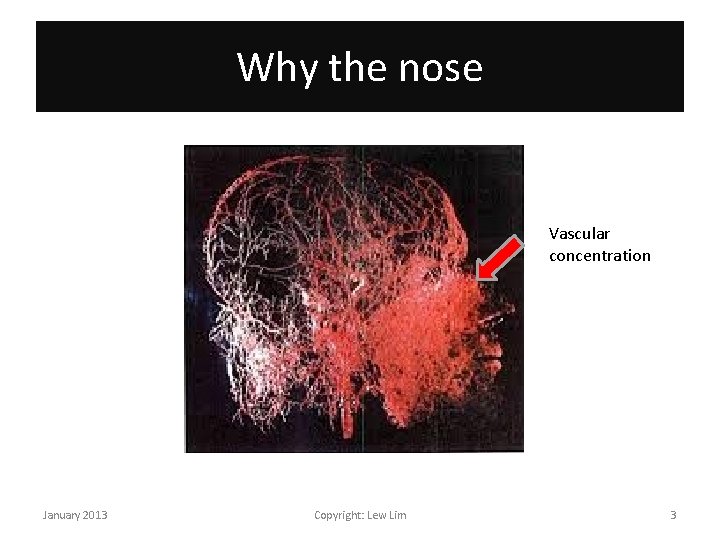
Why the nose Vascular concentration January 2013 Copyright: Lew Lim 3
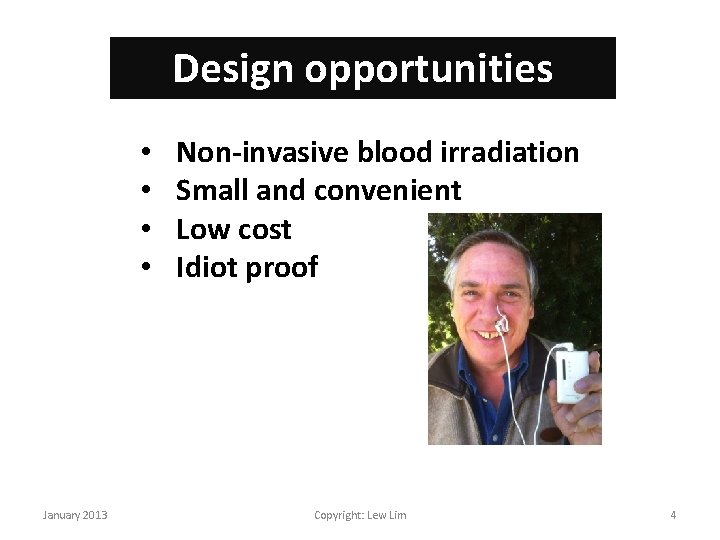
Design opportunities • • January 2013 Non-invasive blood irradiation Small and convenient Low cost Idiot proof Copyright: Lew Lim 4
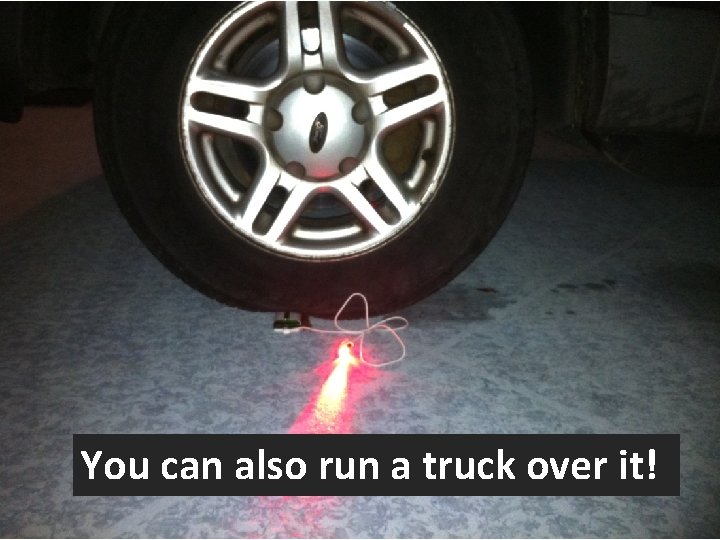
You can also run a truck over it! January 2013 Copyright: Lew Lim 5
It stimulates systemic homeostasis …and the body attempts to heal anything unprogrammed. January 2013 Copyright: Lew Lim 6
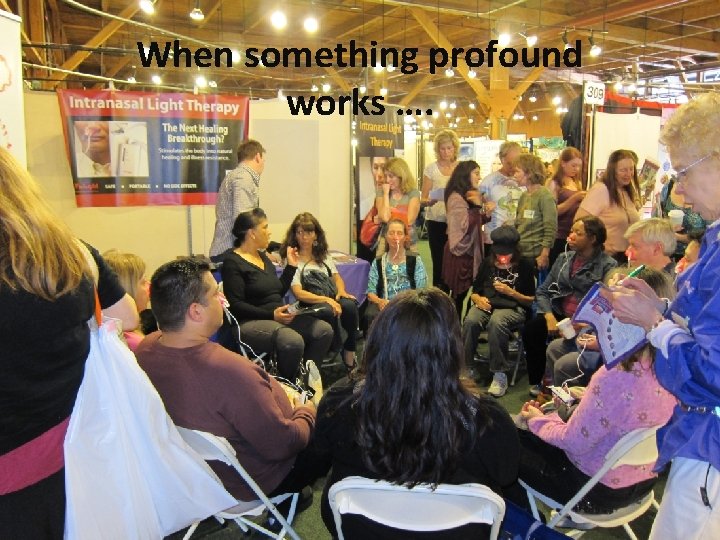
When something profound works …. January 2013 Copyright: Lew Lim 7
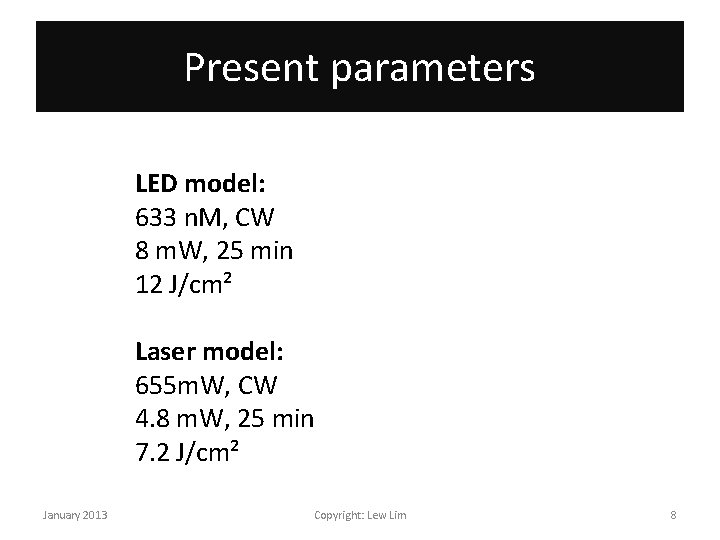
Present parameters LED model: 633 n. M, CW 8 m. W, 25 min 12 J/cm² Laser model: 655 m. W, CW 4. 8 m. W, 25 min 7. 2 J/cm² January 2013 Copyright: Lew Lim 8
Re-emphasis from blood irradiation to brain stimulation January 2013 Copyright: Lew Lim 9
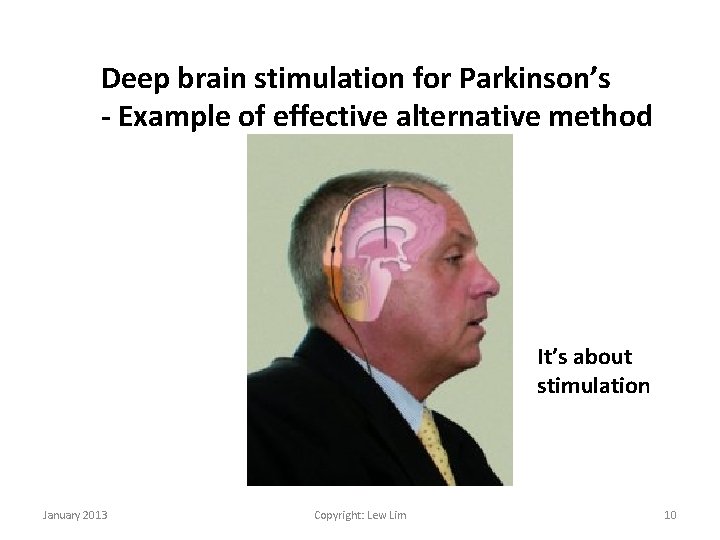
Deep brain stimulation for Parkinson’s - Example of effective alternative method It’s about stimulation January 2013 Copyright: Lew Lim 10
History of neurological evidence With present Intranasal Low Level Laser Therapy parameters • • • Facial pain, 1998 Intractable headache, 1998 Cerebral thrombosis, 1999 Parkinson’s disease, 1999 Alzheimer’s disease, 1999 Mild cognitive impairment, 2000 • • Insomnia, 2001 Post-stroke conditions, 2003 Migraine, 2003 Traumatic brain injury, 2003 Schizophrenia, 2000 Vascular dementia, 2005 Cerebral palsy, 2007 Can we still improve? January 2013 Copyright: Lew Lim 11
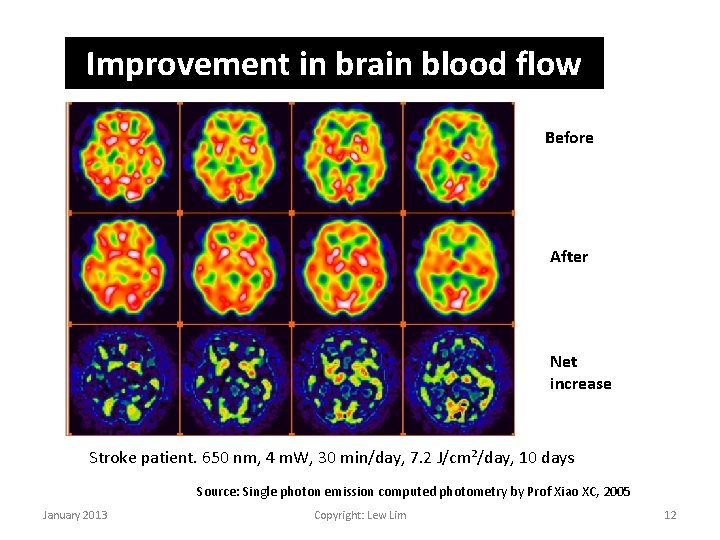
Improvement in brain blood flow Before After Net increase Stroke patient. 650 nm, 4 m. W, 30 min/day, 7. 2 J/cm²/day, 10 days Source: Single photon emission computed photometry by Prof Xiao XC, 2005 January 2013 Copyright: Lew Lim 12
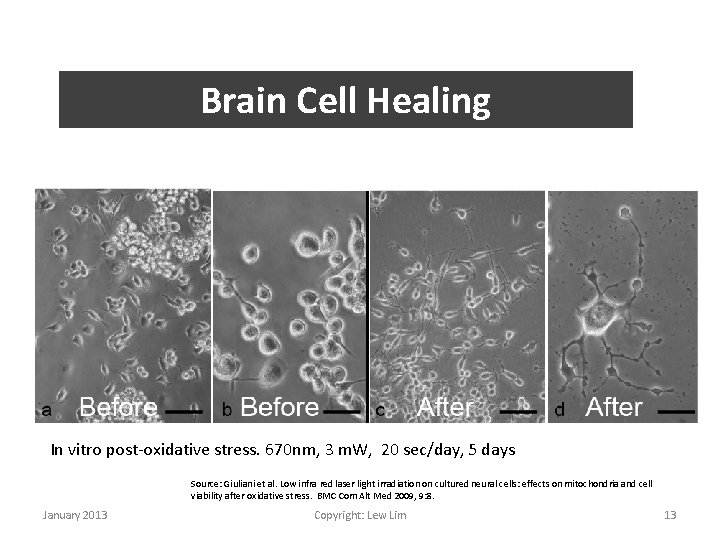
Brain Cell Healing In vitro post-oxidative stress. 670 nm, 3 m. W, 20 sec/day, 5 days Source: Giuliani et al. Low infra red laser light irradiation on cultured neural cells: effects on mitochondria and cell viability after oxidative stress. BMC Com Alt Med 2009, 9: 8. January 2013 Copyright: Lew Lim 13
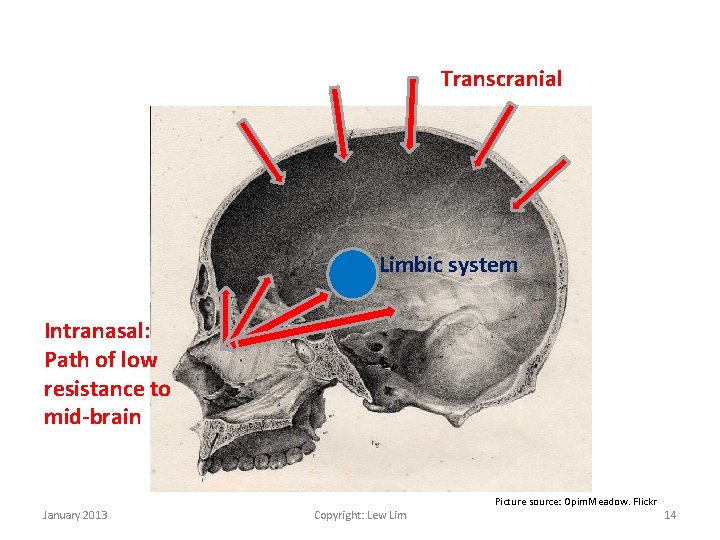
Transcranial Limbic system Intranasal: Path of low resistance to mid-brain January 2013 Copyright: Lew Lim Picture source: Opim. Meadow. Flickr 14
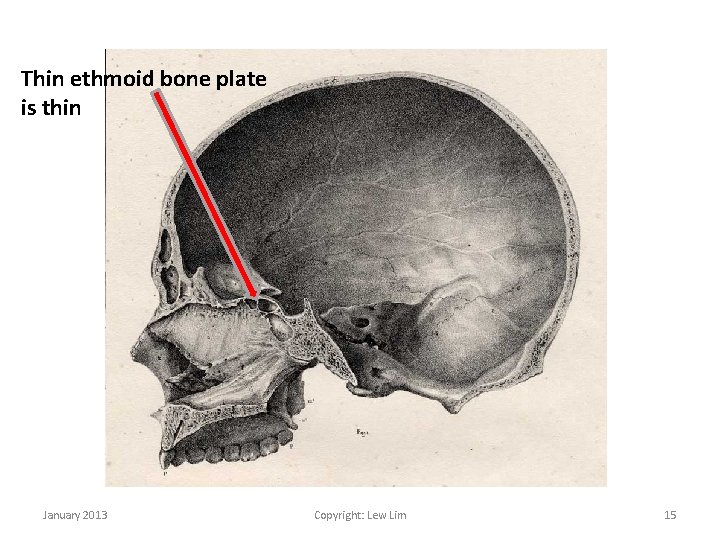
Thin ethmoid bone plate is thin January 2013 Copyright: Lew Lim 15

Opportunity for new parameters January 2013 Copyright: Lew Lim 16
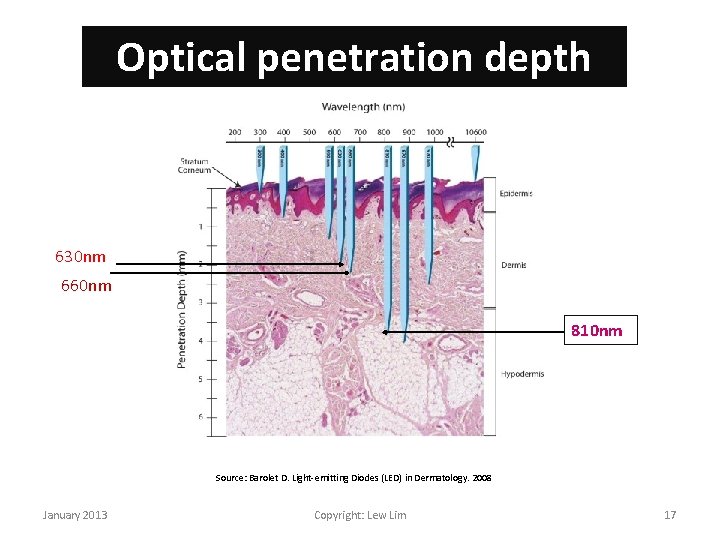
Optical penetration depth 630 nm 660 nm 810 nm Source: Barolet D. Light-emitting Diodes (LED) in Dermatology. 2008 January 2013 Copyright: Lew Lim 17
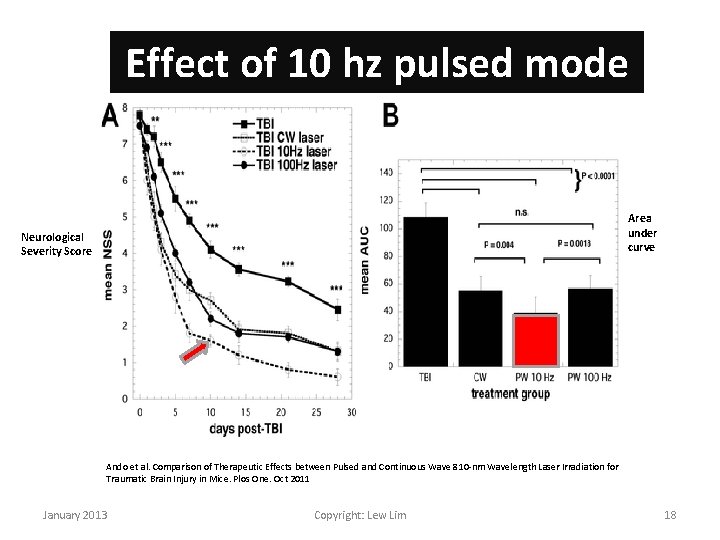
Effect of 10 hz pulsed mode Area under curve Neurological Severity Score Ando et al. Comparison of Therapeutic Effects between Pulsed and Continuous Wave 810 -nm Wavelength Laser Irradiation for Traumatic Brain Injury in Mice. Plos One. Oct 2011 January 2013 Copyright: Lew Lim 18
Deeper tissue travel may help with proximity to: • Substantia nigra for Parkinson’s • Subventricular zone for neurogenesis • Hypothalamus for homeostasis 10 Hz helps: • Greater neural response • Seratonin for depression • Alpha state 8 -12 Hz entrainment for an “ordered state” • Hippocampal theta state 5 -10 Hz: resonates with hippocampus for behavioral inhibition, attention, spatial memory Large beam footprint for: • Systemic response • Vascular dementia and Alzheimer’s January 2013 Copyright: Lew Lim 19
The “brain-effective” model 810 nm 10 m. W Pulsed: 10 Hz 50% duty cycle 25 min 7. 5 J/cm² post-duty cycle January 2013 Copyright: Lew Lim 20
Initial reports Enhanced neural response: • Improved cognitive performance • Enhanced post-stroke conditions • Parkinson’s disease condition better But more clinical investigations needed January 2013 Copyright: Lew Lim 21
Full paper available: http: //www. mediclights. com/brain-potential Presentation By: Lew Lim lewlim@mediclights. com January 2013 Copyright: Lew Lim 22
- Slides: 22