
THE POSTMORTEM Chapter 10 Introduction to Team Software
- Slides: 15
THE POSTMORTEM Chapter 10 Introduction to Team Software Process
Agenda • Why we need a Postmortem? • What a Postmortem can do for you? • The Process Improvement Proposal • The TSPi Postmortem Scripts
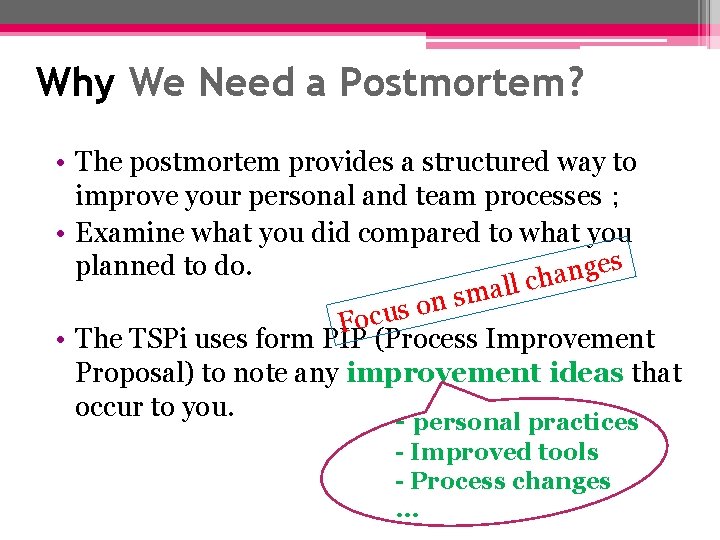
Why We Need a Postmortem? • The postmortem provides a structured way to improve your personal and team processes; • Examine what you did compared to what you s e planned to do. g n ha c l l a sm n o s Focu • The TSPi uses form PIP (Process Improvement Proposal) to note any improvement ideas that occur to you. - personal practices - Improved tools - Process changes …
Postmortem Process 1. Entry Criteria • The team has completed and tested the product. • The engineers have gathered all the data and completed all the required forms.
2. Review Process Data Quality/Process manager • Analyze project data & identify problem and improvement areas. • Examine the data on team & team members did • Identify where the process worked or did not. • Compare team’s performance with goals and plans. • Identify problem areas and needs for improvement. • Submit PIPs on these improvement suggestions.
3. Evaluate Role Performance Team leader leads the team in evaluating the effectiveness of the team roles: • Where they were effective • Where there is room for improvement.
4. Prepare Cycle-1 Report • Describe what you produced, the processes, the role you performed, work, not work, how to do better, your and team performance, lesson learned how to improve, compare with prior development ▫ Contents ▫ Summary ▫ Roles Reports
Team leader’s report • • • Team’s performance Motivational & commitment issues Meeting facilitation The practices were used, how worked and not. How to handle this role responsibility better in the future.
Development manager’s report • Compares the product content to the requirements and assesses the effectiveness of the dev strategy. • Strategy worked as expected, or what other might have been more effective • How should the strategy be changed?
Planning manager’s report • Team’s performance compared with the plan • Way to do better • Compare with prior cycle or other projects.
Quality/process manager’s report • Describe team performance with the quality goals • The quality trends for the development cycles completed to date. • PIP
Support manager’s report • Describe the support facilities and notes any problems • Suggests area of improvement • Comment on configuration management and change control procedures • How to handle better change tracking in handling risks • How the reuse strategy work? • Percent resue achieved by team and each engineer
Engineer’s report • Personal performance • Personal planning performance and the quality of the work you did. • How do better with specific data to support your conclusion. • Personal improvement on next cycle.
5. Prepare Role Evaluation • Each engineer completes an evaluation of the team and of each team role using form PEER. ▫ Provide an opportunity to recognize good work and suggest where role or tasks to improve.
6. Exit Criteria • The team has produced a high-quality product, together with all the required documentation. • The completed product is under configuration control. • The process data have been evaluated, and PIPs have been completed and submitted. • The role evaluations have been completed (PEER). • All TSPi forms have been completed. • The project notebook is updated.