
The Possible Adverse Consequences of Preemptive Nanotechnology Regulation
The Possible Adverse Consequences of Preemptive Nanotechnology Regulation John C. Monica, Jr. Porter Wright Morris & Arthur, L. L. P. Washington, D. C. www. nanolawreport. com Regulations for Nanotechnology in Consumer Products Intertech-Pira February 9, 2007
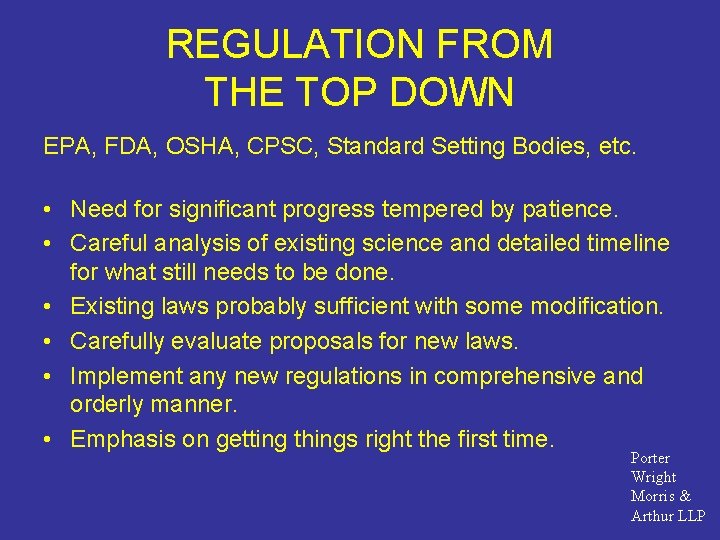
REGULATION FROM THE TOP DOWN EPA, FDA, OSHA, CPSC, Standard Setting Bodies, etc. • Need for significant progress tempered by patience. • Careful analysis of existing science and detailed timeline for what still needs to be done. • Existing laws probably sufficient with some modification. • Carefully evaluate proposals for new laws. • Implement any new regulations in comprehensive and orderly manner. • Emphasis on getting things right the first time. Porter Wright Morris & Arthur LLP
REGULATION FROM THE TOP DOWN Good Example: K. Florini, et al. , “Nanotechnology: Getting It Right the First Time, ” Nanotechnology Law & Business, February/March 2006, www. nanolabweb. com Porter Wright Morris & Arthur LLP
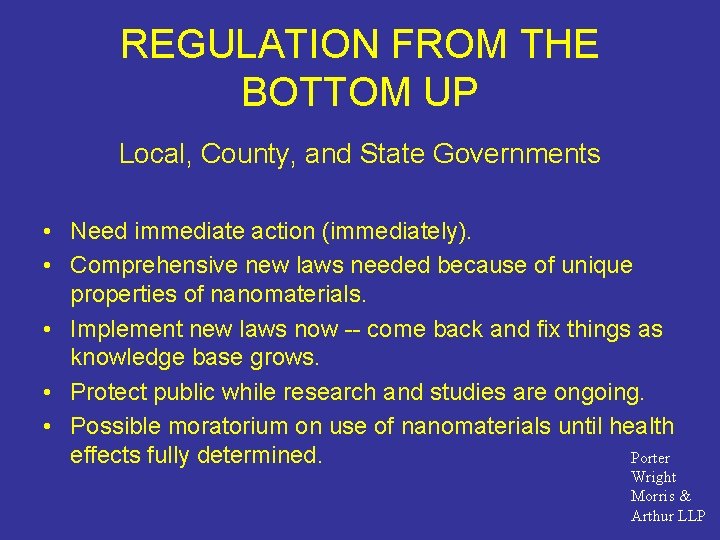
REGULATION FROM THE BOTTOM UP Local, County, and State Governments • Need immediate action (immediately). • Comprehensive new laws needed because of unique properties of nanomaterials. • Implement new laws now -- come back and fix things as knowledge base grows. • Protect public while research and studies are ongoing. • Possible moratorium on use of nanomaterials until health Porter effects fully determined. Wright Morris & Arthur LLP
Berkeley, California’s Nanomaterials Reporting and Handling Ordinance • • • First in the United States. Implemented out of impatience with federal government. Intent is that other governments will follow. Alleged input from nano-community. Viewed by its proponents as a “minimum” level of necessary regulation. Porter Wright Morris & Arthur LLP
Ordinance All facilities that manufacture or use manufactured nanoparticles shall submit a separate written disclosure of the current toxicology, to the extent known, and how the facility will safely handle, monitor, contain, dispose, track inventory, prevent release and mitigate such materials. . . All manufactured nanoparticles defined as a particle with one axis less than 100 nanometers in length, shall be reported in the disclosure plan. Porter Wright Morris & Arthur LLP
Issues 1. Definition of “nanoparticle. ” 2. Are toxicology reporting requirements reasonable? 3. Are materials handling requirements reasonable? 4. Should there be a minimum threshold requirement? 5. Why only “manufactured” nanoparticles? 6. Spawn litigation/chill business development? 7. Confidentiality concerns. Porter Wright Morris & Arthur LLP
1. Definition of Nanoparticle. All manufactured nanoparticles defined as a particle Ordinance: with one axis less than 100 nanometers in length. ASTM A sub-classification of ultrafine particles with lengths in two or three dimensions greater than 0. 001 micrometer (1 nanometer) and smaller than about 0. 1 micrometer (100 nanometers) and which may or may not exhibit size-related intensive property. Nat. Nano. Engineered nanomaterials are those that have been purposefully manufactured or synthesized Initiative to have a size with at least one dimension in the range of approximately 1 – 100 nm and that exhibit Porter Wright unique properties determined by this size Morris & Arthur LLP
2. Are toxicology reporting requirements reasonable? Ordinance: . . . shall submit a separate written disclosure of the current toxicology, to the extent known. . . Toxicology of what? • Actual particles v. Existing categories? • Cousins? • NIOSH Nanoparticle Information Library (NIL)? What type(s) of toxicology? Literature search? • ICON database sufficient? Conflicting data? • Report all? Helpful? • Exposure routes, subspecialties ? “To the extent known”. . . • New toxicology research necessary? • “to the extent already published” WHY? Porter Wright Morris & Arthur LLP
3. Are materials handling requirements reasonable? Ordinance: . . . how the facility will safely handle, monitor, contain, dispose, track inventory, prevent release and mitigate such materials. . . How to accomplish if toxicology still undecided? Precautionary principles – differences in approaches. Pharmaceutical model v. Traditional industrial hygiene model. What’s reasonable? Federal guidelines? Porter Wright Morris & Arthur LLP
4. Should there be a minimum threshold requirement? “Traditional” = 500 pds per year aggregate threshold (ex/ lead and mercury) v. All manufactured nanoparticles (in any amount) Porter Wright Morris & Arthur LLP
5. Why only “manufactured” nanoparticles? Manufactured v. Natural Incidental Engineered Porter Wright Morris & Arthur LLP
![6. Spawn litigation/chill business development? “[T]he proposed safety measures may protect the business from](http://slidetodoc.com/presentation_image/ba524f7be0da6eb3ddbe313eeb9b1028/image-13.jpg "6. Spawn litigation/chill business development? “[T]he proposed safety measures may protect the business from")
6. Spawn litigation/chill business development? “[T]he proposed safety measures may protect the business from potential health and safety liabilities. ” “No cost to the City because the. . . program reclaims all costs from the industry. ” “The cost to industry is minimal. . . unless it is shown that The nanoparticles in use are potentially harmful. . . ” Porter Wright Morris & Arthur LLP
7. Confidentiality concerns. Porter Wright Morris & Arthur LLP
CONCLUSIONS • Legitimate interest in public health. • Governments should tread lightly when imposing regulations. Seek industry, scientific, and legal input. • Carefully craft regulations to target reasonably foreseeable risks. • Primary focus on learning and understanding potential risks. • Preemptive strikes may do more harm than good. • In the meantime, manufacturers should take responsibility for the EHS implications of their products consistent with existing products liability law and existing government regulation. Porter Wright Morris & Arthur LLP
- Slides: 15