
The Positive and Negative Transfer of Chinese in
- Slides: 1
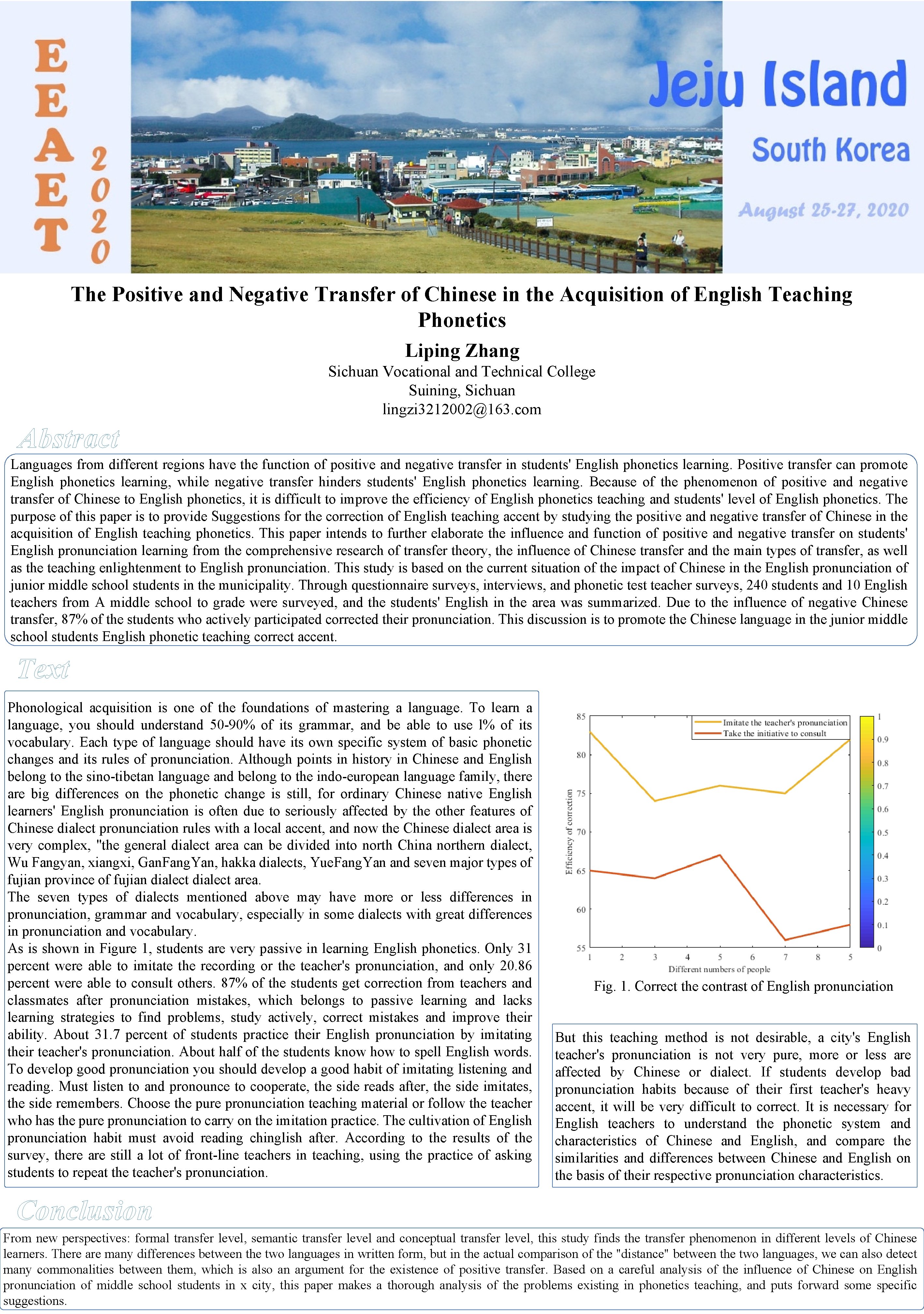
The Positive and Negative Transfer of Chinese in the Acquisition of English Teaching Phonetics Liping Zhang Sichuan Vocational and Technical College Suining, Sichuan lingzi 3212002@163. com Abstract Languages from different regions have the function of positive and negative transfer in students' English phonetics learning. Positive transfer can promote English phonetics learning, while negative transfer hinders students' English phonetics learning. Because of the phenomenon of positive and negative transfer of Chinese to English phonetics, it is difficult to improve the efficiency of English phonetics teaching and students' level of English phonetics. The purpose of this paper is to provide Suggestions for the correction of English teaching accent by studying the positive and negative transfer of Chinese in the acquisition of English teaching phonetics. This paper intends to further elaborate the influence and function of positive and negative transfer on students' English pronunciation learning from the comprehensive research of transfer theory, the influence of Chinese transfer and the main types of transfer, as well as the teaching enlightenment to English pronunciation. This study is based on the current situation of the impact of Chinese in the English pronunciation of junior middle school students in the municipality. Through questionnaire surveys, interviews, and phonetic test teacher surveys, 240 students and 10 English teachers from A middle school to grade were surveyed, and the students' English in the area was summarized. Due to the influence of negative Chinese transfer, 87% of the students who actively participated corrected their pronunciation. This discussion is to promote the Chinese language in the junior middle school students English phonetic teaching correct accent. Text Phonological acquisition is one of the foundations of mastering a language. To learn a language, you should understand 50 -90% of its grammar, and be able to use l% of its vocabulary. Each type of language should have its own specific system of basic phonetic changes and its rules of pronunciation. Although points in history in Chinese and English belong to the sino-tibetan language and belong to the indo-european language family, there are big differences on the phonetic change is still, for ordinary Chinese native English learners' English pronunciation is often due to seriously affected by the other features of Chinese dialect pronunciation rules with a local accent, and now the Chinese dialect area is very complex, "the general dialect area can be divided into north China northern dialect, Wu Fangyan, xiangxi, Gan. Fang. Yan, hakka dialects, Yue. Fang. Yan and seven major types of fujian province of fujian dialect area. The seven types of dialects mentioned above may have more or less differences in pronunciation, grammar and vocabulary, especially in some dialects with great differences in pronunciation and vocabulary. As is shown in Figure 1, students are very passive in learning English phonetics. Only 31 percent were able to imitate the recording or the teacher's pronunciation, and only 20. 86 percent were able to consult others. 87% of the students get correction from teachers and classmates after pronunciation mistakes, which belongs to passive learning and lacks learning strategies to find problems, study actively, correct mistakes and improve their ability. About 31. 7 percent of students practice their English pronunciation by imitating their teacher's pronunciation. About half of the students know how to spell English words. To develop good pronunciation you should develop a good habit of imitating listening and reading. Must listen to and pronounce to cooperate, the side reads after, the side imitates, the side remembers. Choose the pure pronunciation teaching material or follow the teacher who has the pure pronunciation to carry on the imitation practice. The cultivation of English pronunciation habit must avoid reading chinglish after. According to the results of the survey, there are still a lot of front-line teachers in teaching, using the practice of asking students to repeat the teacher's pronunciation. Fig. 1. Correct the contrast of English pronunciation But this teaching method is not desirable, a city's English teacher's pronunciation is not very pure, more or less are affected by Chinese or dialect. If students develop bad pronunciation habits because of their first teacher's heavy accent, it will be very difficult to correct. It is necessary for English teachers to understand the phonetic system and characteristics of Chinese and English, and compare the similarities and differences between Chinese and English on the basis of their respective pronunciation characteristics. Conclusion From new perspectives: formal transfer level, semantic transfer level and conceptual transfer level, this study finds the transfer phenomenon in different levels of Chinese learners. There are many differences between the two languages in written form, but in the actual comparison of the "distance" between the two languages, we can also detect many commonalities between them, which is also an argument for the existence of positive transfer. Based on a careful analysis of the influence of Chinese on English pronunciation of middle school students in x city, this paper makes a thorough analysis of the problems existing in phonetics teaching, and puts forward some specific suggestions.