
The Polygon AngleSum Theorems Lesson 3 5 Additional
- Slides: 5
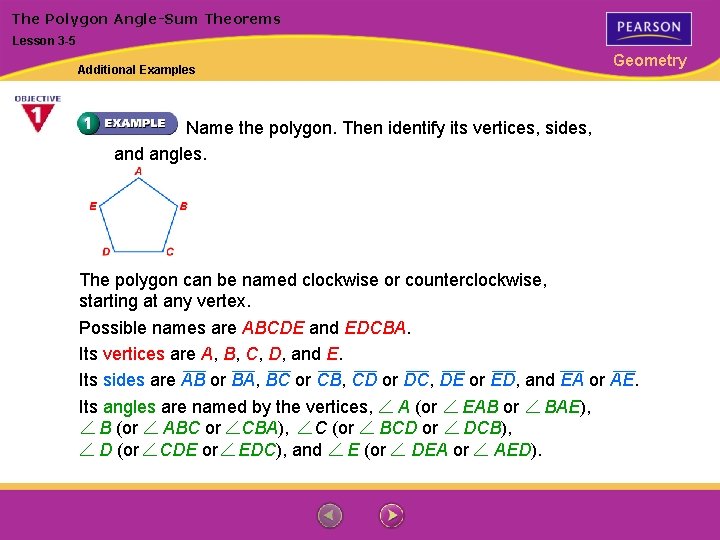
The Polygon Angle-Sum Theorems Lesson 3 -5 Additional Examples Geometry Name the polygon. Then identify its vertices, sides, and angles. The polygon can be named clockwise or counterclockwise, starting at any vertex. Possible names are ABCDE and EDCBA. Its vertices are A, B, C, D, and E. Its sides are AB or BA, BC or CB, CD or DC, DE or ED, and EA or AE. Its angles are named by the vertices, A (or EAB or BAE), B (or ABC or CBA), C (or BCD or DCB), D (or CDE or EDC), and E (or DEA or AED).
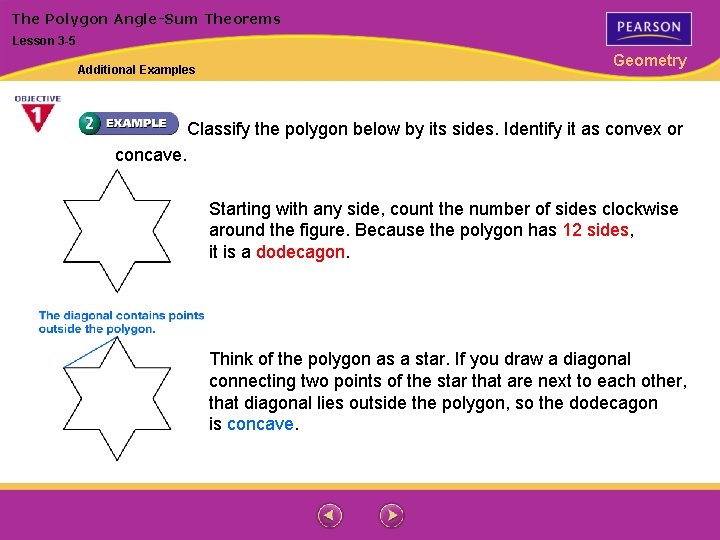
The Polygon Angle-Sum Theorems Lesson 3 -5 Additional Examples Geometry Classify the polygon below by its sides. Identify it as convex or concave. Starting with any side, count the number of sides clockwise around the figure. Because the polygon has 12 sides, it is a dodecagon. Think of the polygon as a star. If you draw a diagonal connecting two points of the star that are next to each other, that diagonal lies outside the polygon, so the dodecagon is concave.
The Polygon Angle-Sum Theorems Lesson 3 -5 Geometry Additional Examples Find the sum of the measures of the angles of a decagon. A decagon has 10 sides, so n = 10. Sum = (n – 2)(180) Polygon Angle-Sum Theorem = (10 – 2)(180) Substitute 10 for n. = 8 • 180 Simplify. = 1440
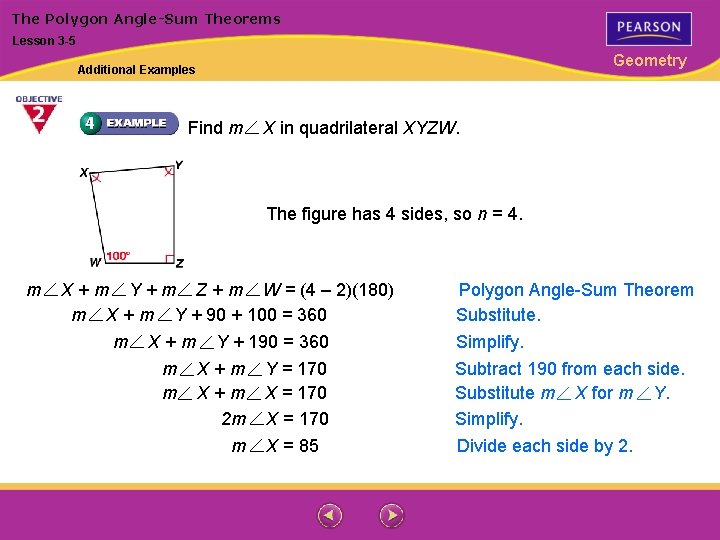
The Polygon Angle-Sum Theorems Lesson 3 -5 Geometry Additional Examples Find m X in quadrilateral XYZW. The figure has 4 sides, so n = 4. m X + m Y + m Z + m W = (4 – 2)(180) m X + m Y + 90 + 100 = 360 m X+m m m Y + 190 = 360 X+m 2 m m Y = 170 X = 85 Polygon Angle-Sum Theorem Substitute. Simplify. Subtract 190 from each side. Substitute m X for m Y. Simplify. Divide each side by 2.
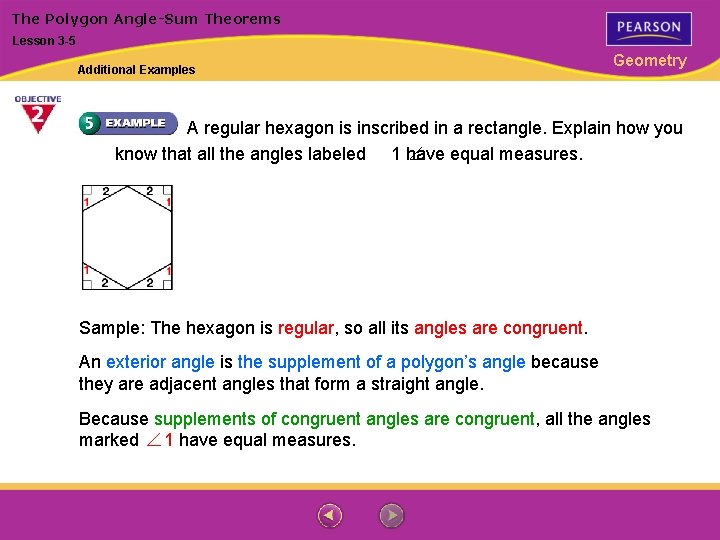
The Polygon Angle-Sum Theorems Lesson 3 -5 Additional Examples Geometry A regular hexagon is inscribed in a rectangle. Explain how you know that all the angles labeled 1 have equal measures. Sample: The hexagon is regular, so all its angles are congruent. An exterior angle is the supplement of a polygon’s angle because they are adjacent angles that form a straight angle. Because supplements of congruent angles are congruent, all the angles marked 1 have equal measures.