
The Political Psychology of International Security and Conflict
- Slides: 20
The Political Psychology of International Security and Conflict
• International security and conflict • Causes of war, the security dilemma, and deterrence
Why violence and war? • Different explanations • Some look at the biology to suggest that mankind was genetically predisposed to be innately violent • Others suggests that human aggression was more of a socially learned responses • General consensus: “most serious students of human violence recognize some mixture of innate predisposition (which may vary with individuals) and situational conditions”
• Explanation of conflicts in political science: • psychological factors • Role of perception and misperception between leaders of states in causing or avoiding international conflicts • Problems of successful crisis management, given leader psychology or organizational limitations as a factor in avoidance of war • Dynamics and composition of policy making groups themselves have been suggested to play a major role in averting or causing conflict • Personality and characteristics of leaders have also been suggested to play a role in causing or preventing conflicts
• Earliest exposition of the causes of political violence is found in Thucydides’ History of the Peloponnesian War • Power struggle between the neighboring Greek states of Sparta and Athens over 3, 000 years ago • Thucydides has been described as first “realist” (also first political psychologist)due to his attention to the anarchic, self-help nature of the ancient Greek international system, competition of power, alliance and influence, lack of morality in the affairs of states • Competition between states for power often leads conflict
• Enemy image: speeches by the leaders of Sparta and Athens were replete with immensely negative stereotypes and caricatures of one another • Driven by perception and misperception of each other • The psychology of fear and misperception were at work, leading both nations to disastrous blood-bath • After 23 year struggle they were easily conquered by the Persians • They needed to be allies and pool their military power to offset the might of Persia, neither side was making rational calculations of the regional power balance • Psychological factors underlying the causes of the war
• WWI: importance of psychological variables in explaining conflicts • Misperception (fear) by leaders played a major role (other factors: military alliances, great power competition over colonies and naval forces, etc. ) • Security dilemma: a situation in which the actions taken by each state to increase its own security had the effect of simultaneously decreasing the security of its neighbors. • Uncertainty, each state left to make decisions based solely upon their beliefs about neighbors’ motivations and capabilities
Security dilemma • What is perceived to be (either correctly or incorrectly) a threatening international security environment, national leaders take actions they perceive to be “defensive” ones (such as arms buildups, increased defense spending, fortification of borders, development of national missile defenses, etc) to protect themselves from these external threats • Knowing that their won motivations are peaceful, these leaders tend to make the assumption that their true intentions are clear to all of their neighbors. • However, unlike relatively unthreatening steps that a homeowner might take to enhance the security of his/her own house from burglars (installing alarms or building guard dog) equivalent actions taken by states to enhance their security vis-à-vis other states require the building of more imposing militaries of defense, actions that inevitably undermine the security of their neighbors
• Policy makers struggling to understand the psychology of their potential opponents (and their real policy intentions) is that they become trapped in a cycle of trying to divine intentions based solely upon visible indicators of behaviors (size of militaries, where they were located) • In real world of security you cannot judge an opponent’s true military intentions based solely upon their capabilities, military weapons can be employed either defensively or offensively • National missile defence (NMD) programs, defensive/offenisve
• Policy makers pursuing what they believed to be purely (or defensive military buildups often failed to understand how their actions were likely to be perceived misperceived) by neighboring states • The Cold War classic example of the security dilemma in action
• Perceptions are issues of attribution • How we tend to psychologically assign cause and effect relationship to our environment • Attribution theory: focus on how people judge and evaluate others • People process information and they search for cause in the behavior of others
• Fundamental attribution error: our tendency to explain (or attribute) another person’s behavior or actions in their dispositional qualities (personalities, motivations) rather than situational factors in the environment that may have caused the behavior • U. S policy makers during the Cold War tended to explain Soviet’s military buildup and forward deployment of forces in Eastern Europe as being due to the dispositional qualities of Soviet leaders (Stalin or Khruschev’s aggressive intentions toward Western Europe), and not to situational factors (such as the formation of the NATO, concerns about another invasion from the West) that actually motivated the behavior
The Psychology of Deterrence • Deterrence is the threat by one political actor to take actions in response to another actor’s potential actions that would make the cost incurred far outweigh any possible benefits obtained by aggressor • During the cold War, superpowers sought to deter extreme threats to their national interest through nuclear deterrence or the threat to retaliate for such aggression by using nuclear weapons • Deterrence as use of threats to prevent someone from doing something • Nuclear deterrence- Mutual Assured Destruction (MAD)
• credibility, willingness to use power, communication • In order to for deterrence to function successfully , the actor seeking to deter an opponent must be able to effectively communicate to them, and deter has physical capability to carry out a threat and that threat has credibility
The effects of problem representation of “framing” upon perception and decision making in the security context • How policy makers frame of represent a given policy problem, option, or situation, in other words. How they perceive it, or see it as similar or dissimilar to previous events can be critically important in determining how they will behave when making decisions in a security setting
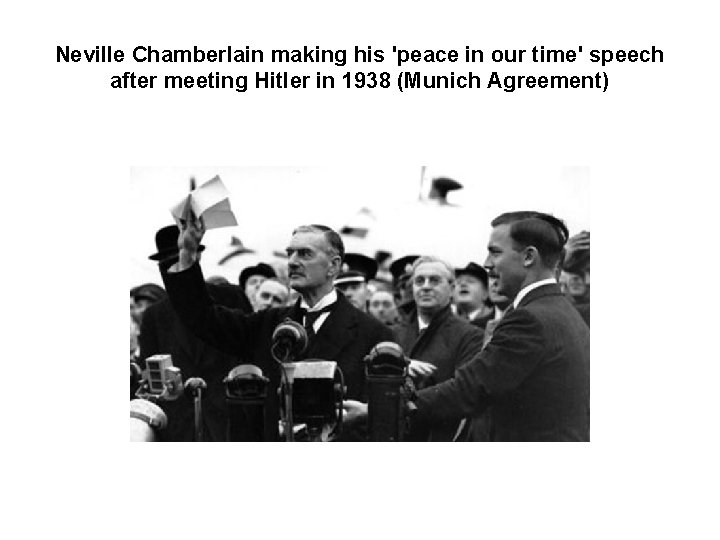
• Analogy (decision making heuristic, shortcut) which policy makers see a current event or situation as similar a previous historical event • Munich analogy • Munich Treaty (1938) is described as British Prime Minister Neville Chamberlain ’s ‘appeasement’ of Adolph Hitler, allow Germany to move east into Czechoslovakia which could not stop Hitler’s aggression and brought war to Europe following the Germany’s invasion of Poland (Treaty aim to satisfy Germany and brought peace) • Individuals uses Munich Analogy to underline that instead of appease the aggressor leader aggressor state must be stopped with immediate and decisive force to avoid another disastrous results following the Munich treaty.
Neville Chamberlain making his 'peace in our time' speech after meeting Hitler in 1938 (Munich Agreement)
• Kennedy’s use of the Guns of August analogy during the Cuban missile crisis in 1962 - analogy based upon the experience of the events leading up to the outbreak of WWI, led him to be far more cautious and mindful of his actions during the tense days of the crisis • Prospect theory, psychological model developed by Kahneman and Tversky (1979), theory predicts that individuals will tend to be risk averse in the domain of gains and risk everything in the domain of losses • Whether something is considered to be a gain or loss is determined relative to the original starting or reference point
Group dynamics and malfunctions of process • Malfunctions of group process or decision making under stress have often been suggested to increase likelihood of bad decisions or conflict • Groupthink
• Eight symptoms of group think • 1 - illusion of invulnerability: allow group members to feel confident in decision making • 2 - rationalization • 3 - beliefs in the inherent morality of the group • 4 -active use of stereotypes • 5 - use of direct pressure or dissenters • 6 - self-censorship • 7 - use of mindguards • 8 - the illusion of unanimity • Group malfunctions, leading to groupthink by senior decision makers led to a number of historical policy fiascoes such as Kenned administration's decision making surrounding the Bay of Pigs, decision by the Johnson administration to intervene in Vietnam in 1965.