
The Political Manipulation of Religion and Its Limits
- Slides: 8
The Political Manipulation of Religion and Its Limits: How Faith-Based Service Organizations Fit Into Policy Networks Michael D. Mc. Ginnis Professor, Political Science, Indiana University mcginnis@indiana. edu ASREC-SSSR, Tampa, Nov. 2, 2007 http: //php. indiana. edu/~mcginnis/tampapaper. doc
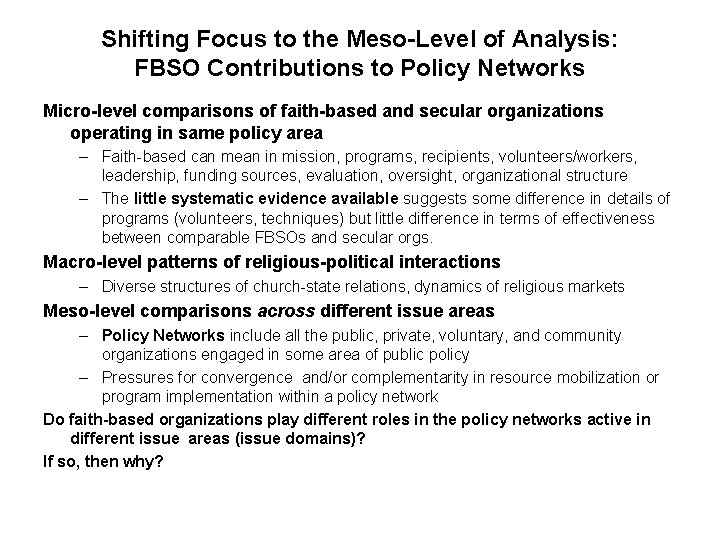
Shifting Focus to the Meso-Level of Analysis: FBSO Contributions to Policy Networks Micro-level comparisons of faith-based and secular organizations operating in same policy area – Faith-based can mean in mission, programs, recipients, volunteers/workers, leadership, funding sources, evaluation, oversight, organizational structure – The little systematic evidence available suggests some difference in details of programs (volunteers, techniques) but little difference in terms of effectiveness between comparable FBSOs and secular orgs. Macro-level patterns of religious-political interactions – Diverse structures of church-state relations, dynamics of religious markets Meso-level comparisons across different issue areas – Policy Networks include all the public, private, voluntary, and community organizations engaged in some area of public policy – Pressures for convergence and/or complementarity in resource mobilization or program implementation within a policy network Do faith-based organizations play different roles in the policy networks active in different issue areas (issue domains)? If so, then why?
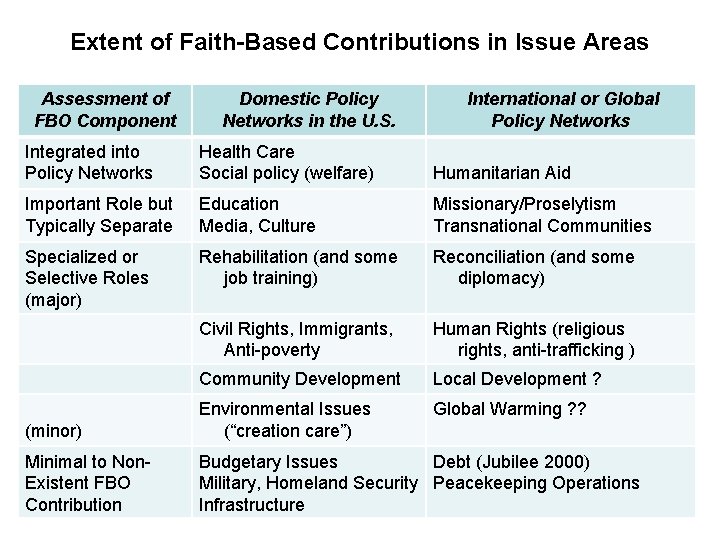
Extent of Faith-Based Contributions in Issue Areas Assessment of FBO Component Domestic Policy Networks in the U. S. International or Global Policy Networks Integrated into Policy Networks Health Care Social policy (welfare) Humanitarian Aid Important Role but Typically Separate Education Media, Culture Missionary/Proselytism Transnational Communities Specialized or Selective Roles (major) Rehabilitation (and some job training) Reconciliation (and some diplomacy) Civil Rights, Immigrants, Anti-poverty Human Rights (religious rights, anti-trafficking ) Community Development Local Development ? Global Warming ? ? (minor) Environmental Issues (“creation care”) Minimal to Non. Existent FBO Contribution Budgetary Issues Debt (Jubilee 2000) Military, Homeland Security Peacekeeping Operations Infrastructure
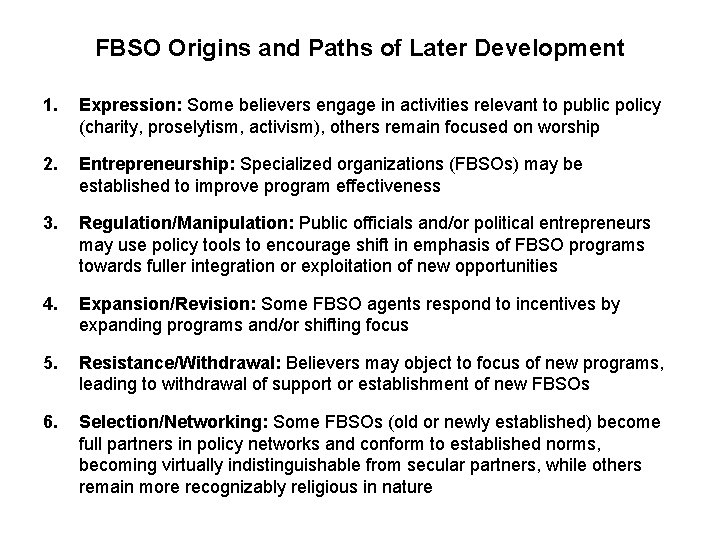
FBSO Origins and Paths of Later Development 1. Expression: Some believers engage in activities relevant to public policy (charity, proselytism, activism), others remain focused on worship 2. Entrepreneurship: Specialized organizations (FBSOs) may be established to improve program effectiveness 3. Regulation/Manipulation: Public officials and/or political entrepreneurs may use policy tools to encourage shift in emphasis of FBSO programs towards fuller integration or exploitation of new opportunities 4. Expansion/Revision: Some FBSO agents respond to incentives by expanding programs and/or shifting focus 5. Resistance/Withdrawal: Believers may object to focus of new programs, leading to withdrawal of support or establishment of new FBSOs 6. Selection/Networking: Some FBSOs (old or newly established) become full partners in policy networks and conform to established norms, becoming virtually indistinguishable from secular partners, while others remain more recognizably religious in nature
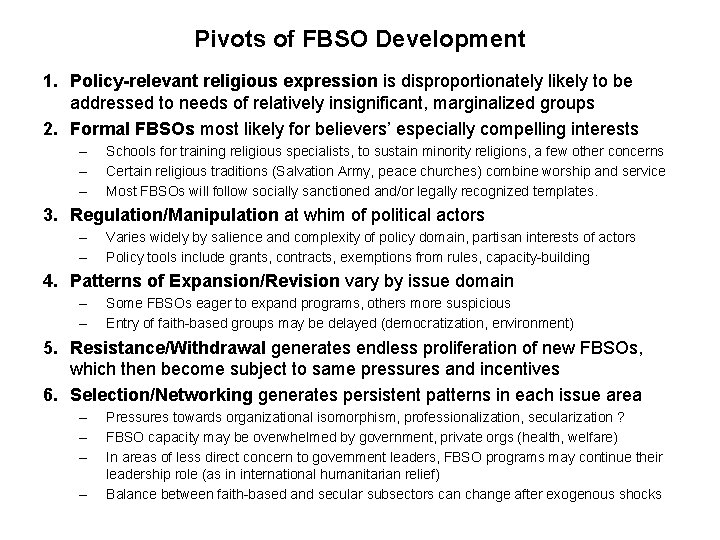
Pivots of FBSO Development 1. Policy-relevant religious expression is disproportionately likely to be addressed to needs of relatively insignificant, marginalized groups 2. Formal FBSOs most likely for believers’ especially compelling interests – – – Schools for training religious specialists, to sustain minority religions, a few other concerns Certain religious traditions (Salvation Army, peace churches) combine worship and service Most FBSOs will follow socially sanctioned and/or legally recognized templates. 3. Regulation/Manipulation at whim of political actors – – Varies widely by salience and complexity of policy domain, partisan interests of actors Policy tools include grants, contracts, exemptions from rules, capacity-building 4. Patterns of Expansion/Revision vary by issue domain – – Some FBSOs eager to expand programs, others more suspicious Entry of faith-based groups may be delayed (democratization, environment) 5. Resistance/Withdrawal generates endless proliferation of new FBSOs, which then become subject to same pressures and incentives 6. Selection/Networking generates persistent patterns in each issue area – – Pressures towards organizational isomorphism, professionalization, secularization ? FBSO capacity may be overwhelmed by government, private orgs (health, welfare) In areas of less direct concern to government leaders, FBSO programs may continue their leadership role (as in international humanitarian relief) Balance between faith-based and secular subsectors can change after exogenous shocks
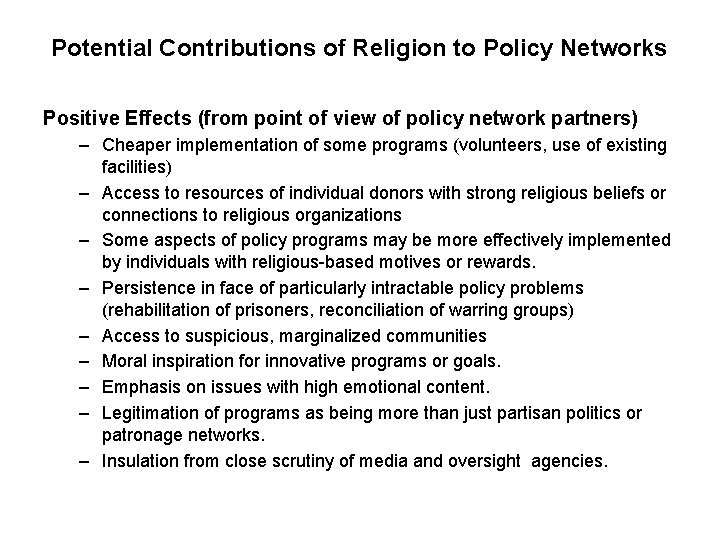
Potential Contributions of Religion to Policy Networks Positive Effects (from point of view of policy network partners) – Cheaper implementation of some programs (volunteers, use of existing facilities) – Access to resources of individual donors with strong religious beliefs or connections to religious organizations – Some aspects of policy programs may be more effectively implemented by individuals with religious-based motives or rewards. – Persistence in face of particularly intractable policy problems (rehabilitation of prisoners, reconciliation of warring groups) – Access to suspicious, marginalized communities – Moral inspiration for innovative programs or goals. – Emphasis on issues with high emotional content. – Legitimation of programs as being more than just partisan politics or patronage networks. – Insulation from close scrutiny of media and oversight agencies.
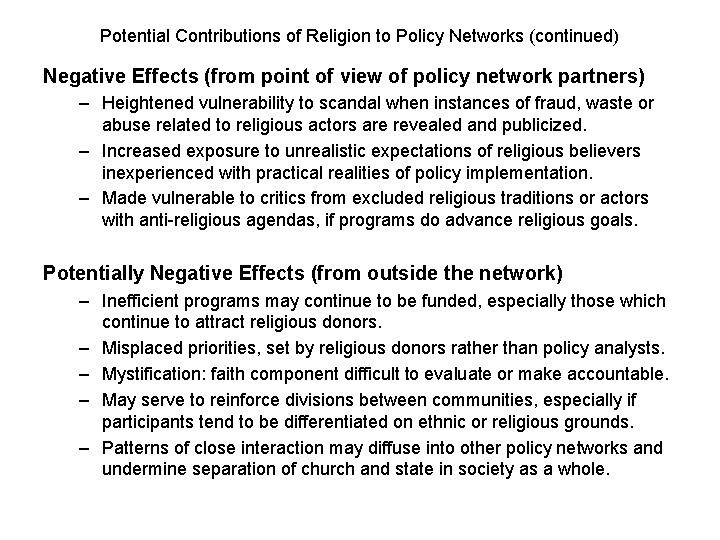
Potential Contributions of Religion to Policy Networks (continued) Negative Effects (from point of view of policy network partners) – Heightened vulnerability to scandal when instances of fraud, waste or abuse related to religious actors are revealed and publicized. – Increased exposure to unrealistic expectations of religious believers inexperienced with practical realities of policy implementation. – Made vulnerable to critics from excluded religious traditions or actors with anti-religious agendas, if programs do advance religious goals. Potentially Negative Effects (from outside the network) – Inefficient programs may continue to be funded, especially those which continue to attract religious donors. – Misplaced priorities, set by religious donors rather than policy analysts. – Mystification: faith component difficult to evaluate or make accountable. – May serve to reinforce divisions between communities, especially if participants tend to be differentiated on ethnic or religious grounds. – Patterns of close interaction may diffuse into other policy networks and undermine separation of church and state in society as a whole.
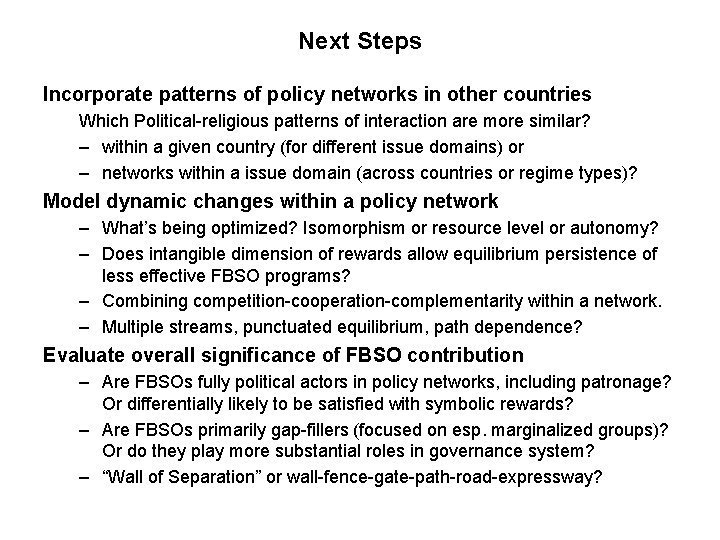
Next Steps Incorporate patterns of policy networks in other countries Which Political-religious patterns of interaction are more similar? – within a given country (for different issue domains) or – networks within a issue domain (across countries or regime types)? Model dynamic changes within a policy network – What’s being optimized? Isomorphism or resource level or autonomy? – Does intangible dimension of rewards allow equilibrium persistence of less effective FBSO programs? – Combining competition-cooperation-complementarity within a network. – Multiple streams, punctuated equilibrium, path dependence? Evaluate overall significance of FBSO contribution – Are FBSOs fully political actors in policy networks, including patronage? Or differentially likely to be satisfied with symbolic rewards? – Are FBSOs primarily gap-fillers (focused on esp. marginalized groups)? Or do they play more substantial roles in governance system? – “Wall of Separation” or wall-fence-gate-path-road-expressway?