
The Political Landscape Chapter 1 The Political Landscape









- Slides: 25
The Political Landscape Chapter 1
The Political Landscape • Key Terms (1) 1. Citizen 2. Conservative 3. Democracy 4. Liberal 5. monarchy 6. Natural law 7. Oligarchy 8. Politics 9. Republic 10. Totalitarianism
The Political Landscape • Textbook Assignment (1) – Using the websites on p. 29: • Look at the liberal and conservative websites. Find at least 3 items from each site that you agree with or disagree with and write why – www. conservative. org – www. liberaloasis. com
The Political Landscape • Notebook check 1 – Jan. 9, 2009 – – Key Terms (1) Assigned Readings (1) Textbook Assignment (1) Chapter 1 Notes
The Political Landscape • What is the purpose of government? – – To bring order to chaos To lead people To protect rights To interpret laws
The Political Landscape • What is the purpose of our government? – – – Establish justice Ensure domestic tranquility Provide for the common defense Promote the general welfare Secure the blessings of liberty
The Political Landscape • Individual states of the U. S. – State: a body of people in a defined territory, organized politically and having the power to make and enforce the law without the consent of higher authority – Characteristics of a state: • • Population Territory Sovereignty Government
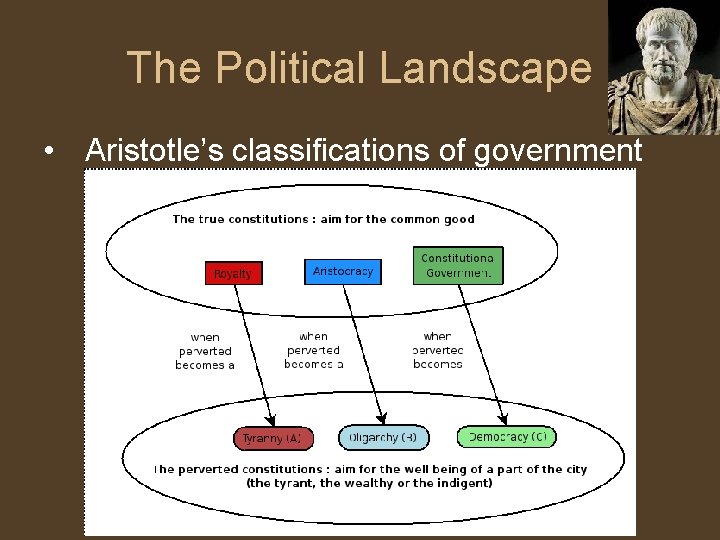
The Political Landscape • Aristotle’s classifications of government
The Political Landscape • Widely accepted theories on origins of the state – The Force Theory (not Obi Wan’s): A state was born of force, e. g. Primal man decided to force his will and rule upon others – Evolutionary Theory: A state gradually developed from families – clans
The Political Landscape • Widely accepted theories on origins of the state – Divine Right Theory: Belief that the rule of the king was God-given – Social Contract Theory: An agreement among individuals to unite and form a society in which members are governed by a set of rules
The Political Landscape • Democracy: – Greek = demos (people) + kratia (rule) – Supreme political authority rests with the people – People have sovereign power – Government is only conducted with the people’s consent
The Political Landscape • Democracy: – Direct – all citizens participate directly in the decisions of government – Indirect – citizens elect representatives to make decisions for them (republic)
The Political Landscape • Where does the power rest? – Unitary: All power in a central authority, e. g. Parliament – Federal: A division of power between a central and several local gov’ts, e. g. U. S. – Confederate: A loose alliance that gives power to a central authority
The Political Landscape • Oligarchy: – Rule of a few, determined by social status, wealth, military, or achievement
The Political Landscape • Our English Heritage – Magna Carta (1215): Establishes that the power of the king is not absolute – Petition of Rights (1628): Further limited the power of the king over political prisoners without the right to trial – English Bill of Rights (1689): Gave Parliament more power than the Monarchy
The Political Landscape • Our English Heritage – Thomas Hobbes: Argued that government was necessary to keep order and avoid chaos – John Locke: 1690 First and Second Treatises on Government – Right to life, liberty, property – Jean Rousseau: 1762 The Social Contract – People give up some freedom in favor of the needs of the majority – Baron de Montesquieu: Limit the power of the government, divide to make checks and balances
The Political Landscape • Albany Plan, Ben Franklin (1754) for the 13 Colonies – – Control Indian Affairs Raise an army Regulate trade Collect taxes
The Political Landscape • Characteristics of our democracy: – – – – Personal Liberty Equality Popular Consent / Majority Rule Popular Sovereignty Civil Society Individualism Religious Faith Changing Size and Population
The Political Landscape • To work, our democracy needs: – Recognition of the fundamental worth of each person – Respect for the equality of all persons – Majority rule and minority rights – Necessity of compromise – Individual freedoms, both from and to
The Political Landscape • Political Culture: – Attitudes toward the political system and its various parts; attitudes toward the role of the self in the system.
The Political Landscape • Changing face of America: – 18 th Century: Americans were united by one language and a yearning for personal freedoms – 19 th Century: Mass immigration periods – 20 th Century: Difficulty of a mixed society of very different cultures
The Political Landscape • Changing face of America: – Now, the 21 st Century: • Graying America, people living into older ages (Women 80, men 74) • Baby Boomers – Post WWII, 76. 8 Million • Generation X – mid 60’s to mid 70’s, 50 million • Generation Y – late 70’s to mid 90’s • See Figure 1. 4, p. 18
The Political Landscape • Affects on politics: – Political Ideology: An individual’s coherent set of values and beliefs about the purpose and scope of government • • • Conservatism: The belief that government is best when it governs least Liberalism: The belief that government involvement in daily life is necessary in protecting individual freedoms Libertarianism: One who favors a free market economy with no government interference in personal liberties
The Political Landscape • Key points of any election: – – – Abortion rights Environmental regulation Gun control Government and the poor School vouchers, education in general
The Political Landscape • Voter Apathy: – When the voter has no confidence in government and does not participate in an election. – What could cause this? End of Chapter 1