
The Political Economy of International Migration 1 Also
- Slides: 30
The Political Economy of International Migration (1) (Also World Bank continued) Benjamin Graham
Reading Quiz (1) • What is Caplan’s argument in the Vox article? • A. Migration should not be restricted • B. We should prioritize skilled laborers over family reunification when issuing visas • C. We should prioritize family reunification over specific skills when issuing visas • D. We should sharply limit migration to save the American way of life Lecture 21: The Political Economy of Migration (1) Benjamin Graham
Reading Quiz (2) • According to Carbaugh, what is a fear developing nations have regarding open immigration policies? • A. an increase in crime • B. Emigration-induced Dutch Disease • C. A shortage of unskilled labor • D. highly educated citizens leaving for wealthier countries • E. less regulation of imports Lecture 21: The Political Economy of Migration (1) Benjamin Graham
Reading Quiz (3) • What mechanism(s) reduce the negative impact of brain drain on developing countries? • A. The opportunity to emigrate increases incentives to acquire skills that are valued overseas • B. Most emigrants are disloyal to their homeland anyway • C. Many migrants send large remittances back home • D. Low skilled individuals are more likely than high-skilled individuals to emigrate • E. A & C • F. A, C, & D Lecture 21: The Political Economy of Migration (1) Benjamin Graham
The World Bank and Governance • Building capacity is the (relatively) easy part • Slow, difficult, painstaking, but uncontroversial • What about addressing corruption and accountability? • There is a paradox to external impositions of democracy and accountability Lecture 21: The World Bank Benjamin Graham
Sovereignty and the Limits of Conditionality • The World Bank has been running a land titling program in Cambodia • in 2009, the Boeung Kak lake development in the capital displaces thousands of families who are denied title under the program • Complaint filed with the World Bank • Bank withheld loans for five years trying to force resolution • Eventually the Bank gave up Lecture 21: The World Bank Benjamin Graham
Is the Bank overstepping its bounds? • Eminent domain is used all the time by governments to achieve development goals • Including in the U. S. • Is it right for the World Bank to decide whose property rights take precedent in Cambodia? Why or why not? Lecture 21: The World Bank Benjamin Graham
International Migration • Todays plan: • Terrorism and the future of open borders • Political economy of international migration: • Who wins and who loses • Who wields political power Lecture 21: The Political Economy of Migration (1) Benjamin Graham
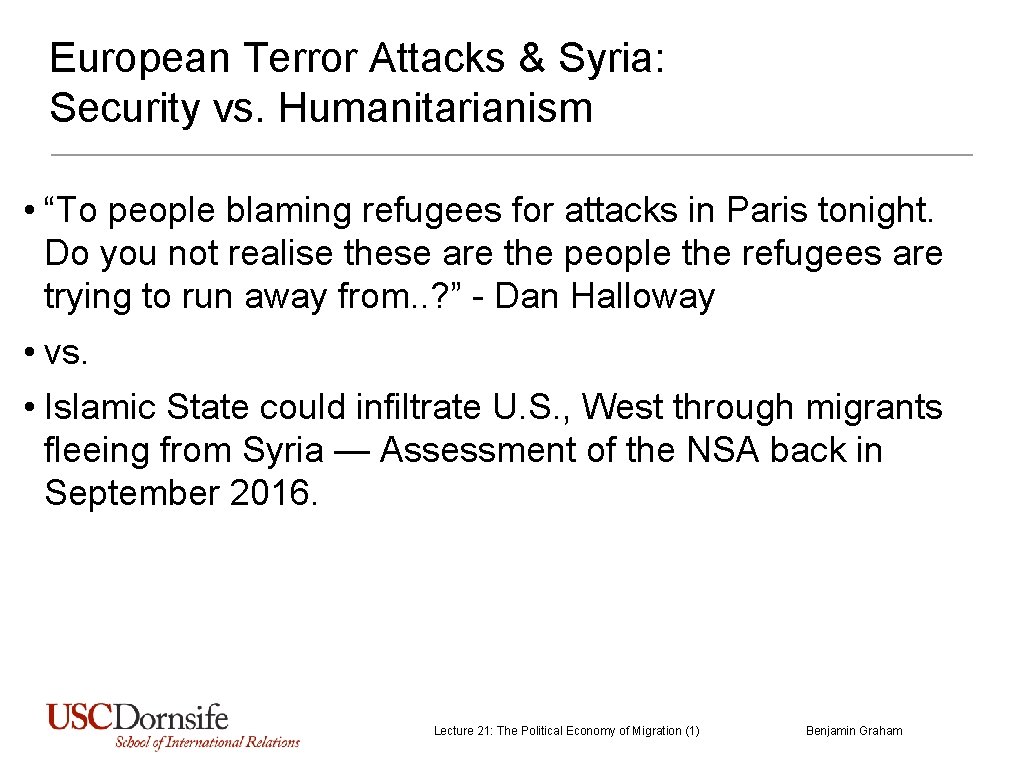
European Terror Attacks & Syria: Security vs. Humanitarianism • “To people blaming refugees for attacks in Paris tonight. Do you not realise these are the people the refugees are trying to run away from. . ? ” - Dan Halloway • vs. • Islamic State could infiltrate U. S. , West through migrants fleeing from Syria — Assessment of the NSA back in September 2016. Lecture 21: The Political Economy of Migration (1) Benjamin Graham
The Most Recent NYC Terror Attack • Attacker was from Uzbekistan • Entered via a “diversity lottery” visa Lecture 21: The Political Economy of Migration (1) Benjamin Graham
How much do you think terrorism fears should shape U. S. immigration policy? • A. It is the most important thing • B. A lot • B. Some. • C. A little • D. It is not important at all Lecture 21: The Political Economy of Migration (1) Benjamin Graham
Lecture 21: The Political Economy of Migration (1) Benjamin Graham
Review Question • What are three primary factors of production? • A. Land, Water, and Air • B. Iron, Wheat, and Oil • C. Transportation, Housing, and Manufacturing • D. Land, Labor, and Capital • E. Physical Capital, Human Capital, and Financial Capital Lecture 21: The Political Economy of Migration (1) Benjamin Graham
Moving Factors of Production • Comparative advantage is based on a country’s endowments of land, labor and capital • Land can’t move • Foreign investment is the movement of capital • International migration is the movement of labor Lecture 21: The Political Economy of Migration (1) Benjamin Graham
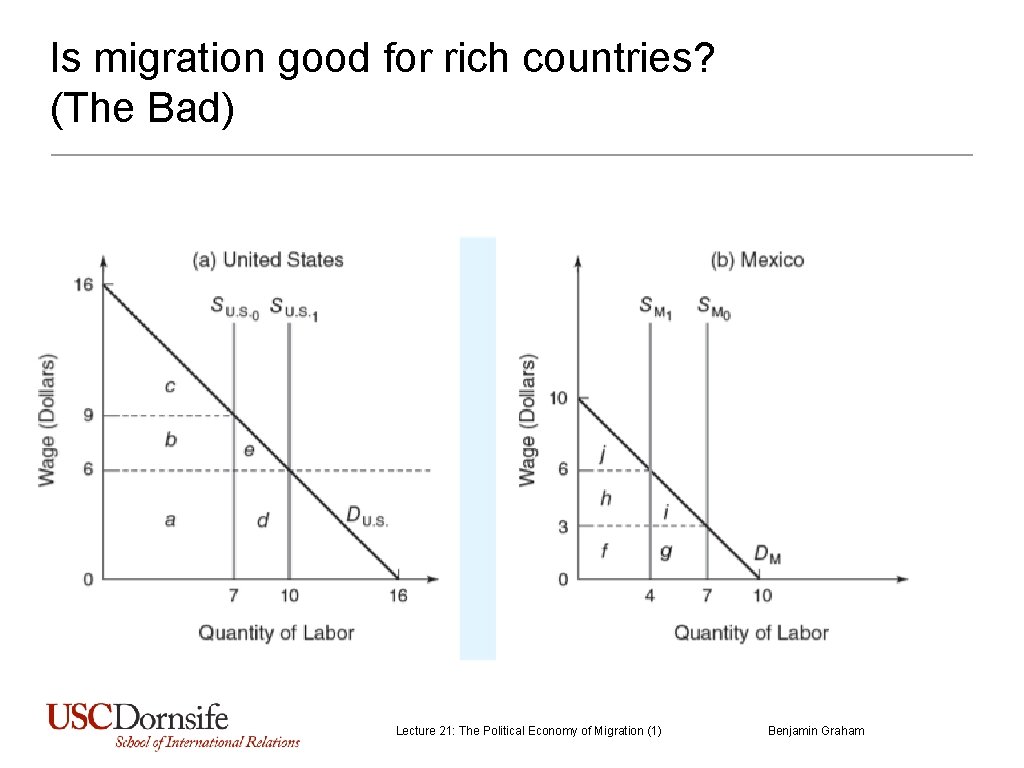
Reviewing Our Factor Endowment Story • Who loses when unskilled labor moves from poor countries to rich countries? • A. Skilled workers and capital owners in rich countries • B. Unskilled labor in rich countries and capital/land owners in poor countries • C. Capital/land owners in rich countries Lecture 21: The Political Economy of Migration (1) Benjamin Graham
Is migration good for migrants? • The wage ratio for a 35 -year old male with 9 years of education from Peru is 3. 8 • • He makes $21, 000 per year in the US if he immigrates If he stays in Peru, he makes $5500 per year • That is adjusted for purchasing power parity! • The ratio for Haiti is 7. 8 Lecture 21: The Political Economy of Migration (1) Benjamin Graham
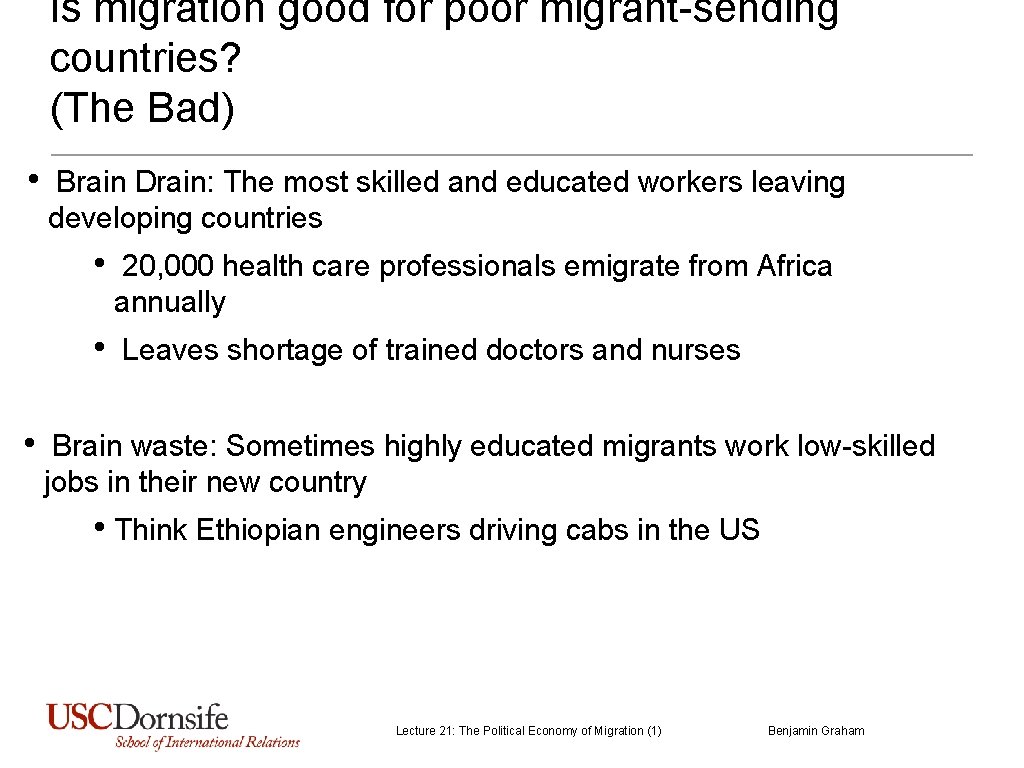
Is migration good for poor migrant-sending countries? (The Bad) • • Brain Drain: The most skilled and educated workers leaving developing countries • 20, 000 health care professionals emigrate from Africa annually • Leaves shortage of trained doctors and nurses Brain waste: Sometimes highly educated migrants work low-skilled jobs in their new country • Think Ethiopian engineers driving cabs in the US Lecture 21: The Political Economy of Migration (1) Benjamin Graham
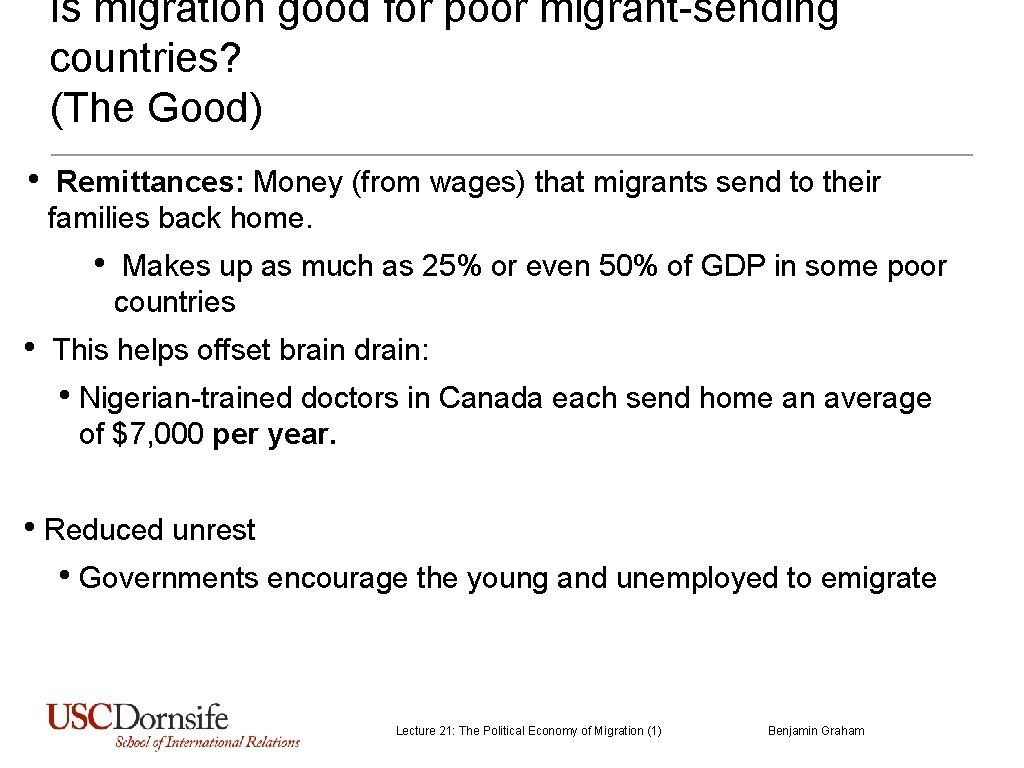
Is migration good for poor migrant-sending countries? (The Good) • Remittances: Money (from wages) that migrants send to their families back home. • • Makes up as much as 25% or even 50% of GDP in some poor countries This helps offset brain drain: • Nigerian-trained doctors in Canada each send home an average of $7, 000 per year. • Reduced unrest • Governments encourage the young and unemployed to emigrate Lecture 21: The Political Economy of Migration (1) Benjamin Graham
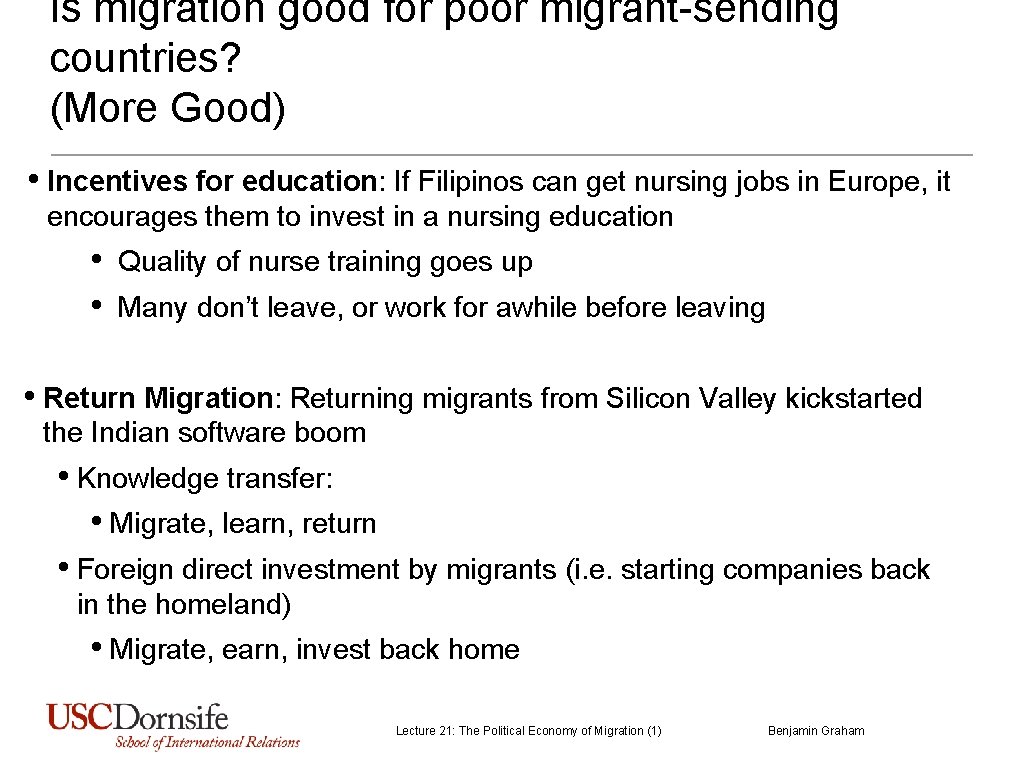
Is migration good for poor migrant-sending countries? (More Good) • Incentives for education: If Filipinos can get nursing jobs in Europe, it encourages them to invest in a nursing education • • Quality of nurse training goes up Many don’t leave, or work for awhile before leaving • Return Migration: Returning migrants from Silicon Valley kickstarted the Indian software boom • Knowledge transfer: • Migrate, learn, return • Foreign direct investment by migrants (i. e. starting companies back in the homeland) • Migrate, earn, invest back home Lecture 21: The Political Economy of Migration (1) Benjamin Graham
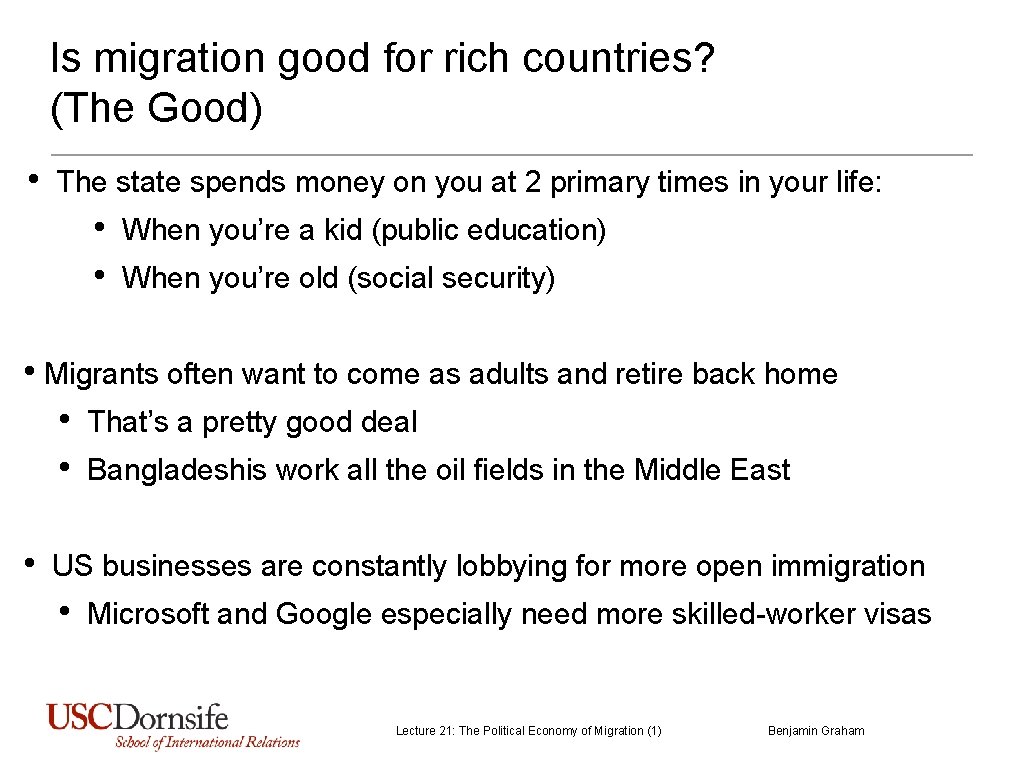
Is migration good for rich countries? (The Good) • The state spends money on you at 2 primary times in your life: • • When you’re a kid (public education) When you’re old (social security) • Migrants often want to come as adults and retire back home • That’s a pretty good deal • Bangladeshis work all the oil fields in the Middle East • US businesses are constantly lobbying for more open immigration • Microsoft and Google especially need more skilled-worker visas Lecture 21: The Political Economy of Migration (1) Benjamin Graham
Is migration good for rich countries? (The Bad) Lecture 21: The Political Economy of Migration (1) Benjamin Graham
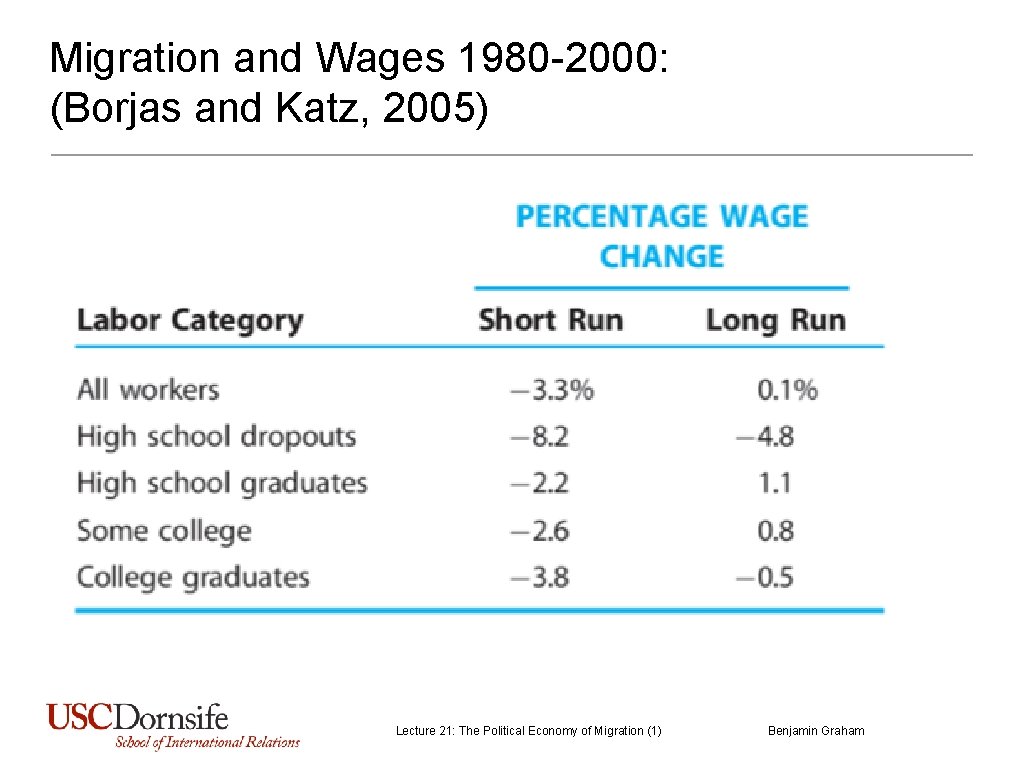
Migration and Wages 1980 -2000: (Borjas and Katz, 2005) Lecture 21: The Political Economy of Migration (1) Benjamin Graham
Here is a pro-immigration argument Lecture 21: The Political Economy of Migration (1) Benjamin Graham
Is migration good for rich countries? (The Bad) • Immigration into the U. S. increases inequality • Mostly because we let in very unskilled and very skilled workers, few people in the middle • Low skilled migrants reduce low-skilled wages • BUT: Migrants and non-migrants are not perfect substitutes, even at the same skill level • In total: 1980 -2000, immigration accounts for about 5% of the increase in inequality in the U. S. (Card 2009). Lecture 21: The Political Economy of Migration (1) Benjamin Graham
Is migration good for rich countries? (The Bad) • • What group(s) in the U. S. tend to oppose immigration? Why? Is unskilled labor in the U. S. politically powerful? • Why or why not? Lecture 21: The Political Economy of Migration (1) Benjamin Graham
And An Anti-immigration Ad Lecture 21: The Political Economy of Migration (1) Benjamin Graham
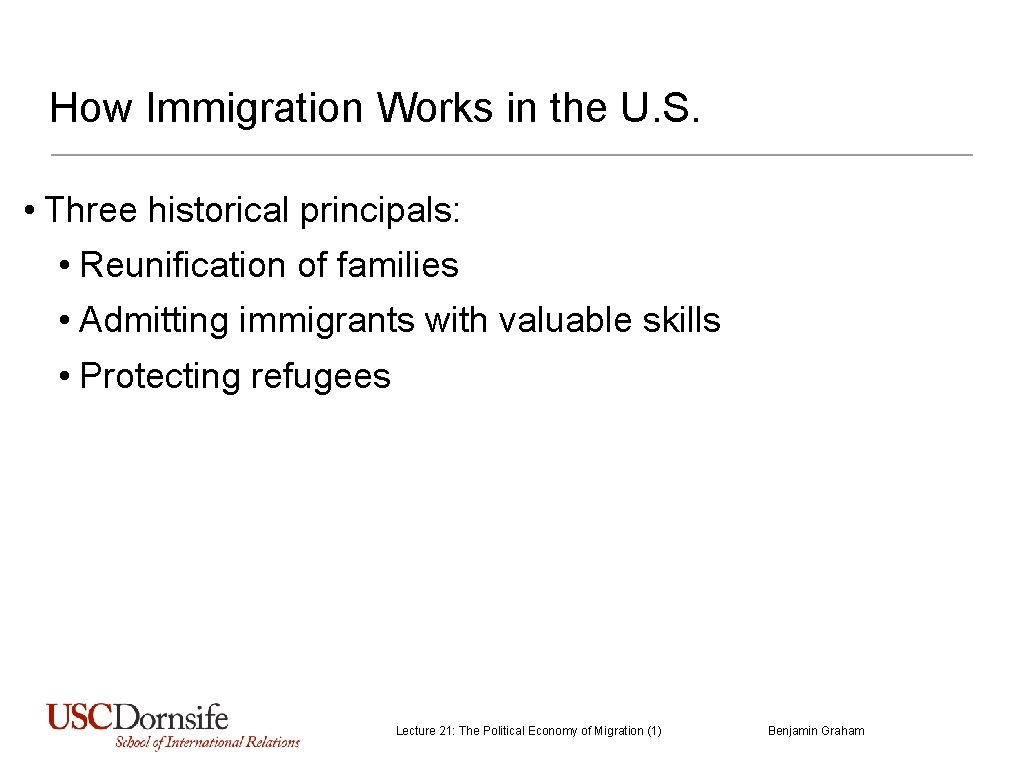
How Immigration Works in the U. S. • Three historical principals: • Reunification of families • Admitting immigrants with valuable skills • Protecting refugees Lecture 21: The Political Economy of Migration (1) Benjamin Graham
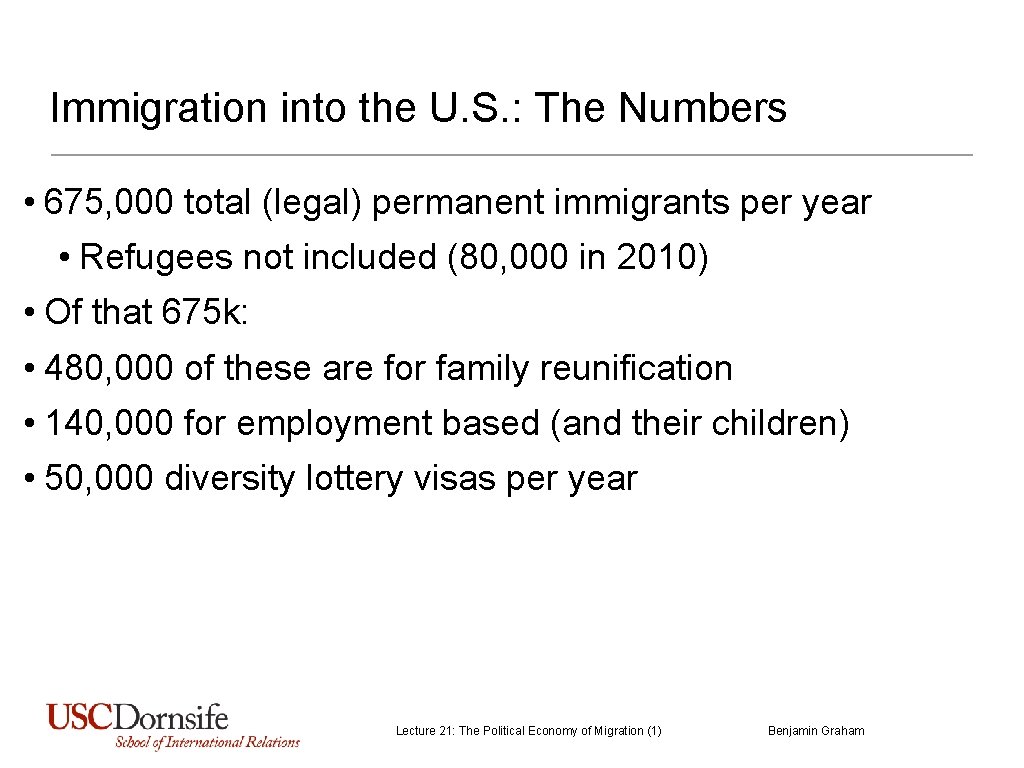
Immigration into the U. S. : The Numbers • 675, 000 total (legal) permanent immigrants per year • Refugees not included (80, 000 in 2010) • Of that 675 k: • 480, 000 of these are for family reunification • 140, 000 for employment based (and their children) • 50, 000 diversity lottery visas per year Lecture 21: The Political Economy of Migration (1) Benjamin Graham
Why Michael Clemens is My Hero • Careful, rigorous work quantifying the effects of migration on: • 1. Migrants themselves • 2. Migrants’ families • 3. Migrants’ countries of origin Lecture 21: The Political Economy of Migration (1) Benjamin Graham
A Question: • Why does capital move so much more freely than people? • Does this make sense? Lecture 21: The Political Economy of Migration (1) Benjamin Graham