
The political determinants of European Monetary System exchange



- Slides: 19
The political determinants of European Monetary System exchange rate realignments Cristina Bodea Michigan State University Prepared for presentation at the 5 th IPES meeting Harvard University 2010
Background The European Monetary System (EMS) - Preceded in the early 1970 s by the unsuccessful “snake in the tunnel” arrangement for exchange rates - Set up in 1979 as a further step towards accomplishing monetary union in the European Communities (EC) - ERM (the Exchange Rate Mechanism) was the core feature of EMS & worked as fixed but adjustable exchange rates among the participating countries - ERM, despite relative success, suffered a series of realignments: participating currencies lost value against the de facto anchor currency - the German DM
What the paper does Gros and Thygesen 1998 (p. 35): “Its (the EMS) origins are largely – and, as viewed in this book, rightly – seen as political, rather than economic”. Brussels European Council Resolution (Dec. 1978, Art. 3. 2): “Adjustments of central rates will be subject to mutual agreement by a common procedure which will comprise all countries participating in the exchange rate mechanism and the Commission” - Aims to explain the politics behind the realignments of the EMS currencies - For theoretical hypotheses: politicians’ electoral and partisan motivations; the credibility attributes of fixed rates; relative ability of governments to hold on to constraining fixed exchange rate commitments; ERM == cooperative arrangement for fixed rates as opposed to unilateral fixing - Use monthly data on exchange rate realignments, economic conditions and political events for all EMS-ERM member countries from 1979 to 1993.
Theory and hypotheses (1) Comprehensive view of the politics of EMS incorporates three (interconnected) approaches: 1. Credibility of fixed exchange rates literature 2. Treaty compliance and treaty obligations 3. Domestic politics
Credibility of fixed exchange rates literature - The EMS imposition of an exchange rate constraint == increase of the credibility of central banks’ commitment to low inflation (Giavazzi & Pagano 1988) - Still, within EMS countries, CBI was low until 1993 and political parties faced different levels of the credibility problem – the left more than the right - The EMS – costs (devaluations usually less than implied by inflation, so overvalued exchange rates), but also benefits (joint interventions to defend peg & politically deferring to a multilateral decision) - Strong consensus on neo-liberal policies (Mc. Namara 1998, Woolley 1992) – harder to achieve by countries with high levels of left representation, given its natural constituency Hypotheses: More left wing representation (national level and EMS level) will make realignments less likely.
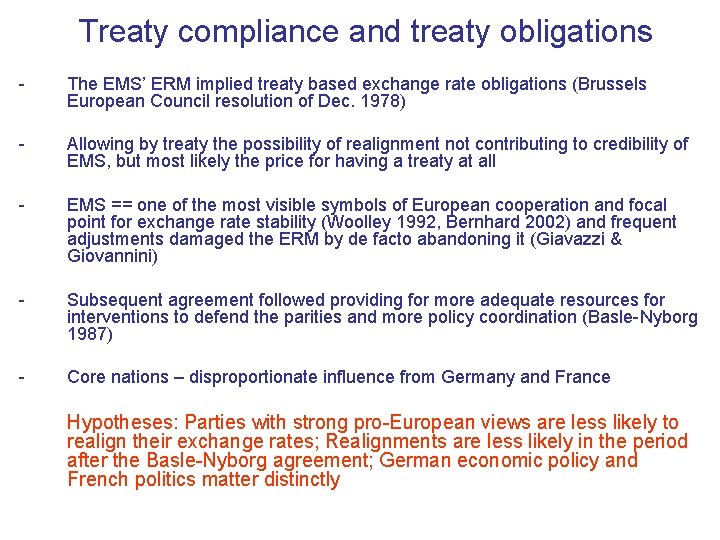
Treaty compliance and treaty obligations - The EMS’ ERM implied treaty based exchange rate obligations (Brussels European Council resolution of Dec. 1978) - Allowing by treaty the possibility of realignment not contributing to credibility of EMS, but most likely the price for having a treaty at all - EMS == one of the most visible symbols of European cooperation and focal point for exchange rate stability (Woolley 1992, Bernhard 2002) and frequent adjustments damaged the ERM by de facto abandoning it (Giavazzi & Giovannini) - Subsequent agreement followed providing for more adequate resources for interventions to defend the parities and more policy coordination (Basle-Nyborg 1987) - Core nations – disproportionate influence from Germany and France Hypotheses: Parties with strong pro-European views are less likely to realign their exchange rates; Realignments are less likely in the period after the Basle-Nyborg agreement; German economic policy and French politics matter distinctly
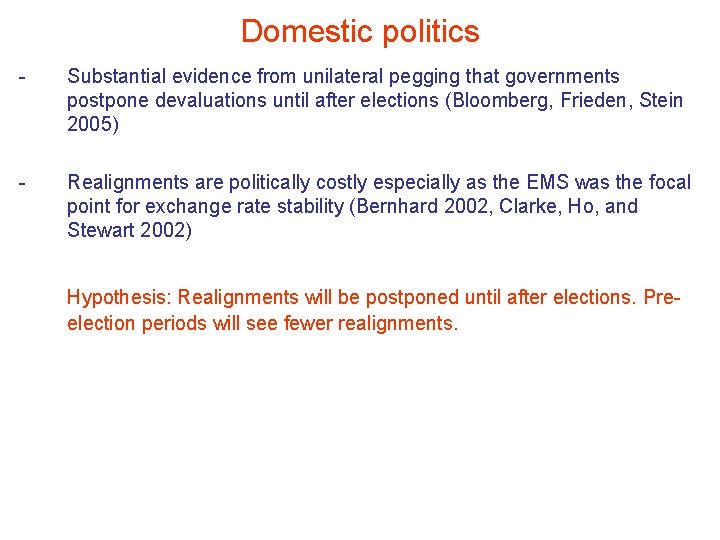
Domestic politics - Substantial evidence from unilateral pegging that governments postpone devaluations until after elections (Bloomberg, Frieden, Stein 2005) - Realignments are politically costly especially as the EMS was the focal point for exchange rate stability (Bernhard 2002, Clarke, Ho, and Stewart 2002) Hypothesis: Realignments will be postponed until after elections. Preelection periods will see fewer realignments.
Data and variables(1) Monthly data on realignments and economic and political variables from entry into the EMS until Aug. 1993 Dependent variable (Gros and Thygesen 1992, Ozkan 2003): - Currency realignments against the DM (alternative – realignments against the ECU) - 54 realignments against the DM (41 against the ECU) Main independent variables - Credibility hypotheses: left wing representation (CMP); EMS level left wing representation (CMP); trade union membership (OECD); - Treaty hypotheses: party positions on Europe (CMP); Basle. Nyborg agreement of Sept. 1987; French elections and left wing representation - Domestic politics: 6 months pre and post elections (both presidential and parliamentary) (DPI; Strom )
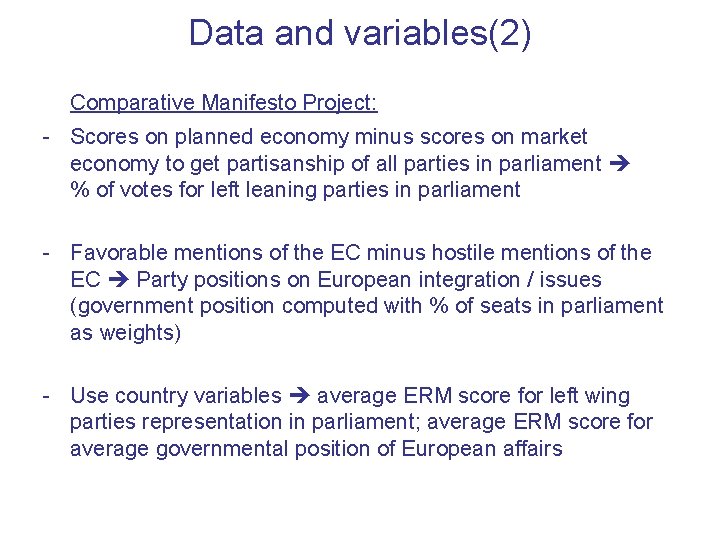
Data and variables(2) Comparative Manifesto Project: - Scores on planned economy minus scores on market economy to get partisanship of all parties in parliament % of votes for left leaning parties in parliament - Favorable mentions of the EC minus hostile mentions of the EC Party positions on European integration / issues (government position computed with % of seats in parliament as weights) - Use country variables average ERM score for left wing parties representation in parliament; average ERM score for average governmental position of European affairs
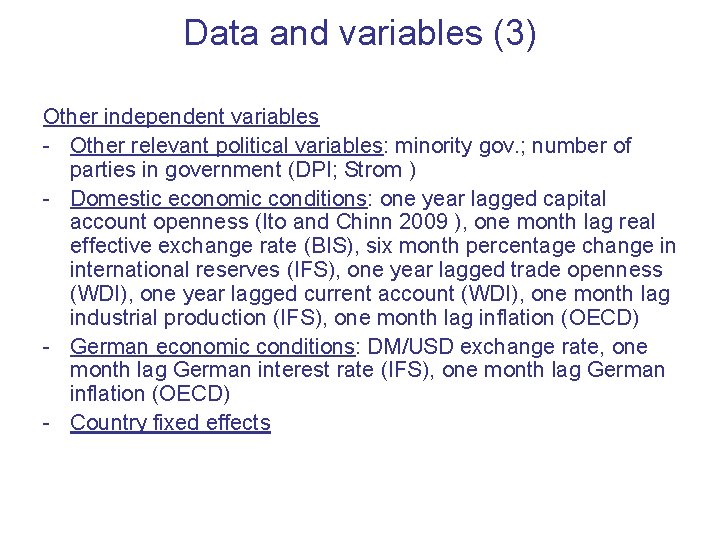
Data and variables (3) Other independent variables - Other relevant political variables: minority gov. ; number of parties in government (DPI; Strom ) - Domestic economic conditions: one year lagged capital account openness (Ito and Chinn 2009 ), one month lag real effective exchange rate (BIS), six month percentage change in international reserves (IFS), one year lagged trade openness (WDI), one year lagged current account (WDI), one month lag industrial production (IFS), one month lag inflation (OECD) - German economic conditions: DM/USD exchange rate, one month lag German interest rate (IFS), one month lag German inflation (OECD) - Country fixed effects
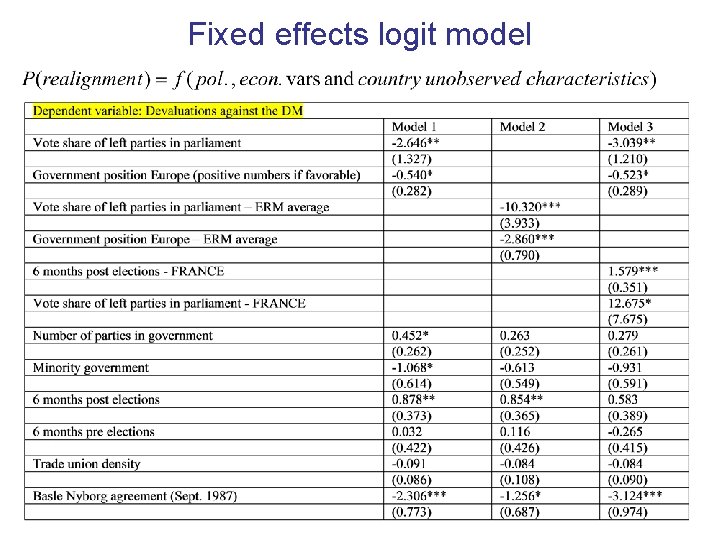
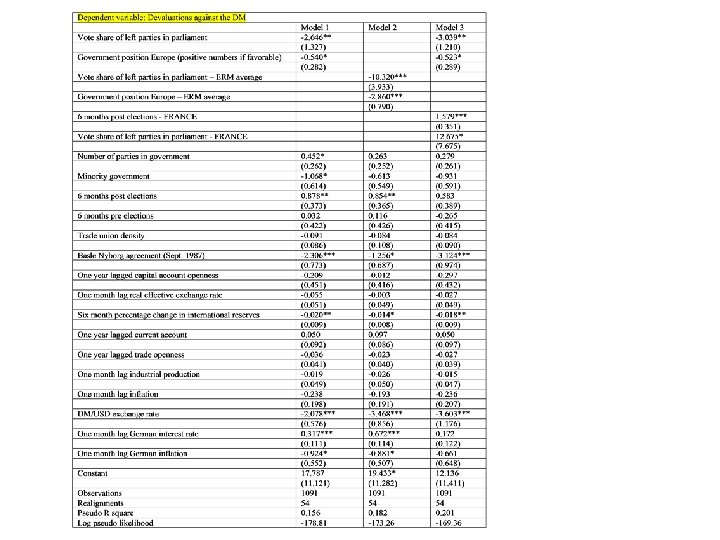
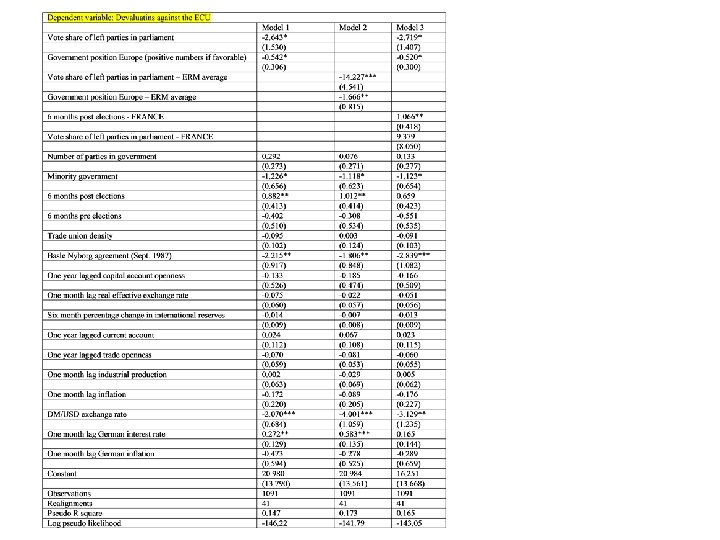
Fixed effects logit model
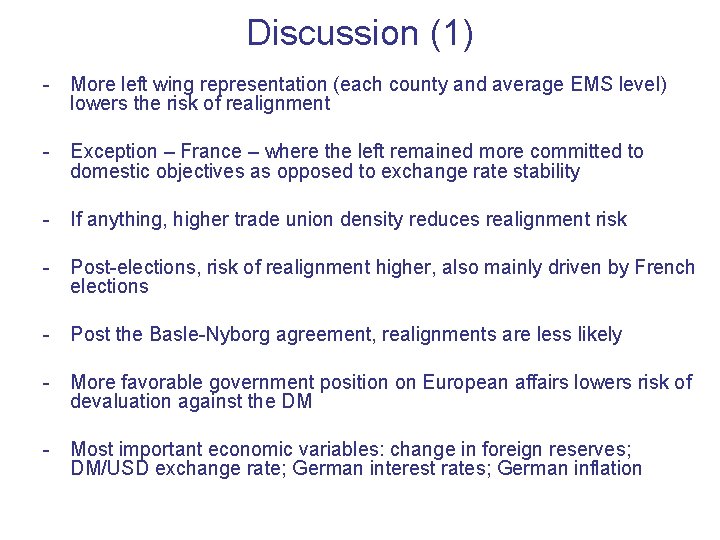
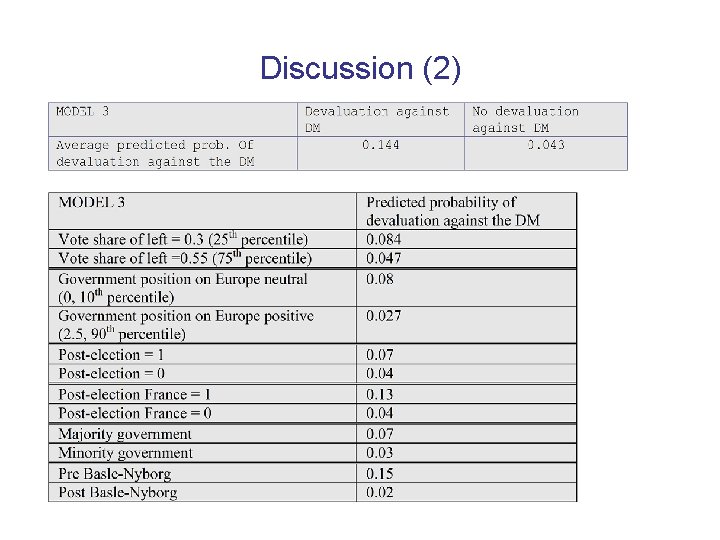
Discussion (1) - More left wing representation (each county and average EMS level) lowers the risk of realignment - Exception – France – where the left remained more committed to domestic objectives as opposed to exchange rate stability - If anything, higher trade union density reduces realignment risk - Post-elections, risk of realignment higher, also mainly driven by French elections - Post the Basle-Nyborg agreement, realignments are less likely - More favorable government position on European affairs lowers risk of devaluation against the DM - Most important economic variables: change in foreign reserves; DM/USD exchange rate; German interest rates; German inflation
Discussion (2)
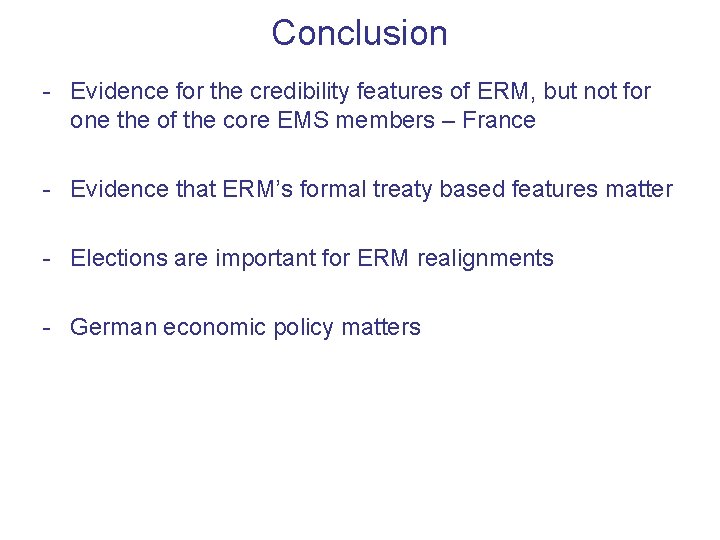
Conclusion - Evidence for the credibility features of ERM, but not for one the of the core EMS members – France - Evidence that ERM’s formal treaty based features matter - Elections are important for ERM realignments - German economic policy matters
More details …
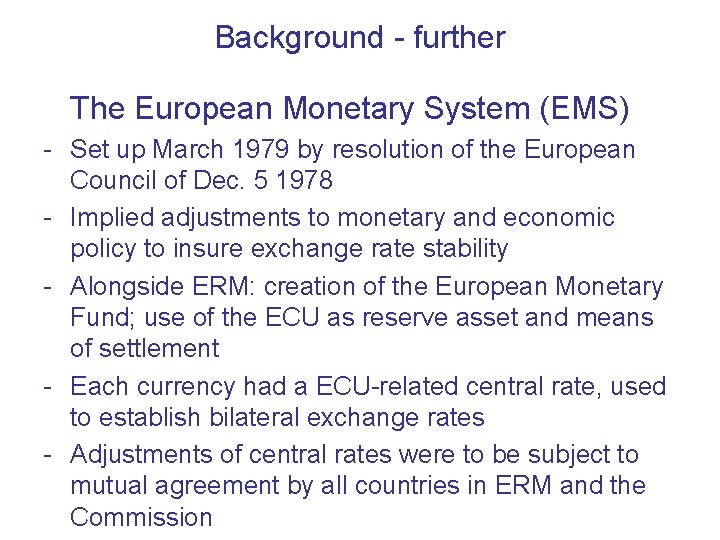
Background - further The European Monetary System (EMS) - Set up March 1979 by resolution of the European Council of Dec. 5 1978 - Implied adjustments to monetary and economic policy to insure exchange rate stability - Alongside ERM: creation of the European Monetary Fund; use of the ECU as reserve asset and means of settlement - Each currency had a ECU-related central rate, used to establish bilateral exchange rates - Adjustments of central rates were to be subject to mutual agreement by all countries in ERM and the Commission
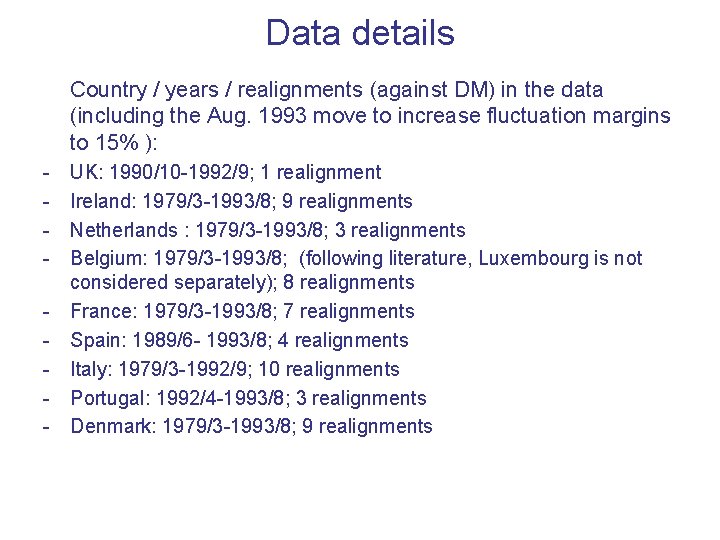
Data details Country / years / realignments (against DM) in the data (including the Aug. 1993 move to increase fluctuation margins to 15% ): - UK: 1990/10 -1992/9; 1 realignment Ireland: 1979/3 -1993/8; 9 realignments Netherlands : 1979/3 -1993/8; 3 realignments Belgium: 1979/3 -1993/8; (following literature, Luxembourg is not considered separately); 8 realignments France: 1979/3 -1993/8; 7 realignments Spain: 1989/6 - 1993/8; 4 realignments Italy: 1979/3 -1992/9; 10 realignments Portugal: 1992/4 -1993/8; 3 realignments Denmark: 1979/3 -1993/8; 9 realignments