
The Policy Process Setting the Agenda and Formulating


- Slides: 15
The Policy Process – Setting the Agenda and Formulating Policy
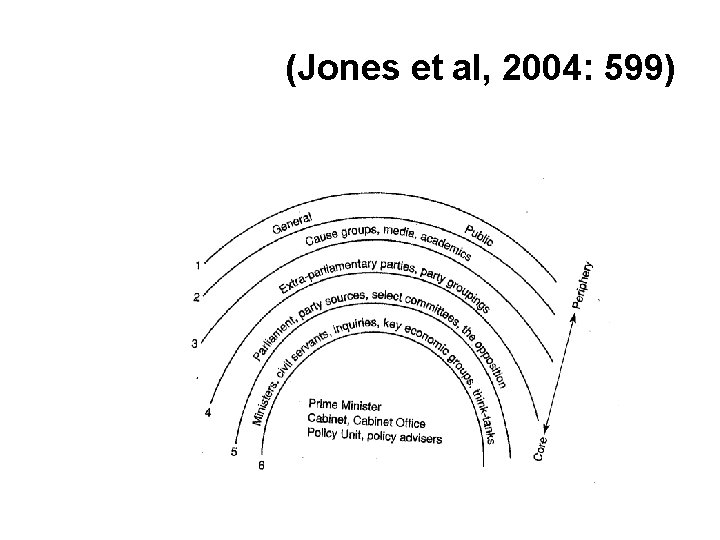
Introduction • Policy initiatives can originate in all parts of the political system. • The question of HOW issues emerge onto policy makers’ agendas is critical. • Often reflects the distribution of power in contemporary society. • Frequency and importance of initiatives seem to grow as one moves from the periphery towards the centre.
Agenda Setting – who sets it? – – – General Public Cause groups, media and academic experts Extra-parliamentary parties and party groupings Parliaments Ministers, Departments, official enquiries and ‘think tanks – Prime Minister and Cabinet
(Jones et al, 2004: 599)
Down’s Issue Attention Cycle • Five Stages: 1. Pre-problem stage 2. Alarmed discovery and euphoric enthusiasm 3. Realisation of the cost of significant progress 4. Gradual decline of public interest 5. The post-problem stage
Does the media manufacture problems? 1. An incident 2. Media takes story 3. Incident portrayed as wider social problem 4. Stereotypes emerge; distortion of issues; disproportionate coverage 5. Public Panic 6. Demands for policy makers to do something
If the media don’t manufacture problems then …. • Question: is policy made and implemented in response to a perceived social problem? • Answer: this is often seen as an oversimplification of the issue • Kingdon (1984) takes a more complex approach to explaining things……
Kingdon’s Three Streams of Activity 1. 2. 3. • • Problems Policy Proposals Political Situation If these streams are just right and converge together then they create a POLICY WINDOW It is the opening of the window which puts the issues onto the political agenda.
Three Dimensions of Power • One dimensional view: pluralist accounts with widely dispersed power within society (Dahl) • Two dimensional view: need to focus on ‘non decisions’ (Bachrach & Baratz, 1963) • Three dimensional view: need to focus on how people are conditioned not to be conflictual (Lukes, 1974)
• Lets assume that the agenda has been well and truly SET……. . • Now what happens? • The policy itself needs to be formulated in some kind of coherent way……. .
What is policy formulation? • Once a policy idea receives political endorsement it is fed into the system for detailed elaboration. • This elaboration is known as policy formulation. • “The process of defining, considering and accepting or rejecting (policy) options” (Howlett & Ramesh, 1995).
Who formulates public policy? • The government? • Experts in the policy area? • Consultative bodies? • Overall, four sets of actors dominate the policy formulation process – ministers, civil servants, pressure groups, and experts.
How is policy formulated? • Through the bureaucratic process • Through the legislative process • But remember the changing nature of governance…. . – Hollowed out state – Separation of policy making from delivery of services – The EU effect
What constraints do those formulating policy face? • Financial resources • Political support • Competence of key personnel • Time • Timing • • Coordination Personality factors International Events The Influence of Europe • Policy Networks
Conclusions • Given that there are different interpretations of policy problems, the dominant voices can determine what the issue actually is. • Not all those with an interest in the policy question will necessarily have a seat at the policy formulation table. • How issues emerge can reflect the distribution of power in contemporary society.