
The Policy Development Process and the Agenda for
- Slides: 14
The Policy Development Process and the Agenda for Effective Institutions: the Philippines Gilberto M. Llanto The Micro Foundations of East Asian Economic Integration Hotel Okura, Tokyo, Japan February 26, 2007 G M LLANTO- The Policy Development Process and the Agenda for Effective Institutions
Institutions and the policy development process n n Implementing institutions Supporting institutions: (a) coordinating body and (b) independent policy review institution G M LLANTO- The Policy Development Process and the Agenda for Effective Institutions 2
n The paper discusses role of supporting institutions in the policy development process and offers suggestions on how to make them more effective. G M LLANTO- The Policy Development Process and the Agenda for Effective Institutions 3
Current economic situation n n Modest economic performance (GDP growth Q 1 to Q 3 at 5. 4%; fiscal deficit, 2. 7% of GDP in 2005; expected to decline to 0. 9% in 2007. Low level of productivity Huge public debt BUT growth potential is considerable G M LLANTO- The Policy Development Process and the Agenda for Effective Institutions 4
What to do? n n n Need to accelerate economic policy reform efforts As economies evolve, so should structures and institutions Economic reform has to be continuous. G M LLANTO- The Policy Development Process and the Agenda for Effective Institutions 5
Supporting institutions n n Coordinating institutions: National Economic and Development Authority (NEDA) and the Department of Budget and Management (DBM) Independent policy review institution: Philippine Institute for Development Studies G M LLANTO- The Policy Development Process and the Agenda for Effective Institutions 6
Recent reform effort by DBM n Public expenditure management reform: (a) medium term expenditure framework (MTEF), (b) organizational performance indicator framework (OPIF), and (c) accountability, monitoring and evaluation framework. G M LLANTO- The Policy Development Process and the Agenda for Effective Institutions 7
OPIF n Outcomes and outputs framework: (a) support policy development process, (b) strengthen departments’ internal management and (c) strengthen external reporting for accountability purposes G M LLANTO- The Policy Development Process and the Agenda for Effective Institutions 8
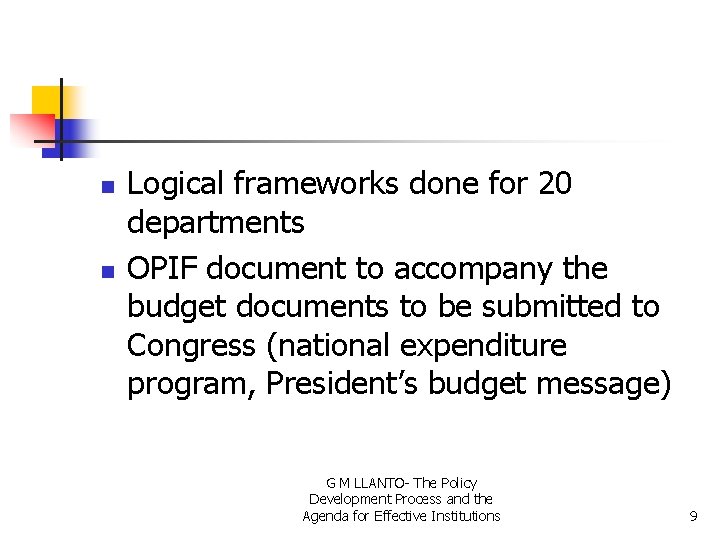
n n Logical frameworks done for 20 departments OPIF document to accompany the budget documents to be submitted to Congress (national expenditure program, President’s budget message) G M LLANTO- The Policy Development Process and the Agenda for Effective Institutions 9
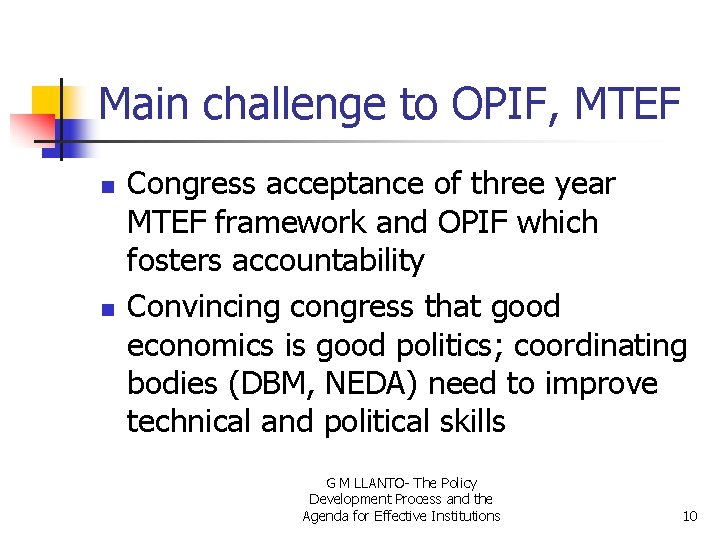
Main challenge to OPIF, MTEF n n Congress acceptance of three year MTEF framework and OPIF which fosters accountability Convincing congress that good economics is good politics; coordinating bodies (DBM, NEDA) need to improve technical and political skills G M LLANTO- The Policy Development Process and the Agenda for Effective Institutions 10
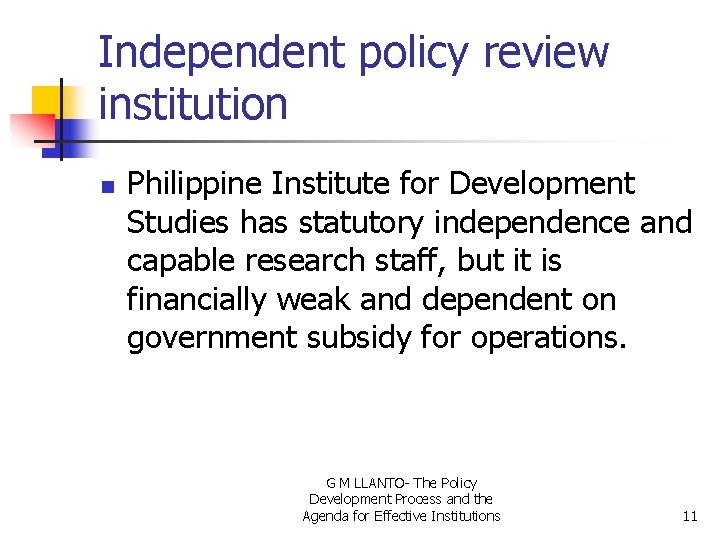
Independent policy review institution n Philippine Institute for Development Studies has statutory independence and capable research staff, but it is financially weak and dependent on government subsidy for operations. G M LLANTO- The Policy Development Process and the Agenda for Effective Institutions 11
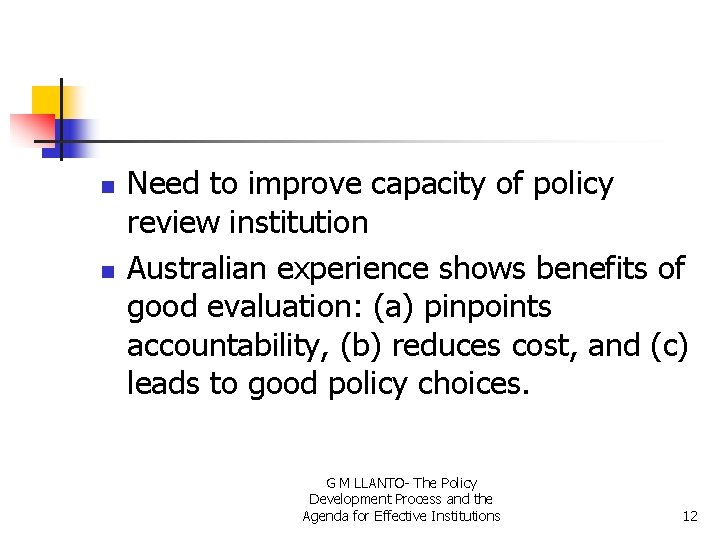
n n Need to improve capacity of policy review institution Australian experience shows benefits of good evaluation: (a) pinpoints accountability, (b) reduces cost, and (c) leads to good policy choices. G M LLANTO- The Policy Development Process and the Agenda for Effective Institutions 12
Concluding remarks n n n The policy development process needs supporting institutions: (coordination tasks as well as independent review) Policy development process is not a disembodied phenomenon. The message (content) of the reform is important but the medium (effective institutions, both implementing and supporting) is also critical. G M LLANTO- The Policy Development Process and the Agenda for Effective Institutions 13
Thank you! G M LLANTO- The Policy Development Process and the Agenda for Effective Institutions 14