
The Police What is the role of police
- Slides: 21
The Police § § § What is the role of police in society? What police organizations exist in Canada? What constitutes a legal arrest? What are the rights of an accused during arrest? What are the rights of the police during an arrest? Where do we draw the line between protection and freedom?
What is the role of police in society? Roles/Functions Positive Examples Negative Examples
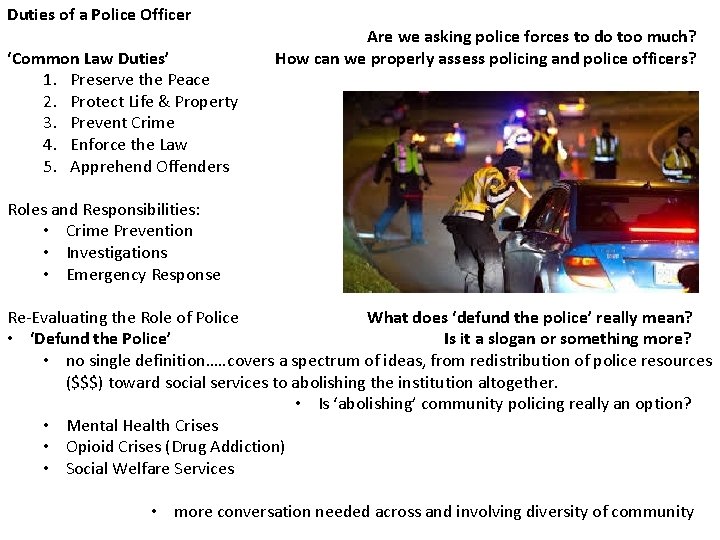
Duties of a Police Officer ‘Common Law Duties’ 1. Preserve the Peace 2. Protect Life & Property 3. Prevent Crime 4. Enforce the Law 5. Apprehend Offenders Are we asking police forces to do too much? How can we properly assess policing and police officers? Roles and Responsibilities: • Crime Prevention • Investigations • Emergency Response Re-Evaluating the Role of Police What does ‘defund the police’ really mean? • ‘Defund the Police’ Is it a slogan or something more? • no single definition…. . covers a spectrum of ideas, from redistribution of police resources ($$$) toward social services to abolishing the institution altogether. • Is ‘abolishing’ community policing really an option? • Mental Health Crises • Opioid Crises (Drug Addiction) • Social Welfare Services • more conversation needed across and involving diversity of community
The Police – The most expensive component of the criminal justice system is policing. In 2007, Canada’s police forces cost about $10 billion annually and included almost 64 000 police officers at three different levels – federal, provincial/territorial and municipal. Federal Police Royal Canadian Mounted Police (RCMP) • Serve as provincial police in all provinces and territories except Ontario, Quebec, Newfoundland Labrador • Serve as municipal police too Mandate: 1. Border Integrity • Customs • Immigration and Passport Branch • Marine and Ports Branch 2. Drugs and Organized Crime • Drug Enforcement • Organized Crime Branch 3. International Policing • INTERPOL • International Operations 4. Financial Crime
The Police The Provincial Police The Ontario Provincial Police as an example. . Police Services Act – • Policing municipalities that are not required by law to maintain their own police force; • Responding to municipal police requests for special assistance in emergencies; • Providing traffic control on all 400 series and major highways, including those sections that are within the jurisdiction of municipal police forces; • Providing investigative services on request, to the coroner’s office and to other provincial ministries; and • Performing other assigned duties, such as maintaining the provincial firearms registry, providing security at Queen’s Park, and protecting Ontario government officials and dignitaries
The Police – Municipal Police Each municipality funds its own police force. Smaller communities that do not have municipal funds for their own forces use the services of the provincial police or the RCMP. A municipal police officer’s duties may include: • • preserving the peace preventing crimes occurring assisting victims of crime apprehending criminals laying charges and participating in prosecutions executing warrants enforcing municipal bylaws In 2007, municipal police services employed 66 per cent of all police officers in Canada. Aboriginal Police The goal of such police forces is to offer services that are professional and in touch with the culture and needs of the community.
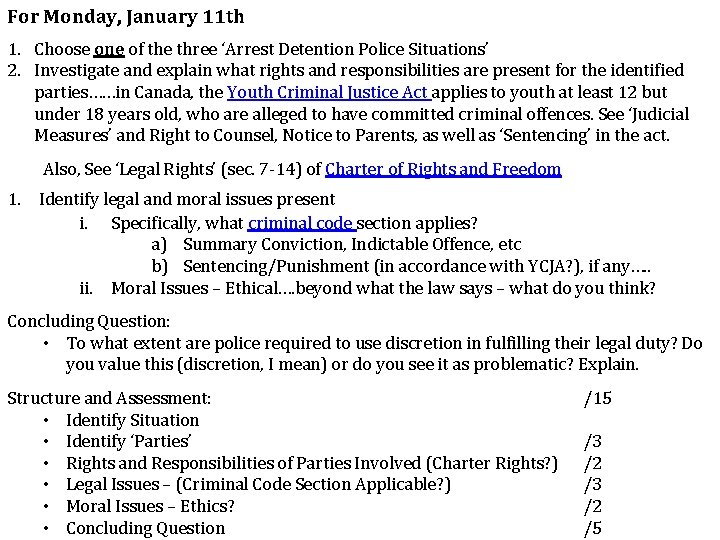
For Monday, January 11 th 1. Choose one of the three ‘Arrest Detention Police Situations’ 2. Investigate and explain what rights and responsibilities are present for the identified parties……in Canada, the Youth Criminal Justice Act applies to youth at least 12 but under 18 years old, who are alleged to have committed criminal offences. See ‘Judicial Measures’ and Right to Counsel, Notice to Parents, as well as ‘Sentencing’ in the act. Also, See ‘Legal Rights’ (sec. 7 -14) of Charter of Rights and Freedom 1. Identify legal and moral issues present i. Specifically, what criminal code section applies? a) Summary Conviction, Indictable Offence, etc b) Sentencing/Punishment (in accordance with YCJA? ), if any…. . ii. Moral Issues – Ethical…. beyond what the law says – what do you think? Concluding Question: • To what extent are police required to use discretion in fulfilling their legal duty? Do you value this (discretion, I mean) or do you see it as problematic? Explain. Structure and Assessment: • Identify Situation • Identify ‘Parties’ • Rights and Responsibilities of Parties Involved (Charter Rights? ) • Legal Issues – (Criminal Code Section Applicable? ) • Moral Issues – Ethics? • Concluding Question /15 /3 /2 /5
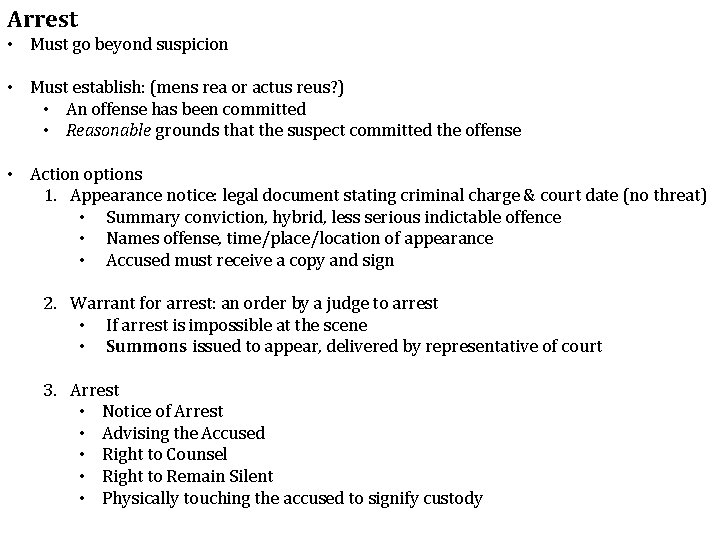
Arrest • Must go beyond suspicion • Must establish: (mens rea or actus reus? ) • An offense has been committed • Reasonable grounds that the suspect committed the offense • Action options 1. Appearance notice: legal document stating criminal charge & court date (no threat) • Summary conviction, hybrid, less serious indictable offence • Names offense, time/place/location of appearance • Accused must receive a copy and sign 2. Warrant for arrest: an order by a judge to arrest • If arrest is impossible at the scene • Summons issued to appear, delivered by representative of court 3. Arrest • Notice of Arrest • Advising the Accused • Right to Counsel • Right to Remain Silent • Physically touching the accused to signify custody
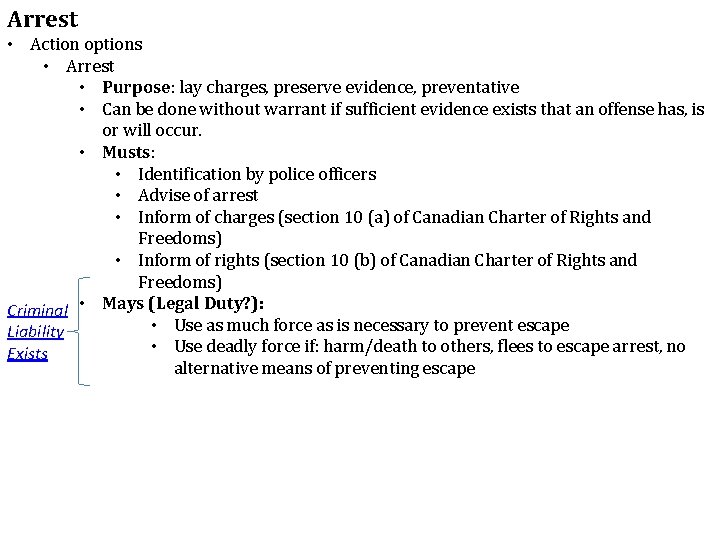
Arrest • Action options • Arrest • Purpose: lay charges, preserve evidence, preventative • Can be done without warrant if sufficient evidence exists that an offense has, is or will occur. • Musts: • Identification by police officers • Advise of arrest • Inform of charges (section 10 (a) of Canadian Charter of Rights and Freedoms) • Inform of rights (section 10 (b) of Canadian Charter of Rights and Freedoms) Criminal • Mays (Legal Duty? ): • Use as much force as is necessary to prevent escape Liability • Use deadly force if: harm/death to others, flees to escape arrest, no Exists alternative means of preventing escape
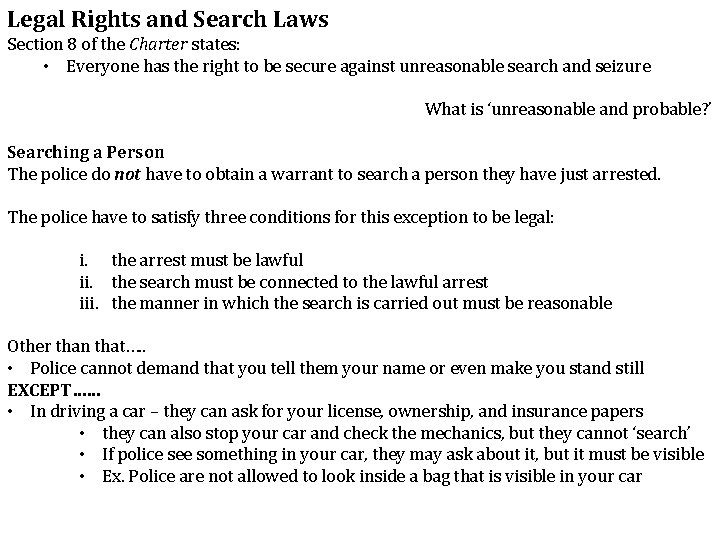
Legal Rights and Search Laws Section 8 of the Charter states: • Everyone has the right to be secure against unreasonable search and seizure What is ‘unreasonable and probable? ’ Searching a Person The police do not have to obtain a warrant to search a person they have just arrested. The police have to satisfy three conditions for this exception to be legal: i. the arrest must be lawful ii. the search must be connected to the lawful arrest iii. the manner in which the search is carried out must be reasonable Other than that…. . • Police cannot demand that you tell them your name or even make you stand still EXCEPT…… • In driving a car – they can ask for your license, ownership, and insurance papers • they can also stop your car and check the mechanics, but they cannot ‘search’ • If police see something in your car, they may ask about it, but it must be visible • Ex. Police are not allowed to look inside a bag that is visible in your car
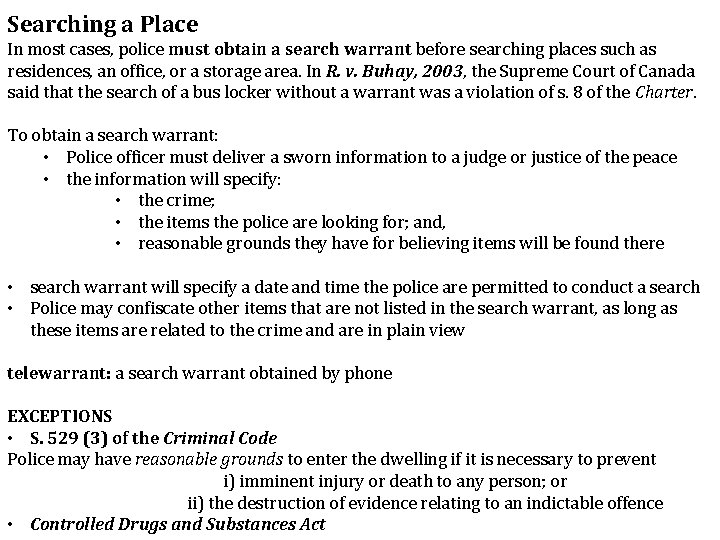
Searching a Place In most cases, police must obtain a search warrant before searching places such as residences, an office, or a storage area. In R. v. Buhay, 2003, the Supreme Court of Canada said that the search of a bus locker without a warrant was a violation of s. 8 of the Charter. To obtain a search warrant: • Police officer must deliver a sworn information to a judge or justice of the peace • the information will specify: • the crime; • the items the police are looking for; and, • reasonable grounds they have for believing items will be found there • search warrant will specify a date and time the police are permitted to conduct a search • Police may confiscate other items that are not listed in the search warrant, as long as these items are related to the crime and are in plain view telewarrant: a search warrant obtained by phone EXCEPTIONS • S. 529 (3) of the Criminal Code Police may have reasonable grounds to enter the dwelling if it is necessary to prevent i) imminent injury or death to any person; or ii) the destruction of evidence relating to an indictable offence • Controlled Drugs and Substances Act
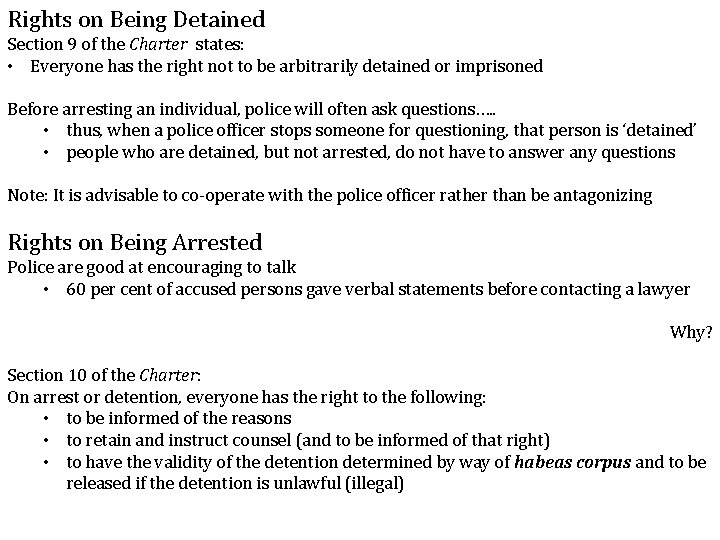
Rights on Being Detained Section 9 of the Charter states: • Everyone has the right not to be arbitrarily detained or imprisoned Before arresting an individual, police will often ask questions…. . • thus, when a police officer stops someone for questioning, that person is ‘detained’ • people who are detained, but not arrested, do not have to answer any questions Note: It is advisable to co-operate with the police officer rather than be antagonizing Rights on Being Arrested Police are good at encouraging to talk • 60 per cent of accused persons gave verbal statements before contacting a lawyer Why? Section 10 of the Charter: On arrest or detention, everyone has the right to the following: • to be informed of the reasons • to retain and instruct counsel (and to be informed of that right) • to have the validity of the detention determined by way of habeas corpus and to be released if the detention is unlawful (illegal)
Citizen’s Arrest The most common form of citizens arrest involves incidents of shoplifting. Immediately after a citizen’s arrest is made, the suspect must be turned over to police. Section 494 of the Criminal Code: (1) Anyone may arrest without arrant a) A person whom he finds committing an indictable offence; or b) A person who, on unreasonable grounds, he believes i. has committed a criminal offence; and ii. is escaping from and freshly pursued by persons who have lawful authority to arrest that person. (2) If an individual is committing a criminal offence on or in relation to property, that person may be arrested without a warrant by a) the owner or a person in lawful possession of the property; or b) a person authorized by the owner or by a person in lawful possession of the property.
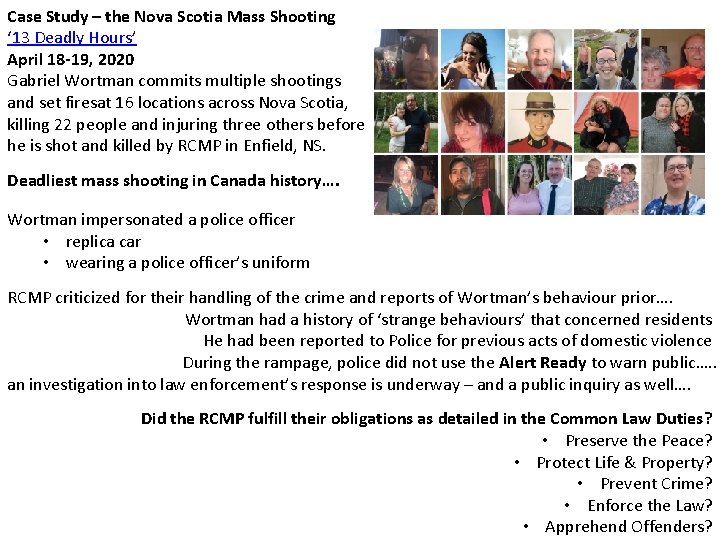
Case Study – the Nova Scotia Mass Shooting ‘ 13 Deadly Hours’ April 18 -19, 2020 Gabriel Wortman commits multiple shootings and set firesat 16 locations across Nova Scotia, killing 22 people and injuring three others before he is shot and killed by RCMP in Enfield, NS. Deadliest mass shooting in Canada history…. Wortman impersonated a police officer • replica car • wearing a police officer’s uniform RCMP criticized for their handling of the crime and reports of Wortman’s behaviour prior…. Wortman had a history of ‘strange behaviours’ that concerned residents He had been reported to Police for previous acts of domestic violence During the rampage, police did not use the Alert Ready to warn public…. . an investigation into law enforcement’s response is underway – and a public inquiry as well…. Did the RCMP fulfill their obligations as detailed in the Common Law Duties? • Preserve the Peace? • Protect Life & Property? • Prevent Crime? • Enforce the Law? • Apprehend Offenders?
Starting a Police Investigation What happens when the police first arrive at the scene of a crime? i. iii. Assist injured at the scene Call in reinforcements to eliminate any hazards that pose a risk Search crime scene – officers assume suspects are present and armed – secure it Protecting and Preserving the Crime Scene Officers must establish two boundaries: i. the centre ii. the perimeter Preserved for three reasons: i. to allow for a thorough search of the scene ii. to seize and collect physical evidence iii. to ensure that the scene is not managed properly Contamination: the loss, destruction, or alteration of physical evidence Police log: a daily written record of what an officer has witnessed
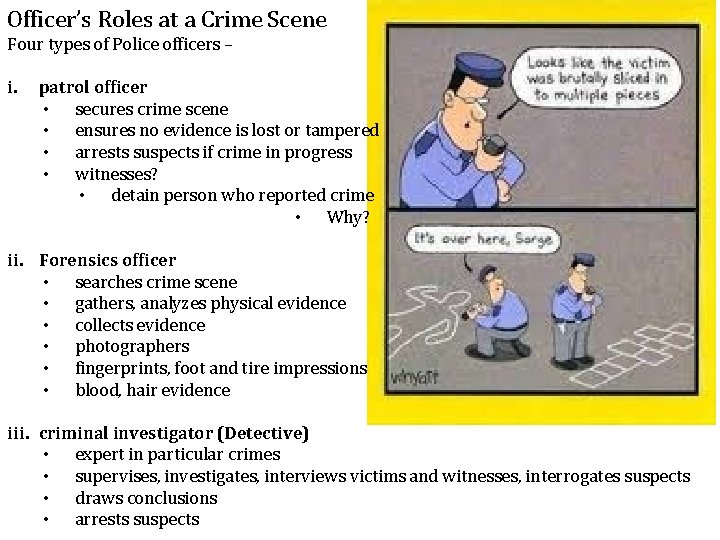
Officer’s Roles at a Crime Scene Four types of Police officers – i. patrol officer • secures crime scene • ensures no evidence is lost or tampered • arrests suspects if crime in progress • witnesses? • detain person who reported crime • Why? ii. Forensics officer • searches crime scene • gathers, analyzes physical evidence • collects evidence • photographers • fingerprints, foot and tire impressions • blood, hair evidence iii. criminal investigator (Detective) • expert in particular crimes • supervises, investigates, interviews victims and witnesses, interrogates suspects • draws conclusions • arrests suspects
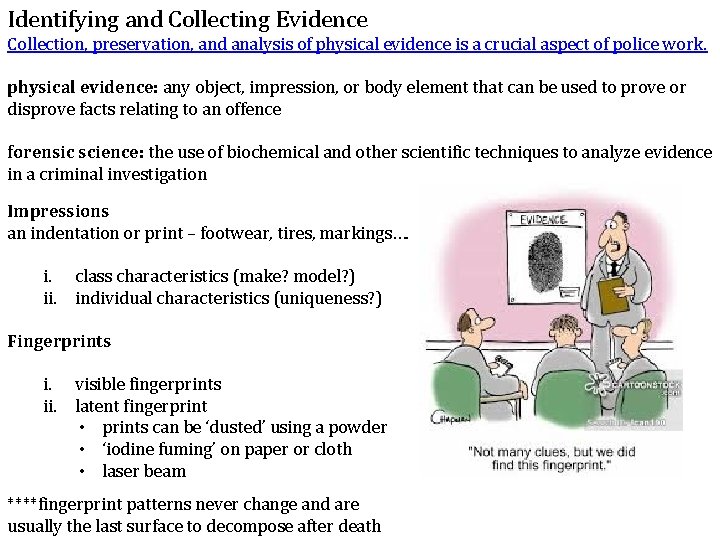
Identifying and Collecting Evidence Collection, preservation, and analysis of physical evidence is a crucial aspect of police work. physical evidence: any object, impression, or body element that can be used to prove or disprove facts relating to an offence forensic science: the use of biochemical and other scientific techniques to analyze evidence in a criminal investigation Impressions an indentation or print – footwear, tires, markings…. i. class characteristics (make? model? ) ii. individual characteristics (uniqueness? ) Fingerprints i. visible fingerprints ii. latent fingerprint • prints can be ‘dusted’ using a powder • ‘iodine fuming’ on paper or cloth • laser beam ****fingerprint patterns never change and are usually the last surface to decompose after death
Body Elements and DNA (deoxyribonucleic acid) Blood is the most common body substance found at a crime scene. Bodily fluids or other bodily elements can be used in DNA testing – The DNA of every cell in a person’s body is identical. However, the pattern of the DNA is different for each person, with the exception of identical twins. Suspect’s DNA ‘print’ can be compared with the DNA profile of a sample from a crime scene One important advantage to DNA testing is the DNA molecules are stable. If properly preserved, they can be use in an investigation decade after the crime occurred. Procedures for Labeling Evidence chain of custody: the witnessed, written record of the people who maintained unbroken control over an item of evidence It must show: • who had contact with the evidence • the dates and times the evidence was handled • the circumstances under which the evidence was handled; and, • what changes, if any, were made to the evidence
Forensics Follow the rules of scientific inquiry: • gather, observe and test data formulate, modify, and reject hypotheses, until only one remains • not an exact science and far from the glamour of ‘CSI’ or ‘Criminal Minds, ’ or other television shows Purpose? • to contribute to law enforcements effort to take criminals of the street Examples of Subdivisions of Forensic Science Forensic Anthropology • study of bones • identity, trauma and post-mortem mutilation Forensic Ondontology • the study of the uniqueness of dentition (teeth) Trace Evidence • hairs, fibres, pollen, paint, soil and glass Ballistic Experts • tools and weapons Sherlock Holmes – Fact or Fiction? Forensic Biologists • blood, saliva, semen Forensic Psychology • the study of the mind of an individual Blood Splatter Analysis • the scientific examination of blood spatterns found at a crime scene to reconstruct the events of the crime
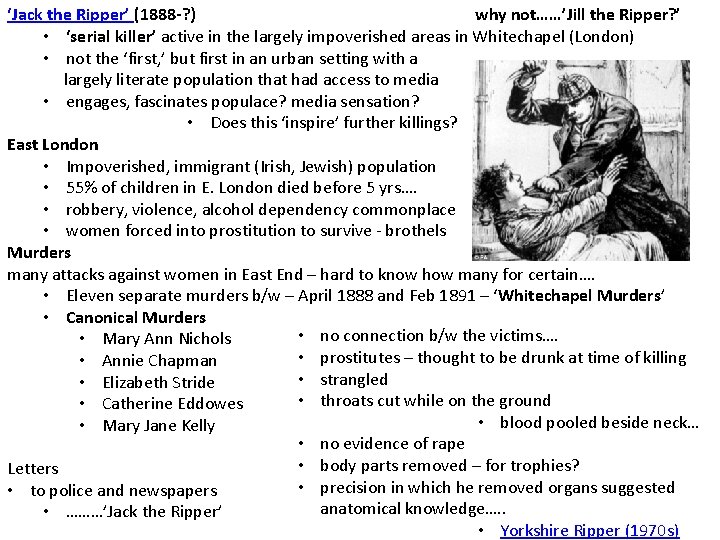
‘Jack the Ripper’ (1888 -? ) why not……’Jill the Ripper? ’ • ‘serial killer’ active in the largely impoverished areas in Whitechapel (London) • not the ‘first, ’ but first in an urban setting with a largely literate population that had access to media • engages, fascinates populace? media sensation? • Does this ‘inspire’ further killings? East London • Impoverished, immigrant (Irish, Jewish) population • 55% of children in E. London died before 5 yrs…. • robbery, violence, alcohol dependency commonplace • women forced into prostitution to survive - brothels Murders many attacks against women in East End – hard to know how many for certain…. • Eleven separate murders b/w – April 1888 and Feb 1891 – ‘Whitechapel Murders’ • Canonical Murders • no connection b/w the victims…. • Mary Ann Nichols • prostitutes – thought to be drunk at time of killing • Annie Chapman • strangled • Elizabeth Stride • throats cut while on the ground • Catherine Eddowes • blood pooled beside neck… • Mary Jane Kelly • no evidence of rape • body parts removed – for trophies? Letters • precision in which he removed organs suggested • to police and newspapers anatomical knowledge…. . • ………’Jack the Ripper’ • Yorkshire Ripper (1970 s)
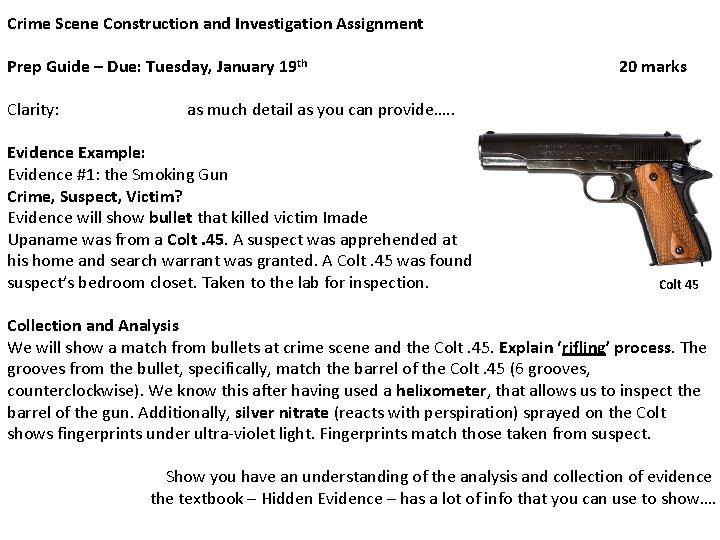
Crime Scene Construction and Investigation Assignment Prep Guide – Due: Tuesday, January 19 th Clarity: 20 marks as much detail as you can provide…. . Evidence Example: Evidence #1: the Smoking Gun Crime, Suspect, Victim? Evidence will show bullet that killed victim Imade Upaname was from a Colt. 45. A suspect was apprehended at his home and search warrant was granted. A Colt. 45 was found in the suspect’s bedroom closet. Taken to the lab for inspection. Colt 45 Collection and Analysis We will show a match from bullets at crime scene and the Colt. 45. Explain ‘rifling’ process. The grooves from the bullet, specifically, match the barrel of the Colt. 45 (6 grooves, counterclockwise). We know this after having used a helixometer, that allows us to inspect the barrel of the gun. Additionally, silver nitrate (reacts with perspiration) sprayed on the Colt shows fingerprints under ultra-violet light. Fingerprints match those taken from suspect. Show you have an understanding of the analysis and collection of evidence the textbook – Hidden Evidence – has a lot of info that you can use to show….