
The Plasma Cell Membrane Plasma Membrane Maintaining Balance
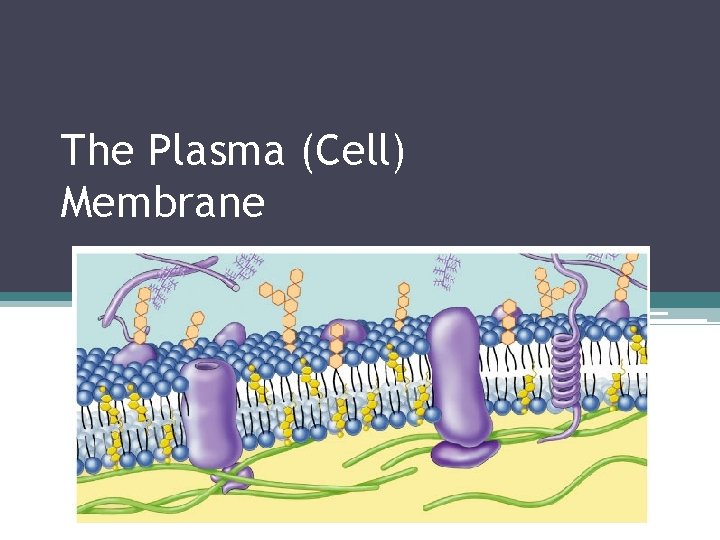
The Plasma (Cell) Membrane
Plasma Membrane Maintaining Balance • Separates living cell from nonliving environment • Allows flow of nutrients into and out of cell • Homeostasis ▫ Maintain a stable internal environment • Selective permeability ▫ Allows some molecules into the cell while keeping others out

Structure of Phospholipid Bilayer • Two layers of phospholipids back to back • Lipid with a phosphate group attached
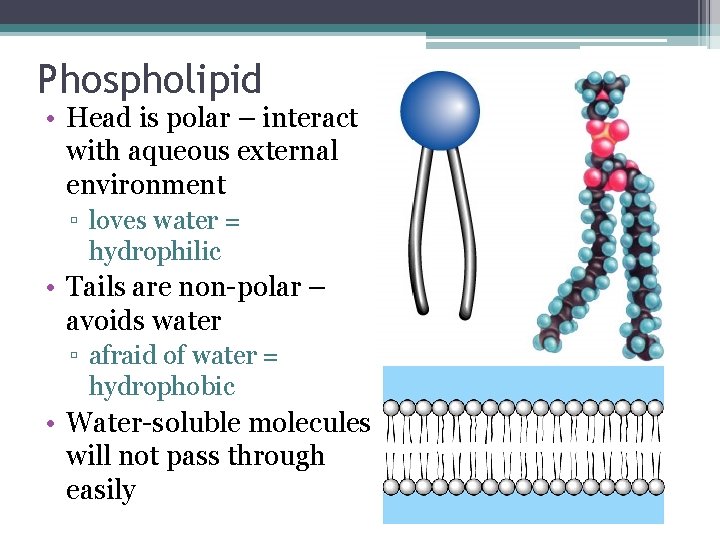
Phospholipid • Head is polar – interact with aqueous external environment ▫ loves water = hydrophilic • Tails are non-polar – avoids water ▫ afraid of water = hydrophobic • Water-soluble molecules will not pass through easily
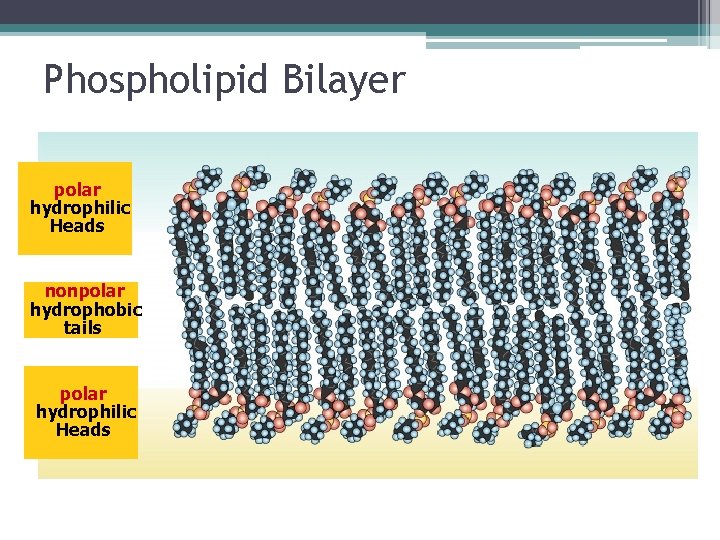
Phospholipid Bilayer polar hydrophilic Heads nonpolar hydrophobic tails polar hydrophilic Heads
Fluid Mosaic Model • Model of the plasma membrane It’s like a fluid… It’s like a mosaic… It’s the Fluid Mosaic Model ! ▫ Fluid due to flexible nature of membrane ▫ Phospholipids move like water current ▫ Proteins in membrane create pattern (mosaic) on membrane surface
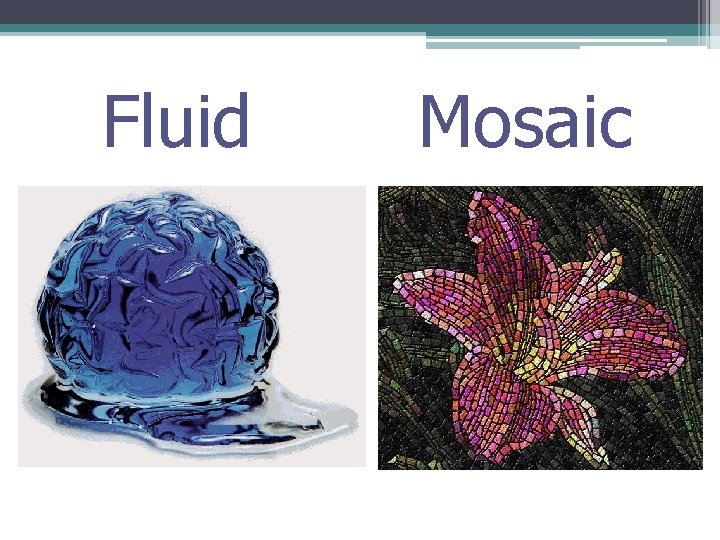
Fluid Mosaic
Other Components • Cholesterol ▫ Helps stabilize phospholipids ▫ Stops fatty acid chains from sticking together • Proteins on membrane surface aid in cell identification • Transport Proteins ▫ Span the width of the membrane ▫ Regulates which molecules may pass through the membrane

Functions Outside Plasma Membrane Inside Cell Transporter Identity Marker Enzyme Activity Cell Adhesion Receptor Attach to Cytoskeleton
Functions • Transporter ▫Exocytosis- moving molecules out of the cell ▫Endocytosis- moving molecules intothe cell • Enzyme Activity ▫Aid in enzyme activity • Receptor ▫Receiving chemical signals • Identity Marker ▫Surface protein markers are embedded and aid in cell to cell communication • Attach to Cytoskeleton ▫Maintains structure and shape ▫Attached to fibers that are on cytoskeleton • Cell Adhesion ▫Allows cells to come together and adhere
- Slides: 10