
THE PLANT WORLD Competencies Determines the generic classification
- Slides: 32
THE PLANT WORLD
Competencies: Determines the generic classification of plants
Video on Plant Evolution and Classification Guide Questions 1. Where did plants evolve from? 2. How plants are classified?
KINDS OF PLANTS ACCORDING TO THE FOLLOWING: 1. Size Microscopic – cannot be seen by the unaided eye. Example: bacteria Macroscopic – large enough to be seen by the naked eye.
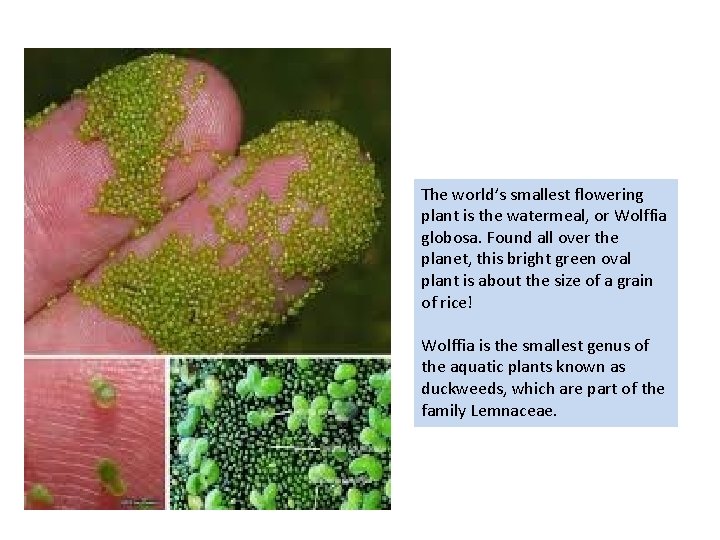
The world’s smallest flowering plant is the watermeal, or Wolffia globosa. Found all over the planet, this bright green oval plant is about the size of a grain of rice! Wolffia is the smallest genus of the aquatic plants known as duckweeds, which are part of the family Lemnaceae.
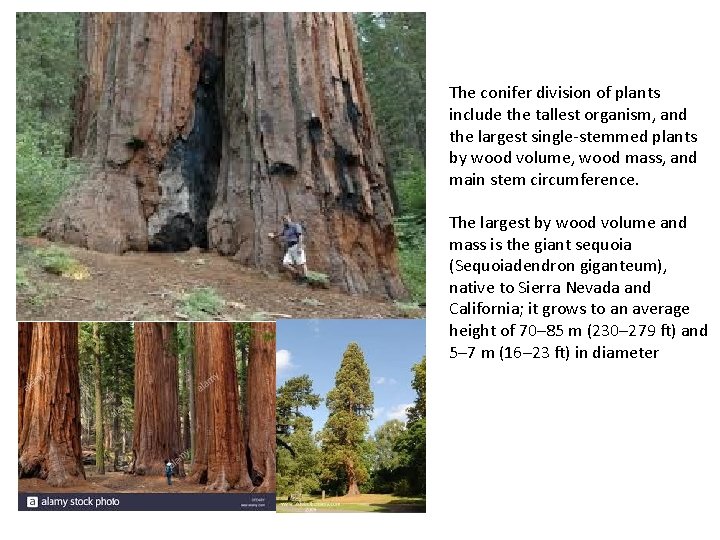
The conifer division of plants include the tallest organism, and the largest single-stemmed plants by wood volume, wood mass, and main stem circumference. The largest by wood volume and mass is the giant sequoia (Sequoiadendron giganteum), native to Sierra Nevada and California; it grows to an average height of 70– 85 m (230– 279 ft) and 5– 7 m (16– 23 ft) in diameter
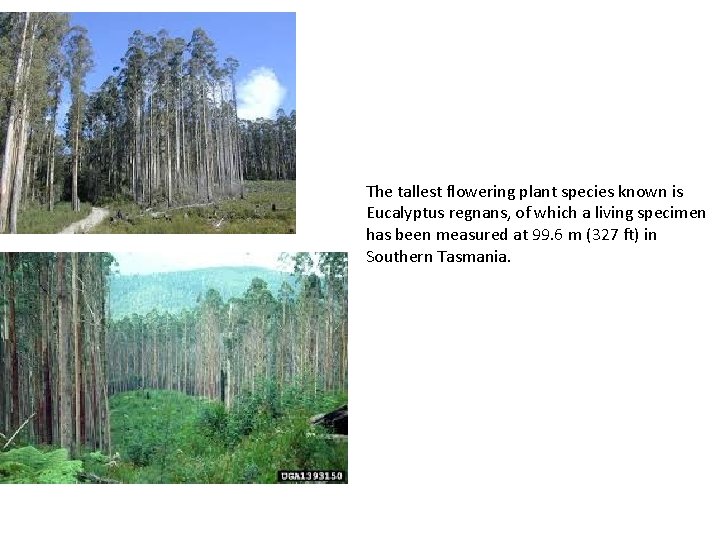
The tallest flowering plant species known is Eucalyptus regnans, of which a living specimen has been measured at 99. 6 m (327 ft) in Southern Tasmania.
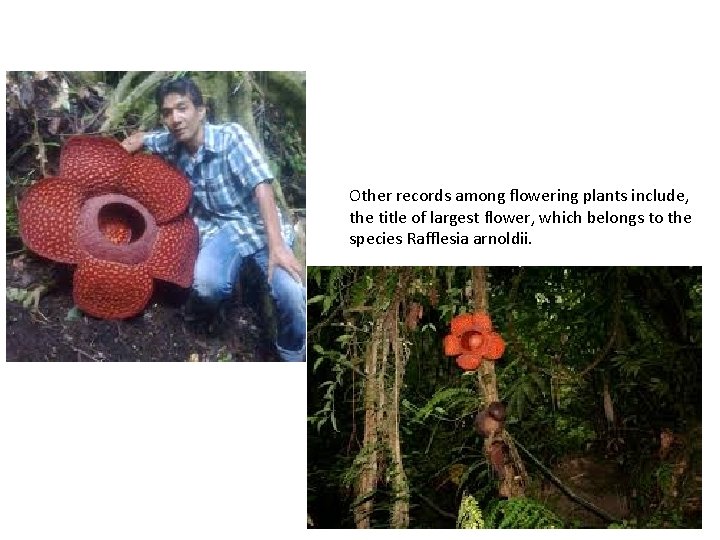
Other records among flowering plants include, the title of largest flower, which belongs to the species Rafflesia arnoldii.
2. Body Form Unicellular – the simplest form with one cell. Multicellular – numerous cell formed into cells.
3. Mode of Reproduction Cryptogam – non-seed bearing or flowering plants. Examples: fungi, algae, bryophytes, ferns Phanerogams – seed-bearing or flowering plants.
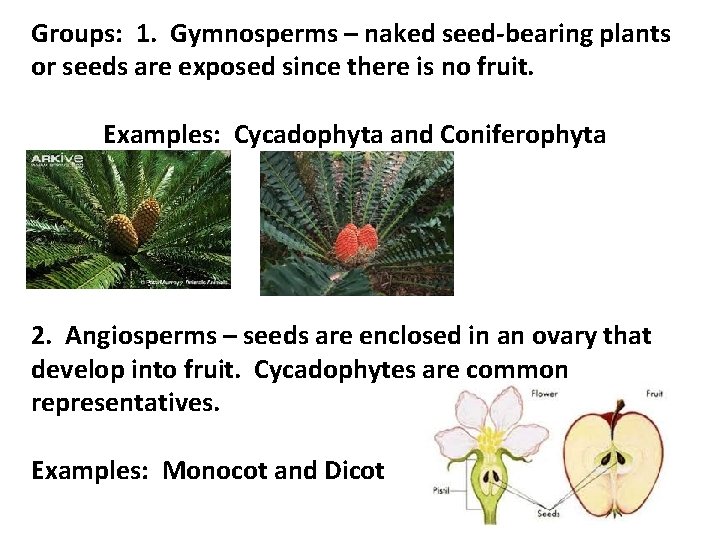
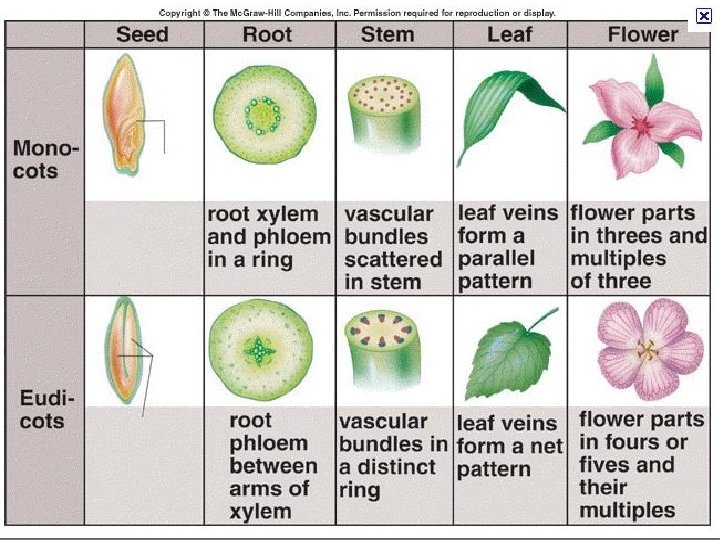
Groups: 1. Gymnosperms – naked seed-bearing plants or seeds are exposed since there is no fruit. Examples: Cycadophyta and Coniferophyta 2. Angiosperms – seeds are enclosed in an ovary that develop into fruit. Cycadophytes are common representatives. Examples: Monocot and Dicot
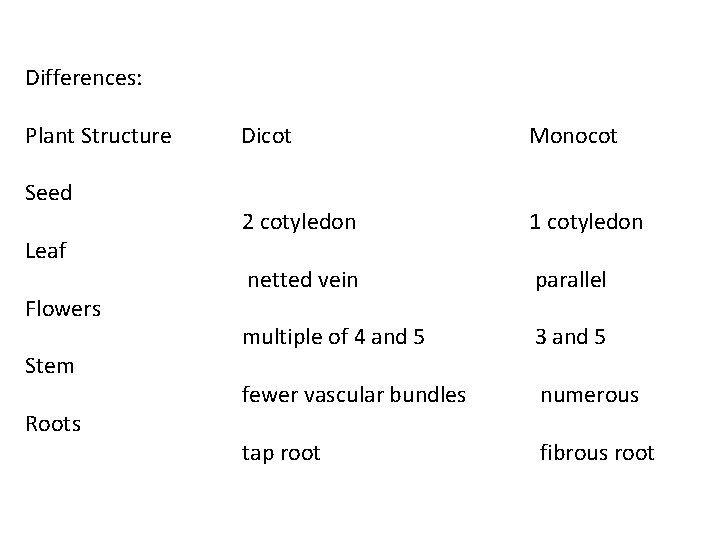
Differences: Plant Structure Seed Leaf Flowers Stem Roots Dicot Monocot 2 cotyledon 1 cotyledon netted vein parallel multiple of 4 and 5 3 and 5 fewer vascular bundles numerous tap root fibrous root
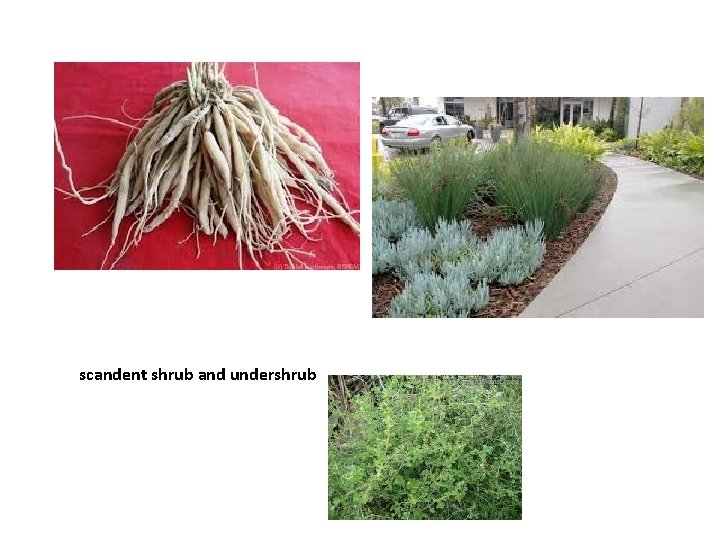
4. Texture trees – tall, woody plants with single main stem and height exceed more than 5 ft tall. Shrubs - semi woody semi flesh without a single main stem and usually less than 5 feet tall Types: scandent shrub and undershrub herbs – soft-stemmed or non woody plants.
scandent shrub and undershrub
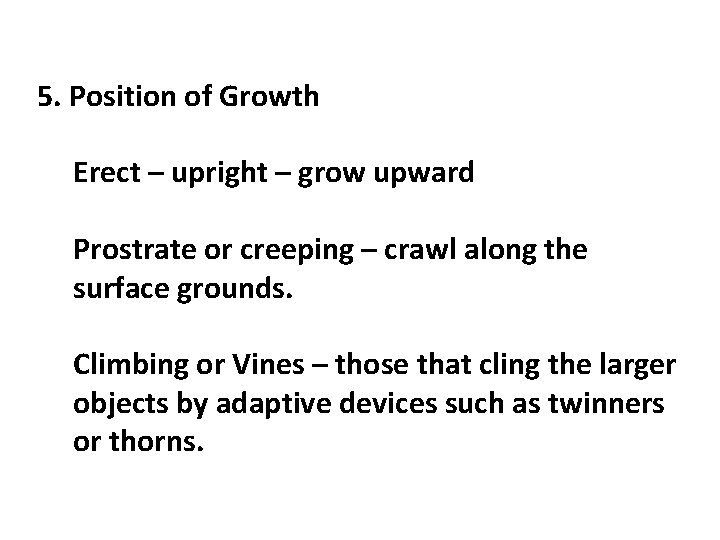
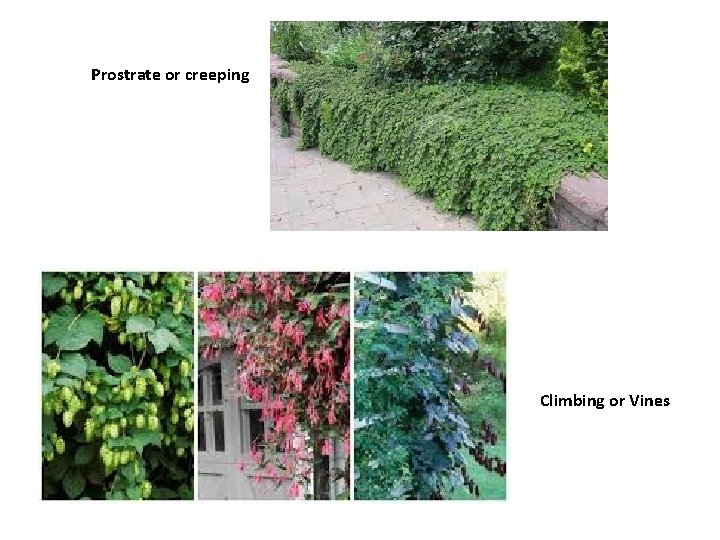
5. Position of Growth Erect – upright – grow upward Prostrate or creeping – crawl along the surface grounds. Climbing or Vines – those that cling the larger objects by adaptive devices such as twinners or thorns.
Prostrate or creeping Climbing or Vines
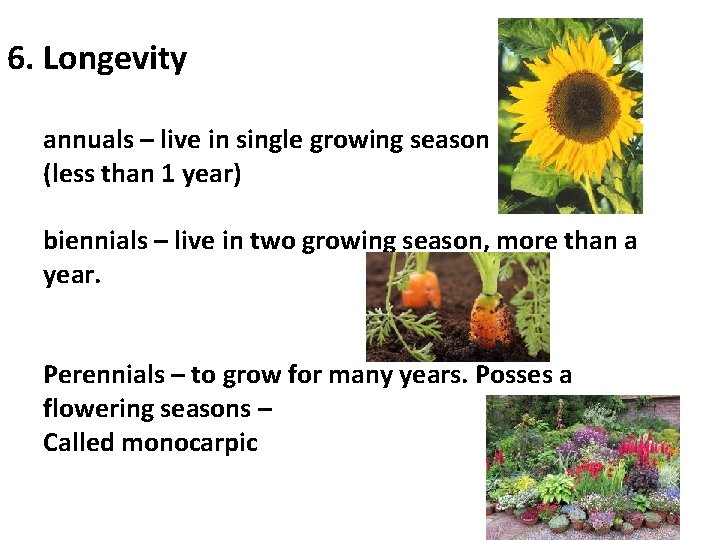
6. Longevity annuals – live in single growing season (less than 1 year) biennials – live in two growing season, more than a year. Perennials – to grow for many years. Posses a flowering seasons – Called monocarpic
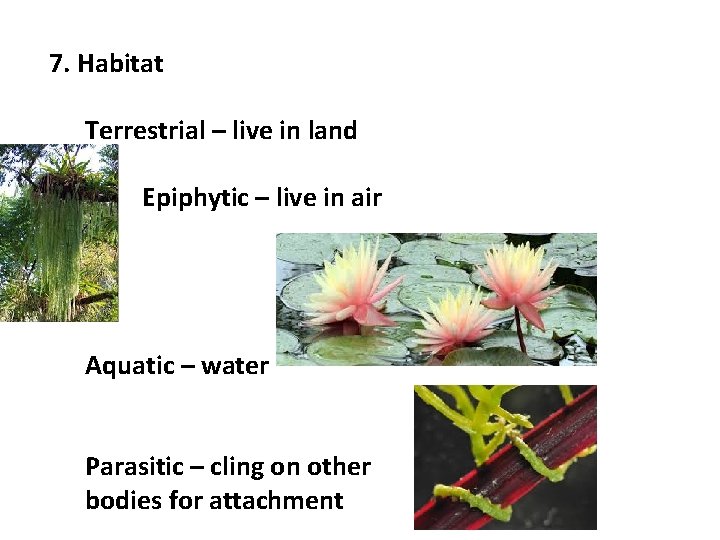
7. Habitat Terrestrial – live in land Epiphytic – live in air Aquatic – water Parasitic – cling on other bodies for attachment
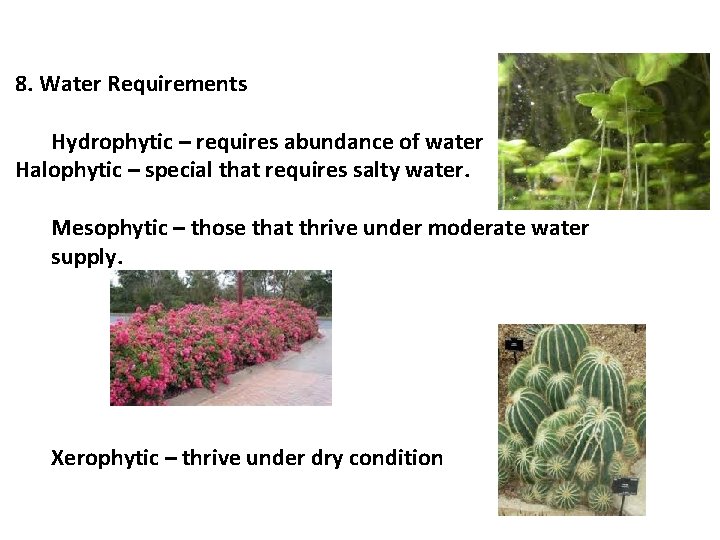
8. Water Requirements Hydrophytic – requires abundance of water Halophytic – special that requires salty water. Mesophytic – those that thrive under moderate water supply. Xerophytic – thrive under dry condition
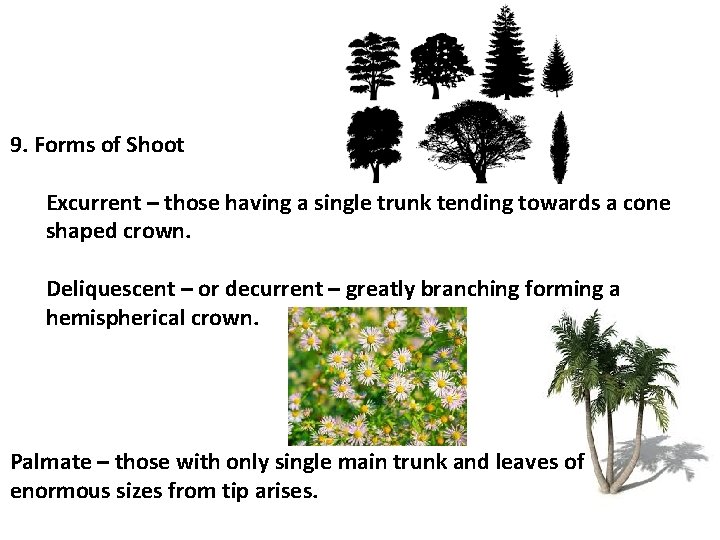
9. Forms of Shoot Excurrent – those having a single trunk tending towards a cone shaped crown. Deliquescent – or decurrent – greatly branching forming a hemispherical crown. Palmate – those with only single main trunk and leaves of enormous sizes from tip arises.
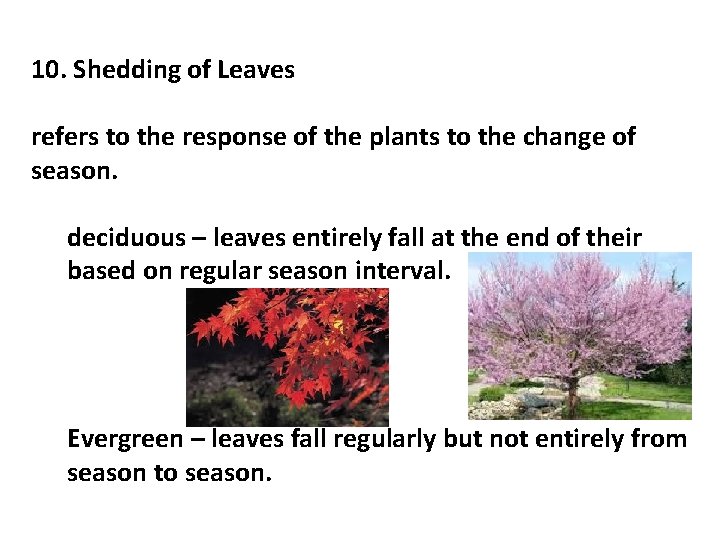
10. Shedding of Leaves refers to the response of the plants to the change of season. deciduous – leaves entirely fall at the end of their based on regular season interval. Evergreen – leaves fall regularly but not entirely from season to season.
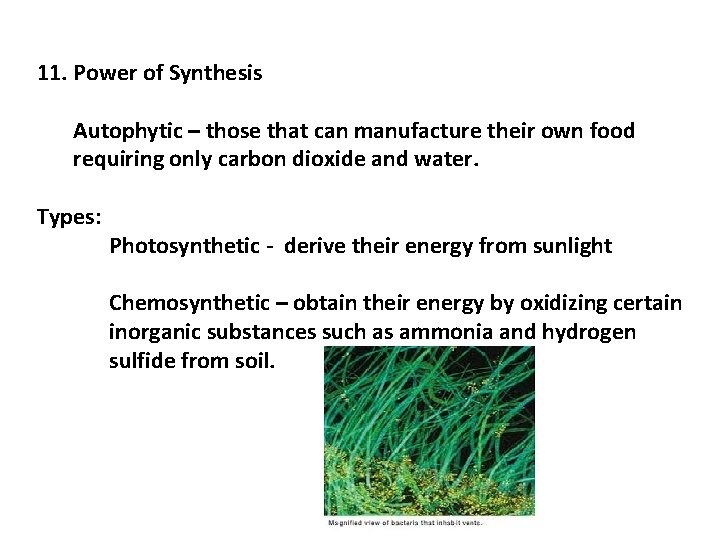
11. Power of Synthesis Autophytic – those that can manufacture their own food requiring only carbon dioxide and water. Types: Photosynthetic - derive their energy from sunlight Chemosynthetic – obtain their energy by oxidizing certain inorganic substances such as ammonia and hydrogen sulfide from soil.
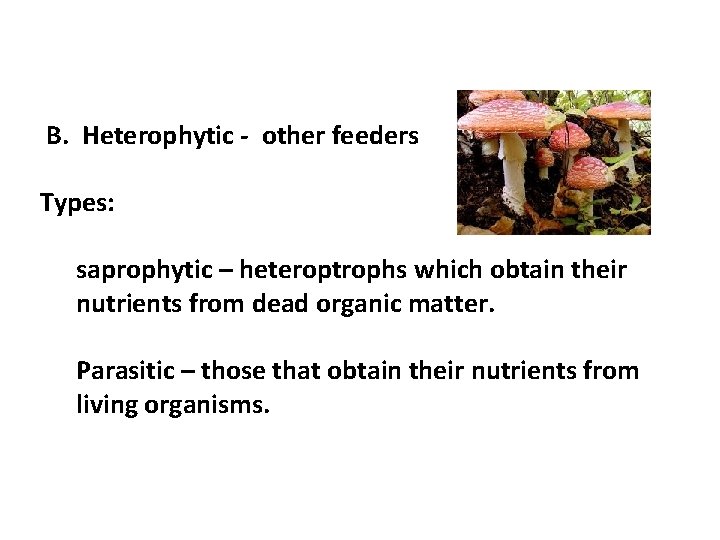
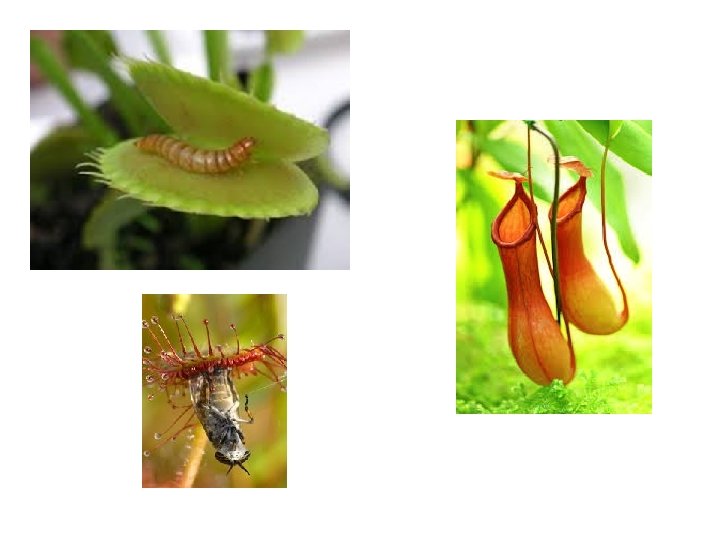
B. Heterophytic - other feeders Types: saprophytic – heteroptrophs which obtain their nutrients from dead organic matter. Parasitic – those that obtain their nutrients from living organisms.
ACTIVITIES OF PLANTS A. Vegetative Activities – those which have to do with the growth and preservation of the individual. Absorption – accumulation of materials via osmosis Translocation – transferring of materials via xylem and phloem. Photosynthesis – process of using the energy to manufacture food via food conversion.
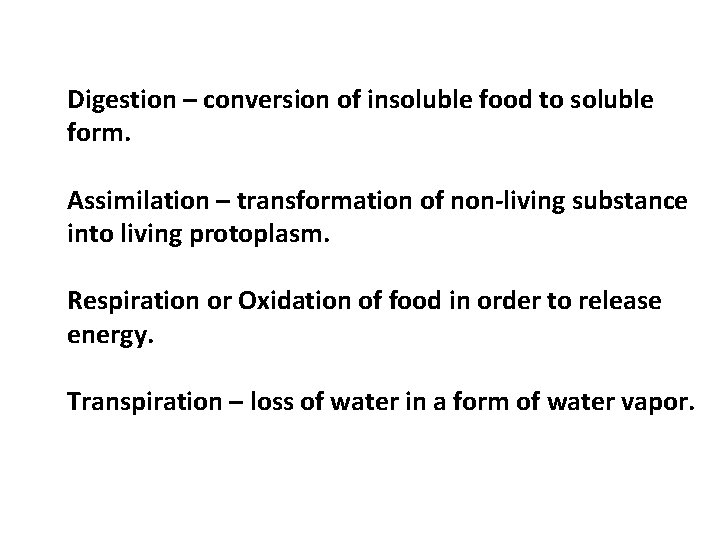
Digestion – conversion of insoluble food to soluble form. Assimilation – transformation of non-living substance into living protoplasm. Respiration or Oxidation of food in order to release energy. Transpiration – loss of water in a form of water vapor.
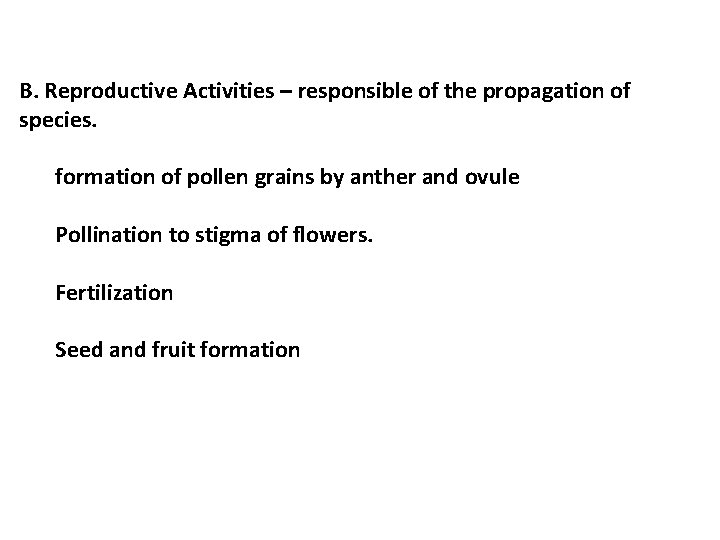
B. Reproductive Activities – responsible of the propagation of species. formation of pollen grains by anther and ovule Pollination to stigma of flowers. Fertilization Seed and fruit formation
Application: Classify the following Plants: 1. Pine tree (Pinus insularis) 2. Squash (Cucurbita maxima)
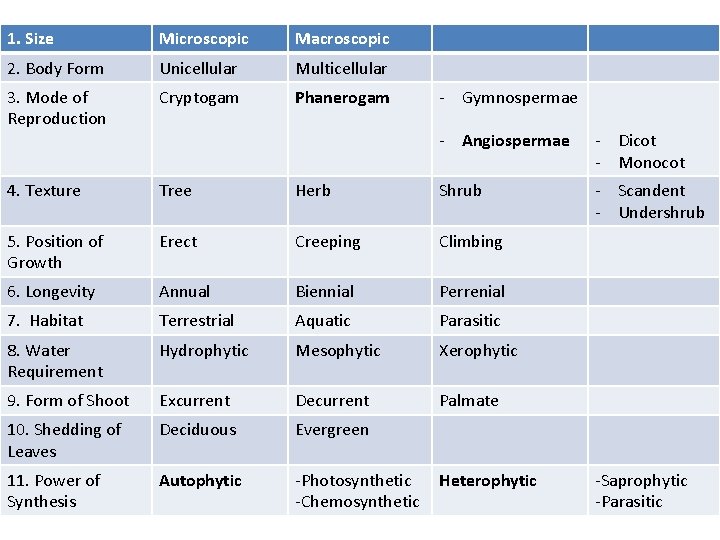
1. Size Microscopic Macroscopic 2. Body Form Unicellular Multicellular 3. Mode of Reproduction Cryptogam Phanerogam 4. Texture Tree 5. Position of Growth - Gymnospermae - Angiospermae - Dicot - Monocot Herb Shrub - Scandent - Undershrub Erect Creeping Climbing 6. Longevity Annual Biennial Perrenial 7. Habitat Terrestrial Aquatic Parasitic 8. Water Requirement Hydrophytic Mesophytic Xerophytic 9. Form of Shoot Excurrent Decurrent Palmate 10. Shedding of Leaves Deciduous Evergreen 11. Power of Synthesis Autophytic -Photosynthetic -Chemosynthetic Heterophytic -Saprophytic -Parasitic