
The Planning of Reliability Centered Maintenance Programs for
The Planning of Reliability Centered Maintenance Programs for Nuclear Fusion Power Plant I-Li Lu, Ph. D. Applied Statistics, Applied Mathematics Platform Performance Technology BOEING is a trademark of Boeing Management Company. Copyright © 2011 Boeing. All rights reserved. EOT_RT_Template. ppt | 8/1/2011 1
Presentation Outline Engineering, Operations & Technology | Boeing Research & Technology Fa. ST | Flight Sciences Technology § Objectives § Solutions based on the Integrated Decision Evaluation & Analysis System (IDEAS) § Optimization Concepts § Cyclical Random Plasma Leakage Models § Simulation § Conclusion Copyright © 2011 Boeing. All rights reserved. EOT_RT_Template. ppt | 2
Objectives Engineering, Operations & Technology | Boeing Research & Technology Fa. ST | Flight Sciences Technology § Reliability, Availability, Maintainability, and Inspectability (RAMI): § DEMO must demonstrate a high enough availability for power producers to build a commercial fusion plant. § Power producers cannot expect an ultimate fusion power plant availability of 80% (or more) if DEMO cannot demonstrate a 50% or higher availability. Achieving this DEMO availability goal will require reliability in component design, design integration for RAMI , high maintainability, and systems to monitor and inspect components. We must develop and qualify methods and capabilities needed to achieve RAMI objectives. Copyright © 2011 Boeing. All rights reserved. EOT_RT_Template. ppt | 3
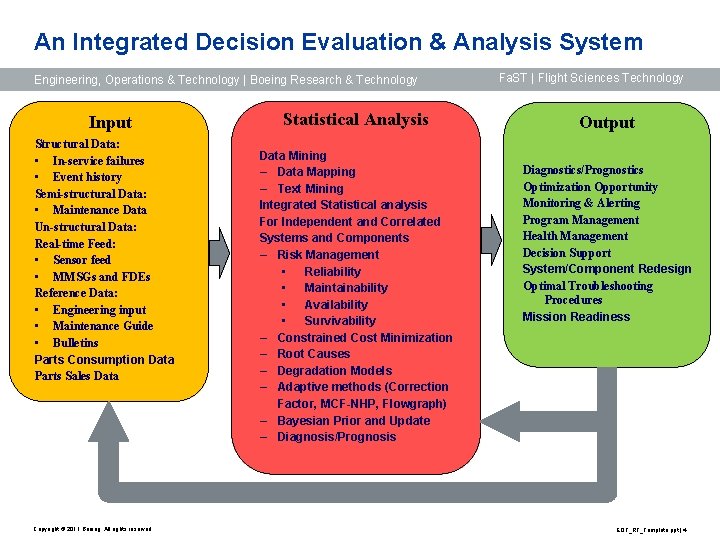
An Integrated Decision Evaluation & Analysis System Engineering, Operations & Technology | Boeing Research & Technology Input Structural Data: • In-service failures • Event history Semi-structural Data: • Maintenance Data Un-structural Data: Real-time Feed: • Sensor feed • MMSGs and FDEs Reference Data: • Engineering input • Maintenance Guide • Bulletins Parts Consumption Data Parts Sales Data Copyright © 2011 Boeing. All rights reserved. Statistical Analysis Data Mining – Data Mapping – Text Mining Integrated Statistical analysis For Independent and Correlated Systems and Components – Risk Management • Reliability • Maintainability • Availability • Survivability – Constrained Cost Minimization – Root Causes – Degradation Models – Adaptive methods (Correction Factor, MCF-NHP, Flowgraph) – Bayesian Prior and Update – Diagnosis/Prognosis Fa. ST | Flight Sciences Technology Output Diagnostics/Prognostics Optimization Opportunity Monitoring & Alerting Program Management Health Management Decision Support System/Component Redesign Optimal Troubleshooting Procedures Mission Readiness EOT_RT_Template. ppt | 4
Fusion R&D-Unique Tailoring Engineering, Operations & Technology | Boeing Research & Technology Fa. ST | Flight Sciences Technology • Inherent, but not obvious, in Reliability Centered Maintenance (RCM) and IDEAS is the process for handling large technological leaps • Large technology leaps were the hidden driver for RCM and IDEAS • IDEAS includes: 1. Standardized reliability analysis processes 2. Statistical treatment of recorded data 3. Analysis of model-generated data 4. Feedback of the above into testing • Items 2 – 4 address technology leaps • Fusion tailoring must include a large expansion of modeling, analysis of model results, and input of analysis results into experiment planning Copyright © 2011 Boeing. All rights reserved. EOT_RT_Template. ppt | 5
Fusion RAMI Approach Engineering, Operations & Technology | Boeing Research & Technology Fa. ST | Flight Sciences Technology • Using standard methods, develop a Reliability Estimation Tool • Purposes of the Tool – Estimate reliability of the fusion power plant, plant systems, subsystems, and devices – Availability Estimates – Sensitivity Analyses • Maintenance Intervals • Maintenance Approach Analyses • Critical Item/Technology Identification – Experiment Planning Guidance – Facility Planning Guidance Copyright © 2011 Boeing. All rights reserved. EOT_RT_Template. ppt | 6

Reliability Estimation Tool Structure Engineering, Operations & Technology | Boeing Research & Technology Fa. ST | Flight Sciences Technology • Overall tool structure designed and maintained by Boeing • Plant → System → Subsystem → Element breakdown defined by Boeing and power plant team • Data Mining of historical results by Boeing • Physical modeling of material/component behavior (for situations where historical data is unavailable or inadequate) by power plant team members or fusion community at large, as needed • Feedback of tool results to power plant team by Boeing • Experiment/Facility planning inputs by power plant team to fusion community Copyright © 2011 Boeing. All rights reserved. EOT_RT_Template. ppt | 7
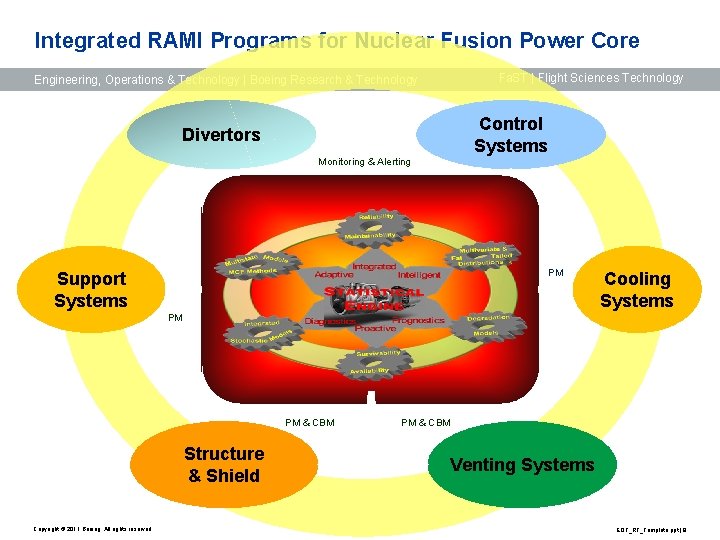
Integrated RAMI Programs for Nuclear Fusion Power Core Fa. ST | Flight Sciences Technology Engineering, Operations & Technology | Boeing Research & Technology Control Systems Divertors Monitoring & Alerting CBM PM PM Support Systems Cooling Systems PM PM & CBM Structure & Shield Copyright © 2011 Boeing. All rights reserved. PM & CBM Venting Systems EOT_RT_Template. ppt | 8
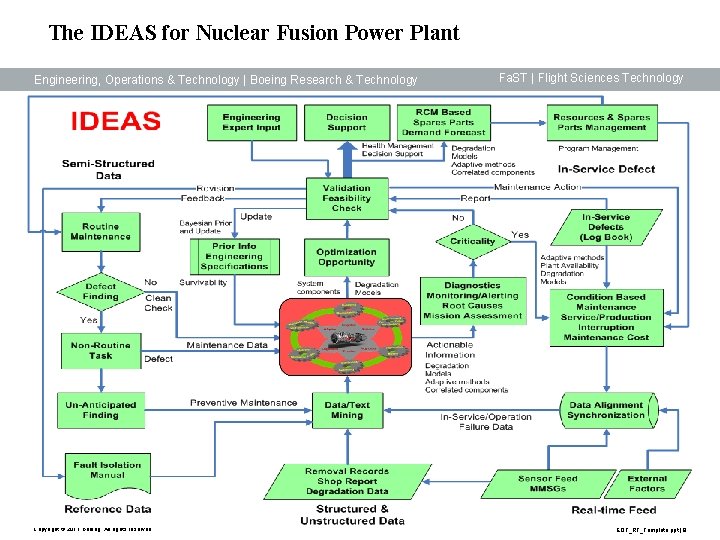
The IDEAS for Nuclear Fusion Power Plant Engineering, Operations & Technology | Boeing Research & Technology Copyright © 2011 Boeing. All rights reserved. Fa. ST | Flight Sciences Technology EOT_RT_Template. ppt | 9
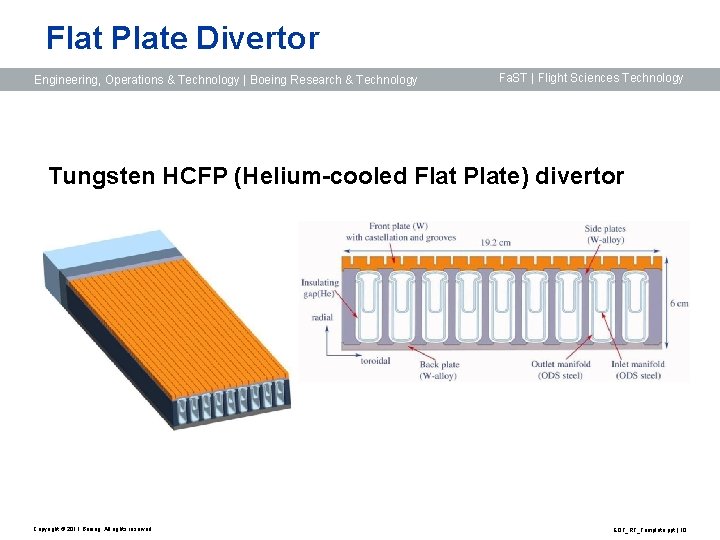
Flat Plate Divertor Engineering, Operations & Technology | Boeing Research & Technology Fa. ST | Flight Sciences Technology Tungsten HCFP (Helium-cooled Flat Plate) divertor Copyright © 2011 Boeing. All rights reserved. EOT_RT_Template. ppt | 10
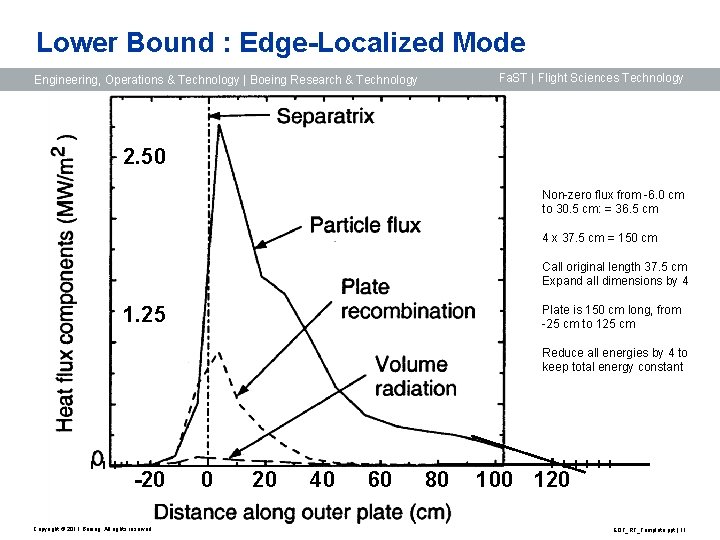
Lower Bound : Edge-Localized Mode Fa. ST | Flight Sciences Technology Engineering, Operations & Technology | Boeing Research & Technology 2. 50 Non-zero flux from -6. 0 cm to 30. 5 cm: = 36. 5 cm 4 x 37. 5 cm = 150 cm Call original length 37. 5 cm Expand all dimensions by 4 1. 25 Plate is 150 cm long, from -25 cm to 125 cm Reduce all energies by 4 to keep total energy constant -20 Copyright © 2011 Boeing. All rights reserved. 0 20 40 60 80 100 120 EOT_RT_Template. ppt | 11
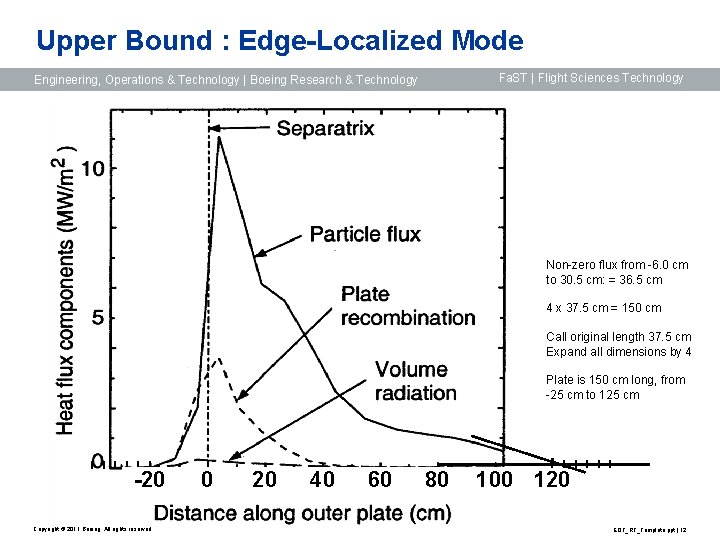
Upper Bound : Edge-Localized Mode Fa. ST | Flight Sciences Technology Engineering, Operations & Technology | Boeing Research & Technology Non-zero flux from -6. 0 cm to 30. 5 cm: = 36. 5 cm 4 x 37. 5 cm = 150 cm Call original length 37. 5 cm Expand all dimensions by 4 Plate is 150 cm long, from -25 cm to 125 cm -20 Copyright © 2011 Boeing. All rights reserved. 0 20 40 60 80 100 120 EOT_RT_Template. ppt | 12
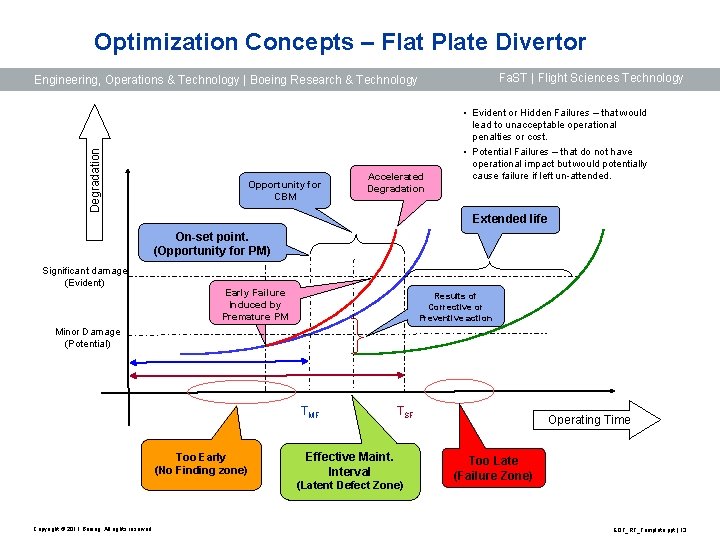
Optimization Concepts – Flat Plate Divertor Fa. ST | Flight Sciences Technology Degradation Engineering, Operations & Technology | Boeing Research & Technology Opportunity for CBM Accelerated Degradation • Evident or Hidden Failures – that would lead to unacceptable operational penalties or cost. • Potential Failures – that do not have operational impact but would potentially cause failure if left un-attended. Extended life On-set point. (Opportunity for PM) Significant damage (Evident) Early Failure Induced by Premature PM Results of Corrective or Preventive action Minor Damage (Potential) TMF Too Early (No Finding zone) TSF Effective Maint. Interval (Latent Defect Zone) Copyright © 2011 Boeing. All rights reserved. Operating Time Too Late (Failure Zone) EOT_RT_Template. ppt | 13
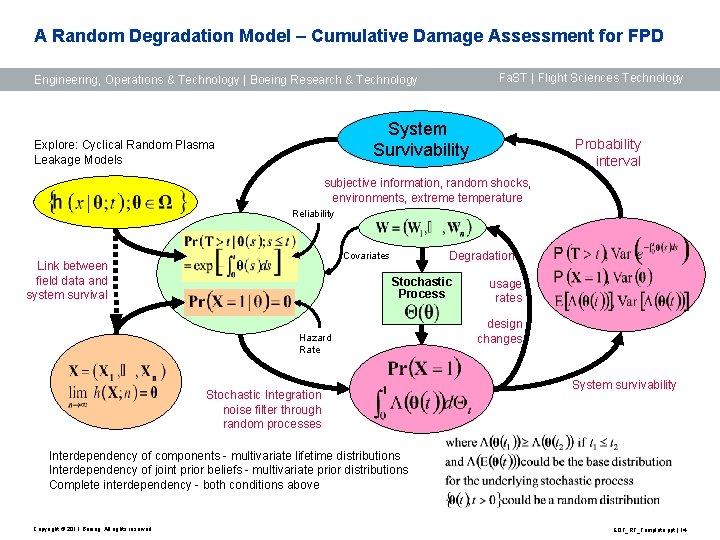
A Random Degradation Model – Cumulative Damage Assessment for FPD Fa. ST | Flight Sciences Technology Engineering, Operations & Technology | Boeing Research & Technology System Survivability Explore: Cyclical Random Plasma Leakage Models Probability interval subjective information, random shocks, environments, extreme temperature Reliability Degradation Covariates Link between field data and system survival Stochastic Process Hazard Rate Stochastic Integration noise filter through random processes usage rates design changes System survivability Interdependency of components - multivariate lifetime distributions Interdependency of joint prior beliefs - multivariate prior distributions Complete interdependency - both conditions above Copyright © 2011 Boeing. All rights reserved. EOT_RT_Template. ppt | 14
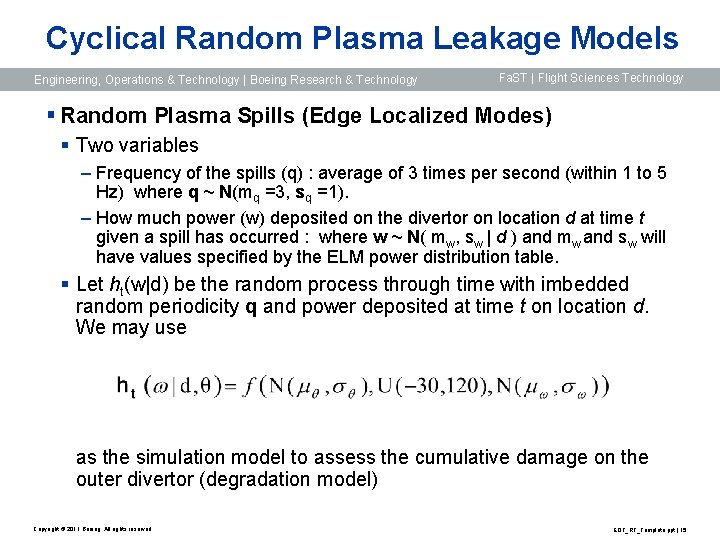
Cyclical Random Plasma Leakage Models Engineering, Operations & Technology | Boeing Research & Technology Fa. ST | Flight Sciences Technology § Random Plasma Spills (Edge Localized Modes) § Two variables – Frequency of the spills (q) : average of 3 times per second (within 1 to 5 Hz) where q ~ N(mq =3, sq =1). – How much power (w) deposited on the divertor on location d at time t given a spill has occurred : where w ~ N( mw, sw | d ) and mw and sw will have values specified by the ELM power distribution table. § Let ht(w|d) be the random process through time with imbedded random periodicity q and power deposited at time t on location d. We may use as the simulation model to assess the cumulative damage on the outer divertor (degradation model) Copyright © 2011 Boeing. All rights reserved. EOT_RT_Template. ppt | 15
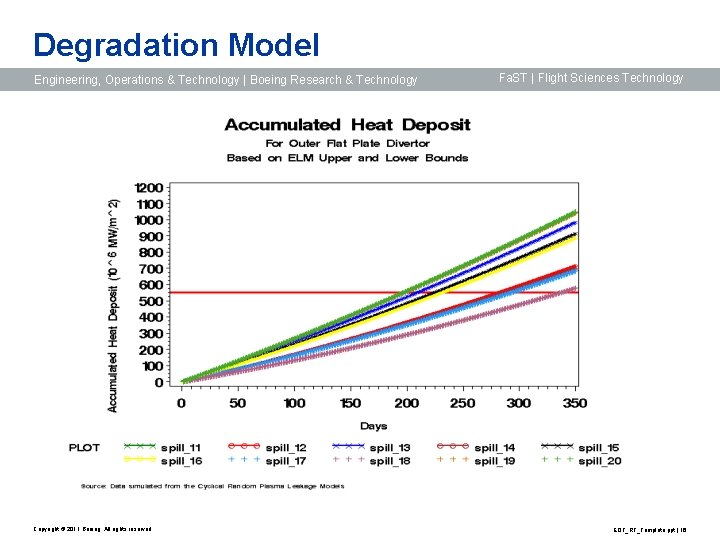
Degradation Model Engineering, Operations & Technology | Boeing Research & Technology Copyright © 2011 Boeing. All rights reserved. Fa. ST | Flight Sciences Technology EOT_RT_Template. ppt | 16
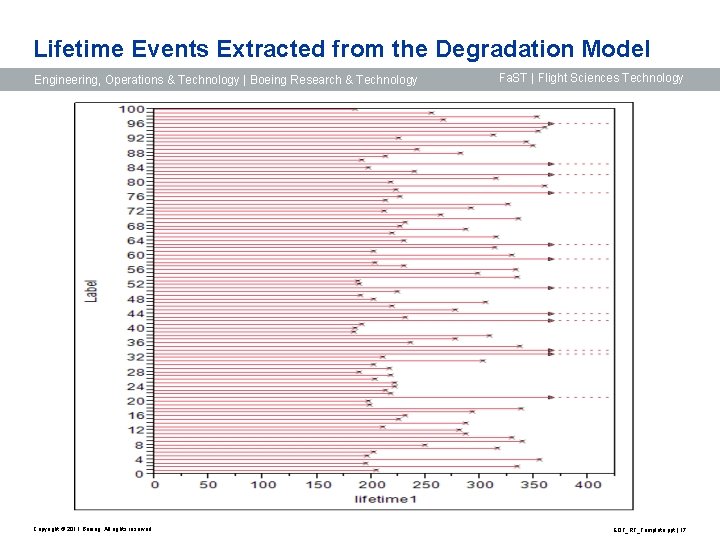
Lifetime Events Extracted from the Degradation Model Engineering, Operations & Technology | Boeing Research & Technology Copyright © 2011 Boeing. All rights reserved. Fa. ST | Flight Sciences Technology EOT_RT_Template. ppt | 17
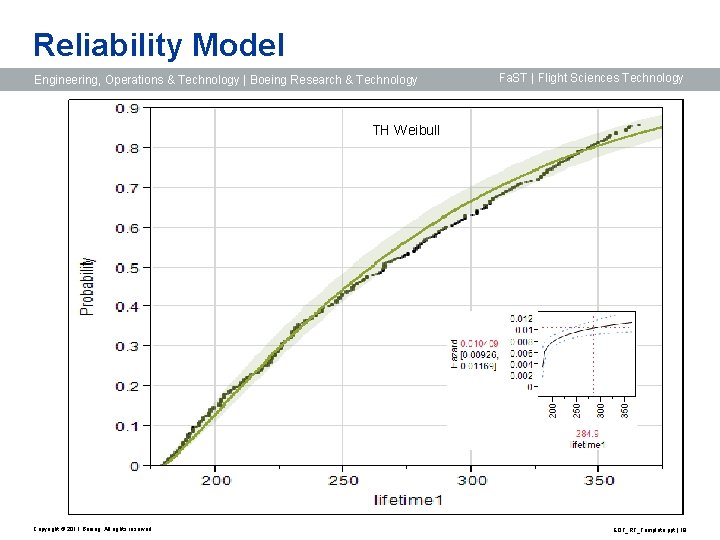
Reliability Model Engineering, Operations & Technology | Boeing Research & Technology Fa. ST | Flight Sciences Technology TH Weibull Copyright © 2011 Boeing. All rights reserved. EOT_RT_Template. ppt | 18
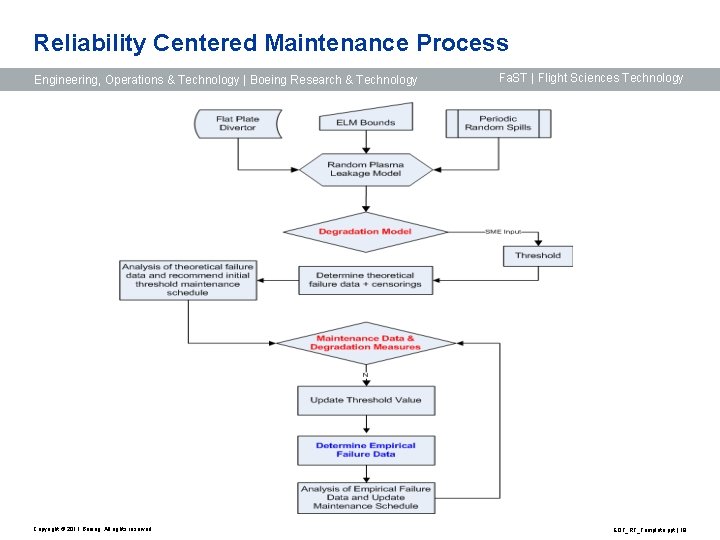
Reliability Centered Maintenance Process Engineering, Operations & Technology | Boeing Research & Technology Copyright © 2011 Boeing. All rights reserved. Fa. ST | Flight Sciences Technology EOT_RT_Template. ppt | 19
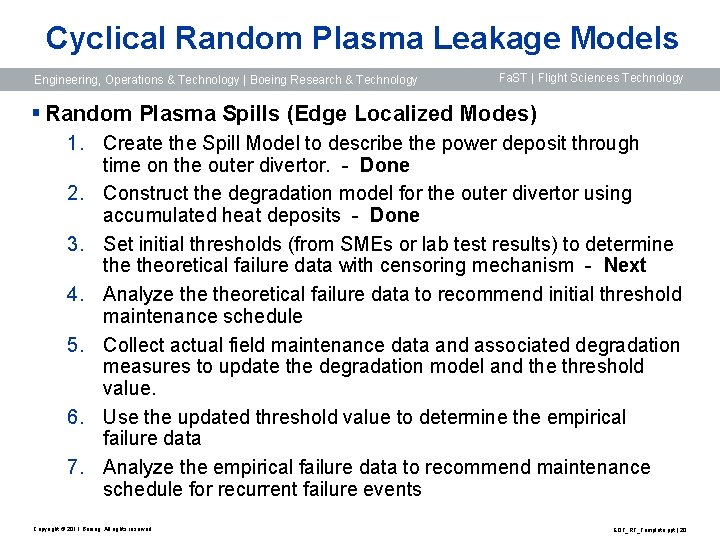
Cyclical Random Plasma Leakage Models Engineering, Operations & Technology | Boeing Research & Technology Fa. ST | Flight Sciences Technology § Random Plasma Spills (Edge Localized Modes) 1. Create the Spill Model to describe the power deposit through time on the outer divertor. - Done 2. Construct the degradation model for the outer divertor using accumulated heat deposits - Done 3. Set initial thresholds (from SMEs or lab test results) to determine theoretical failure data with censoring mechanism - Next 4. Analyze theoretical failure data to recommend initial threshold maintenance schedule 5. Collect actual field maintenance data and associated degradation measures to update the degradation model and the threshold value. 6. Use the updated threshold value to determine the empirical failure data 7. Analyze the empirical failure data to recommend maintenance schedule for recurrent failure events Copyright © 2011 Boeing. All rights reserved. EOT_RT_Template. ppt | 20
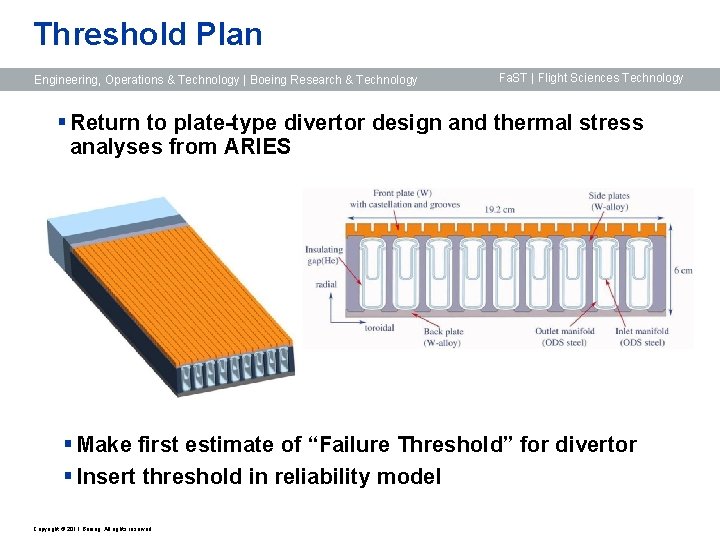
Threshold Plan Engineering, Operations & Technology | Boeing Research & Technology Fa. ST | Flight Sciences Technology § Return to plate-type divertor design and thermal stress analyses from ARIES § Make first estimate of “Failure Threshold” for divertor § Insert threshold in reliability model Copyright © 2011 Boeing. All rights reserved.

Engineering, Operations & Technology | Boeing Research & Technology Copyright © 2011 Boeing. All rights reserved. Fa. ST | Flight Sciences Technology EOT_RT_Template. ppt | 22
- Slides: 22