
The Planets Mercury Venus Earth Mars Jupiter Saturn


- Slides: 13
The Planets Mercury, Venus, Earth, Mars, Jupiter, Saturn, Uranus, Neptune, (Pluto? )
How far away are the planets?
Astronomical Unit n n We use AU’s to measure the distance between planets. 1 AU is the distance from the Sun to the Earth. 1 AU = 150 million kilometers or 93 million miles Mercury is. 5 AU from the Sun and Pluto is 50 AU from the sun
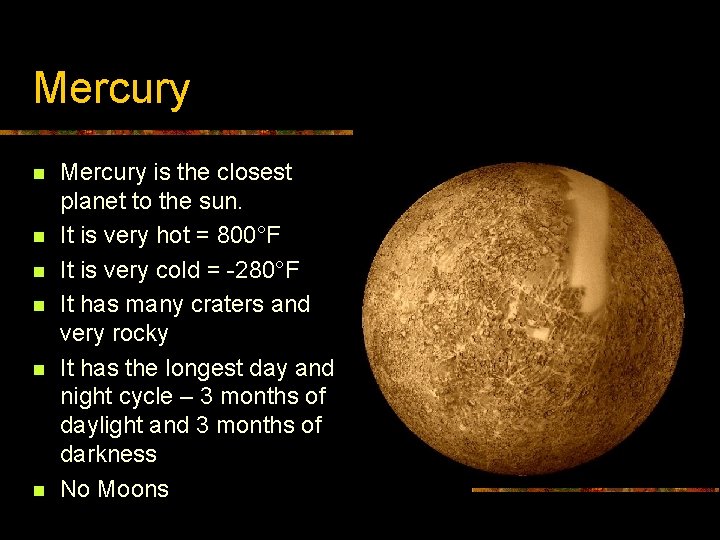
Mercury n n n Mercury is the closest planet to the sun. It is very hot = 800°F It is very cold = -280°F It has many craters and very rocky It has the longest day and night cycle – 3 months of daylight and 3 months of darkness No Moons
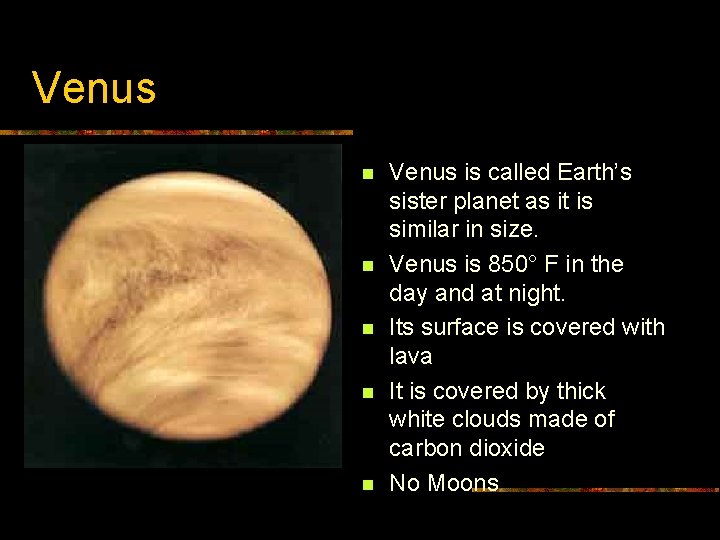
Venus n n n Venus is called Earth’s sister planet as it is similar in size. Venus is 850° F in the day and at night. Its surface is covered with lava It is covered by thick white clouds made of carbon dioxide No Moons
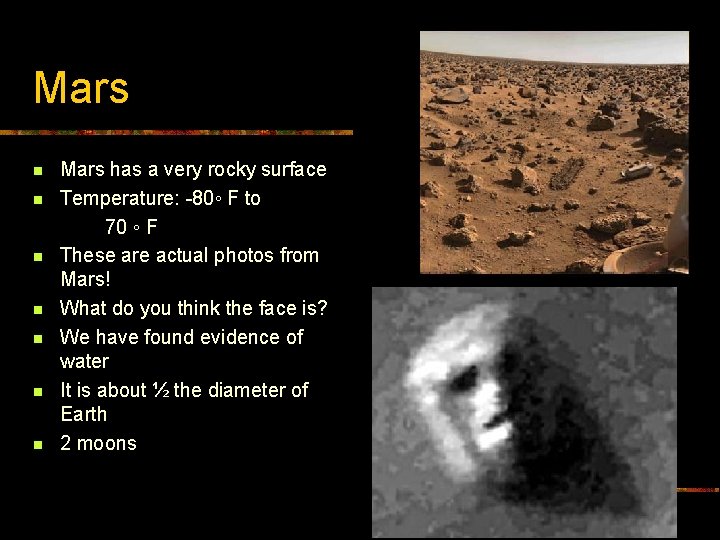
Mars n n n n Mars has a very rocky surface Temperature: -80◦ F to 70 ◦ F These are actual photos from Mars! What do you think the face is? We have found evidence of water It is about ½ the diameter of Earth 2 moons
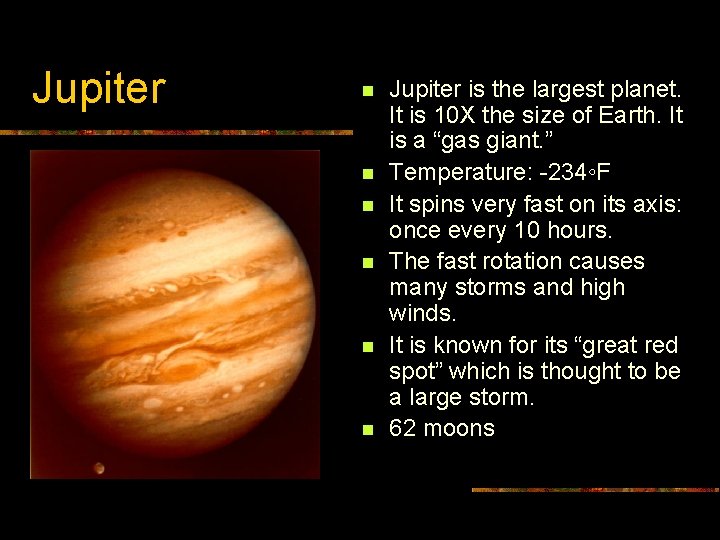
Jupiter n n n Jupiter is the largest planet. It is 10 X the size of Earth. It is a “gas giant. ” Temperature: -234◦F It spins very fast on its axis: once every 10 hours. The fast rotation causes many storms and high winds. It is known for its “great red spot” which is thought to be a large storm. 62 moons
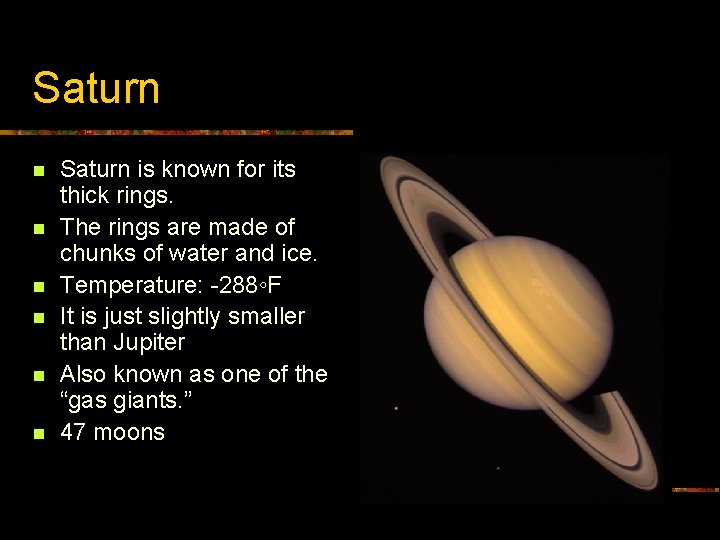
Saturn n n n Saturn is known for its thick rings. The rings are made of chunks of water and ice. Temperature: -288◦F It is just slightly smaller than Jupiter Also known as one of the “gas giants. ” 47 moons
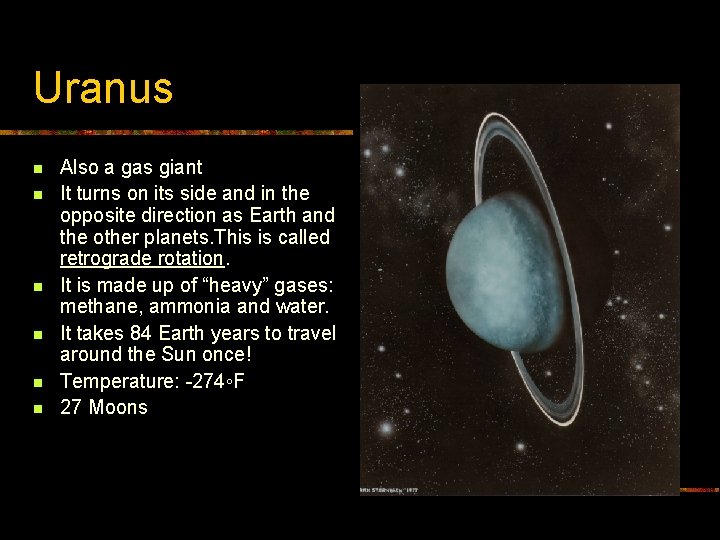
Uranus n n n Also a gas giant It turns on its side and in the opposite direction as Earth and the other planets. This is called retrograde rotation. It is made up of “heavy” gases: methane, ammonia and water. It takes 84 Earth years to travel around the Sun once! Temperature: -274◦F 27 Moons
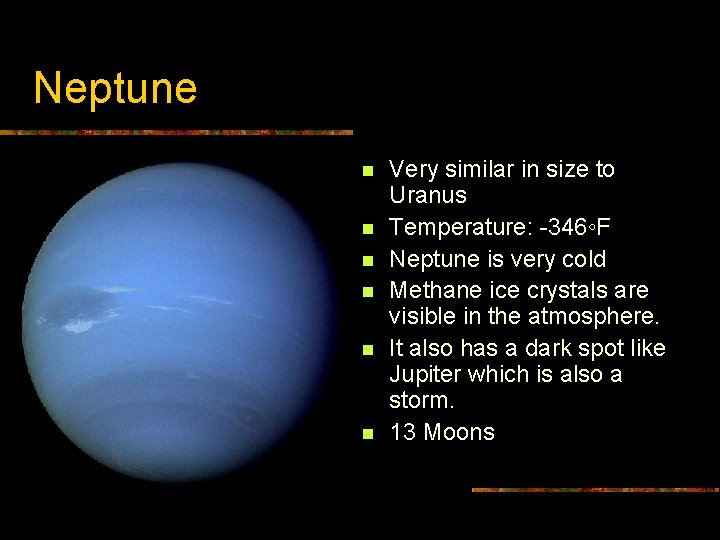
Neptune n n n Very similar in size to Uranus Temperature: -346◦F Neptune is very cold Methane ice crystals are visible in the atmosphere. It also has a dark spot like Jupiter which is also a storm. 13 Moons
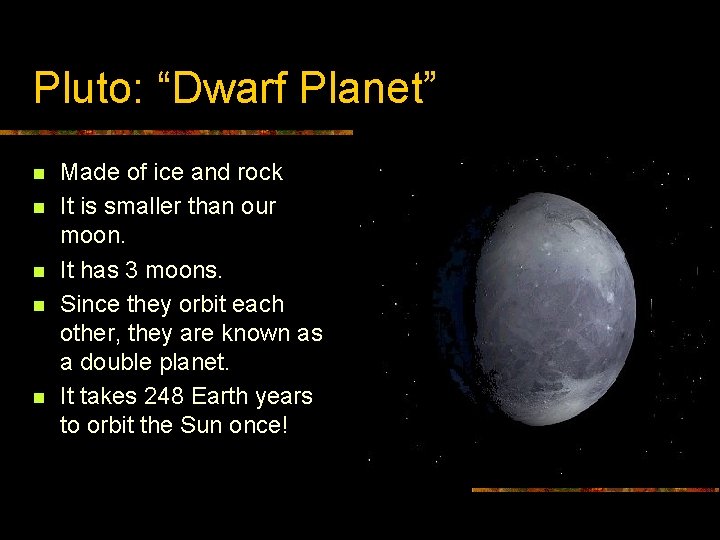
Pluto: “Dwarf Planet” n n n Made of ice and rock It is smaller than our moon. It has 3 moons. Since they orbit each other, they are known as a double planet. It takes 248 Earth years to orbit the Sun once!
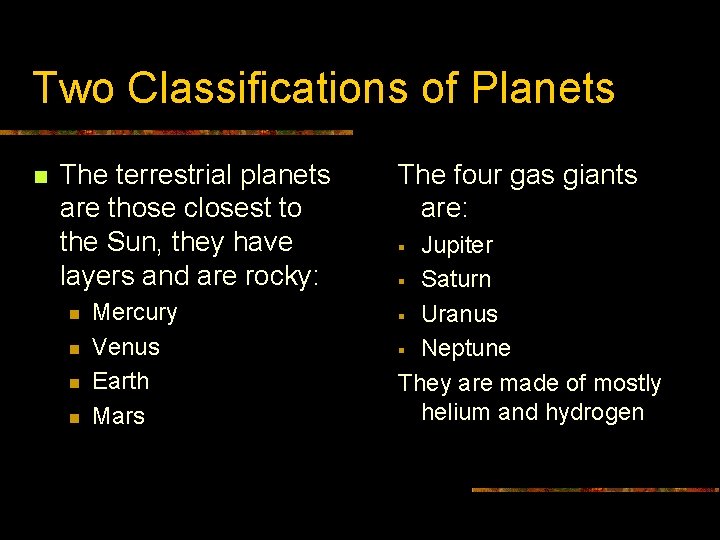
Two Classifications of Planets n The terrestrial planets are those closest to the Sun, they have layers and are rocky: n n Mercury Venus Earth Mars The four gas giants are: Jupiter § Saturn § Uranus § Neptune They are made of mostly helium and hydrogen §
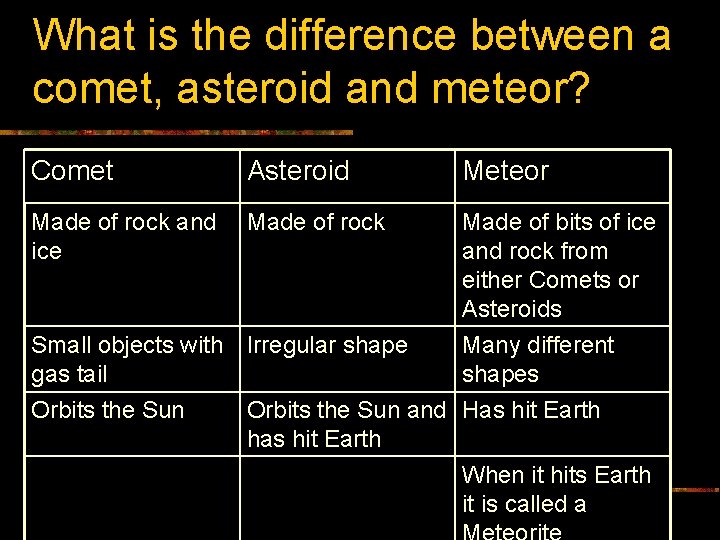
What is the difference between a comet, asteroid and meteor? Comet Asteroid Meteor Made of rock and ice Made of rock Made of bits of ice and rock from either Comets or Asteroids Small objects with Irregular shape gas tail Orbits the Sun Many different shapes Orbits the Sun and Has hit Earth has hit Earth When it hits Earth it is called a