
The Planetary Society Living Interplanetary Flight Experiment LIFE



- Slides: 21
The Planetary Society Living Interplanetary Flight Experiment (LIFE) Moscow Solar System Symposium (1 M-S 3) 11 -15 October 2010 1 MS-3 LOUIS FRIEDMAN 1
LIFE �Testing the Theory of Transpermia �Survivability of micro-organisms on a voyage between the planets �Pathfinder to Mars Sample Return �Including biological sample handling �First Deliberate Sending of Earth Life into the Solar System 11 -15 October 2010 1 MS-3 LOUIS FRIEDMAN 2
Testing Transpermia THE INTERPLANETARY TRANSFER OF BIOLOGICAL MATERIAL
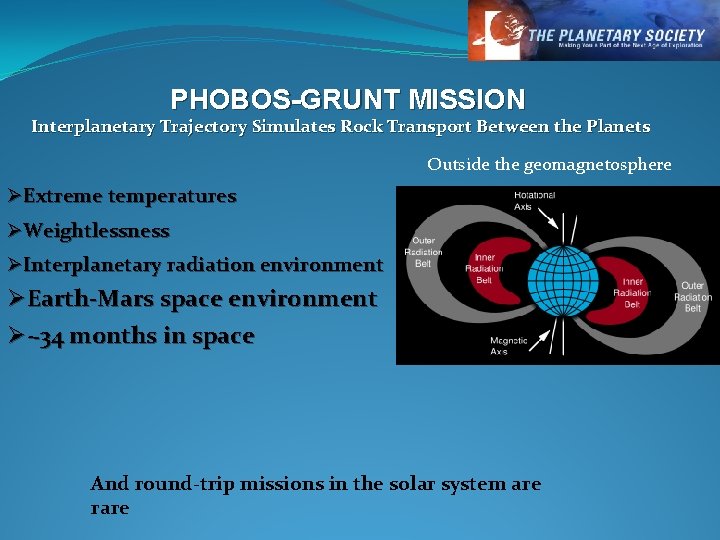
PHOBOS-GRUNT MISSION Interplanetary Trajectory Simulates Rock Transport Between the Planets Outside the geomagnetosphere ØExtreme temperatures ØWeightlessness ØInterplanetary radiation environment ØEarth-Mars space environment Ø~34 months in space And round-trip missions in the solar system are rare
Phobos LIFE Team � Science Team � Bruce Betts, Experiment Mgr. - The � � � � � Planetary Society Louis Friedman – The Planetary Society David Warmflash, Principal Investigator - U of Pennsylvania George Fox - U of Houston Neva Ciftcioglu – Nanobac Pharmaceuticals Inc K. Ingemar Jönsson, Kristianstad University, Sweden Joseph Kirschvinck – Caltech, U of Kyoto David Mc. Kay – NASA/JSC Cody Nash - Caltech Elena Vorobyova, Moscow State University Alexander Zakharov, Space Research Inst. 11 -15 October 2010 1 MS-3 LOUIS FRIEDMAN � ATCC Team Marian Mc. Kee (Team Lead) � Tim Lilburn � Amy Smith � DLR team � Petra Rettberg (Team Lead) � Elke Rabbow � Ralf Möller � Marko Waßmann � Thomas Berger � Gerda Horneck � Günther Reitz � � Engineering Team � Bud Fraze, Stellar Exploration � Tomas Svitek, Stellar Exploration 5
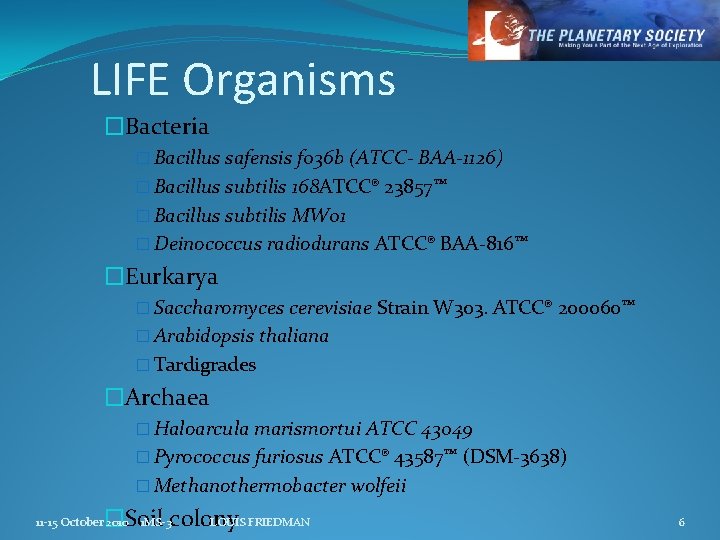
LIFE Organisms �Bacteria � Bacillus safensis f 036 b (ATCC- BAA-1126) � Bacillus subtilis 168 ATCC® 23857™ � Bacillus subtilis MW 01 � Deinococcus radiodurans ATCC® BAA-816™ �Eurkarya � Saccharomyces cerevisiae Strain W 303. ATCC® 200060™ � Arabidopsis thaliana � Tardigrades �Archaea � Haloarcula marismortui ATCC 43049 � Pyrococcus furiosus ATCC® 43587™ (DSM-3638) � Methanothermobacter wolfeii �Soil 1 MS-3 colony LOUIS FRIEDMAN 11 -15 October 2010 6
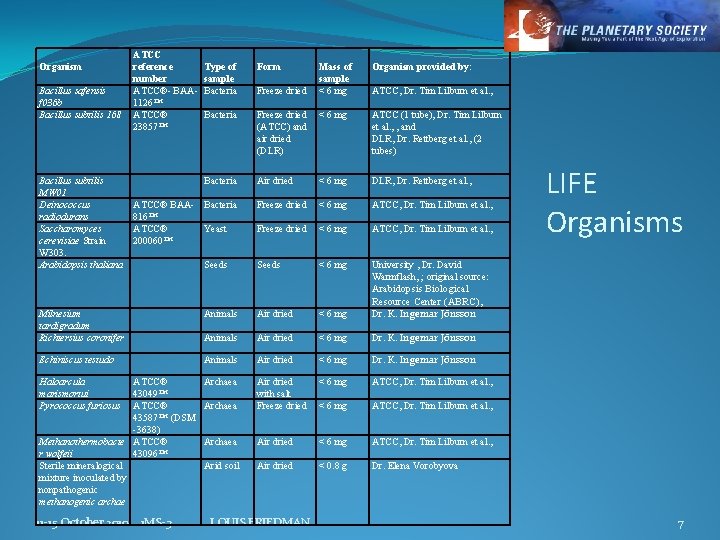
Organism Bacillus safensis f 036 b Bacillus subtilis 168 Bacillus subtilis MW 01 Deinococcus radiodurans Saccharomyces cerevisiae Strain W 303. Arabidopsis thaliana ATCC reference number ATCC®- BAA 1126™ ATCC® 23857™ Type of sample Bacteria Form Bacteria ATCC® BAA- Bacteria 816™ ATCC® Yeast 200060™ Seeds Mass of sample < 6 mg Organism provided by: Freeze dried (ATCC) and air dried (DLR) < 6 mg ATCC (1 tube), Dr. Tim Lilburn et al. , , and DLR, Dr. Rettberg et al. , (2 tubes) Air dried < 6 mg DLR, Dr. Rettberg et al. , Freeze dried < 6 mg ATCC, Dr. Tim Lilburn et al. , Seeds < 6 mg University , Dr. David Warmflash, ; original source: Freeze dried ATCC, Dr. Tim Lilburn et al. , Milnesium tardigradum Richtersius coronifer Animals Air dried < 6 mg Arabidopsis Biological Resource Center (ABRC), Dr. K. Ingemar Jönsson Animals Air dried < 6 mg Dr. K. Ingemar Jönsson Echiniscus testudo Animals Air dried < 6 mg Dr. K. Ingemar Jönsson Air dried with salt Freeze dried < 6 mg ATCC, Dr. Tim Lilburn et al. , Air dried < 0. 8 g Dr. Elena Vorobyova Haloarcula marismortui Pyrococcus furiosus ATCC® Archaea 43049™ ATCC® Archaea 43587™ (DSM -3638) Methanothermobacte ATCC® Archaea r wolfeii 43096™ Sterile mineralogical Arid soil mixture inoculated by nonpathogenic methanogenic archae 11 -15 October 2010 1 MS-3 LOUIS FRIEDMAN LIFE Organisms 7
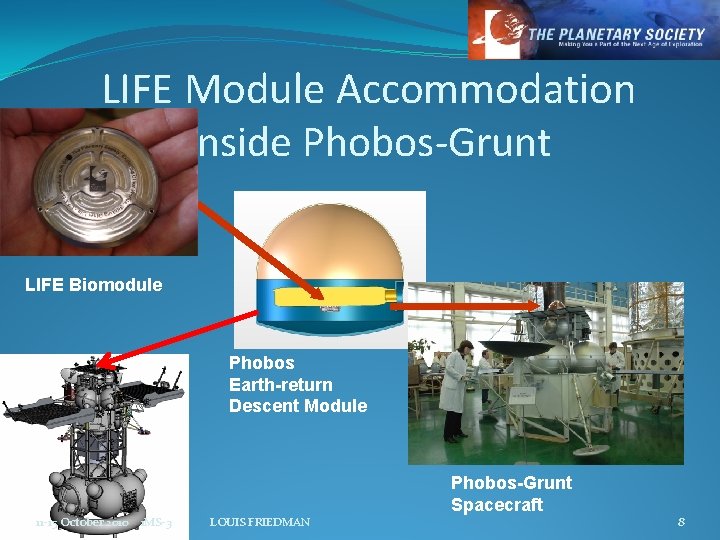
LIFE Module Accommodation Inside Phobos-Grunt LIFE Biomodule Phobos Earth-return Descent Module Phobos-Grunt Spacecraft 11 -15 October 2010 1 MS-3 LOUIS FRIEDMAN 8
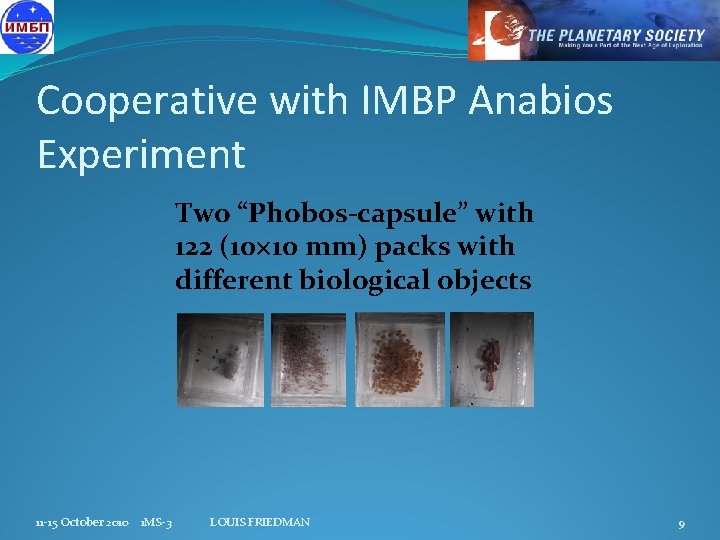
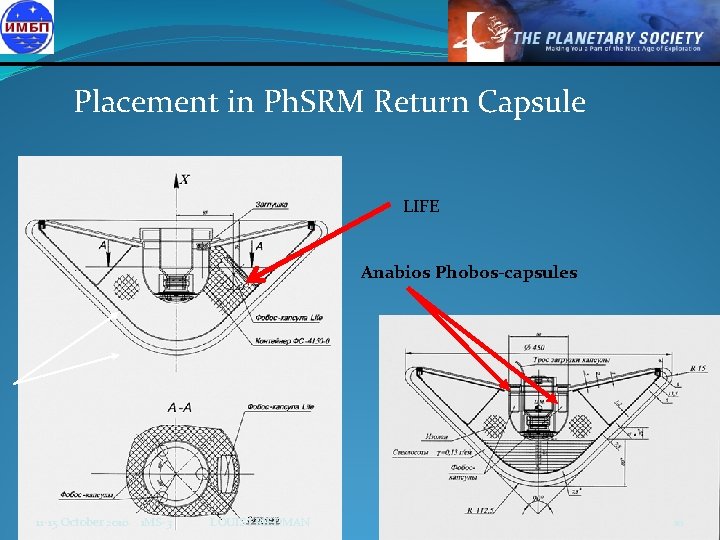
Cooperative with IMBP Anabios Experiment Two “Phobos-capsule” with 122 (10 10 mm) packs with different biological objects 11 -15 October 2010 1 MS-3 LOUIS FRIEDMAN 9
Placement in Ph. SRM Return Capsule LIFE Anabios Phobos-capsules 11 -15 October 2010 1 MS-3 LOUIS FRIEDMAN 10
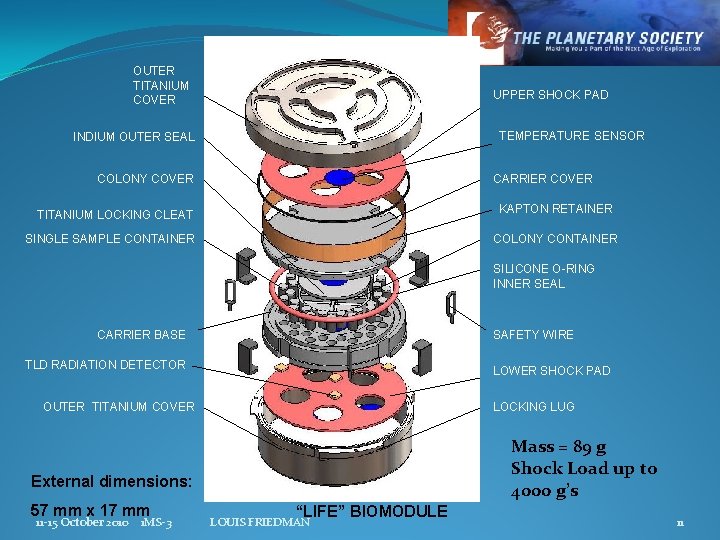
OUTER TITANIUM COVER UPPER SHOCK PAD TEMPERATURE SENSOR INDIUM OUTER SEAL COLONY COVER CARRIER COVER KAPTON RETAINER TITANIUM LOCKING CLEAT SINGLE SAMPLE CONTAINER COLONY CONTAINER SILICONE O-RING INNER SEAL CARRIER BASE SAFETY WIRE TLD RADIATION DETECTOR LOWER SHOCK PAD OUTER TITANIUM COVER LOCKING LUG Mass = 89 g Shock Load up to 4000 g’s External dimensions: 57 mm x 17 mm 11 -15 October 2010 1 MS-3 “LIFE” BIOMODULE LOUIS FRIEDMAN 11
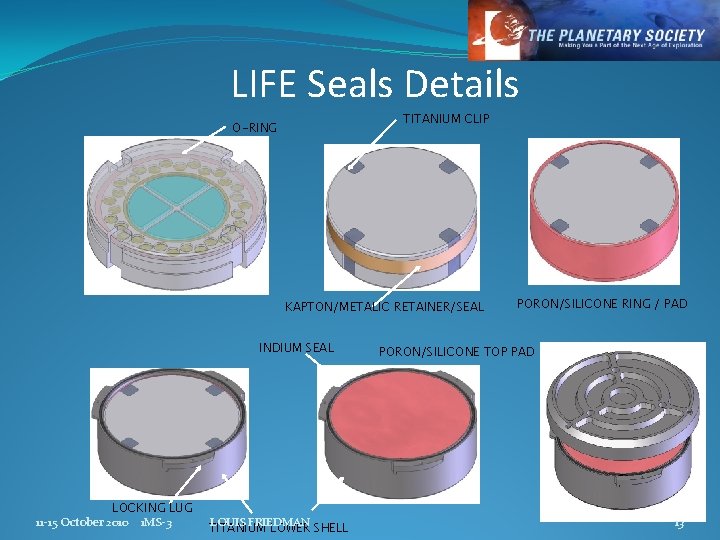
More on the LIFE Bio-module �Three-tiered vacuum seal with locking lugs and pins �Structural integrity was primary concern �Meets COSPAR Planetary Protection requirements with very low probability of hitting Mars and very high structural integrity �Accommodates diverse samples: 30 individual sample holders for 10 triplicate samples �Single “colony” soil sample �Includes passive radiation detectors inside biomodule �Includes thermal extremes detectors 11 -15 October 2010 1 MS-3 LOUIS FRIEDMAN 12
LIFE Seals Details TITANIUM CLIP O-RING KAPTON/METALIC RETAINER/SEAL INDIUM SEAL LOCKING LUG 11 -15 October 2010 1 MS-3 LOUIS FRIEDMAN TITANIUM LOWER SHELL PORON/SILICONE RING / PAD PORON/SILICONE TOP PAD 13
Impact tests > 4000 g’s 11 -15 October 2010 1 MS-3 LOUIS FRIEDMAN 14
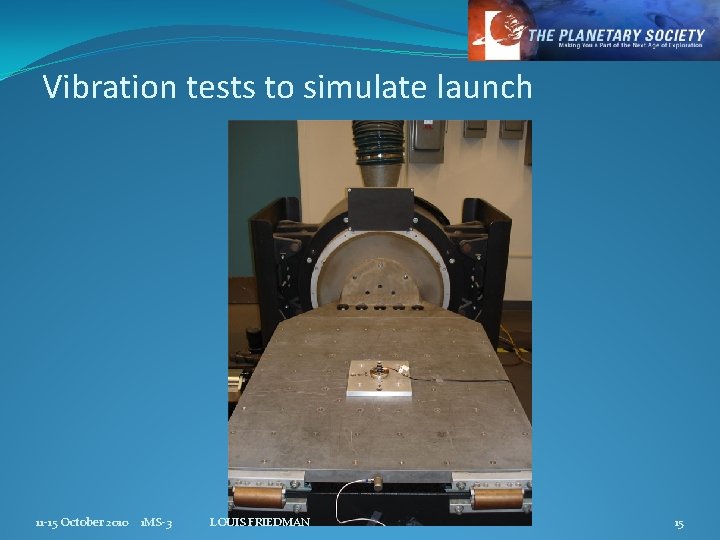
Vibration tests to simulate launch 11 -15 October 2010 1 MS-3 LOUIS FRIEDMAN 15
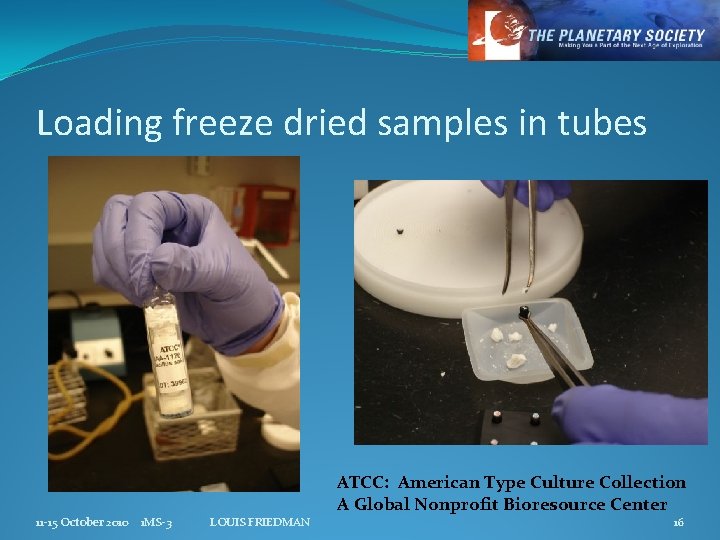
Loading freeze dried samples in tubes 11 -15 October 2010 1 MS-3 LOUIS FRIEDMAN ATCC: American Type Culture Collection A Global Nonprofit Bioresource Center 16
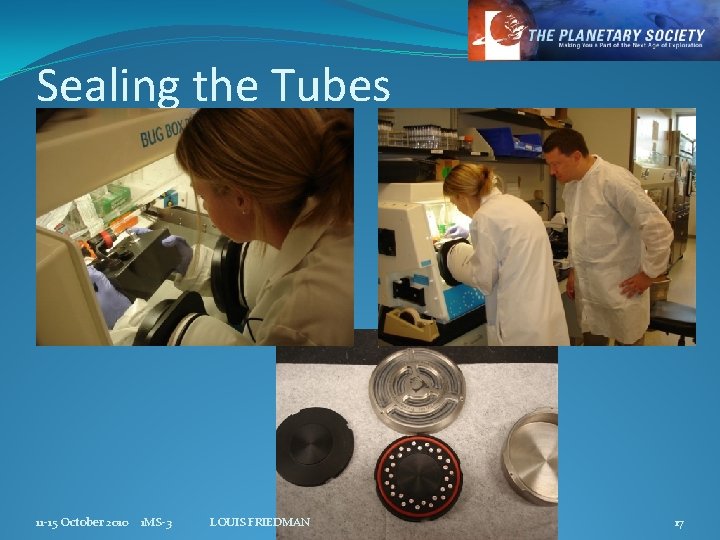
Sealing the Tubes 11 -15 October 2010 1 MS-3 LOUIS FRIEDMAN 17
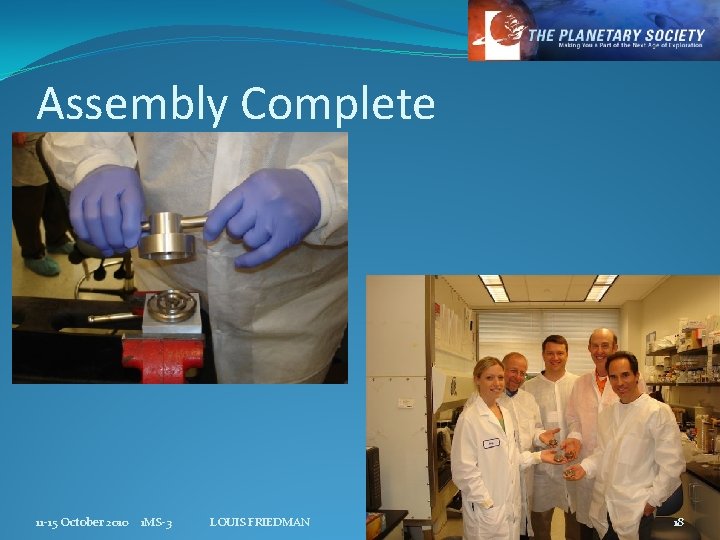
Assembly Complete 11 -15 October 2010 1 MS-3 LOUIS FRIEDMAN 18
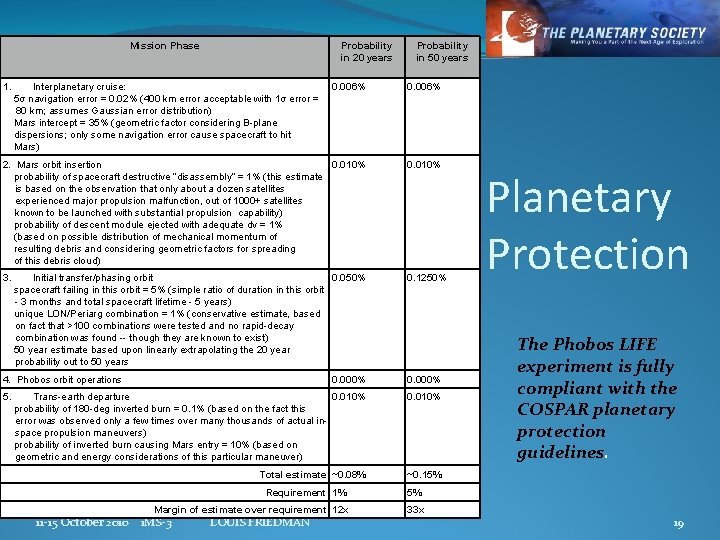
Mission Phase 1. Probability in 20 years Interplanetary cruise: 5σ navigation error = 0. 02% (400 km error acceptable with 1σ error = 80 km; assumes Gaussian error distribution) Mars intercept = 35% (geometric factor considering B-plane dispersions; only some navigation error cause spacecraft to hit Mars) Probability in 50 years 0. 006% 2. Mars orbit insertion 0. 010% probability of spacecraft destructive “disassembly” = 1% (this estimate is based on the observation that only about a dozen satellites experienced major propulsion malfunction, out of 1000+ satellites known to be launched with substantial propulsion capability) probability of descent module ejected with adequate dv = 1% (based on possible distribution of mechanical momentum of resulting debris and considering geometric factors for spreading of this debris cloud) 0. 010% 3. 0. 1250% Initial transfer/phasing orbit 0. 050% spacecraft failing in this orbit = 5% (simple ratio of duration in this orbit - 3 months and total spacecraft lifetime - 5 years) unique LON/Periarg combination = 1% (conservative estimate, based on fact that >100 combinations were tested and no rapid-decay combination was found -- though they are known to exist) 50 year estimate based upon linearly extrapolating the 20 year probability out to 50 years 4. Phobos orbit operations 5. 0. 000% Trans-earth departure 0. 010% probability of 180 -deg inverted burn = 0. 1% (based on the fact this error was observed only a few times over many thousands of actual inspace propulsion maneuvers) probability of inverted burn causing Mars entry = 10% (based on geometric and energy considerations of this particular maneuver) 0. 010% Total estimate ~0. 08% ~0. 15% 11 -15 October 2010 Requirement 1% 5% Margin of estimate over requirement 12 x 33 x 1 MS-3 LOUIS FRIEDMAN Planetary Protection The Phobos LIFE experiment is fully compliant with the COSPAR planetary protection guidelines. 19
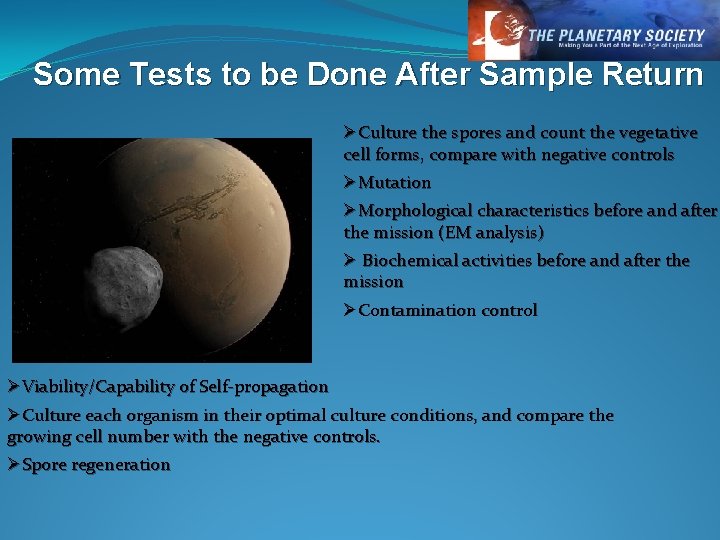
Some Tests to be Done After Sample Return ØCulture the spores and count the vegetative cell forms, compare with negative controls ØMutation ØMorphological characteristics before and after the mission (EM analysis) Ø Biochemical activities before and after the mission ØContamination control ØViability/Capability of Self-propagation ØCulture each organism in their optimal culture conditions, and compare the growing cell number with the negative controls. ØSpore regeneration
www. planetary. org 11 -15 October 2010 1 MS-3 LOUIS FRIEDMAN 21