
The Pippard coherence length In 1953 Sir Brian
The Pippard coherence length In 1953 Sir Brian Pippard considered 1. N/S boundaries have positive surface energy 2. In zero magnetic field superconducting transitions in pure superconductors can be as little as 10 -5 K wide Thus all electrons in the sample must participate in superconductivity and there must be long range order or coherence between the electrons 3. Small particles of superconductors have penetration depths greater than those of bulk samples Therefore superconducting electron densities must change at a relatively slow rate through the sample Lecture 5 He concluded: The superconducting electron density ns cannot change rapidly with position. . . …. it can only change appreciably of a distance of ~10 -4 cm, The boundary between normal and superconducting regions therefore cannot be sharp…. …. . ns has to rise from zero at the boundary to a maximum value over a distance is the Pippard coherence length Superconductivity and Superfluidity
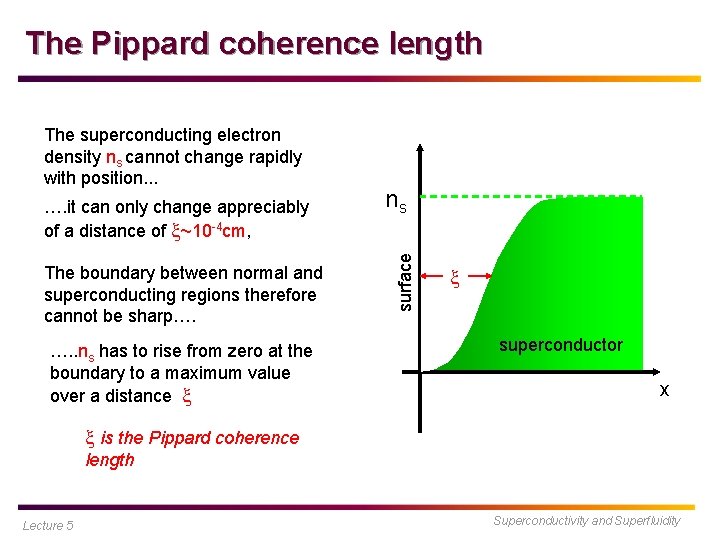
The Pippard coherence length …. it can only change appreciably of a distance of ~10 -4 cm, The boundary between normal and superconducting regions therefore cannot be sharp…. …. . ns has to rise from zero at the boundary to a maximum value over a distance ns surface The superconducting electron density ns cannot change rapidly with position. . . superconductor x is the Pippard coherence length Lecture 5 Superconductivity and Superfluidity
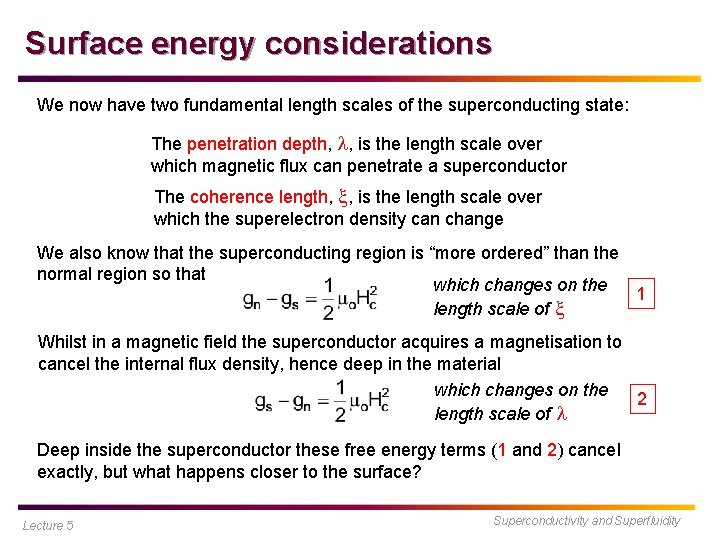
Surface energy considerations We now have two fundamental length scales of the superconducting state: The penetration depth, , is the length scale over which magnetic flux can penetrate a superconductor The coherence length, , is the length scale over which the superelectron density can change We also know that the superconducting region is “more ordered” than the normal region so that which changes on the 1 length scale of Whilst in a magnetic field the superconductor acquires a magnetisation to cancel the internal flux density, hence deep in the material which changes on the 2 length scale of Deep inside the superconductor these free energy terms (1 and 2) cancel exactly, but what happens closer to the surface? Lecture 5 Superconductivity and Superfluidity

Positive and negative surface energy For > Surface energy is positive: Type I superconductivity Lecture 5 For < Surface energy is negative: Type II superconductivity Superconductivity and Superfluidity
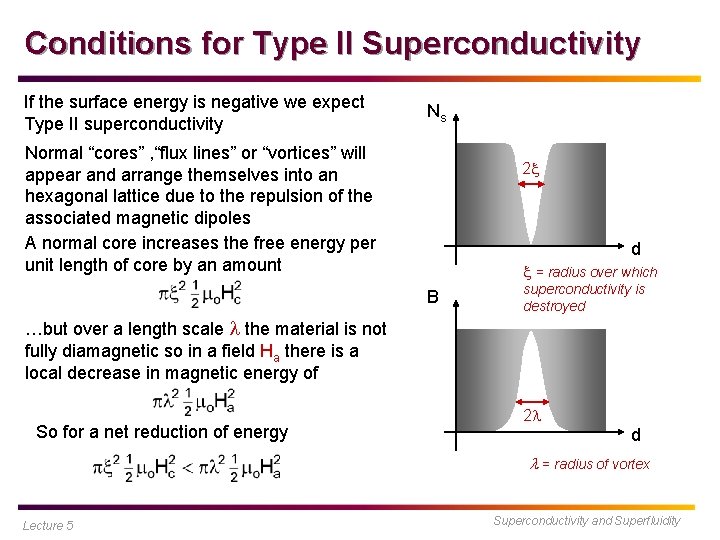
Conditions for Type II Superconductivity If the surface energy is negative we expect Type II superconductivity Ns Normal “cores” , “flux lines” or “vortices” will appear and arrange themselves into an hexagonal lattice due to the repulsion of the associated magnetic dipoles A normal core increases the free energy per unit length of core by an amount 2 d = radius over which B superconductivity is destroyed …but over a length scale the material is not fully diamagnetic so in a field Ha there is a local decrease in magnetic energy of So for a net reduction of energy 2 d = radius of vortex Lecture 5 Superconductivity and Superfluidity
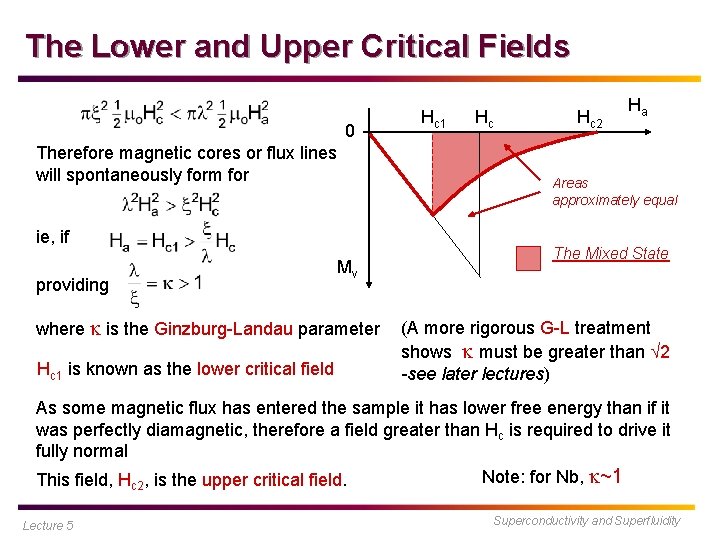
The Lower and Upper Critical Fields 0 Therefore magnetic cores or flux lines will spontaneously form for Mv where is the Ginzburg-Landau parameter Hc 1 is known as the lower critical field Hc Hc 2 Ha Areas approximately equal ie, if providing Hc 1 The Mixed State (A more rigorous G-L treatment shows must be greater than 2 -see later lectures) As some magnetic flux has entered the sample it has lower free energy than if it was perfectly diamagnetic, therefore a field greater than Hc is required to drive it fully normal Note: for Nb, ~1 This field, Hc 2, is the upper critical field. Lecture 5 Superconductivity and Superfluidity

Ginzburg-Landau Theory Everything we have considered so far has treated superconductivity semiclassically However we know that superconductivity must be a deeply quantum phenomenon In the early 1950 s Ginzburg and Landau developed a theory that put superconductivity on a much stronger quantum footing Their theory, which actually predicts the existence of Type II superconductivity, is based upon the general Landau theory of “second order” or “continuous” phase transitions In particular they were able to incorporate the concept of a spatially dependent superconducting electron density ns, and allowed ns to vary with external parameters Note: in the London theory but ns does not depend upon distance as the Pippard model demands. The concept of coherence length is entirely absent. Lecture 5 Superconductivity and Superfluidity

Landau Theory of Phase Transitions As a reminder of Landau theory, take the example of a ferromagnetic to paramagnetic transition where the free energy is expressed as M is the magnetisation - the so-called order parameter of the magnetised ferromagnetic state and is associated with variations in magnetisation (or applied field) F(T, M) The stable state is found at the minimum of the free energy, ie when T>TCM We find M=0 for T>TCM M 0 for T<TCM Any second order transition can be described in the same way, replacing M with an order parameter that goes to zero as T approaches TC Lecture 5 T=TCM M T<TCM Superconductivity and Superfluidity

The Superconducting Order Parameter We have already suggested that superconductivity is carried by superelectrons of density ns ns could thus be the “order parameter” as it goes to zero at Tc However, Ginzburg and Landau chose a quantum mechanical approach, using a wave function to describe the superelectrons, ie This complex scalar is the Ginzburg-Landau order parameter (i) its modulus is roughly interpreted as the number density of superelectrons at point r (ii) The phase factor is related to the supercurrent that flows through the material below Tc (iii) Lecture 5 in the superconducting state, but above Tc Superconductivity and Superfluidity
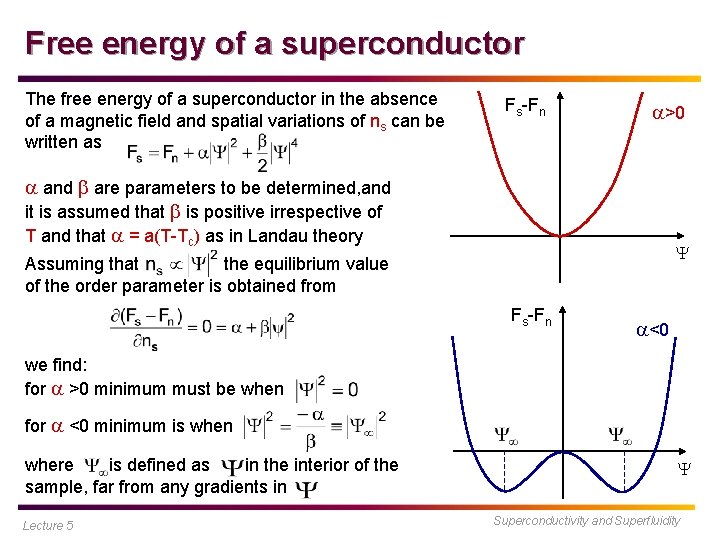
Free energy of a superconductor The free energy of a superconductor in the absence of a magnetic field and spatial variations of ns can be written as Fs-Fn >0 and are parameters to be determined, and it is assumed that is positive irrespective of T and that = a(T-Tc) as in Landau theory Assuming that the equilibrium value of the order parameter is obtained from Fs-Fn <0 we find: for >0 minimum must be when for <0 minimum is when where is defined as in the interior of the sample, far from any gradients in Lecture 5 Superconductivity and Superfluidity
- Slides: 10