
the PIE model minimal model of interactive system





- Slides: 24
the PIE model • ‘minimal’ model of interactive system • focused on external observable aspects of interaction
PIE model – user input • sequence of commands • commands include: – keyboard, mouse movement, mouse click • call the set of commands C • call the sequence P P = seq C
PIE model – system response • the ‘effect’ • effect composed of: ephemeral display the final result • (e. . g printout, changed file) • call the set of effects E
PIE model – the connection • given any history of commands (P) • there is some current effect • call the mapping the interpretation (I) I: P E
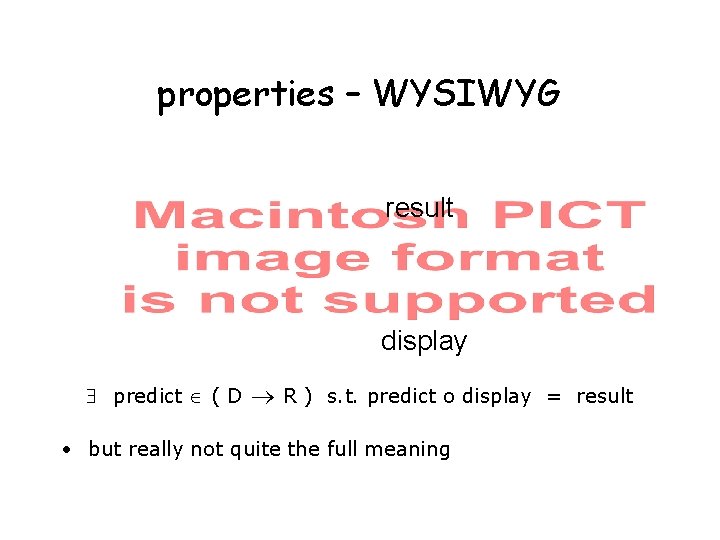
properties – WYSIWYG result display $ predict ( D R ) s. t. predict o display = result • but really not quite the full meaning
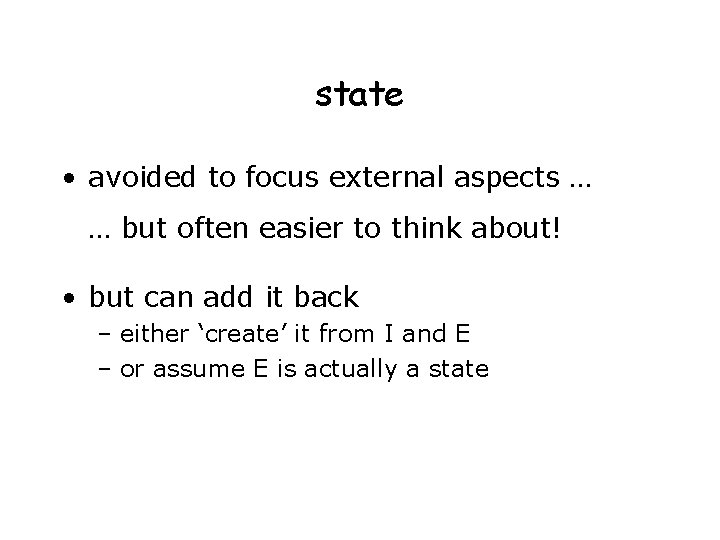
state • avoided to focus external aspects … … but often easier to think about! • but can add it back – either ‘create’ it from I and E – or assume E is actually a state
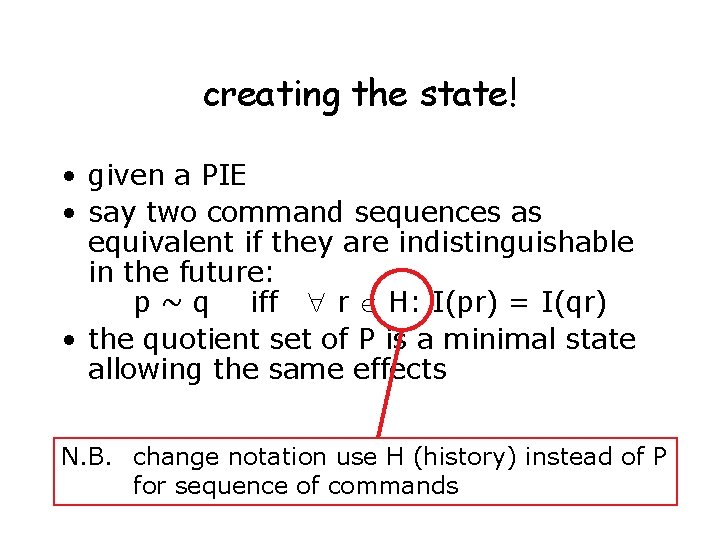
creating the state! • given a PIE • say two command sequences as equivalent if they are indistinguishable in the future: p ~ q iff r H: I(pr) = I(qr) • the quotient set of P is a minimal state allowing the same effects N. B. change notation use H (history) instead of P for sequence of commands
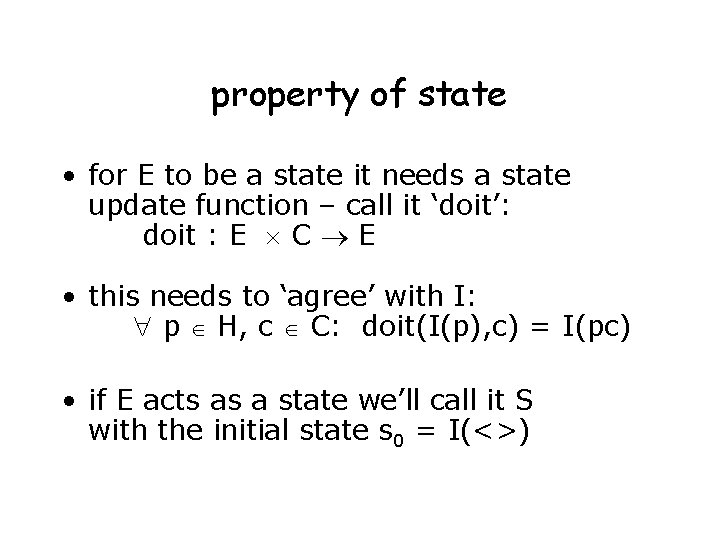
property of state • for E to be a state it needs a state update function – call it ‘doit’: doit : E C E • this needs to ‘agree’ with I: p H, c C: doit(I(p), c) = I(pc) • if E acts as a state we’ll call it S with the initial state s 0 = I(<>)
proving things – undo c: c undo ~ null only for c ≠ undo ?
lesson • undo is no ordinary command! • other meta-commands: back/forward in browsers history window
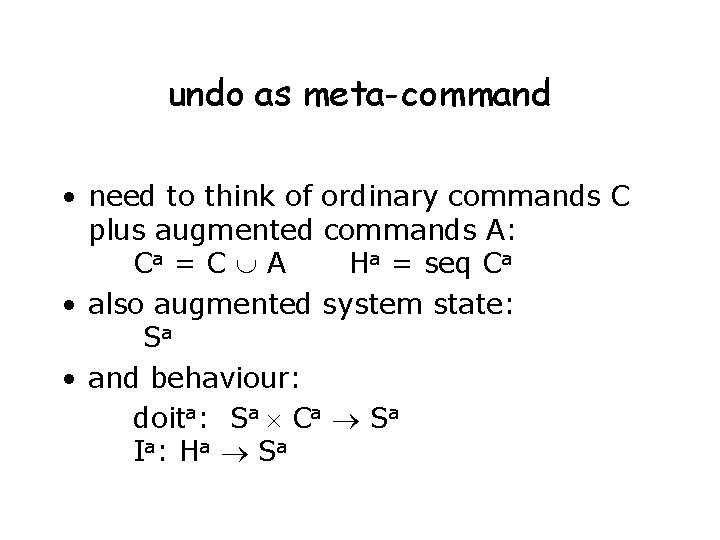
undo as meta-command • need to think of ordinary commands C plus augmented commands A: Ca = C A Ha = seq Ca • also augmented system state: Sa • and behaviour: doita: Sa Ca Sa I a: H a S a
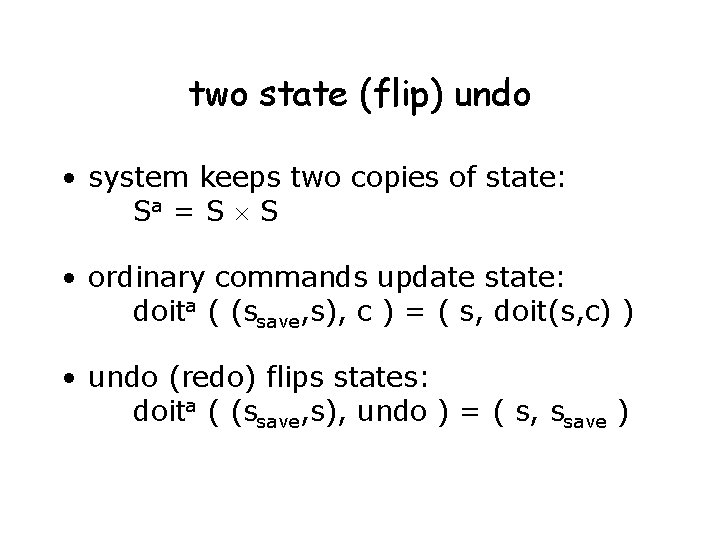
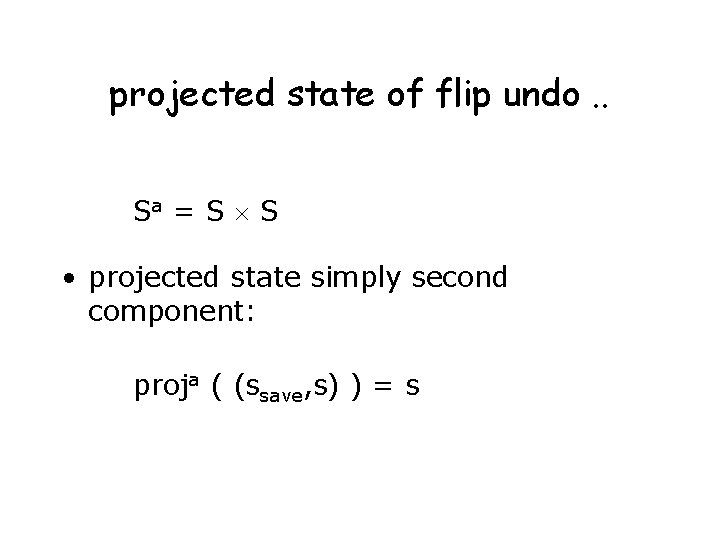
two state (flip) undo • system keeps two copies of state: Sa = S S • ordinary commands update state: doita ( (ssave, s), c ) = ( s, doit(s, c) ) • undo (redo) flips states: doita ( (ssave, s), undo ) = ( s, ssave )
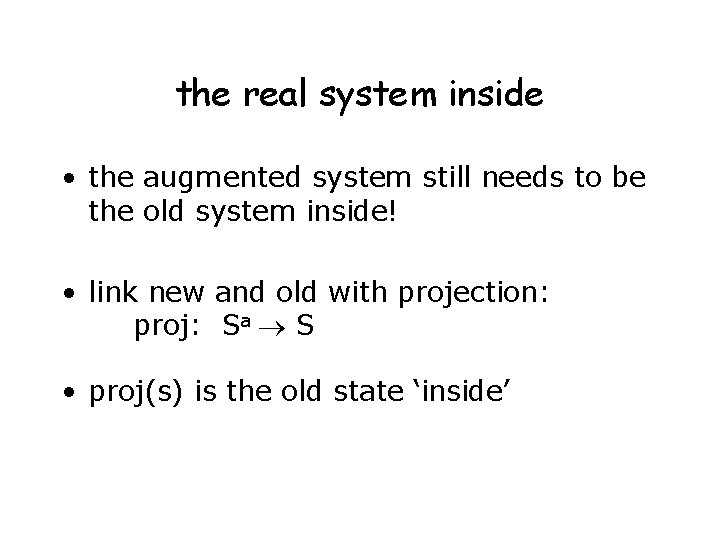
the real system inside • the augmented system still needs to be the old system inside! • link new and old with projection: proj: Sa S • proj(s) is the old state ‘inside’
projected state of flip undo. . Sa = S S • projected state simply second component: proja ( (ssave, s) ) = s
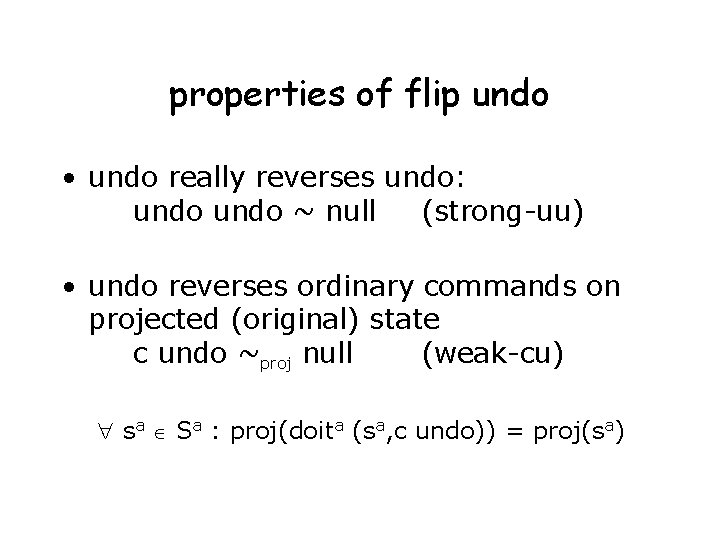
properties of flip undo • undo really reverses undo: undo ~ null (strong-uu) • undo reverses ordinary commands on projected (original) state c undo ~proj null (weak-cu) sa Sa : proj(doita (sa, c undo)) = proj(sa)
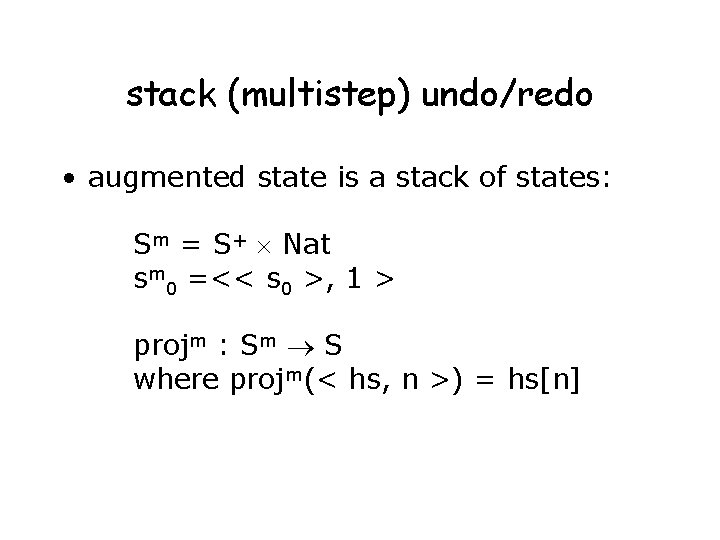
stack (multistep) undo/redo • augmented state is a stack of states: Sm = S+ Nat sm 0 =<< s 0 >, 1 > projm : Sm S where projm(< hs, n >) = hs[n]
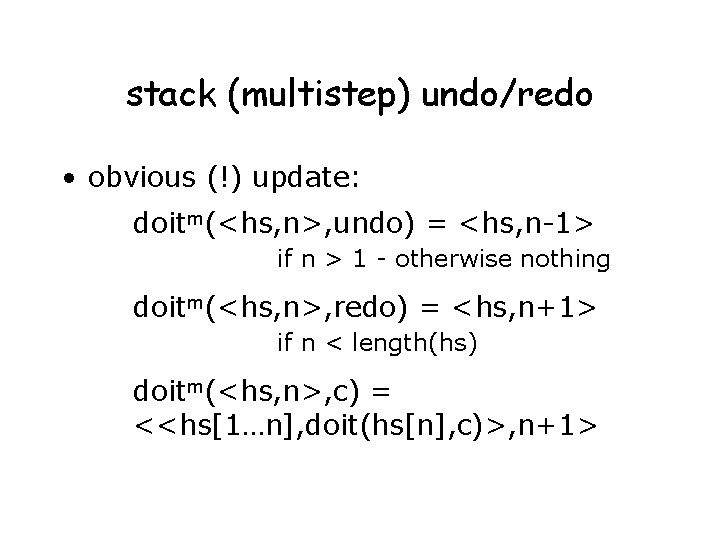
stack (multistep) undo/redo • obvious (!) update: doitm(<hs, n>, undo) = <hs, n-1> if n > 1 - otherwise nothing doitm(<hs, n>, redo) = <hs, n+1> if n < length(hs) doitm(<hs, n>, c) = <<hs[1…n], doit(hs[n], c)>, n+1>
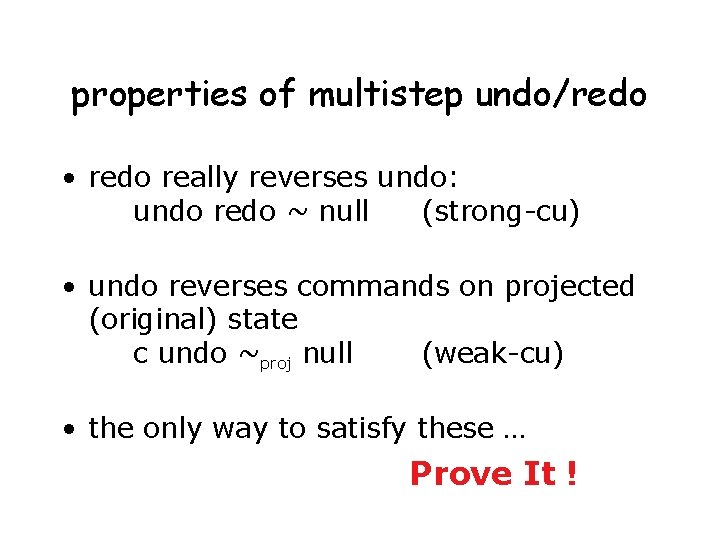
properties of multistep undo/redo • redo really reverses undo: undo redo ~ null (strong-cu) • undo reverses commands on projected (original) state c undo ~proj null (weak-cu) • the only way to satisfy these … Prove It !
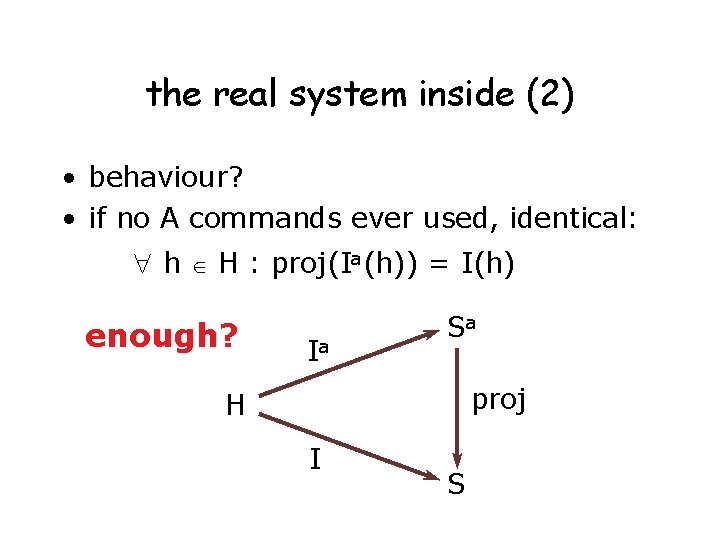
the real system inside (2) • behaviour? • if no A commands ever used, identical: h H : proj(Ia(h)) = I(h) enough? Ia Sa proj H I S
conservativeness of state
encapsulation
conservativeness of effective history
the cube
full details … R. Mancini (1997). Modelling Interactive Computing by exploiting the Undo. Dottorato di Ricerca in Informatica, IX-97 -5, Università degli Studi di Roma "La Sapienza"