
The Piano Mover Problem Motion Planning Geometrical Formulation
The Piano Mover Problem Motion Planning Geometrical Formulation of the Piano Mover Problem J. P. Laumond LAAS–CNRS
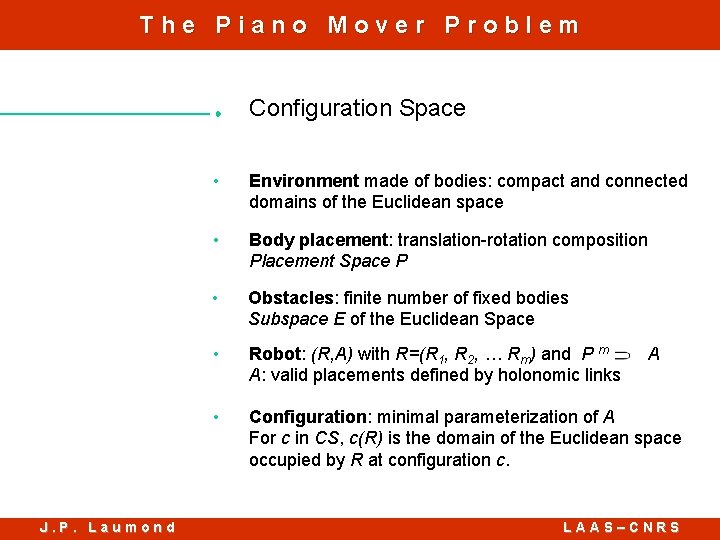
The Piano Mover Problem Configuration Space J. P. Laumond • Environment made of bodies: compact and connected domains of the Euclidean space • Body placement: translation-rotation composition Placement Space P • Obstacles: finite number of fixed bodies Subspace E of the Euclidean Space • Robot: (R, A) with R=(R 1, R 2, … Rm) and P m A: valid placements defined by holonomic links • Configuration: minimal parameterization of A For c in CS, c(R) is the domain of the Euclidean space occupied by R at configuration c. A LAAS–CNRS
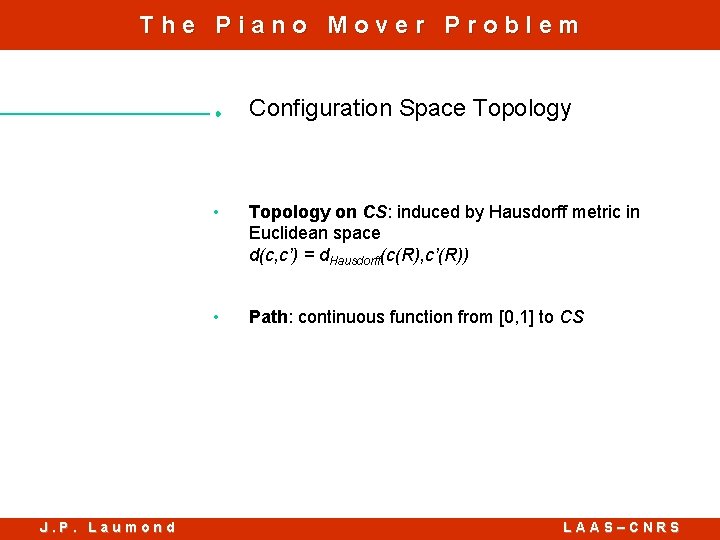
The Piano Mover Problem Configuration Space Topology J. P. Laumond • Topology on CS: induced by Hausdorff metric in Euclidean space d(c, c’) = d. Hausdorff(c(R), c’(R)) • Path: continuous function from [0, 1] to CS LAAS–CNRS
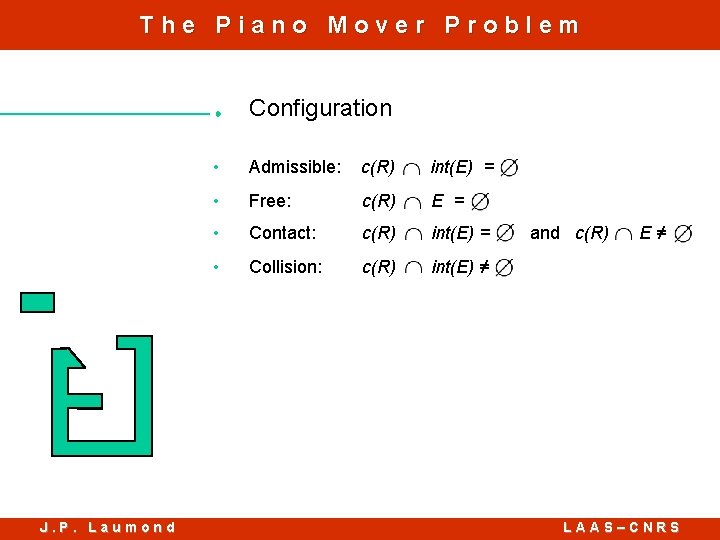
The Piano Mover Problem Configuration J. P. Laumond • Admissible: c(R) int(E) = • Free: c(R) E = • Contact: c(R) int(E) = • Collision: c(R) int(E) ≠ and c(R) E≠ LAAS–CNRS
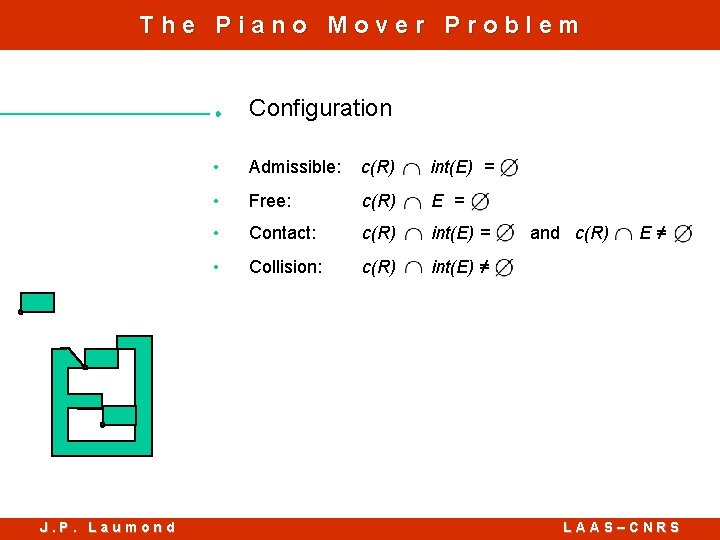
The Piano Mover Problem Configuration J. P. Laumond • Admissible: c(R) int(E) = • Free: c(R) E = • Contact: c(R) int(E) = • Collision: c(R) int(E) ≠ and c(R) E≠ LAAS–CNRS
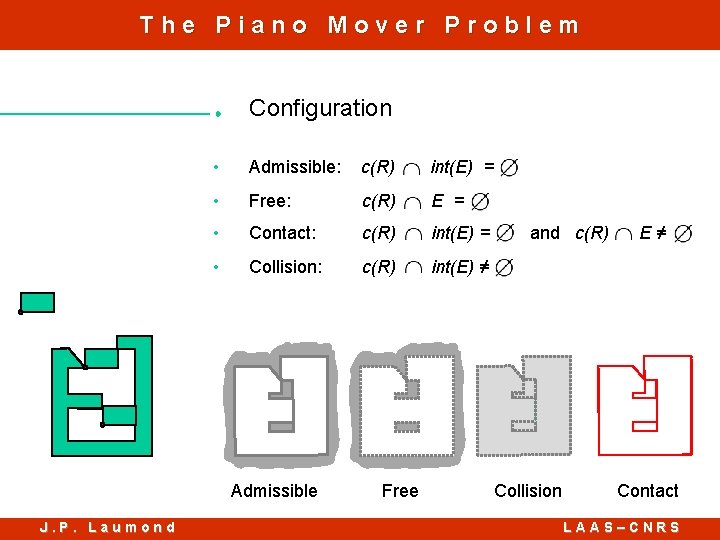
The Piano Mover Problem Configuration • Admissible: c(R) int(E) = • Free: c(R) E = • Contact: c(R) int(E) = • Collision: c(R) int(E) ≠ Admissible J. P. Laumond Free and c(R) Collision E≠ Contact LAAS–CNRS
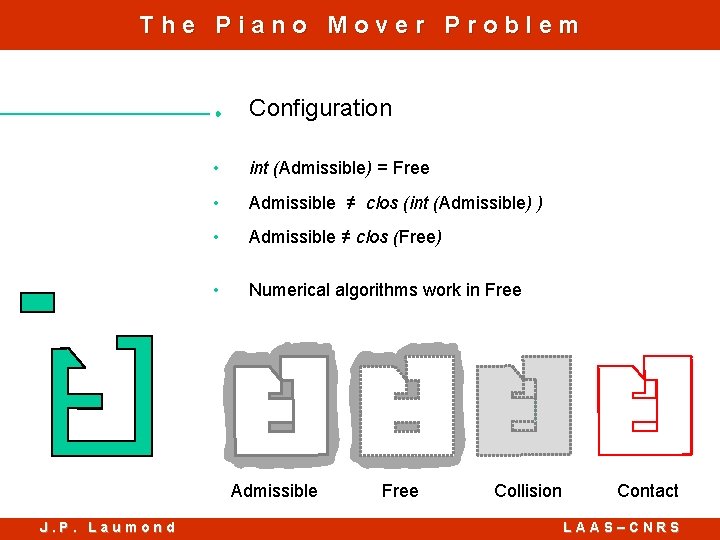
The Piano Mover Problem Configuration • int (Admissible) = Free • Admissible ≠ clos (int (Admissible) ) • Admissible ≠ clos (Free) • Numerical algorithms work in Free Admissible J. P. Laumond Free Collision Contact LAAS–CNRS
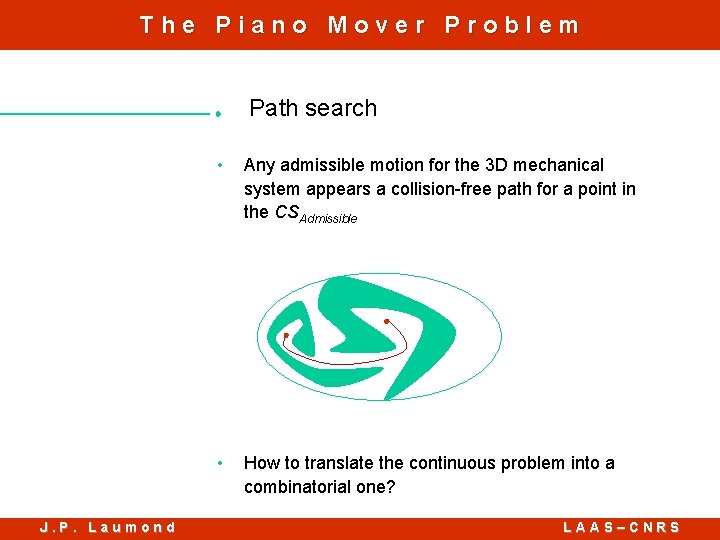
The Piano Mover Problem Path search J. P. Laumond • Any admissible motion for the 3 D mechanical system appears a collision-free path for a point in the CSAdmissible • How to translate the continuous problem into a combinatorial one? LAAS–CNRS
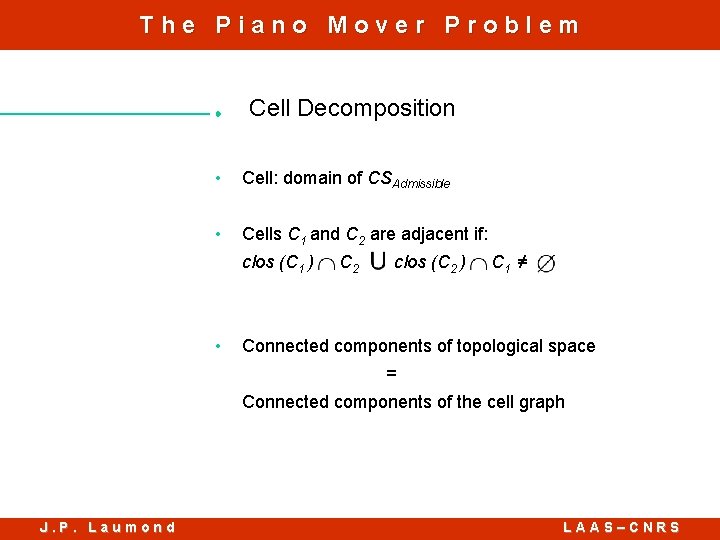
The Piano Mover Problem Cell Decomposition • Cell: domain of CSAdmissible • Cells C 1 and C 2 are adjacent if: clos (C 1 ) • C 2 clos (C 2 ) C 1 ≠ Connected components of topological space = Connected components of the cell graph J. P. Laumond LAAS–CNRS
The Piano Mover Problem Cell Decomposition Ingredients J. P. Laumond • Cell decomposition algorithm • Algorithm to localize a point within a cell • Algorithm to move within a single cell • A path search algorithm within a graph • Examples: • Sweeping line algorithm to decompose polygonal environments into trapezoids • Cylindrical algebraic decomposition LAAS–CNRS
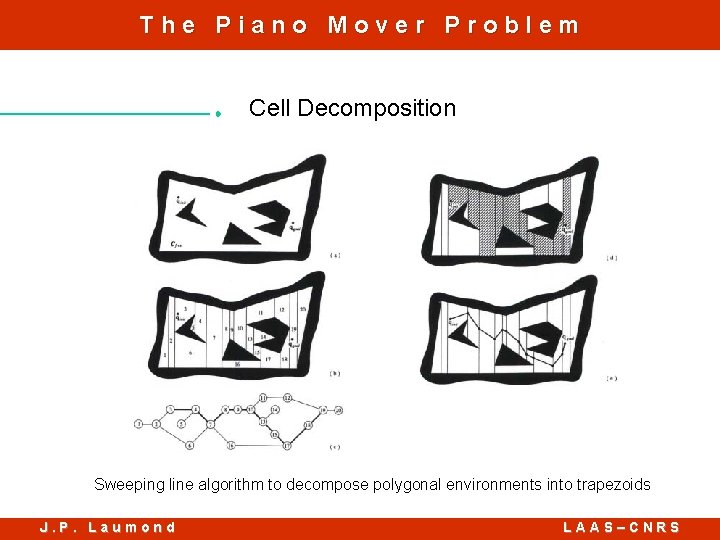
The Piano Mover Problem Cell Decomposition Sweeping line algorithm to decompose polygonal environments into trapezoids J. P. Laumond LAAS–CNRS
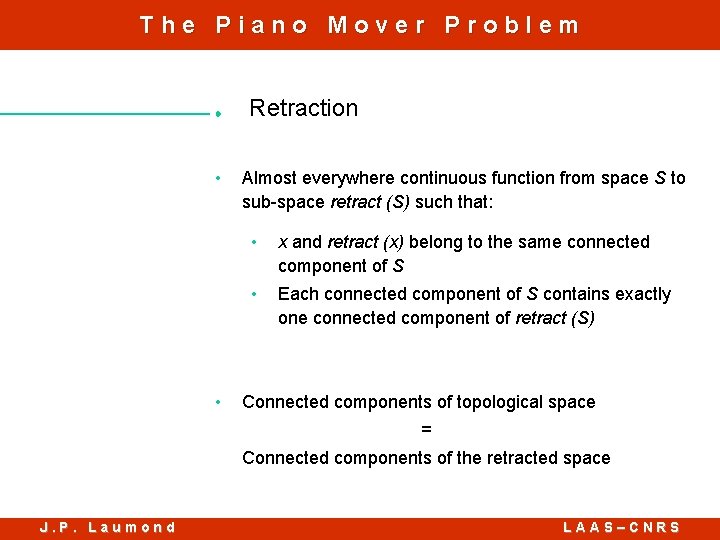
The Piano Mover Problem Retraction • • Almost everywhere continuous function from space S to sub-space retract (S) such that: • x and retract (x) belong to the same connected component of S • Each connected component of S contains exactly one connected component of retract (S) Connected components of topological space = Connected components of the retracted space J. P. Laumond LAAS–CNRS
The Piano Mover Problem Retraction J. P. Laumond • Apply retraction recursively to decrease the dimension of the topological space • Examples: • Voronoï diagrams • Visibility graphs • Retraction on the border of the obstacles (algebraic topology issues) • Probabilistic roadmaps LAAS–CNRS
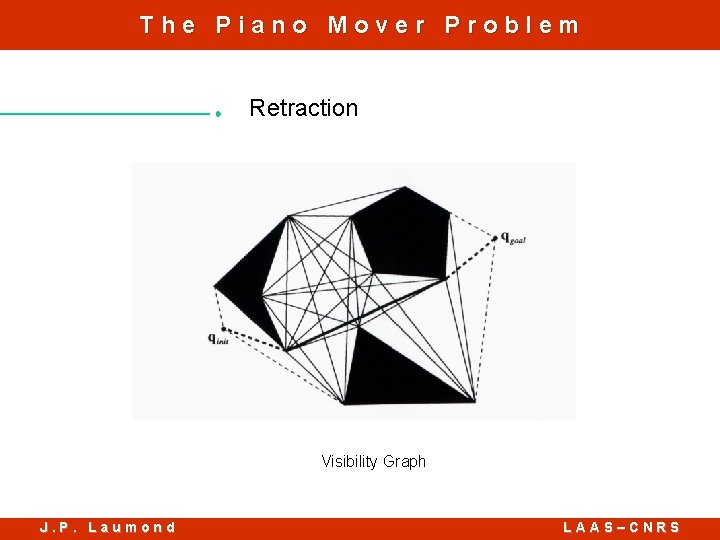
The Piano Mover Problem Retraction Visibility Graph J. P. Laumond LAAS–CNRS
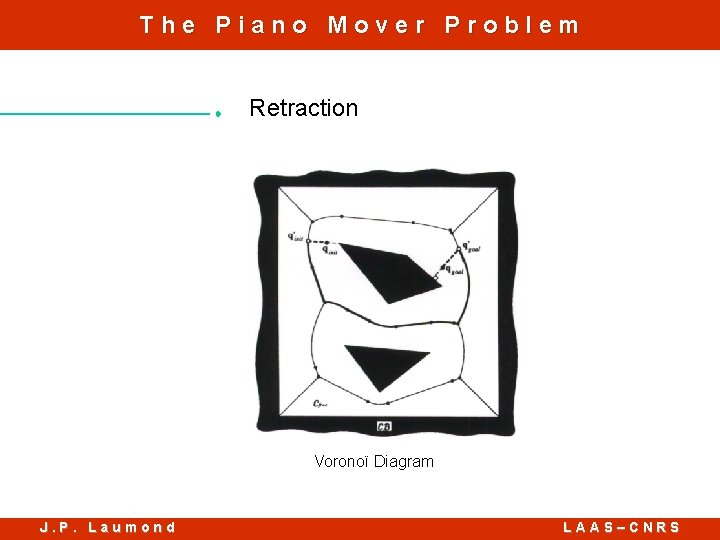
The Piano Mover Problem Retraction Voronoï Diagram J. P. Laumond LAAS–CNRS
The Piano Mover Problem J. P. Laumond LAAS–CNRS
- Slides: 16