
The Pi XL Club The Pi XL Club
The Pi. XL Club The Pi. XL Club The Pi. XL Club The Pi. XL Club The Pi. XL Club The Pi. XL Club The Pi. XL Club The Pi. XL Club The Pi. XL Club The Pi. XL Club The Pi. XL Club The Pi. XL Club The Pi. XL Club The Pi. XL Club The Pi. XL Club The Pi. XL Club The Pi. XL Club The Pi. XL Club The Pi. XL Club The Pi. XL Club The Pi. XL Club The Pi. XL Club The Pi. XL Club The Pi. XL Club The Pi. XL Club The Pi. XL Club The Pi. XL Club The Pi. XL Club The Pi. XL Club The Pi. XL Club The Pi. XL Club The Pi. XL Club The Pi. XL Club The Pi. XL Club The Pi. XL Club The This resource is strictly for the use of member schools for as long as they remain members of The Pi. XL Club. It may not be copied, sold nor transferred to Pi. XL Club The Pi. XL Club The a third party or used by the school after membership ceases. Until such time it may be freely used within the member school. Pi. XL Club The Pi. XL Club The Pi. XL Club The All opinions and contributions are those of the authors. The contents of this resource are not connected with nor endorsed by any other company, Pi. XL Club The Pi. XL Club The organisation or institution. Pi. XL Club The Pi. XL Club The Pi. XL Club The Pi. XL Club The www. pixl. org. uk The Pi. XL Club Ltd, Company number 07321607 Pi. XL Club The Pi. XL Club The Pi. XL Club The Pi. XL Club The Pi. XL Know. IT! GCSE Chemistry Edexcel Topic – Extracting metals and equilibria © Copyright The Pi. XL Club Ltd, 2017
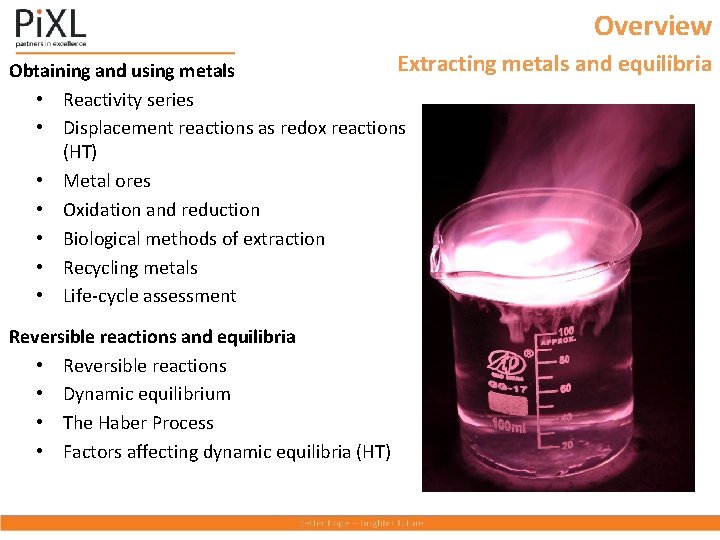
Overview Extracting metals and equilibria Obtaining and using metals • Reactivity series • Displacement reactions as redox reactions (HT) • Metal ores • Oxidation and reduction • Biological methods of extraction • Recycling metals • Life-cycle assessment Reversible reactions and equilibria • Reversible reactions • Dynamic equilibrium • The Haber Process • Factors affecting dynamic equilibria (HT)
Learn. IT! Know. IT! Reactivity of metals • Reactivity series • Displacement reactions as redox reactions (HT)
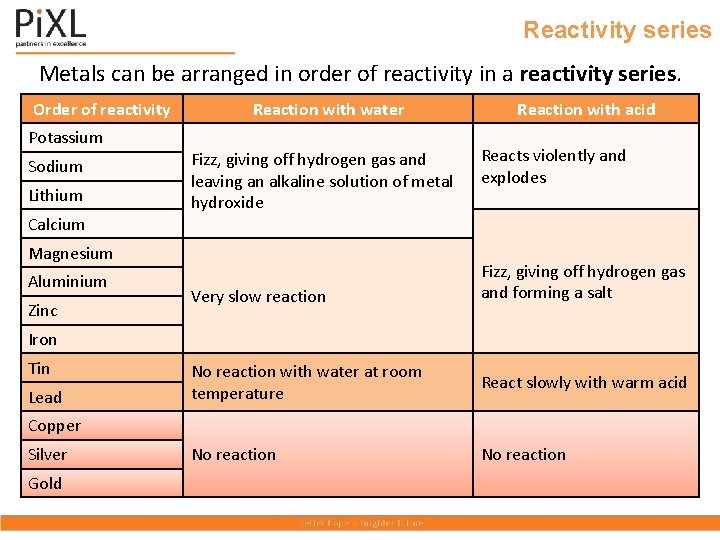
Reactivity series Metals can be arranged in order of reactivity in a reactivity series. Order of reactivity Potassium Sodium Lithium Calcium Reaction with water Fizz, giving off hydrogen gas and leaving an alkaline solution of metal hydroxide Magnesium Aluminium Zinc Very slow reaction Reaction with acid Reacts violently and explodes Fizz, giving off hydrogen gas and forming a salt Iron Tin Lead No reaction with water at room temperature React slowly with warm acid No reaction Copper Silver Gold
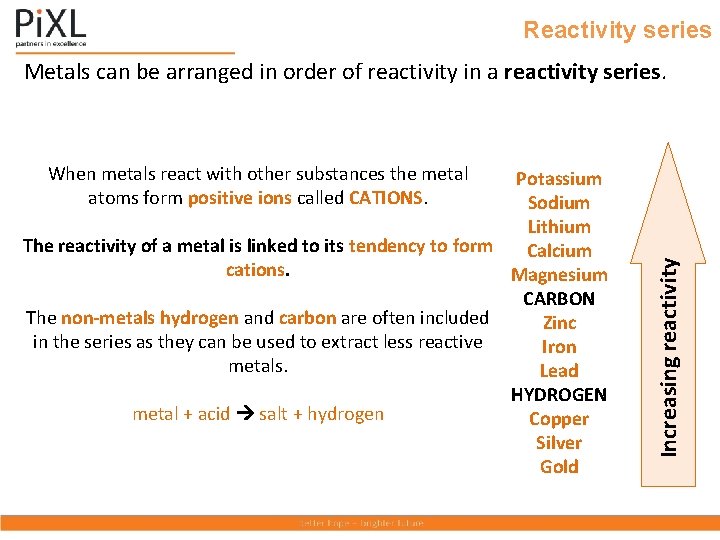
Reactivity series Metals can be arranged in order of reactivity in a reactivity series. Potassium Sodium Lithium The reactivity of a metal is linked to its tendency to form Calcium cations. Magnesium CARBON The non-metals hydrogen and carbon are often included Zinc in the series as they can be used to extract less reactive Iron metals. Lead HYDROGEN metal + acid salt + hydrogen Copper Silver Gold Increasing reactivity When metals react with other substances the metal atoms form positive ions called CATIONS.
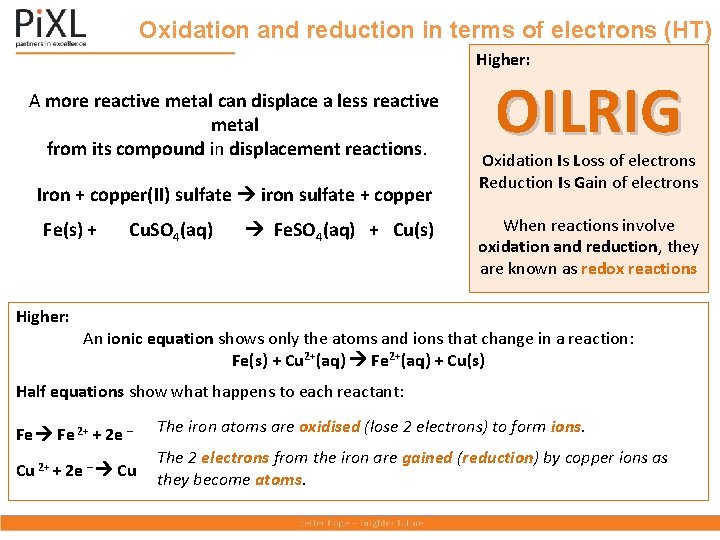
Oxidation and reduction in terms of electrons (HT) Higher: A more reactive metal can displace a less reactive metal from its compound in displacement reactions. Iron + copper(II) sulfate iron sulfate + copper Fe(s) + Higher: Cu. SO 4(aq) Fe. SO 4(aq) + Cu(s) OILRIG Oxidation Is Loss of electrons Reduction Is Gain of electrons When reactions involve oxidation and reduction, they are known as redox reactions An ionic equation shows only the atoms and ions that change in a reaction: Fe(s) + Cu 2+(aq) Fe 2+(aq) + Cu(s) Half equations show what happens to each reactant: Fe 2+ + 2 e – The iron atoms are oxidised (lose 2 electrons) to form ions. Cu 2+ + 2 e – Cu The 2 electrons from the iron are gained (reduction) by copper ions as they become atoms.
Question. IT! Reactivity of metals • Reactivity series • Displacement reactions as redox reactions (HT)
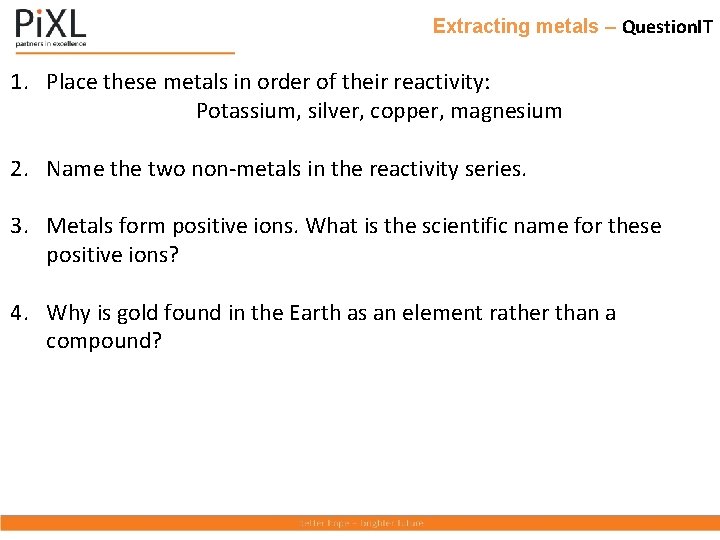
Extracting metals – Question. IT 1. Place these metals in order of their reactivity: Potassium, silver, copper, magnesium 2. Name the two non-metals in the reactivity series. 3. Metals form positive ions. What is the scientific name for these positive ions? 4. Why is gold found in the Earth as an element rather than a compound?
Extracting metals – Question. IT 5. HT – What is a redox reaction? 6. HT – Describe oxidation in terms of electrons. 7. HT – Describe reduction in terms of electrons.
Answer. IT! Reactivity of metals • Reactivity series • Displacement reactions as redox reactions (HT)
Extracting metals – Question. IT 1. Place these metals in order of their reactivity: Potassium, silver, copper, magnesium Highest: Potassium, magnesium, copper, silver: lowest 2. Name the two non-metals in the reactivity series. Carbon and hydrogen 3. Metals form positive ions. What is the scientific name for these positive ions? Cations 4. Why is gold found in the Earth as an element rather than a compound? It is very unreactive.
Extracting metals – Question. IT 5. HT – What is a redox reaction? Reaction involving both oxidation and reduction. 6. HT – Describe oxidation in terms of electrons. OIL – oxidation is loss of electrons. 7. HT – Describe reduction in terms of electrons. RIG – reduction is gain of electrons.
Learn. IT! Know. IT! Extracting metals • • Metal ores Oxidation and reduction Methods of extraction Biological methods of extraction (HT)
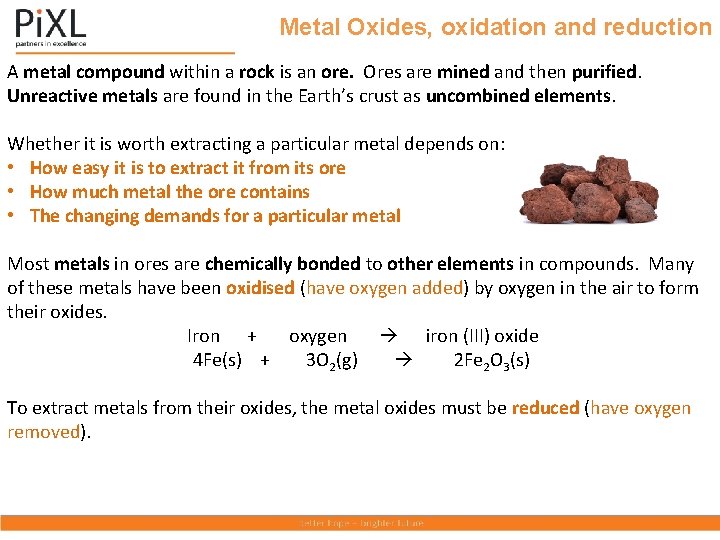
Metal Oxides, oxidation and reduction A metal compound within a rock is an ore. Ores are mined and then purified. Unreactive metals are found in the Earth’s crust as uncombined elements. Whether it is worth extracting a particular metal depends on: • How easy it is to extract it from its ore • How much metal the ore contains • The changing demands for a particular metal Most metals in ores are chemically bonded to other elements in compounds. Many of these metals have been oxidised (have oxygen added) by oxygen in the air to form their oxides. Iron + oxygen iron (III) oxide 4 Fe(s) + 3 O 2(g) 2 Fe 2 O 3(s) To extract metals from their oxides, the metal oxides must be reduced (have oxygen removed).
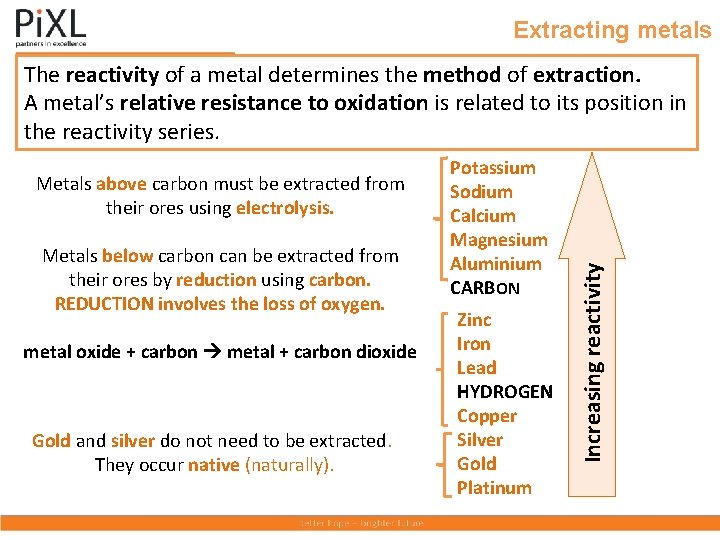
Extracting metals Metals above carbon must be extracted from their ores using electrolysis. Metals below carbon can be extracted from their ores by reduction using carbon. REDUCTION involves the loss of oxygen. metal oxide + carbon metal + carbon dioxide Gold and silver do not need to be extracted. They occur native (naturally). Potassium Sodium Calcium Magnesium Aluminium CARBON Zinc Iron Lead HYDROGEN Copper Silver Gold Platinum Increasing reactivity The reactivity of a metal determines the method of extraction. A metal’s relative resistance to oxidation is related to its position in the reactivity series.
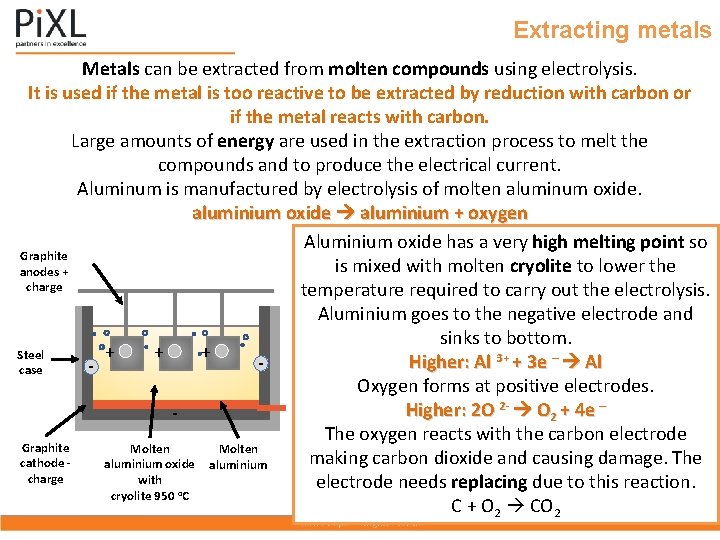
Extracting metals Metals can be extracted from molten compounds using electrolysis. It is used if the metal is too reactive to be extracted by reduction with carbon or if the metal reacts with carbon. Large amounts of energy are used in the extraction process to melt the compounds and to produce the electrical current. Aluminum is manufactured by electrolysis of molten aluminum oxide. aluminium oxide aluminium + oxygen Aluminium oxide has a very high melting point so Graphite is mixed with molten cryolite to lower the anodes + charge temperature required to carry out the electrolysis. Aluminium goes to the negative electrode and sinks to bottom. + + + Steel Higher: Al 3+ + 3 e – Al case Oxygen forms at positive electrodes. Higher: 2 O 2 - O 2 + 4 e – The oxygen reacts with the carbon electrode Graphite Molten making carbon dioxide and causing damage. The cathode aluminium oxide aluminium charge with electrode needs replacing due to this reaction. cryolite 950 o. C C + O 2 CO 2 -
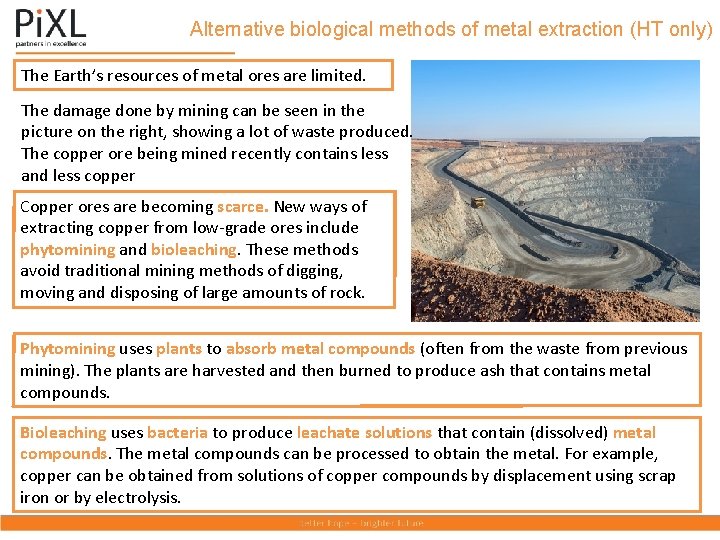
Alternative biological methods of metal extraction (HT only) The Earth’s resources of metal ores are limited. The damage done by mining can be seen in the picture on the right, showing a lot of waste produced. The copper ore being mined recently contains less and less copper Copper ores are becoming scarce. New ways of extracting copper from low-grade ores include phytomining and bioleaching. These methods avoid traditional mining methods of digging, moving and disposing of large amounts of rock. Phytomining uses plants to absorb metal compounds (often from the waste from previous mining). The plants are harvested and then burned to produce ash that contains metal compounds. Bioleaching uses bacteria to produce leachate solutions that contain (dissolved) metal compounds. The metal compounds can be processed to obtain the metal. For example, copper can be obtained from solutions of copper compounds by displacement using scrap iron or by electrolysis.
Question. IT! Extracting metals – Part 1 • • Metal ores Oxidation and reduction Methods of extraction Biological methods of extraction (HT)
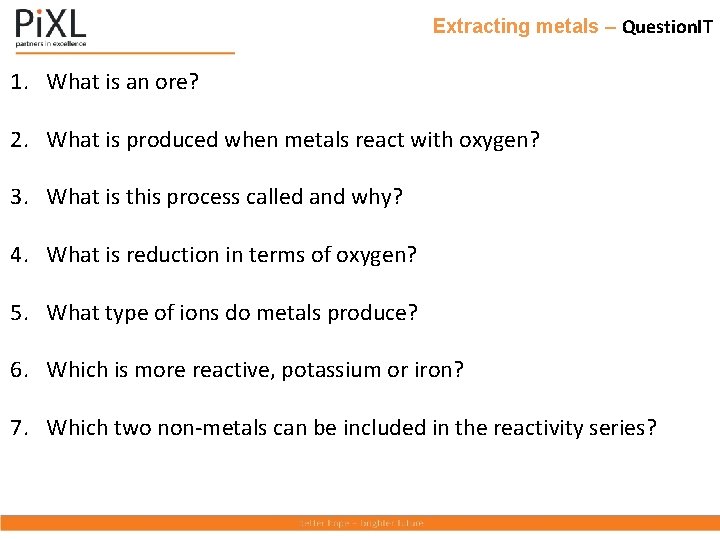
Extracting metals – Question. IT 1. What is an ore? 2. What is produced when metals react with oxygen? 3. What is this process called and why? 4. What is reduction in terms of oxygen? 5. What type of ions do metals produce? 6. Which is more reactive, potassium or iron? 7. Which two non-metals can be included in the reactivity series?
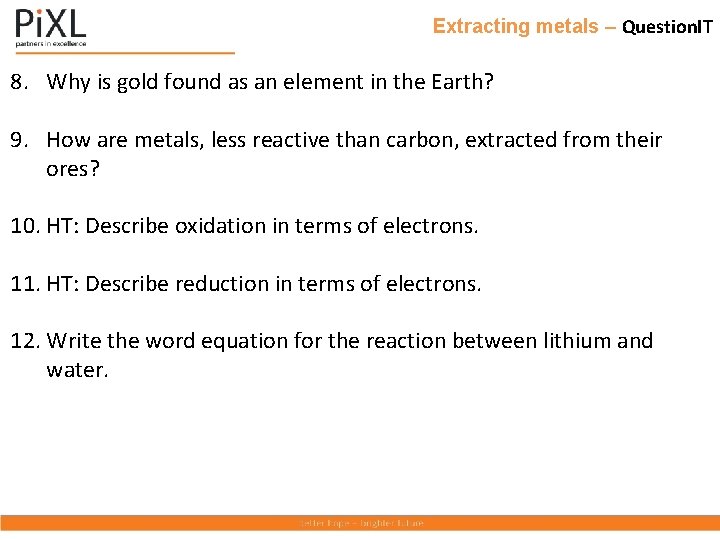
Extracting metals – Question. IT 8. Why is gold found as an element in the Earth? 9. How are metals, less reactive than carbon, extracted from their ores? 10. HT: Describe oxidation in terms of electrons. 11. HT: Describe reduction in terms of electrons. 12. Write the word equation for the reaction between lithium and water.
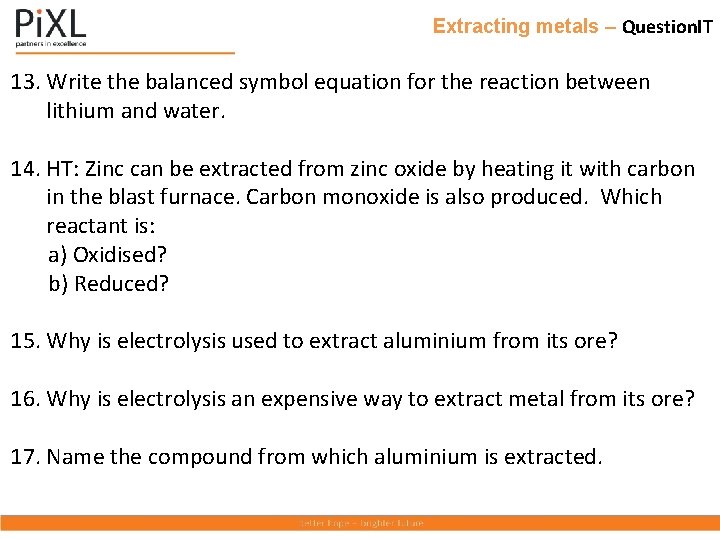
Extracting metals – Question. IT 13. Write the balanced symbol equation for the reaction between lithium and water. 14. HT: Zinc can be extracted from zinc oxide by heating it with carbon in the blast furnace. Carbon monoxide is also produced. Which reactant is: a) Oxidised? b) Reduced? 15. Why is electrolysis used to extract aluminium from its ore? 16. Why is electrolysis an expensive way to extract metal from its ore? 17. Name the compound from which aluminium is extracted.
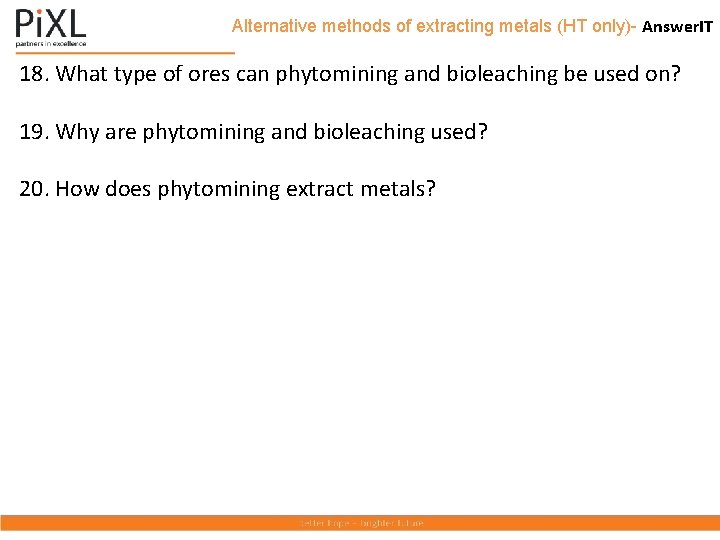
Alternative methods of extracting metals (HT only)- Answer. IT 18. What type of ores can phytomining and bioleaching be used on? 19. Why are phytomining and bioleaching used? 20. How does phytomining extract metals?
Answer. IT! Extracting metals – Part 1 • • Metal ores Oxidation and reduction Methods of extraction Biological methods of extraction (HT)
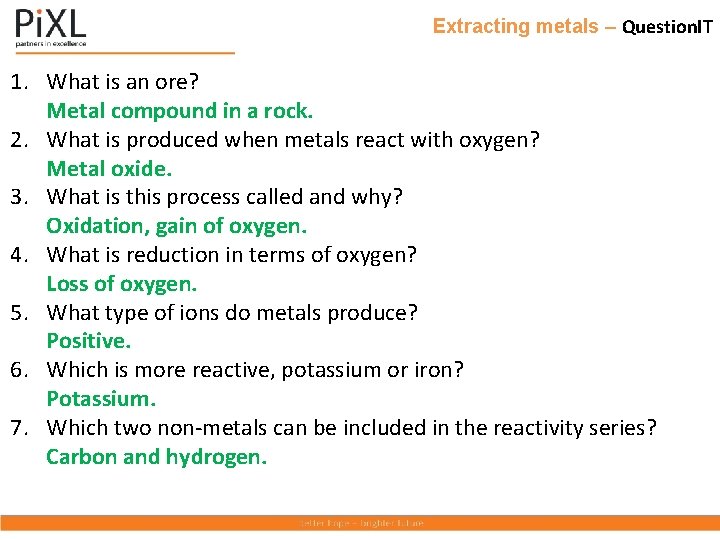
Extracting metals – Question. IT 1. What is an ore? Metal compound in a rock. 2. What is produced when metals react with oxygen? Metal oxide. 3. What is this process called and why? Oxidation, gain of oxygen. 4. What is reduction in terms of oxygen? Loss of oxygen. 5. What type of ions do metals produce? Positive. 6. Which is more reactive, potassium or iron? Potassium. 7. Which two non-metals can be included in the reactivity series? Carbon and hydrogen.
Extracting metals – Question. IT 8. Why is gold found as an element in the Earth? Unreactive metal. 9. How are metals, less reactive than carbon, extracted from their ores? Reduction with carbon. 10. HT: Describe oxidation in terms of electrons. OIL – loss of electrons 11. HT: Describe reduction in terms of electrons. RIG – gain of electrons 12. Write the word equation for the reaction between lithium and water. lithium + water → lithium hydroxide + hydrogen
Extracting metals – Question. IT 13. Write the balanced symbol equation for the reaction between lithium and water. 2 Li(s) + 2 H 2 O(l) → 2 Li. OH(aq) + H 2(g) 14. HT: Zinc can be extracted from zinc oxide by heating it with carbon in the blast furnace. Carbon monoxide is also produced. Which reactant is: a) Oxidised? Carbon b) Reduced? Zinc oxide
Electrolysis – Question. IT 15. Why is electrolysis used to extract aluminium from its ore? Aluminium is more reactive than carbon. 16. Why is electrolysis an expensive way to extract metal from its ore? Large amounts of energy needed. 17. Name the compound from which aluminium is extracted. Aluminium oxide/ bauxite. 18. What type of ores can phytomining and bioleaching be used on? Low-grade ores 19. Why are phytomining and bioleaching used? Avoids traditional mining methods of digging, moving and disposing of large amounts of rock 20. How does phytomining extract metals? Uses plants to absorb metal compounds, the plants are harvested and burned, this produces ash that contains metal compounds.
Learn. IT! Know. IT! Extracting metals – Part 2 • Recycling metals • Life-cycle assessment
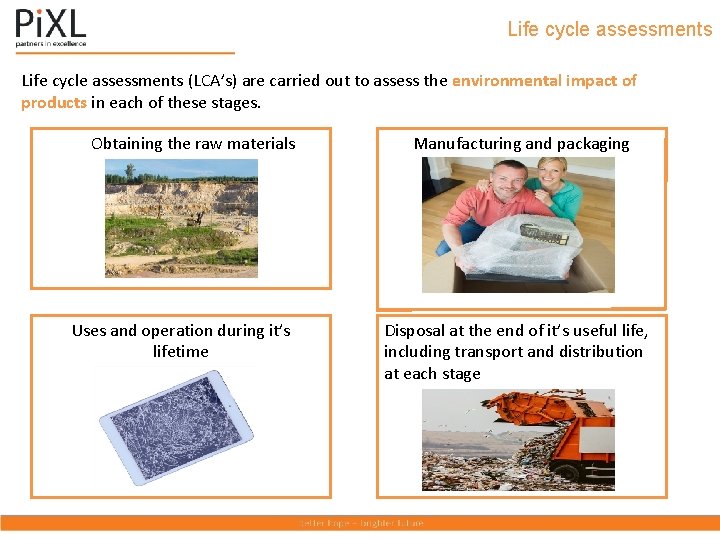
Life cycle assessments (LCA’s) are carried out to assess the environmental impact of products in each of these stages. Obtaining the raw materials Manufacturing and packaging Uses and operation during it’s lifetime Disposal at the end of it’s useful life, including transport and distribution at each stage
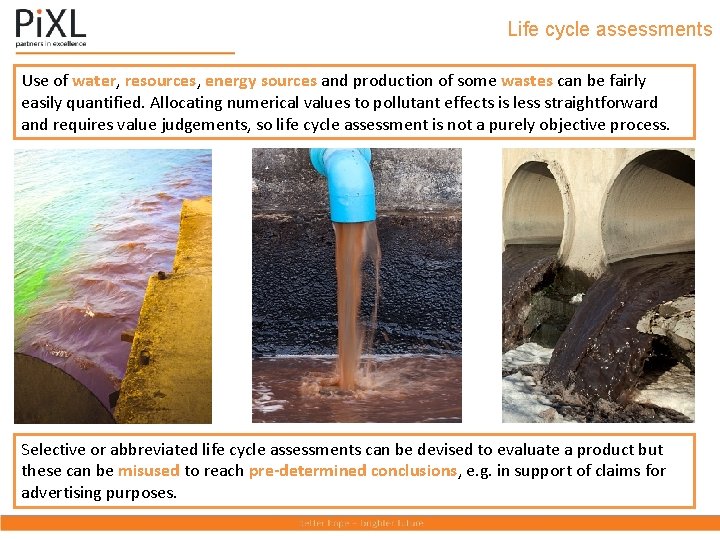
Life cycle assessments Use of water, resources, energy sources and production of some wastes can be fairly easily quantified. Allocating numerical values to pollutant effects is less straightforward and requires value judgements, so life cycle assessment is not a purely objective process. Selective or abbreviated life cycle assessments can be devised to evaluate a product but these can be misused to reach pre-determined conclusions, e. g. in support of claims for advertising purposes.
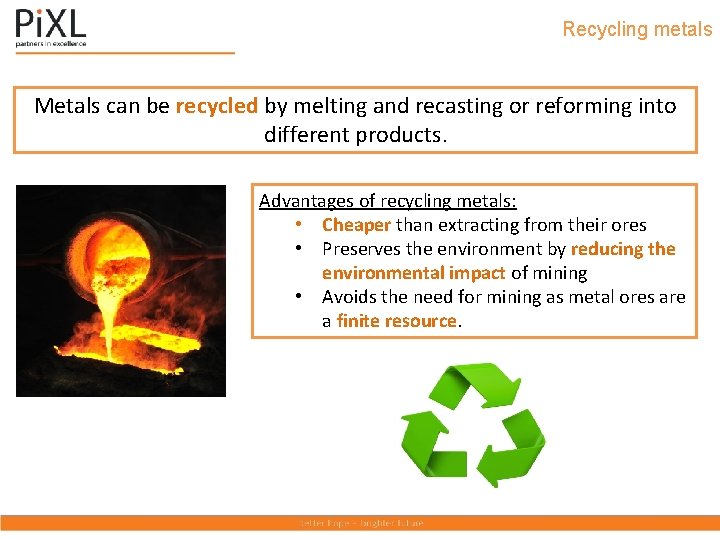
Recycling metals Metals can be recycled by melting and recasting or reforming into different products. Advantages of recycling metals: • Cheaper than extracting from their ores • Preserves the environment by reducing the environmental impact of mining • Avoids the need for mining as metal ores are a finite resource.
Question. IT! Extracting metals – Part 2 • Recycling metals • Life-cycle assessment
Extracting metals – Part 2 - Question. IT 1. What is a life cycle assessment? 2. Life cycle assessments are carried out to assess the environmental impact of what stages of a product? 3. What areas of life cycle assessments can be easily quantified? 4. How can metals be recycled? 5. What are three advantages of recycling metals?
Answer. IT! Extracting metals – Part 2 • Recycling metals • Life-cycle assessment
Extracting metals – Part 2 - Question. IT 1. What is a life-cycle assessment? Considering the impact on the environment for a product; in the lifetime of the product. 2. Life cycle assessments are carried out to assess the environmental impact. What stages of a product are covered? • Obtaining the raw materials • Manufacturing the product • Using the product • Disposal of the product. 3. What areas of life cycle assessments can be easily quantified? Use of water, resources, energy and waste production. 4. How can metals be recycled? Melting, recasting or reforming. 5. What are three advantages of recycling metals? Cheaper, reduced environmental impact, avoids need for mining.

Learn. IT! Know. IT! Reversible reactions and equilibria – Part 1 • • • Reversible reactions Dynamic equilibrium Haber process
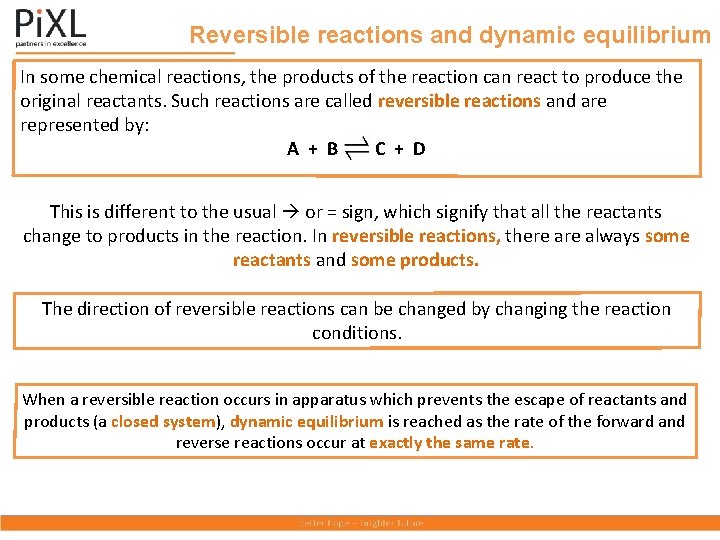
Reversible reactions and dynamic equilibrium In some chemical reactions, the products of the reaction can react to produce the original reactants. Such reactions are called reversible reactions and are represented by: A + B C + D This is different to the usual or = sign, which signify that all the reactants change to products in the reaction. In reversible reactions, there always some reactants and some products. The direction of reversible reactions can be changed by changing the reaction conditions. When a reversible reaction occurs in apparatus which prevents the escape of reactants and products (a closed system), dynamic equilibrium is reached as the rate of the forward and reverse reactions occur at exactly the same rate.
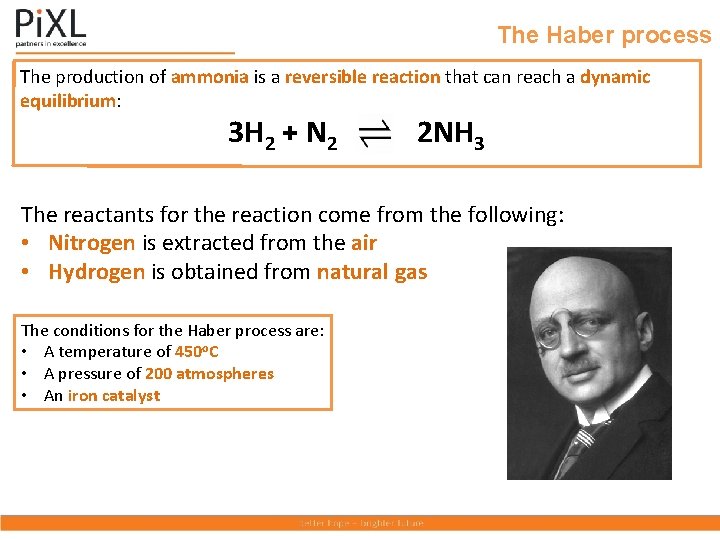
The Haber process The production of ammonia is a reversible reaction that can reach a dynamic equilibrium: 3 H 2 + N 2 2 NH 3 The reactants for the reaction come from the following: • Nitrogen is extracted from the air • Hydrogen is obtained from natural gas The conditions for the Haber process are: • A temperature of 450 o. C • A pressure of 200 atmospheres • An iron catalyst
Question. IT! Reversible reactions and equilibria – Part 1 • Reversible reactions • Dynamic equilibrium • Haber process
Reversible reactions Question. IT 1. What is meant by a reversible reaction? 2. Draw the symbol for a reversible reaction. 3. What is meant by the term dynamic equilibrium? 4. What needs to happen for equilibrium to be reached?
Reversible reactions Question. IT 5. The formation of ammonia is a reversible reaction between nitrogen and hydrogen. Where are these reactants extracted from? 6. Name three conditions for the Haber process.
Answer. IT! Reversible reactions and equilibria – Part 1 • Reversible reactions • Dynamic equilibrium • Haber process
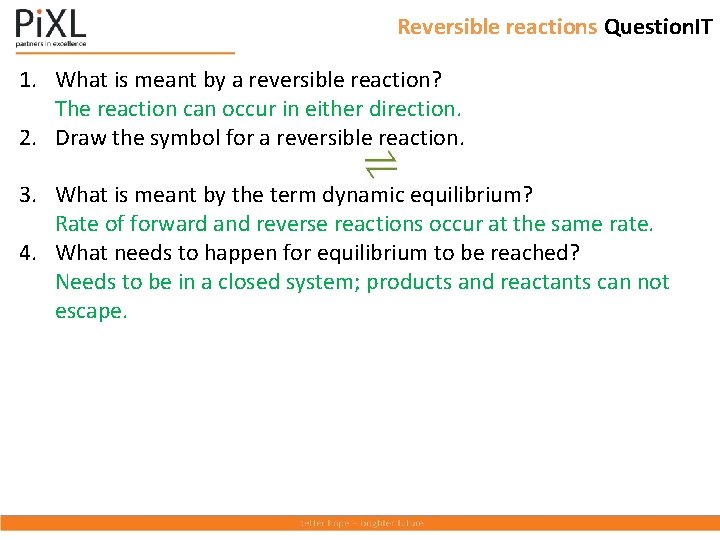
Reversible reactions Question. IT 1. What is meant by a reversible reaction? The reaction can occur in either direction. 2. Draw the symbol for a reversible reaction. 3. What is meant by the term dynamic equilibrium? Rate of forward and reverse reactions occur at the same rate. 4. What needs to happen for equilibrium to be reached? Needs to be in a closed system; products and reactants can not escape.
Reversible reactions Question. IT 5. The formation of ammonia is a reversible reaction between nitrogen and hydrogen. Where are these reactants extracted from? Hydrogen from natural gas; nitrogen from the air. 6. Name three conditions for the Haber process. Temperature – 450 o. C; Pressure – 200 atmospheres; iron catalyst

Learn. IT! Know. IT! Reversible reactions and equilibria – Part 2 • Factors affecting dynamic equilibria (HT)
Factors affecting dynamic equilibrium (HT) The Effect of Changing Concentration If the concentration of one of the reactants or products is changed, the system is no longer at equilibrium and the concentrations of all the substances will change until equilibrium is reached again. E. g. the Haber process equilibrium: N 2 (g) + 3 H 2 (g) 2 NH 3(g) If the concentration of a reactant is increased, more products will be formed until equilibrium is reached again. If the concentration of a product is decreased, more reactants will react until equilibrium is reached again.
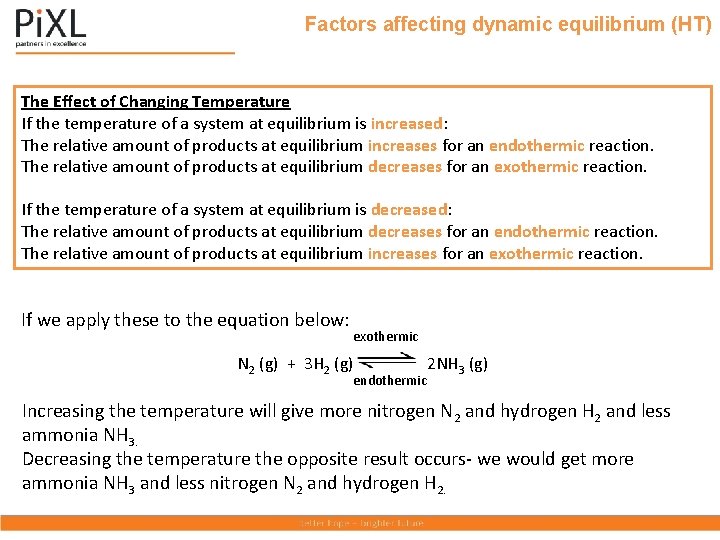
Factors affecting dynamic equilibrium (HT) The Effect of Changing Temperature If the temperature of a system at equilibrium is increased: The relative amount of products at equilibrium increases for an endothermic reaction. The relative amount of products at equilibrium decreases for an exothermic reaction. If the temperature of a system at equilibrium is decreased: The relative amount of products at equilibrium decreases for an endothermic reaction. The relative amount of products at equilibrium increases for an exothermic reaction. If we apply these to the equation below: exothermic N 2 (g) + 3 H 2 (g) 2 NH 3 (g) endothermic Increasing the temperature will give more nitrogen N 2 and hydrogen H 2 and less ammonia NH 3. Decreasing the temperature the opposite result occurs- we would get more ammonia NH 3 and less nitrogen N 2 and hydrogen H 2.
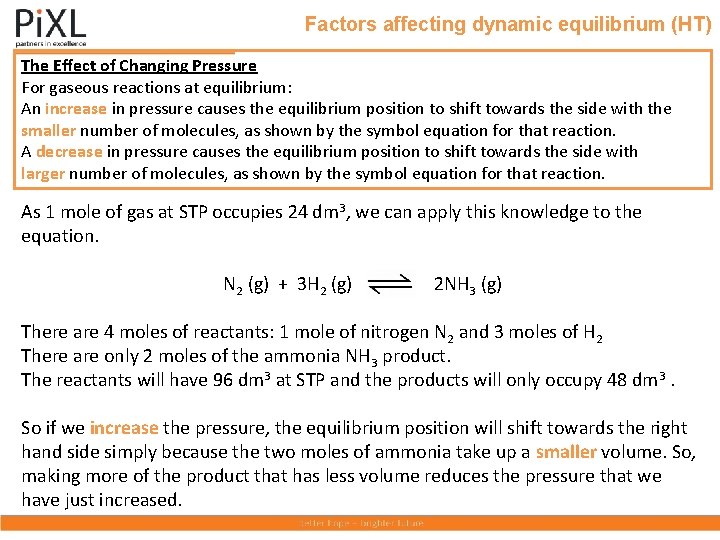
Factors affecting dynamic equilibrium (HT) The Effect of Changing Pressure For gaseous reactions at equilibrium: An increase in pressure causes the equilibrium position to shift towards the side with the smaller number of molecules, as shown by the symbol equation for that reaction. A decrease in pressure causes the equilibrium position to shift towards the side with larger number of molecules, as shown by the symbol equation for that reaction. As 1 mole of gas at STP occupies 24 dm 3, we can apply this knowledge to the equation. N 2 (g) + 3 H 2 (g) 2 NH 3 (g) There are 4 moles of reactants: 1 mole of nitrogen N 2 and 3 moles of H 2 There are only 2 moles of the ammonia NH 3 product. The reactants will have 96 dm 3 at STP and the products will only occupy 48 dm 3. So if we increase the pressure, the equilibrium position will shift towards the right hand side simply because the two moles of ammonia take up a smaller volume. So, making more of the product that has less volume reduces the pressure that we have just increased.
Question. IT! Reversible reactions and equilibria – Part 2 • Factors affecting dynamic equilibria (HT)
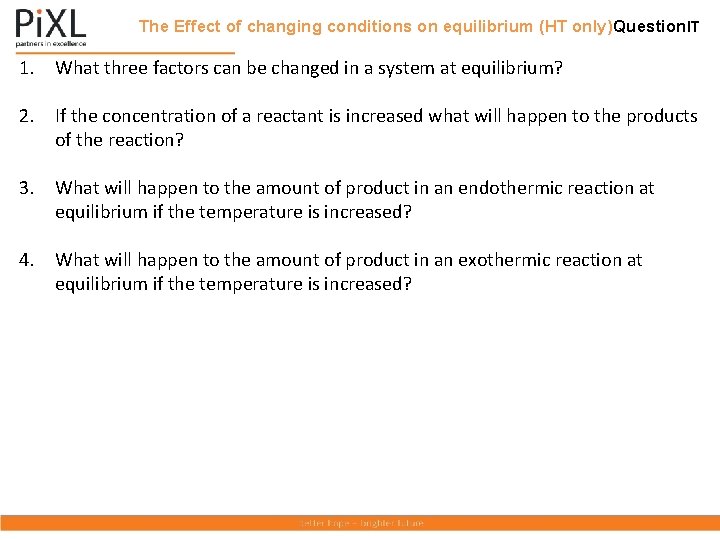
The Effect of changing conditions on equilibrium (HT only)Question. IT 1. What three factors can be changed in a system at equilibrium? 2. If the concentration of a reactant is increased what will happen to the products of the reaction? 3. What will happen to the amount of product in an endothermic reaction at equilibrium if the temperature is increased? 4. What will happen to the amount of product in an exothermic reaction at equilibrium if the temperature is increased?
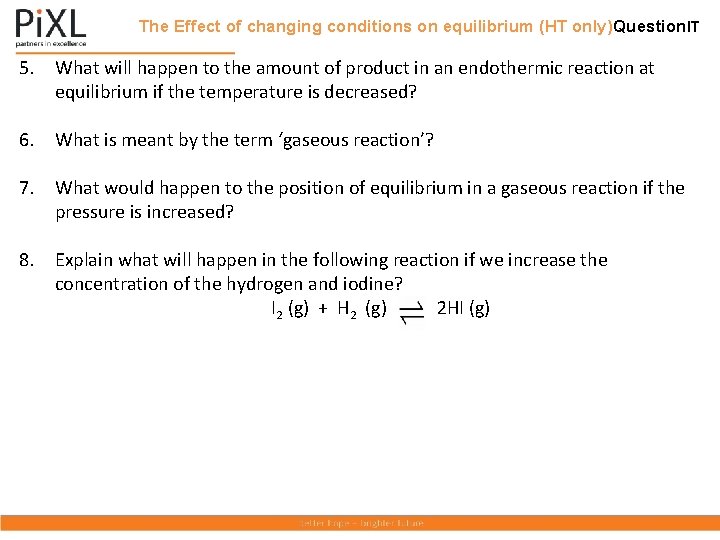
The Effect of changing conditions on equilibrium (HT only)Question. IT 5. What will happen to the amount of product in an endothermic reaction at equilibrium if the temperature is decreased? 6. What is meant by the term ‘gaseous reaction’? 7. What would happen to the position of equilibrium in a gaseous reaction if the pressure is increased? 8. Explain what will happen in the following reaction if we increase the concentration of the hydrogen and iodine? I 2 (g) + H 2 (g) 2 HI (g)
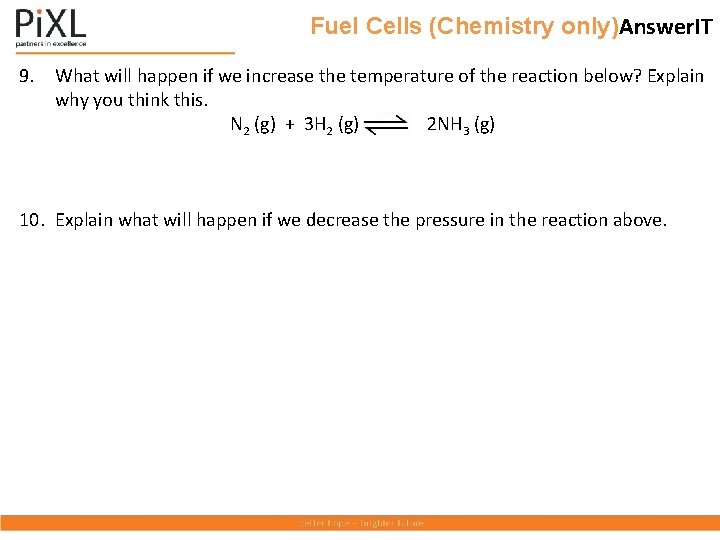
Fuel Cells (Chemistry only)Answer. IT 9. What will happen if we increase the temperature of the reaction below? Explain why you think this. N 2 (g) + 3 H 2 (g) 2 NH 3 (g) 10. Explain what will happen if we decrease the pressure in the reaction above.
Answer. IT! Reversible reactions and equilibria – Part 2 • Factors affecting dynamic equilibria (HT)
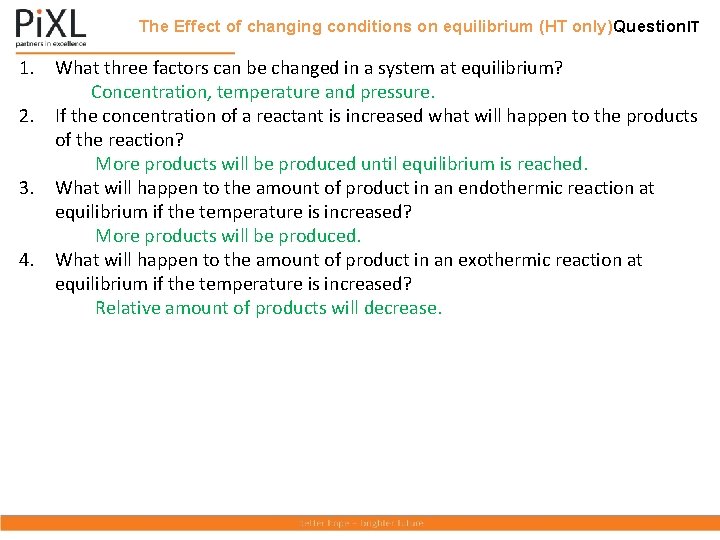
The Effect of changing conditions on equilibrium (HT only)Question. IT 1. What three factors can be changed in a system at equilibrium? Concentration, temperature and pressure. 2. If the concentration of a reactant is increased what will happen to the products of the reaction? More products will be produced until equilibrium is reached. 3. What will happen to the amount of product in an endothermic reaction at equilibrium if the temperature is increased? More products will be produced. 4. What will happen to the amount of product in an exothermic reaction at equilibrium if the temperature is increased? Relative amount of products will decrease.
The Effect of changing conditions on equilibrium (HT only)Question. IT 5. What will happen to the amount of product in an endothermic reaction at equilibrium if the temperature is decreased? Relative amount of products will decrease. 6. What is meant by the term ‘gaseous reaction’? Reaction where all the reactants and products are gases. 7. What would happen to the position of equilibrium in a gaseous reaction if the pressure is increased? Equilibrium would shift towards the side with the smaller number of molecules shown in the balanced chemical equation. 8. Explain what will happen in the following reaction if we increase the concentration of the hydrogen and iodine? I 2 (g) + H 2 (g) 2 HI (g) The extra iodine and hydrogen will react together to make more hydrogen iodide.
The Effect of changing conditions on equilibrium (HT only)Question. IT 9. What will happen if we increase the temperature of the reaction below? Explain why you think this. N 2 (g) + 3 H 2 (g) 2 NH 3 (g) More hydrogen and nitrogen will be made as the backward reaction is endothermic. 10. Explain what will happen if we decrease the pressure in the reaction above. We will get more nitrogen and hydrogen as there are four moles of gas/higher volume for the reactants.
- Slides: 56