
THE PHYSIOLOGY OF SPRINGBOARD DIVING a focus on
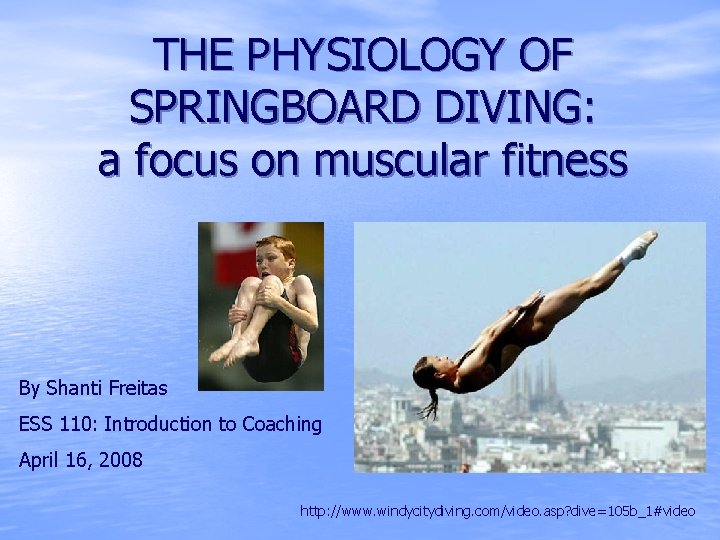
THE PHYSIOLOGY OF SPRINGBOARD DIVING: a focus on muscular fitness By Shanti Freitas ESS 110: Introduction to Coaching April 16, 2008 http: //www. windycitydiving. com/video. asp? dive=105 b_1#video

FITNESS TABLE MUSCULAR FITNESS ENERGY FITNESS Aerob Anaerob Flexibil Streng Enduran ic ic ity ce th Low Medium -high High Mediu mhig h Low Speed Powe r Mediu mhig h High

FLEXIBILITY - high • Divers can increase rotational speed through ‘tightening’ the pike or tuck, thus reducing moment of inertia
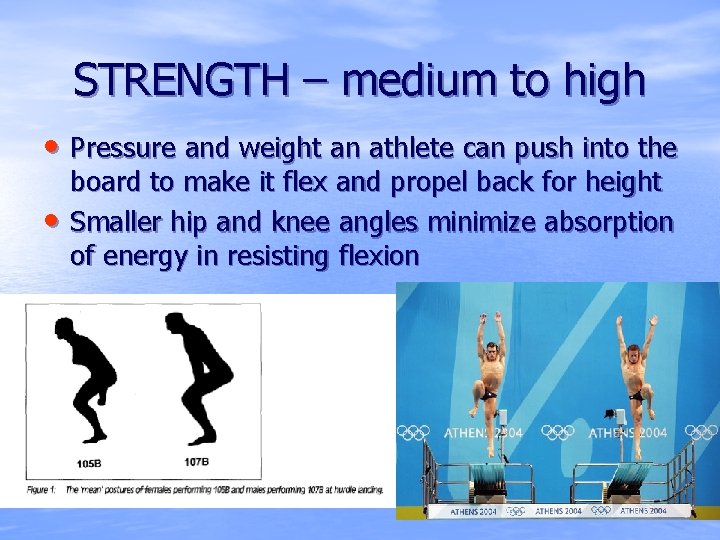
STRENGTH – medium to high • Pressure and weight an athlete can push into the • board to make it flex and propel back for height Smaller hip and knee angles minimize absorption of energy in resisting flexion
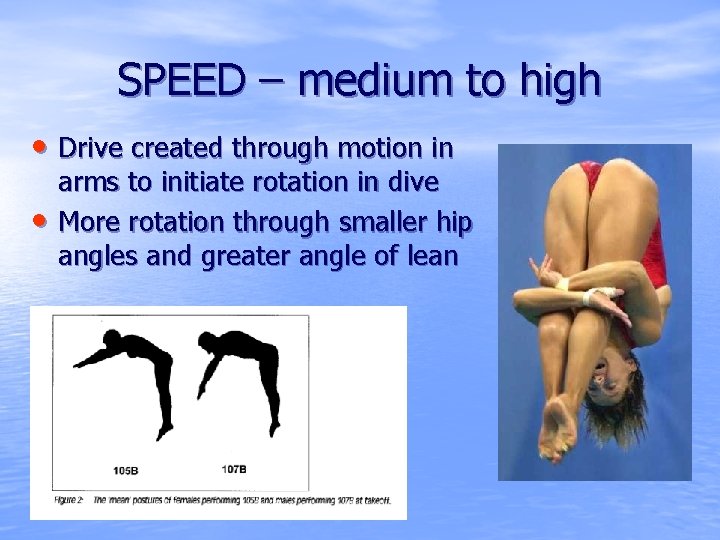
SPEED – medium to high • Drive created through motion in • arms to initiate rotation in dive More rotation through smaller hip angles and greater angle of lean

POWER – high! • Combination of strength to generate height through flexing board, and speed to initiate somersaulting rotation
REFERENCES • Martens, R. (2004). Successful Coaching: America’s Best-Selling Coach’s Guide. Champaign, IL: Human Kinetics. • O’Brien, R. (2003). Springboard and Platform Diving: A Complete Guide for Divers and Coaches. Champaign, IL: Human Kinetics. • O’Brien, R. (1992). Diving for Gold: Basic to Advanced Springboard and Platform Skills. Champaign, IL: Human Kinetics. • Sanders, R. & Gibson, B. (2000). Technique and Timing in the Women’s Forward Two and One Half Somersault Pike and Men’s Three and One Half Somersault Pike 3 m Springboard Dives. Journal of Science and Medicine in Sport 3 (4): 434 -338.
- Slides: 7