
THE PHYSIOLOGY OF BLOOD AN INTRODUCTION AND OVERVIEW
THE PHYSIOLOGY OF BLOOD AN INTRODUCTION AND OVERVIEW By Dr. M. ANTHONY DAVID, MD. NOMAD: 2005: BP: INTROVERVIEW 1
WHAT IS BLOOD? n n IT IS A LIQUID CONNECTIVE TISSUE IN AN AVERAGE 70 Kg MAN: n n 100 Trillion cells. Of which 25 trillions are Red Blood Cells! The average blood volume is 5 – 6 lts. It is roughly 7% of the total body weight. NOMAD: 2005: BP: INTROVERVIEW 2
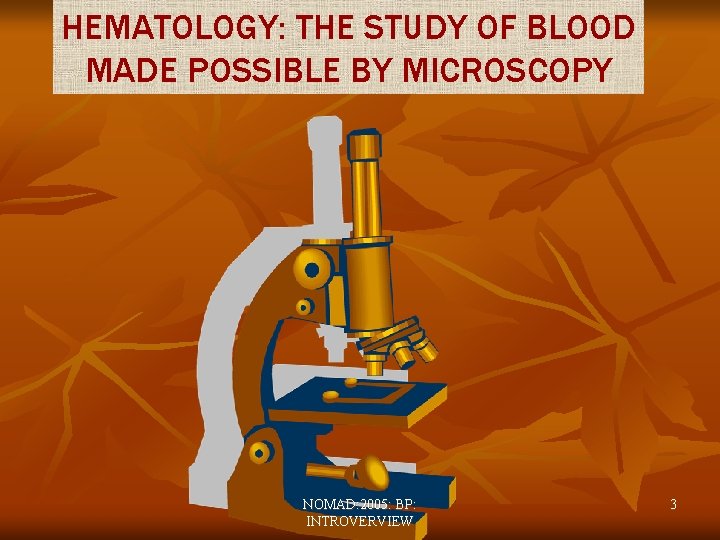
HEMATOLOGY: THE STUDY OF BLOOD MADE POSSIBLE BY MICROSCOPY NOMAD: 2005: BP: INTROVERVIEW 3
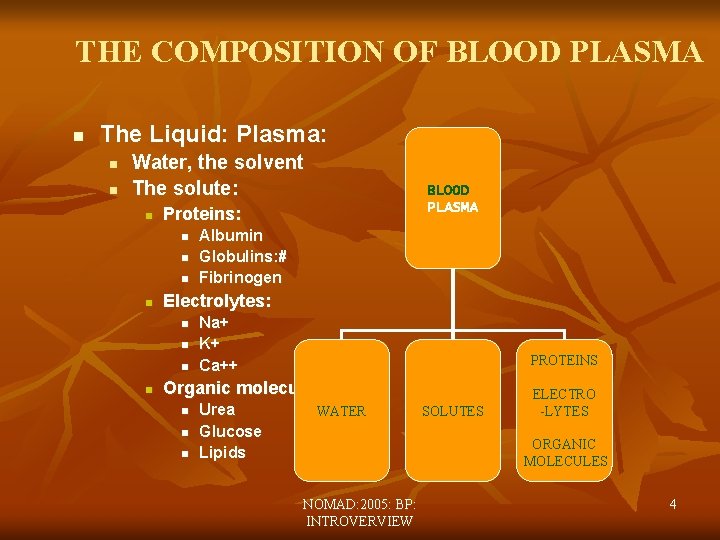
THE COMPOSITION OF BLOOD PLASMA n The Liquid: Plasma: n n Water, the solvent The solute: n Proteins: n n Albumin Globulins: # Fibrinogen Electrolytes: n n BLOOD PLASMA Na+ K+ Ca++ PROTEINS Organic molecules n n n Urea Glucose Lipids WATER SOLUTES ELECTRO -LYTES ORGANIC MOLECULES NOMAD: 2005: BP: INTROVERVIEW 4
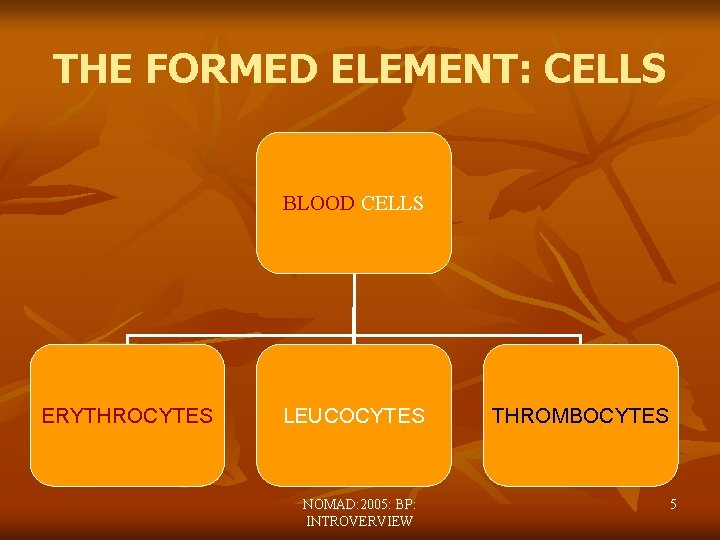
THE FORMED ELEMENT: CELLS BLOOD CELLS ERYTHROCYTES LEUCOCYTES NOMAD: 2005: BP: INTROVERVIEW THROMBOCYTES 5
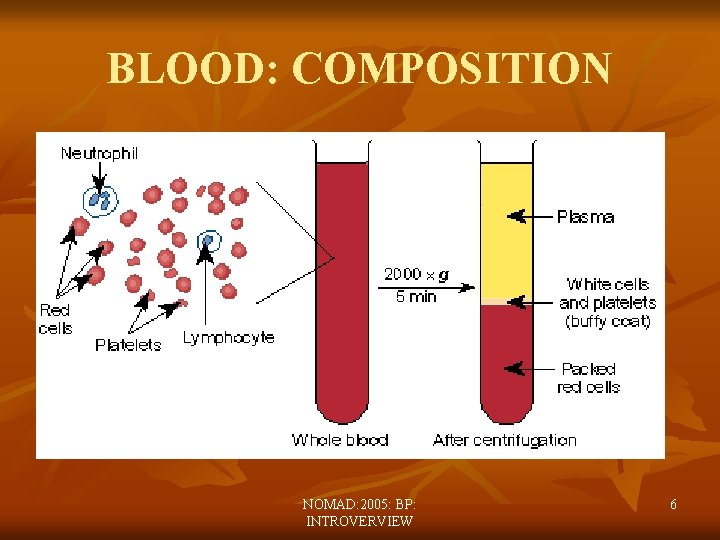
BLOOD: COMPOSITION NOMAD: 2005: BP: INTROVERVIEW 6
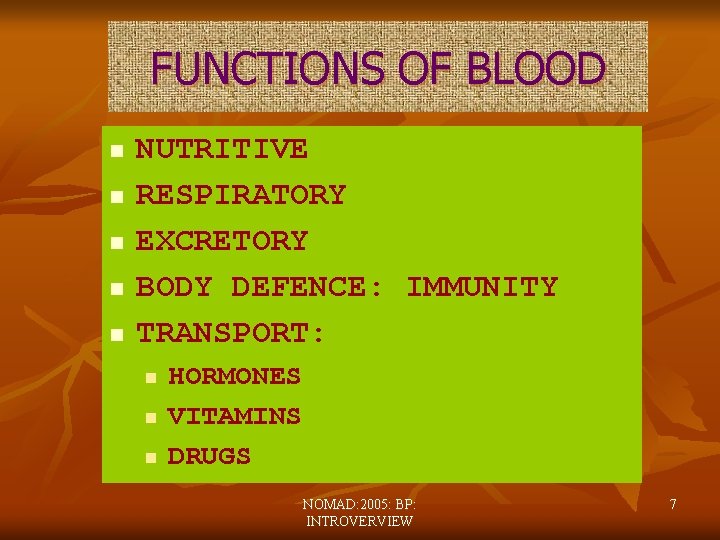
FUNCTIONS OF BLOOD n n n NUTRITIVE RESPIRATORY EXCRETORY BODY DEFENCE: IMMUNITY TRANSPORT: n n n HORMONES VITAMINS DRUGS NOMAD: 2005: BP: INTROVERVIEW 7
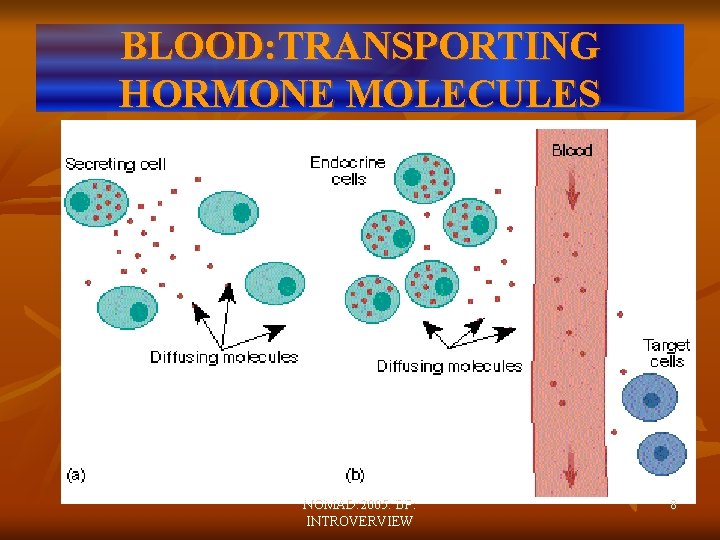
BLOOD: TRANSPORTING HORMONE MOLECULES NOMAD: 2005: BP: INTROVERVIEW 8
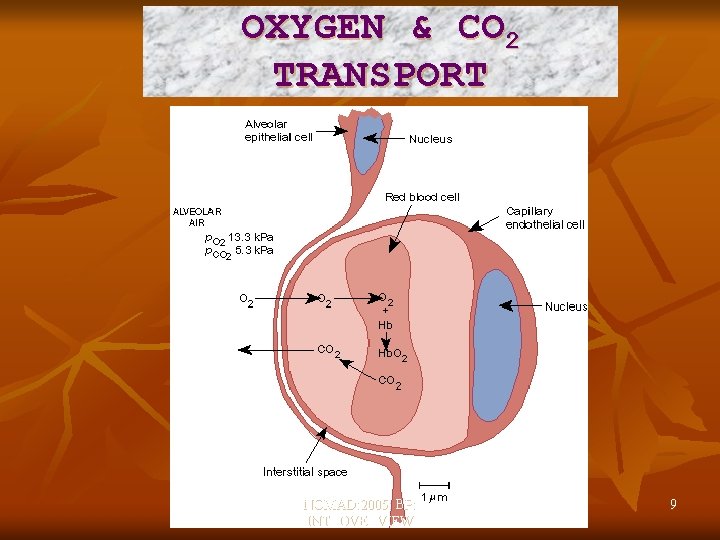
OXYGEN & CO 2 TRANSPORT NOMAD: 2005: BP: INTROVERVIEW 9
FUNCTIONS OF BLOOD n HOMEOSTATIC FUNCTION: n n ACID BASE BALANCE. ELECTROLYTE BALANCE. HEMOSTASIS. THERMOREGULATION. NOMAD: 2005: BP: INTROVERVIEW 10

WHAT IS BLOOD VOLUME? The total amount of blood in circulation plus the amount of blood in the reservoirs constitutes the “Blood Volume” n The average adult 70 kg man has a blood volume of 5 to 6 litres. n NOMAD: 2005: BP: INTROVERVIEW 11

EXPRESSION OF BLOOD VOLUME n n Usually Blood Volume is expressed in liters. It can also be expressed in relation to body weight. n n It is 7% Body Weight Another way to express it is in terms of Body Surface Area. n n Whole Blood : 2. 8 Lts/M 2 Plasma : 1. 5 Lts/M 2 NOMAD: 2005: BP: INTROVERVIEW 12

METHODS OF MEASURING BLOOD VOLUME n n n IN HUMANS: ONLY INDIRECT METHODS DYE DILUTION TECHNIQUE: PRINCIPLE: n n n Injection of a known volume of non toxic substance into the circulation. Measuring the dilution of this injected dye after some time. This gives us the Plasma volume. NOMAD: 2005: BP: INTROVERVIEW 13

DYE DILUTION TECHNIQUE V 1 = VOLUME C 1 = CONCENTRATION OF DYE V 2 = VOLUME C 2 = CONC. OF DYE V 1 X C 1 = V 2 X C 2 OR V 2 = V 1 X C 1 = Amount of Dye injected C 2 Conc. Of the dye in the Plasma NOMAD: 2005: BP: INTROVERVIEW 14

HEMATOCRIT (PCV) The volume of erythrocytes in the whole blood expressed in percentage is the Hematocrit. n This is also called as Packed Cell Volume or PCV. n This is determined by the Wintrobe’s tube, using a Centrifuge. n NOMAD: 2005: BP: INTROVERVIEW 15
HEMATOCRIT n n n A mixture of blood and double oxalate (K – NH 4) is taken upto 100 mark in the Wintrobe’s tube. The tube is placed in the centrifuge. It is rotated at 3, 000 rpm for 30 minutes. The Hematocrit is then read off the tube. Blood Volume = Plasma Volume X 100 - PCV NOMAD: 2005: BP: INTROVERVIEW 16
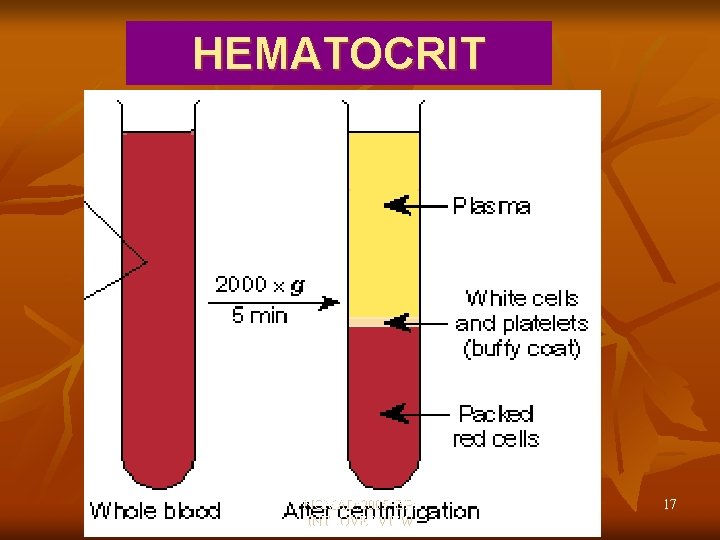
HEMATOCRIT NOMAD: 2005: BP: INTROVERVIEW 17
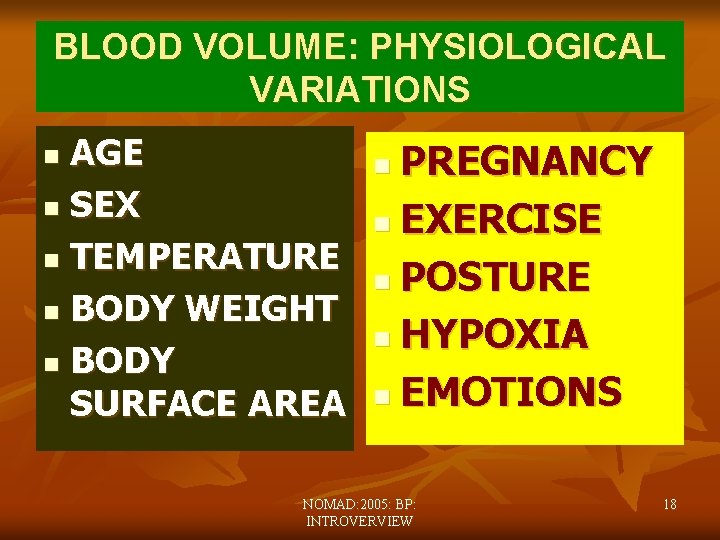
BLOOD VOLUME: PHYSIOLOGICAL VARIATIONS AGE n SEX n TEMPERATURE n BODY WEIGHT n BODY SURFACE AREA n PREGNANCY n EXERCISE n POSTURE n HYPOXIA n EMOTIONS n NOMAD: 2005: BP: INTROVERVIEW 18

BLOOD VOLUME & AGE AT BIRTH 6 Months 1 year 2 yrs 6 months 4 years 7 years 10 years ADULTS BLOOD VOLUME in Liters 0. 3 0. 5 0. 7 1. 0 1. 3 1. 7 2. 5(Girls); 3. 2 (Boys) 5 (Men) 4. 5 (Women) NOMAD: 2005: BP: INTROVERVIEW 19

BLOOD VOLUME: PHYSIOLOGICAL VARIATIONS 1. SEX: n Males have more blood volume than females. 2. TEMPERATURE: n Acute exposure to cold causes reduction in blood volume due to Plasma water loss to tissues. NOMAD: 2005: BP: INTROVERVIEW 20
BLOOD VOLUME: PHYSIOLOGICAL VARIATIONS 3. BODY WEIGHT: n It is usually 7% of the Body Weight. 4. BODY SURFACE AREA: n 2. 8 Lts/Square Meters of BSA NOMAD: 2005: BP: INTROVERVIEW 21

BLOOD VOLUME: PHYSIOLOGICAL VARIATIONS 5. PREGNANCY: n Increases by 20 – 30% due to mass of fetus. 6. EXERCISE: n Vigorous exercise causes an increase. 7. POSTURE: n Changing from lying down to erect. NOMAD: 2005: BP: INTROVERVIEW 22
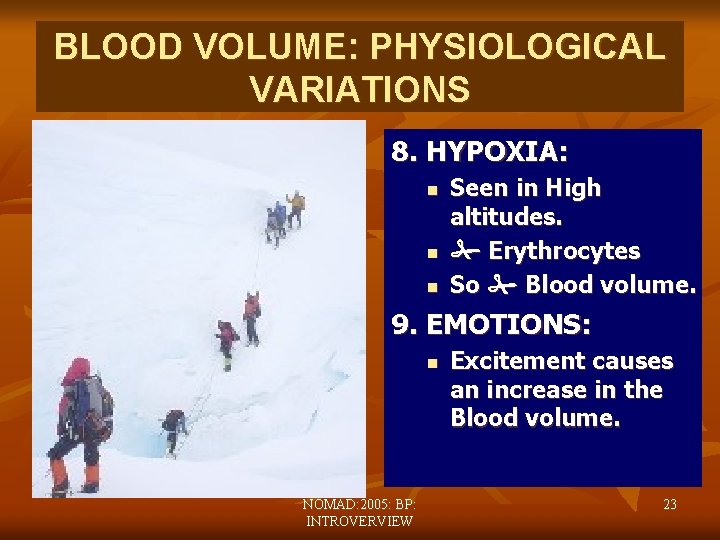
BLOOD VOLUME: PHYSIOLOGICAL VARIATIONS 8. HYPOXIA: n n n Seen in High altitudes. Erythrocytes So Blood volume. 9. EMOTIONS: n NOMAD: 2005: BP: INTROVERVIEW Excitement causes an increase in the Blood volume. 23
BLOOD VOLUME: PATHOLOGICAL VARIATIONS DECREASE IN BLOOD VOLUME IS HYPOVOLEMIA. CAUSES: 1. BLOOD LOSS: 2. SHOCK: n Crushing Injury n Cardiogenic n Neurogenic n Psychogenic. n NOMAD: 2005: BP: INTROVERVIEW 24
HYPOVOLEMIA: CAUSES (contd) 3. HEMOLYSIS: n n n Mismatched transfusion Snake bite Black water fever Hemorrhagic Plagues/Dengue Measles NOMAD: 2005: BP: INTROVERVIEW 25
HYPOVOLEMIA: CAUSES (contd) 4. DEHYDRATION: n n n Diarrhoea Cholera Gastroenteritis Burns Hyperemesis. NOMAD: 2005: BP: INTROVERVIEW 26

HYPOVOLEMIA: CAUSES (contd) 5. ANEMIA: n n Decreased RBC volume Plasma may increase. 6. OBESITY: n Blood volume per body weight decreases though Blood volume per BSA may be normal. 7. HYPOTHYROIDISM (MYXEDEMA): n Decrease in Blood volume. 8. ACUTE COLD: Decreases blood volume. NOMAD: 2005: BP: INTROVERVIEW 27
TREATMENT FOR BLOOD LOSS TRANSFUSION OF WHOLE BLOOD OF THE SAME BLOOD GROUP & TYPE. n INFUSION OF PLASMA n INFUSION OF DEXTRAN OR NORMAL SALINE. n NOMAD: 2005: BP: INTROVERVIEW 28
HEMOPOIESIS & ERYTHROPOIESIS By Dr. M. Anthony David. MD. NOMAD: 2005: BP: INTROVERVIEW 29
HEMOPOIESIS: INTRO n n n Hemo: Referring to blood cells Poiesis: “The development or production of” The word Hemopoiesis refers to the production & development of all the blood cells: n n Erythrocytes: Erythropoiesis Leucocytes: Leucopoiesis Thrombocytes: Thrombopoiesis. Begins in the 20 th week of life in the fetus & continues in the red bone marrow till death. NOMAD: 2005: BP: INTROVERVIEW 30
STEM CELL THEORY n n All blood cells are produced by the bone marrow. They come from a single class of primitive mother cells called as: PLURIPOTENT STEM CELLS. These cells give rise to blood cells of: n n Myeloid series: Cells arising mainly bone marrow. Lymphoid series: cells arising from tissues. NOMAD: 2005: BP: INTROVERVIEW from the lymphoid 31
PROGENITOR CELLS n n Committed stem cells lose their capacity for self-renewal. They become irreversibly committed. These cells are termed as “Progenitor cells” They are regulated by certain hormones or substances so that they can: n n Proliferate Undergo Maturation. NOMAD: 2005: BP: INTROVERVIEW 32

BLOOD CELLS: DEVELOPMENT PROGENITOR CELLS LYMPHOID CELLS PRO MEGA MYELOBLAST NORMOBLAST KARYOBLAST LYMPHOCYTES ERYTHROCYTES THROMBOCYTES NOMAD: 2005: BP: INTROVERVIEW GRANULOCYTES MONOBLAST MONOCYTES 33
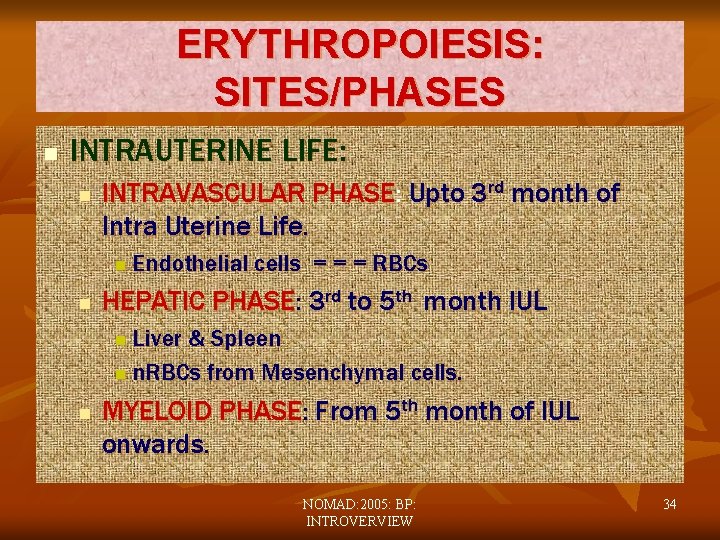
ERYTHROPOIESIS: SITES/PHASES n INTRAUTERINE LIFE: n INTRAVASCULAR PHASE: Upto 3 rd month of Intra Uterine Life. n n Endothelial cells = = = RBCs HEPATIC PHASE: 3 rd to 5 th month IUL Liver & Spleen n n. RBCs from Mesenchymal cells. n n MYELOID PHASE: From 5 th month of IUL onwards. NOMAD: 2005: BP: INTROVERVIEW 34
ERYTHROPOIESIS: SITES/PHASES contd. n POST NATAL LIFE: n CHILDREN: n Predominantly Red Bone Marrow of skeleton: n n n Axial & Appendicular. ADULTS: n Red Bone Marrow of Axial Skeleton. NOMAD: 2005: BP: INTROVERVIEW 35
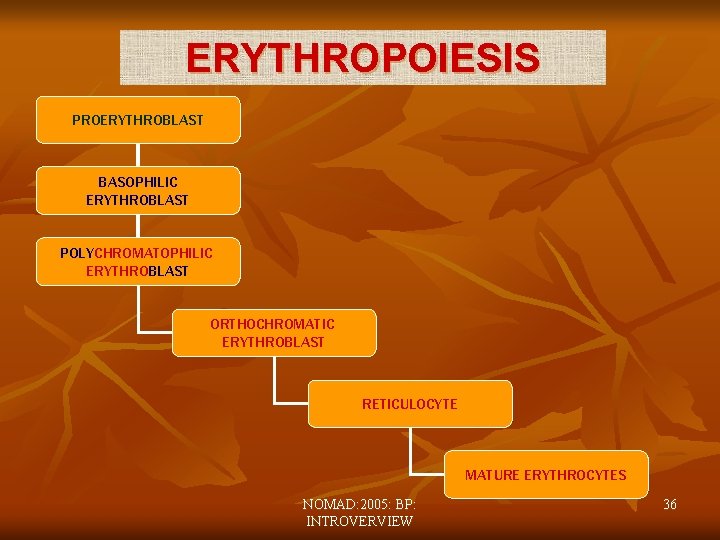
ERYTHROPOIESIS PROERYTHROBLAST BASOPHILIC ERYTHROBLAST POLYCHROMATOPHILIC ERYTHROBLAST ORTHOCHROMATIC ERYTHROBLAST RETICULOCYTE MATURE ERYTHROCYTES NOMAD: 2005: BP: INTROVERVIEW 36
FACTORS REGULATING ERYTHROPOIESIS n n n SINGLE MOST IMPORTANT REGULATOR: “TISSUE OXYGENATION” BURST PROMOTING ACTIVITY ERYTHROPOIETIN IRON VITAMINS: n n n Vitamin B 12 Folic Acid MISCELLANEOUS NOMAD: 2005: BP: INTROVERVIEW 37
ERYTHROPOIETIN n n n A hormone produced by the Kidney. Nowadays available as Synthetic Epoieti Increases the number of: n n Nucleated precursors in the marrow. Reticulocytes & Mature Erythrocytes in the blood. NOMAD: 2005: BP: INTROVERVIEW 38
VITAMINS n B 12: Cyanocobalamine & Folic Acid: n n n Is also called Extrinsic Factor of Castle. Needs the Intrinsic Factor from the Gastric juice for absorption from Small Intestine. Deficiency causes Pernicious (When IF is missing) or Megaloblastic Anemia. Stimulates Erythropoiesis Is found in meat & diary products. NOMAD: 2005: BP: INTROVERVIEW 39

IRON n n n Essential for the synthesis of Hemoglobin. Deficiency causes Microcytic, Hypochromic Anemia. Deficiency causes the commonest type of Anemia. NOMAD: 2005: BP: INTROVERVIEW 40

NOMAD: 2005: BP: INTROVERVIEW 41
- Slides: 41