
The Physiology of a Nerve Impulse Basic Facts
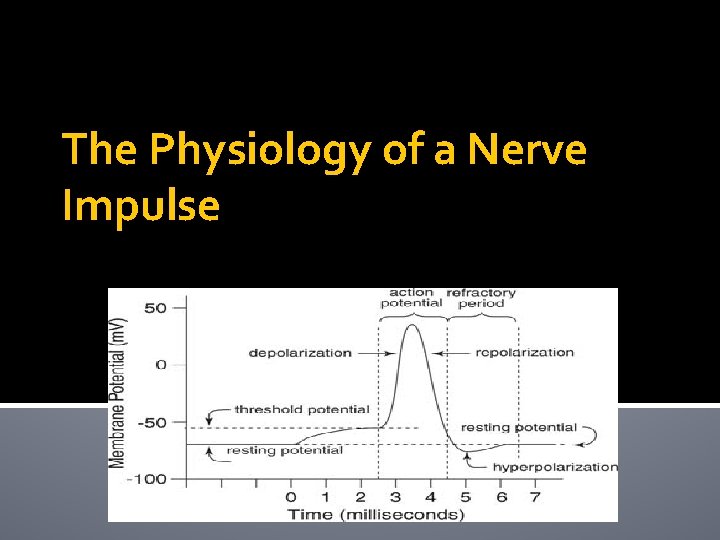
The Physiology of a Nerve Impulse
Basic Facts �Neurons have a resting membrane potential of -70 mv �As ions are moved across the neurons membrane (sodium and potassium) the membrane potential changes �This movement of ions allows for the transfer of the electrical signal which is the nerve impulse

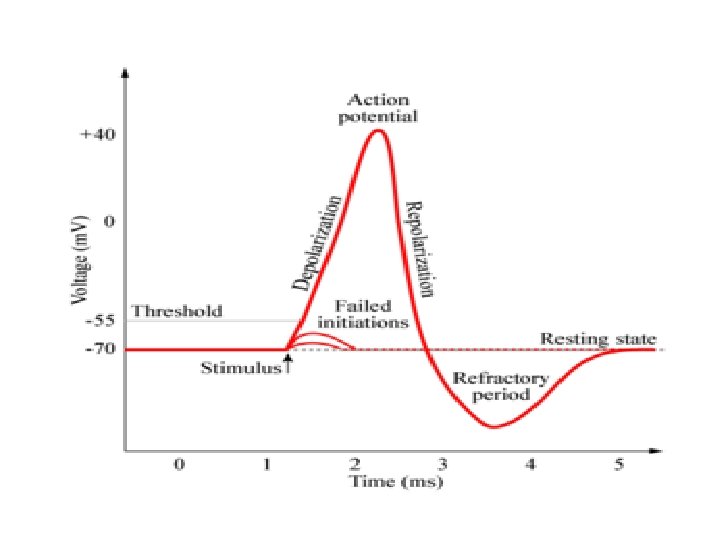
Generation of an Action Potential (Nerve Impulse) � 2 Phases are involved in the generation of a nerve impulse �Depolarization- membrane potential changes from negative to positive due to the movement ions �Repolarization- membrane potential is restored to -70 mv so that another action potential can be generated �The whole process is an “all or none” phenomenon �It always occurs with the same amount of strength each time

Steps in the Generation of an Action Potential
Step 1: Depolarization �An initial stimulus causes sodium ion channels to open which leads to depolarization on the membrane �Potential changes from -70 to +30 mv �Once channels are activated and the action potential passes, they are immediately closed off so that they can re-set themselves for the next potential


2. Repolarization �Potassium ion channels open just as the sodium ion channels close �This allows repolarization to take place �Potassium flows out of the cell to restore the potential back to -70 mv

3. Refractory Period �Time period immediately after the action potential passes by on a neuron �The cell is unable to generate a new action potential during this time period �Occurs when sodium channels are deactivated, thus enabling them from depolarization �This period gives potassium time to flow out of the cell and restore the resting potential

4. Next Impulse �Once the resting potential is restored the cell is ready for the next action potential �Large axons can conduct up to 1000 impulses per second �Smaller ones can only conduct up to 250 per second
Summary Points �The action potential is created by the movement of sodium ions into the neuron �The system is re-set by the flow of potassium ions out of the neuron �All activity occurs within millisecond �Occurs until the stimulus that started it is stopped, or until you consciously stop it
- Slides: 13