
The Physics of Volleyball By Najla Roberts Jocelyn
The Physics of Volleyball By: Najla Roberts & Jocelyn Cortes

Introduction Physics plays more parts in volleyball than you think such as… Types of Forces Newton’s Law of Motion Acceleration Displacement Velocity Projectile Motion Momentum Impulse Work Gravity Friction
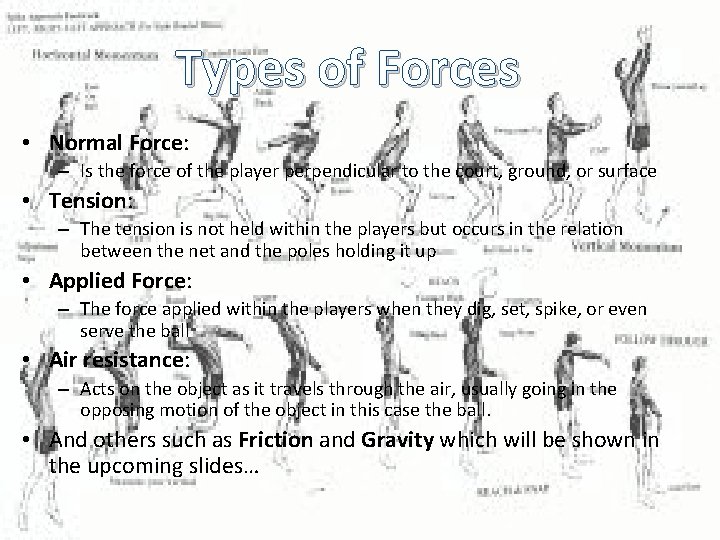
Types of Forces • Normal Force: – Is the force of the player perpendicular to the court, ground, or surface • Tension: – The tension is not held within the players but occurs in the relation between the net and the poles holding it up • Applied Force: – The force applied within the players when they dig, set, spike, or even serve the ball • Air resistance: – Acts on the object as it travels through the air, usually going in the opposing motion of the object in this case the ball. • And others such as Friction and Gravity which will be shown in the upcoming slides…

What types of friction are involved in volley? Types of Friction Learned: • Static: the friction while an object is stationary, the force is applied but does not cause it to move. • Kinetic a friction present when a object is moving. Didn’t Learn: • Rolling: friction that occurs when an object rolls over another and is weaker than both static and sliding friction • Fluid: when a body moves in a fluid or in air, where a resistive force slows down the motion of their body. • Sliding: friction that acts on sliding objects , and is weaker than static friction. Occurs when solid surfaces slide over each other. The answer: Kinetic Friction Fluid Friction

Gravitational Force • Is the force between an objects mass, weight, and the Earth. That Gravitational Force is applied to… • The player • And the ball when it is – Spiked – Passed – Served – Bumped – Etc.

Newton’s Law of Motion There are three laws consisting in this law Every object in uniform motion remains in that state of motion unless an external force is applied. Not uniform motion and is the relation between an objects mass, acceleration, and force applied. Every action is an equal and opposite reaction.

Acceleration Increase in the rate or speed of something v. Occurs when there is an increase in velocity v. Can depend on the initial velocity of serving on the bal

Projectile Motion & Work Projectile Motion Work v Projectile motion involves the downward pull of gravity and the upward or horizontal motion. v Shortens the path of the volleyball v Most volleyball players jump about 300 times a match v (w= F*d) and is measured in Joules.

Momentum/Impulse • Momentum-the quantity of motion of a moving body, measured as a product of its mass and velocity. • There are collisions between the ball and the players. These collisions cause impulses (changes in momentum) which the players do their best to control in order to accurately change the direction and speed of the ball.

Types of Energy When the is coming • Potential energytowards you it has The higher the volleyball is sprung up inmomentum. When you hit it with a force, the air the more potential energy it has. ball rebounds. The Also, the more mass it direction and speed of has the more potential the ball change. energy it will have,
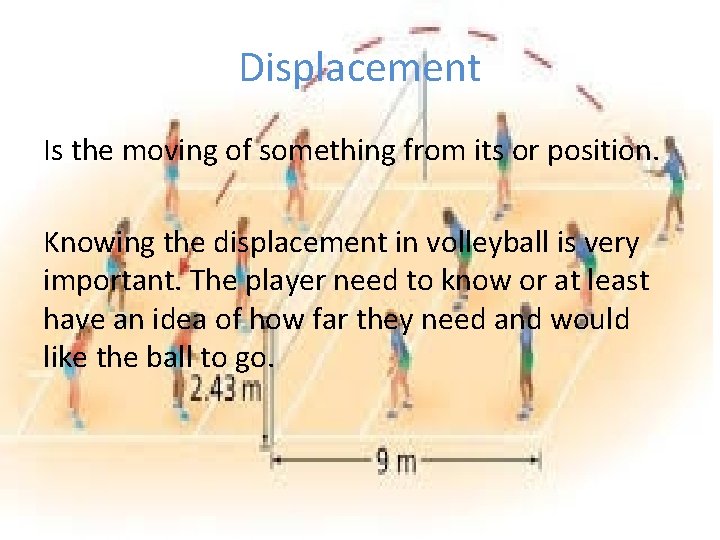
Displacement Is the moving of something from its or position. Knowing the displacement in volleyball is very important. The player need to know or at least have an idea of how far they need and would like the ball to go.
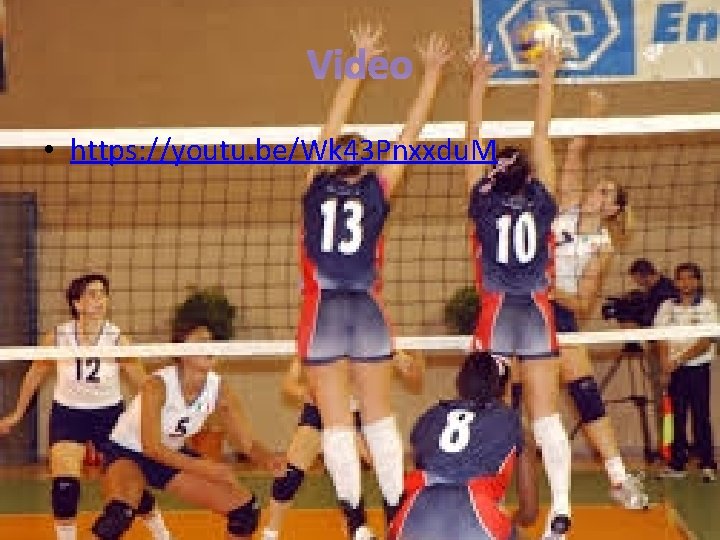
Video • https: //youtu. be/Wk 43 Pnxxdu. M
• www. physicsclassroom. com • http: //www. volleyball. org/history. html. • http: //www. volleyhall. org/history-ofvolleyball. html • http: //www 2. hesston. edu/Physics/Volleyball/ paper. htm • http: //www. real-world-physicsproblems. com/physics-of-volleyball. html
- Slides: 14