
The physics of streamers and discharges P Fonte
- Slides: 35
The physics of streamers and discharges P. Fonte My view, not a review.
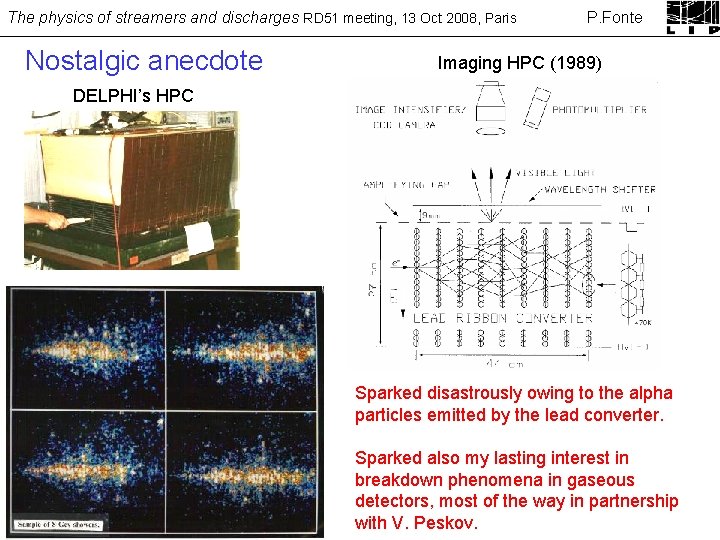
The physics of streamers and discharges RD 51 meeting, 13 Oct 2008, Paris Nostalgic anecdote P. Fonte Imaging HPC (1989) DELPHI’s HPC Sparked disastrously owing to the alpha particles emitted by the lead converter. Sparked also my lasting interest in breakdown phenomena in gaseous detectors, most of the way in partnership with V. Peskov.
The physics of streamers and discharges RD 51 meeting, 13 Oct 2008, Paris P. Fonte Outlook • Known and suspected fundamental breakdown onset modes: slow, fast, rate-induced? • Experimental evidence • Physical origin (or speculations about…) • Suppression • Streamer simulation • Detailed physics • Simulation strategies • Results • The discharge • Phenomenology • Suppression
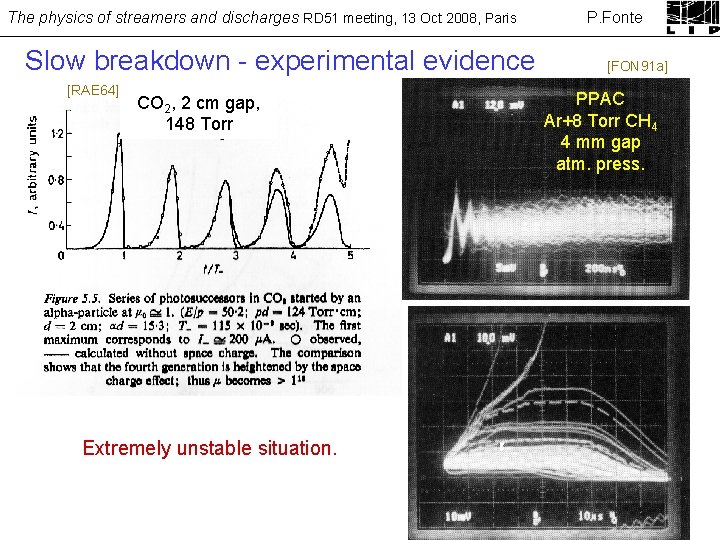
The physics of streamers and discharges RD 51 meeting, 13 Oct 2008, Paris Slow breakdown - experimental evidence [RAE 64] CO 2, 2 cm gap, 148 Torr Extremely unstable situation. P. Fonte [FON 91 a] PPAC Ar+8 Torr CH 4 4 mm gap atm. press.
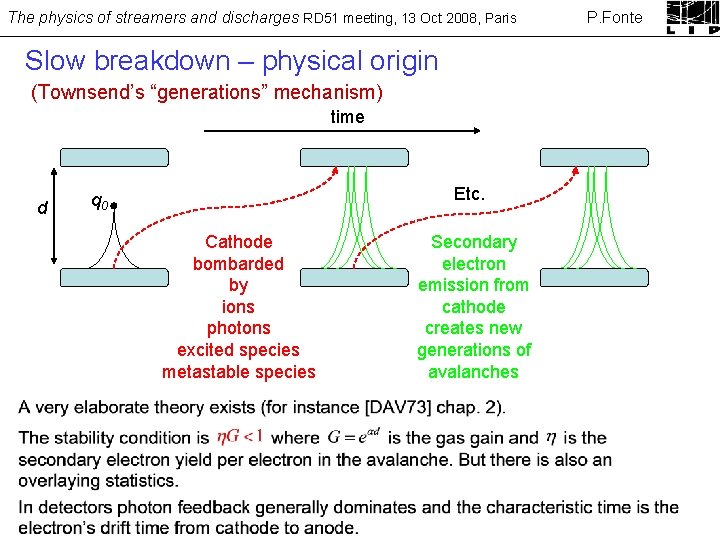
The physics of streamers and discharges RD 51 meeting, 13 Oct 2008, Paris Slow breakdown – physical origin (Townsend’s “generations” mechanism) time d Etc. q 0 Cathode bombarded by ions photons excited species metastable species Secondary electron emission from cathode creates new generations of avalanches P. Fonte
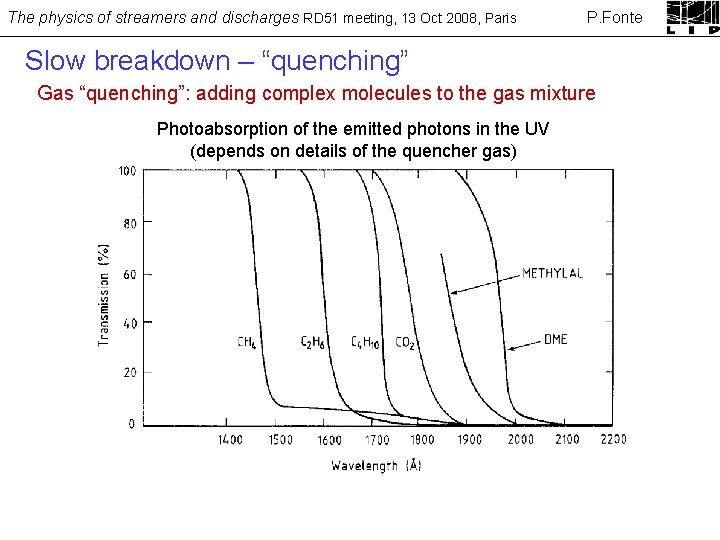
The physics of streamers and discharges RD 51 meeting, 13 Oct 2008, Paris P. Fonte Slow breakdown – “quenching” Gas “quenching”: adding complex molecules to the gas mixture Photoabsorption of the emitted photons in the UV (depends on details of the quencher gas)
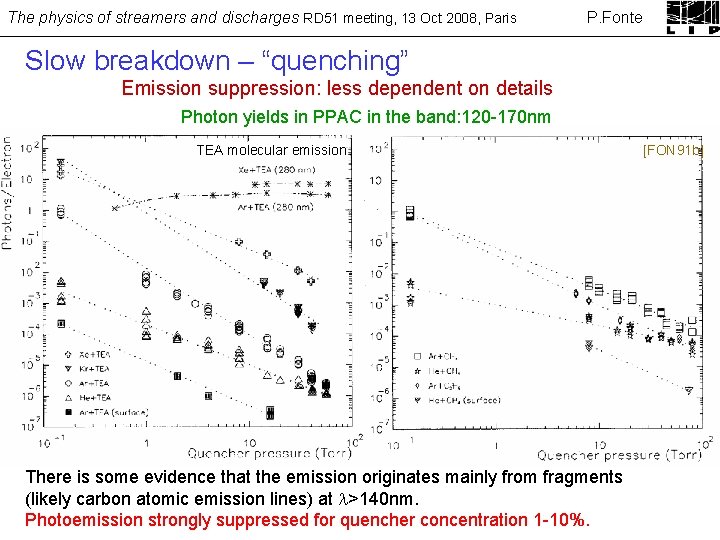
The physics of streamers and discharges RD 51 meeting, 13 Oct 2008, Paris P. Fonte Slow breakdown – “quenching” Emission suppression: less dependent on details Photon yields in PPAC in the band: 120 -170 nm TEA molecular emission There is some evidence that the emission originates mainly from fragments (likely carbon atomic emission lines) at >140 nm. Photoemission strongly suppressed for quencher concentration 1 -10%. [FON 91 b]
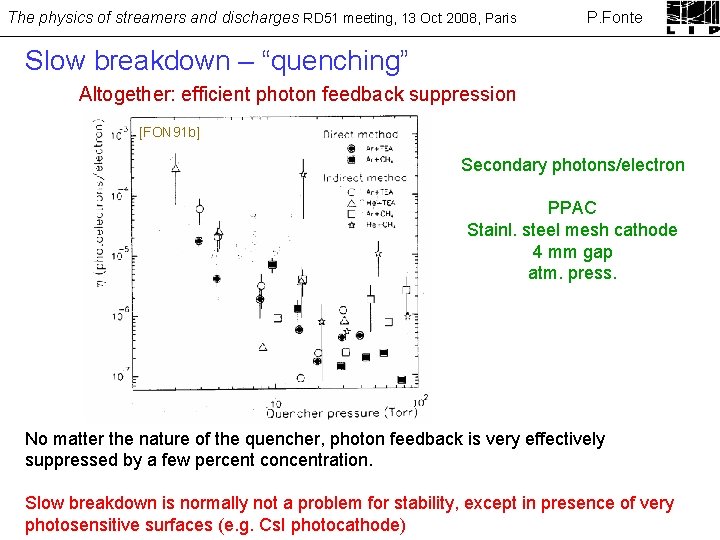
The physics of streamers and discharges RD 51 meeting, 13 Oct 2008, Paris P. Fonte Slow breakdown – “quenching” Altogether: efficient photon feedback suppression [FON 91 b] Secondary photons/electron PPAC Stainl. steel mesh cathode 4 mm gap atm. press. No matter the nature of the quencher, photon feedback is very effectively suppressed by a few percent concentration. Slow breakdown is normally not a problem for stability, except in presence of very photosensitive surfaces (e. g. Cs. I photocathode)
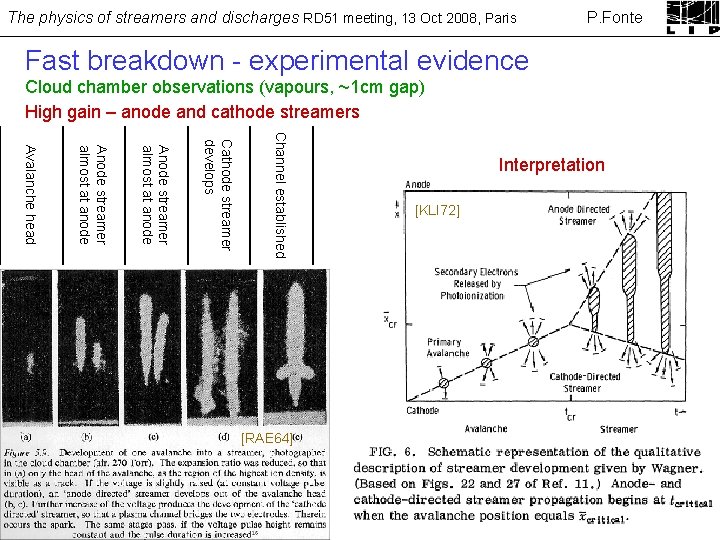
The physics of streamers and discharges RD 51 meeting, 13 Oct 2008, Paris P. Fonte Fast breakdown - experimental evidence Cloud chamber observations (vapours, ~1 cm gap) High gain – anode and cathode streamers Channel established Cathode streamer develops Anode streamer almost at anode Avalanche head [RAE 64] Interpretation [KLI 72]
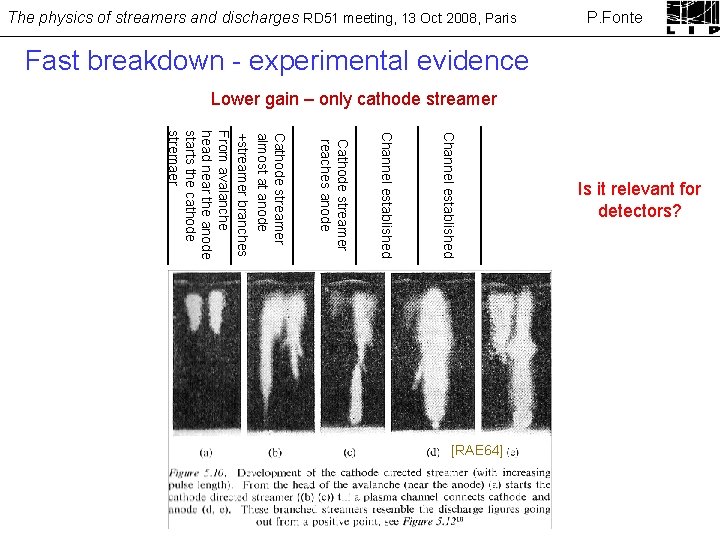
The physics of streamers and discharges RD 51 meeting, 13 Oct 2008, Paris P. Fonte Fast breakdown - experimental evidence Lower gain – only cathode streamer Channel established Cathode streamer reaches anode Cathode streamer almost at anode +streamer branches From avalanche head near the anode starts the cathode stremaer [RAE 64] Is it relevant for detectors?
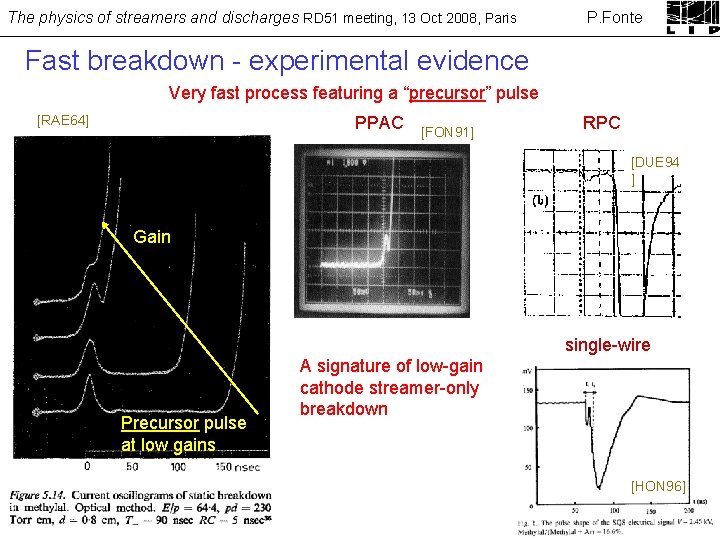
The physics of streamers and discharges RD 51 meeting, 13 Oct 2008, Paris P. Fonte Fast breakdown - experimental evidence Very fast process featuring a “precursor” pulse [RAE 64] PPAC [FON 91] RPC [DUE 94 ] Gain single-wire Precursor pulse at low gains A signature of low-gain cathode streamer-only breakdown [HON 96]
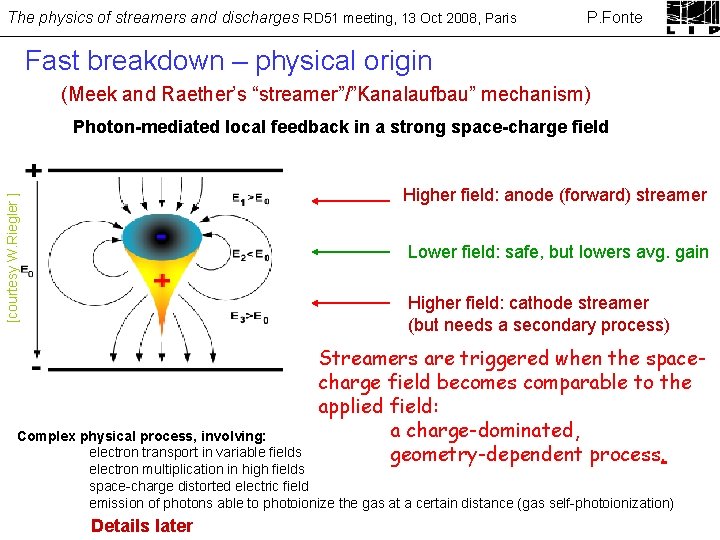
The physics of streamers and discharges RD 51 meeting, 13 Oct 2008, Paris P. Fonte Fast breakdown – physical origin (Meek and Raether’s “streamer”/”Kanalaufbau” mechanism) Photon-mediated local feedback in a strong space-charge field [courtesy W. Riegler ] Higher field: anode (forward) streamer Lower field: safe, but lowers avg. gain Higher field: cathode streamer (but needs a secondary process) Streamers are triggered when the spacecharge field becomes comparable to the applied field: a charge-dominated, geometry-dependent process. Complex physical process, involving: electron transport in variable fields electron multiplication in high fields space-charge distorted electric field emission of photons able to photoionize the gas at a certain distance (gas self-photoionization) Details later
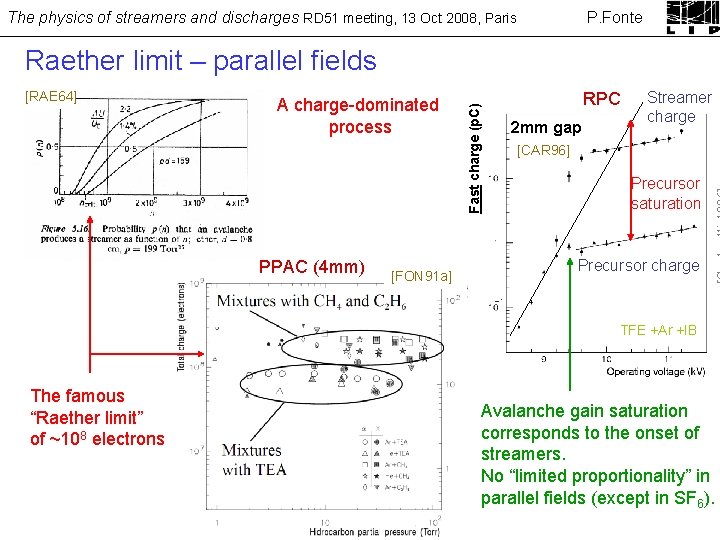
The physics of streamers and discharges RD 51 meeting, 13 Oct 2008, Paris P. Fonte [RAE 64] A charge-dominated process PPAC (4 mm) [FON 91 a] Fast charge (p. C) Raether limit – parallel fields RPC 2 mm gap [CAR 96] Streamer charge “streamer” Precursor saturation Avalanche Precursor charge TFE +Ar +IB The famous “Raether limit” of ~108 electrons Avalanche gain saturation corresponds to the onset of streamers. No “limited proportionality” in parallel fields (except in SF 6).
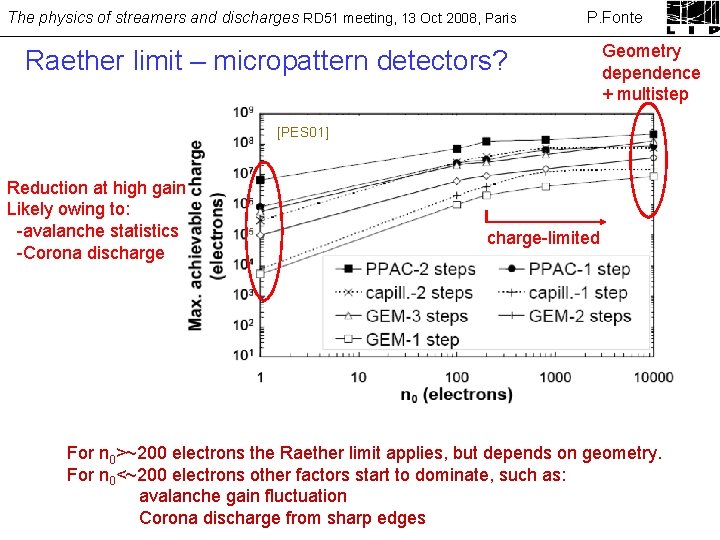
The physics of streamers and discharges RD 51 meeting, 13 Oct 2008, Paris P. Fonte Raether limit – micropattern detectors? Geometry dependence + multistep [PES 01] Reduction at high gain Likely owing to: -avalanche statistics -Corona discharge-limited For n 0>~200 electrons the Raether limit applies, but depends on geometry. For n 0<~200 electrons other factors start to dominate, such as: avalanche gain fluctuation Corona discharge from sharp edges
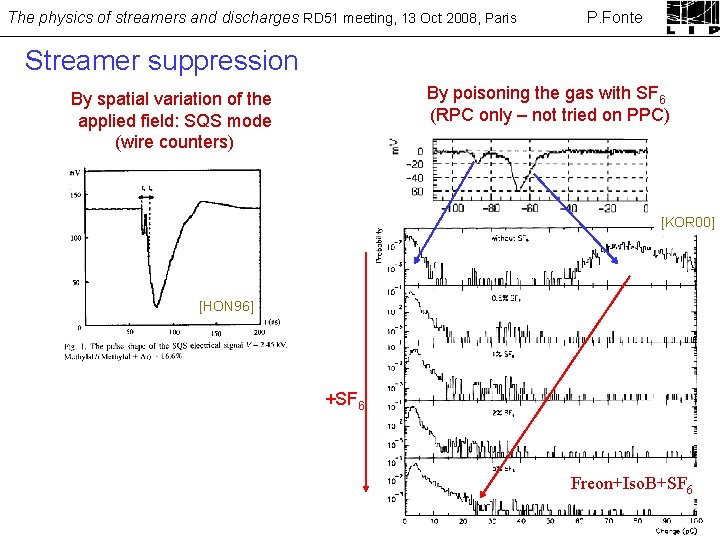
The physics of streamers and discharges RD 51 meeting, 13 Oct 2008, Paris P. Fonte Streamer suppression By poisoning the gas with SF 6 (RPC only – not tried on PPC) By spatial variation of the applied field: SQS mode (wire counters) [KOR 00] [HON 96] +SF 6 Freon+Iso. B+SF 6
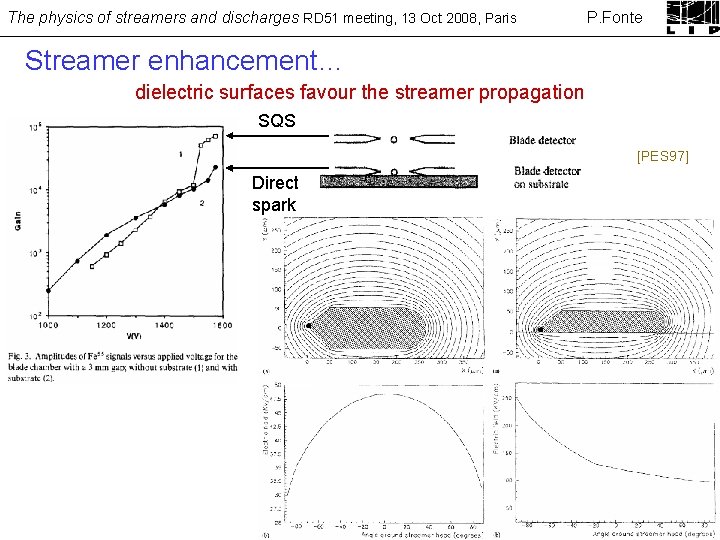
The physics of streamers and discharges RD 51 meeting, 13 Oct 2008, Paris P. Fonte Streamer enhancement… dielectric surfaces favour the streamer propagation SQS [PES 97] Direct spark
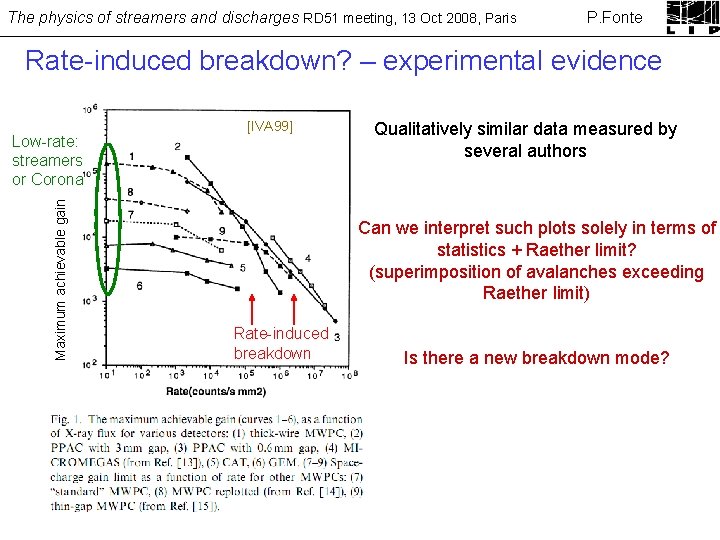
The physics of streamers and discharges RD 51 meeting, 13 Oct 2008, Paris P. Fonte Rate-induced breakdown? – experimental evidence Maximum achievable gain Low-rate: streamers or Corona [IVA 99] Qualitatively similar data measured by several authors Can we interpret such plots solely in terms of statistics + Raether limit? (superimposition of avalanches exceeding Raether limit) Rate-induced breakdown Is there a new breakdown mode?
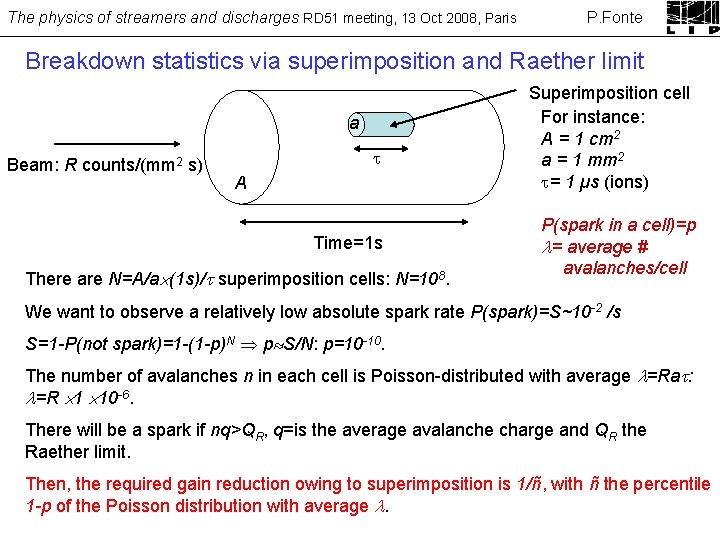
The physics of streamers and discharges RD 51 meeting, 13 Oct 2008, Paris P. Fonte Breakdown statistics via superimposition and Raether limit a Beam: R counts/(mm 2 s) A Time=1 s There are N=A/a (1 s)/ superimposition cells: N=108. Superimposition cell For instance: A = 1 cm 2 a = 1 mm 2 = 1 µs (ions) P(spark in a cell)=p = average # avalanches/cell We want to observe a relatively low absolute spark rate P(spark)=S~10 -2 /s S=1 -P(not spark)=1 -(1 -p)N p S/N: p=10 -10. The number of avalanches n in each cell is Poisson-distributed with average =Ra : =R 1 10 -6. There will be a spark if nq>QR, q=is the average avalanche charge and QR the Raether limit. Then, the required gain reduction owing to superimposition is 1/ñ, with ñ the percentile 1 -p of the Poisson distribution with average .
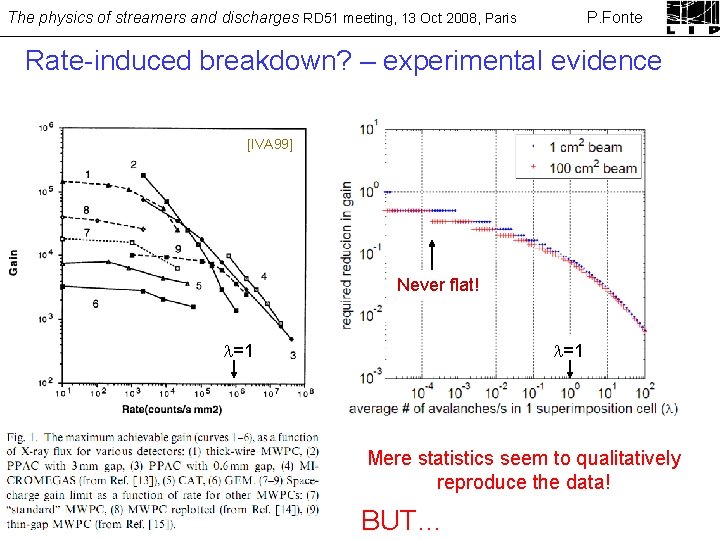
The physics of streamers and discharges RD 51 meeting, 13 Oct 2008, Paris P. Fonte Rate-induced breakdown? – experimental evidence [IVA 99] Never flat! =1 Mere statistics seem to qualitatively reproduce the data! BUT…
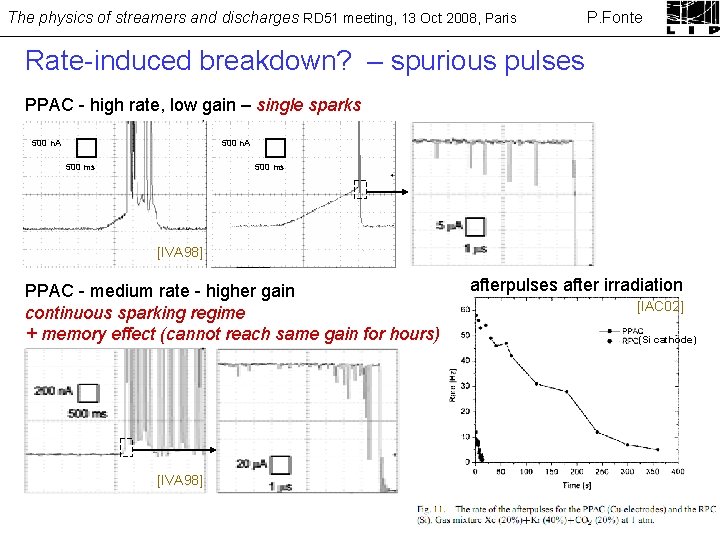
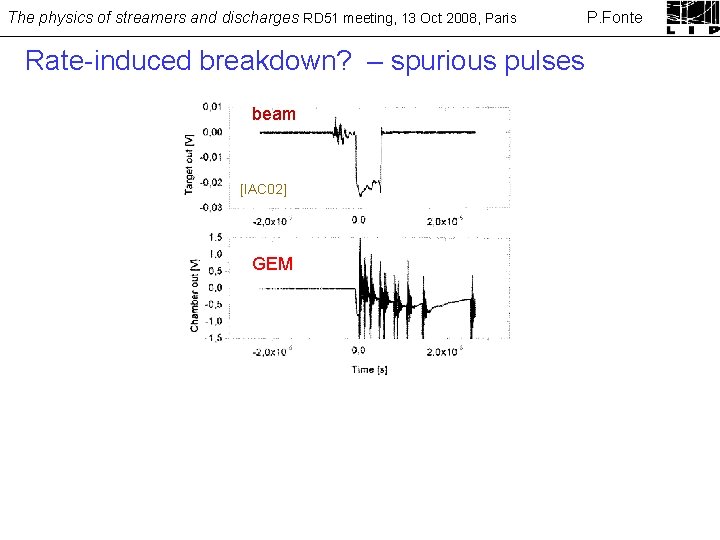
The physics of streamers and discharges RD 51 meeting, 13 Oct 2008, Paris P. Fonte Rate-induced breakdown? – spurious pulses PPAC - high rate, low gain – single sparks 500 n. A 500 ms [IVA 98] PPAC - medium rate - higher gain continuous sparking regime + memory effect (cannot reach same gain for hours) [IVA 98] afterpulses after irradiation [IAC 02] (Si cathode)
The physics of streamers and discharges RD 51 meeting, 13 Oct 2008, Paris Rate-induced breakdown? – spurious pulses beam [IAC 02] GEM P. Fonte
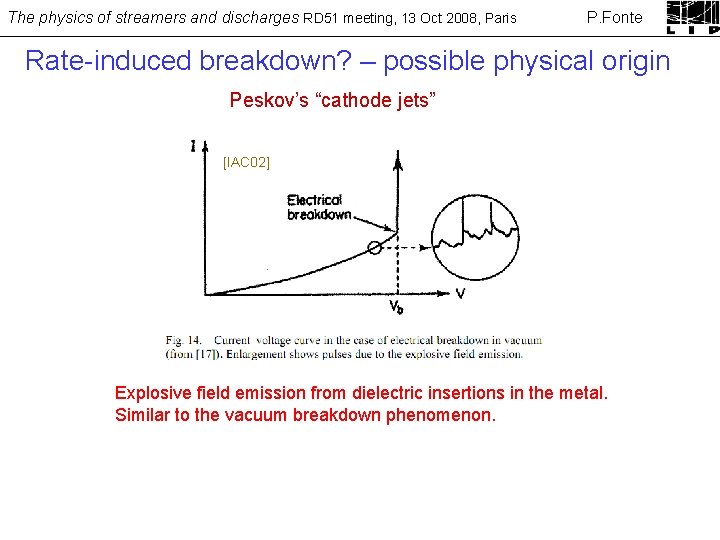
The physics of streamers and discharges RD 51 meeting, 13 Oct 2008, Paris P. Fonte Rate-induced breakdown? – possible physical origin Peskov’s “cathode jets” [IAC 02] Explosive field emission from dielectric insertions in the metal. Similar to the vacuum breakdown phenomenon.
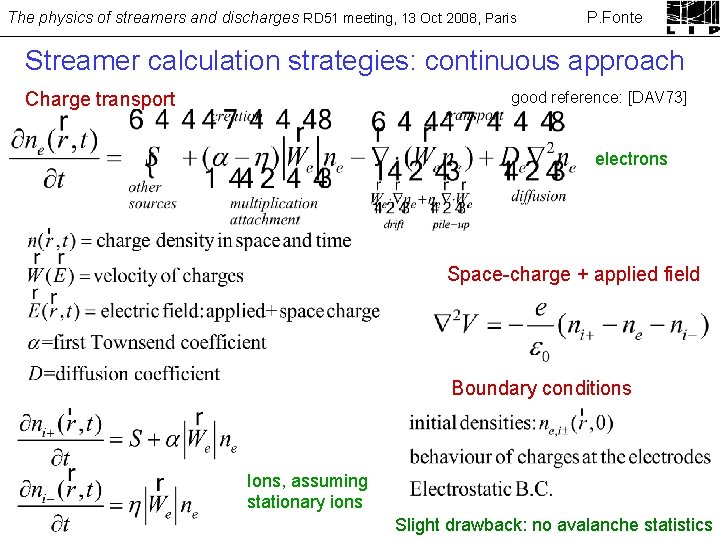
The physics of streamers and discharges RD 51 meeting, 13 Oct 2008, Paris P. Fonte Streamer calculation strategies: continuous approach Charge transport good reference: [DAV 73] electrons Space-charge + applied field Boundary conditions Ions, assuming stationary ions Slight drawback: no avalanche statistics
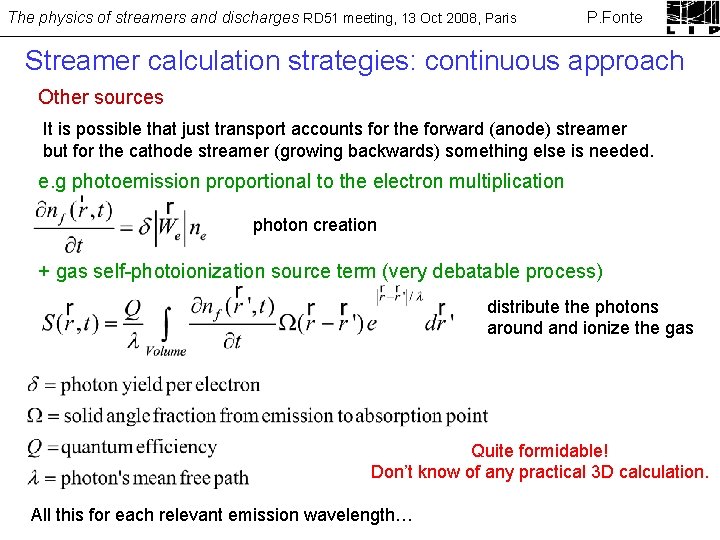
The physics of streamers and discharges RD 51 meeting, 13 Oct 2008, Paris P. Fonte Streamer calculation strategies: continuous approach Other sources It is possible that just transport accounts for the forward (anode) streamer but for the cathode streamer (growing backwards) something else is needed. e. g photoemission proportional to the electron multiplication photon creation + gas self-photoionization source term (very debatable process) distribute the photons around and ionize the gas Quite formidable! Don’t know of any practical 3 D calculation. All this for each relevant emission wavelength…
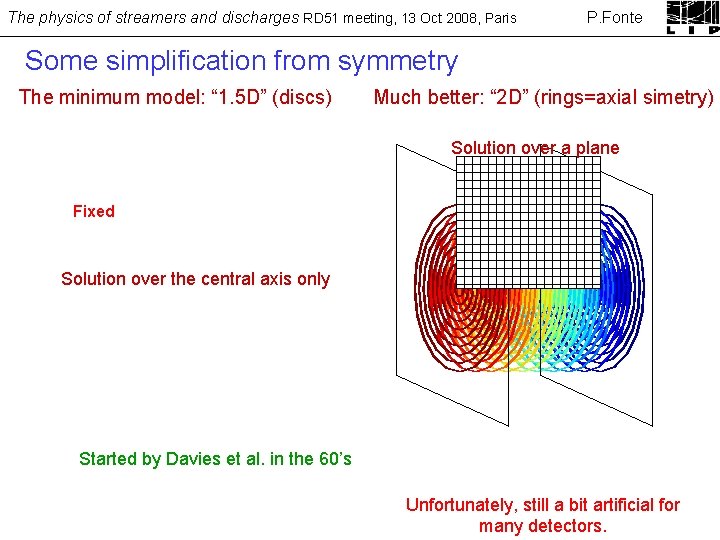
The physics of streamers and discharges RD 51 meeting, 13 Oct 2008, Paris P. Fonte Some simplification from symmetry The minimum model: “ 1. 5 D” (discs) Much better: “ 2 D” (rings=axial simetry) Solution over a plane Fixed Solution over the central axis only Started by Davies et al. in the 60’s Unfortunately, still a bit artificial for many detectors.
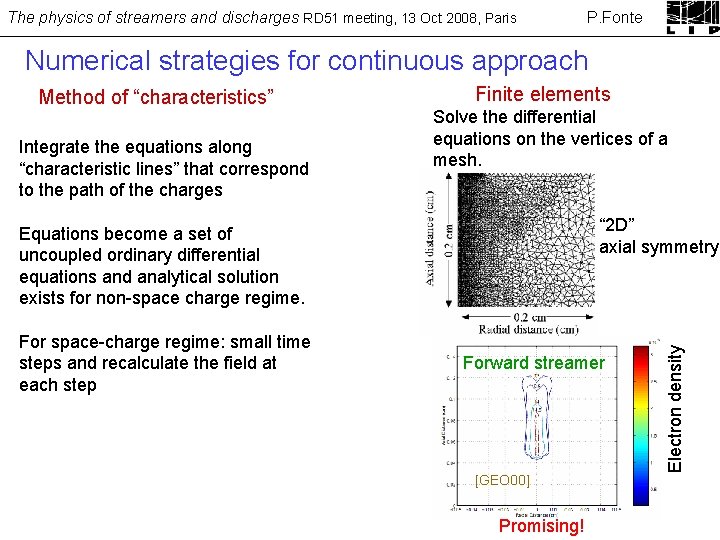
The physics of streamers and discharges RD 51 meeting, 13 Oct 2008, Paris P. Fonte Numerical strategies for continuous approach Integrate the equations along “characteristic lines” that correspond to the path of the charges Finite elements Solve the differential equations on the vertices of a mesh. “ 2 D” axial symmetry Equations become a set of uncoupled ordinary differential equations and analytical solution exists for non-space charge regime. For space-charge regime: small time steps and recalculate the field at each step Forward streamer [GEO 00] Promising! Electron density Method of “characteristics”
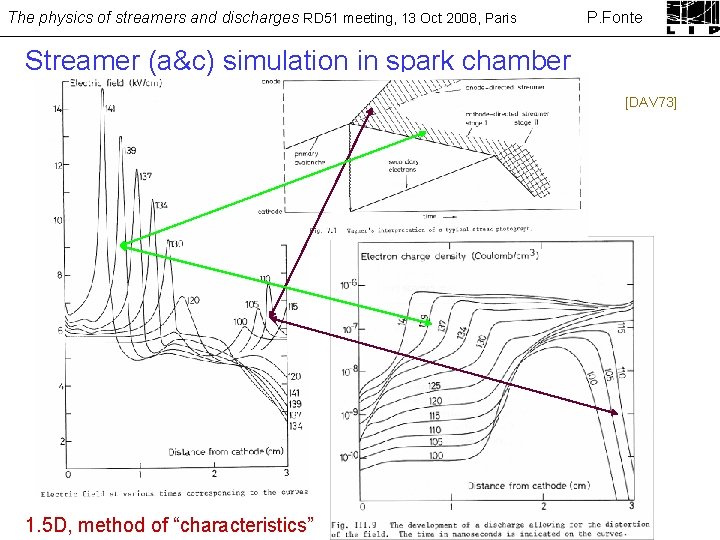
The physics of streamers and discharges RD 51 meeting, 13 Oct 2008, Paris P. Fonte Streamer (a&c) simulation in spark chamber [DAV 73] 1. 5 D, method of “characteristics”
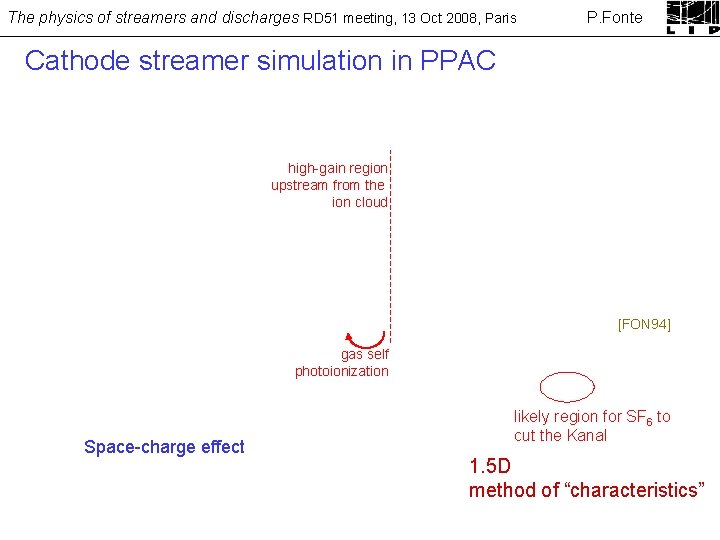
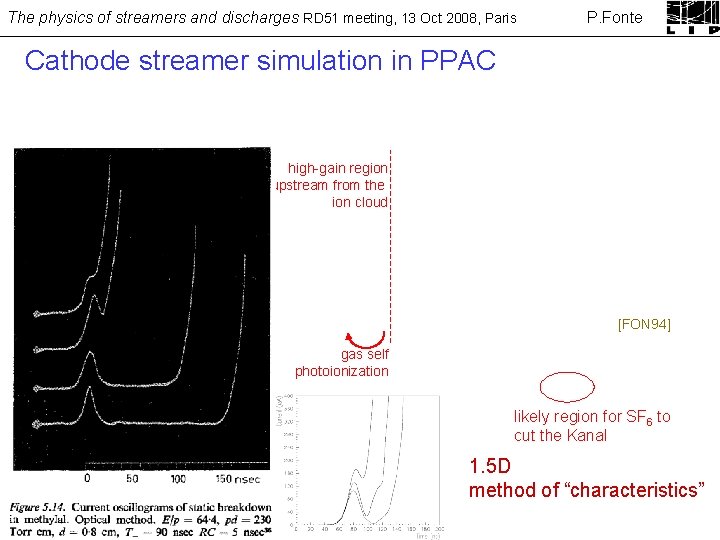
The physics of streamers and discharges RD 51 meeting, 13 Oct 2008, Paris P. Fonte Cathode streamer simulation in PPAC high-gain region upstream from the ion cloud [FON 94] gas self photoionization Space-charge effect likely region for SF 6 to cut the Kanal 1. 5 D method of “characteristics”
The physics of streamers and discharges RD 51 meeting, 13 Oct 2008, Paris P. Fonte Cathode streamer simulation in PPAC high-gain region upstream from the ion cloud [FON 94] gas self photoionization likely region for SF 6 to cut the Kanal 1. 5 D method of “characteristics”
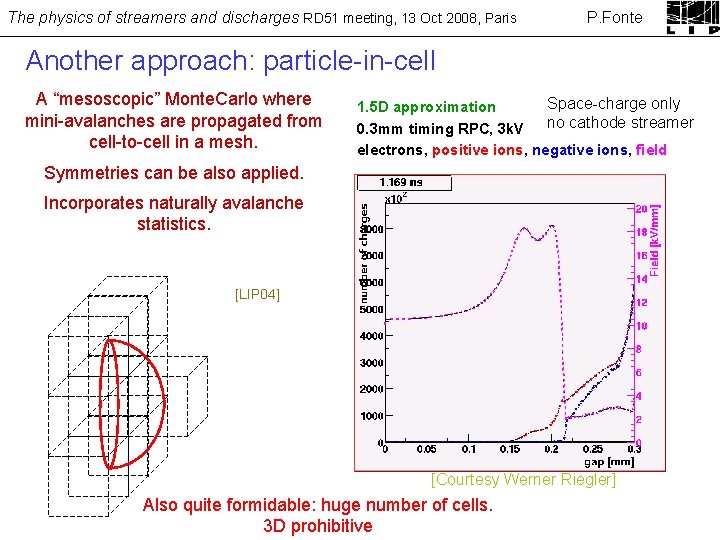
The physics of streamers and discharges RD 51 meeting, 13 Oct 2008, Paris P. Fonte Another approach: particle-in-cell A “mesoscopic” Monte. Carlo where mini-avalanches are propagated from cell-to-cell in a mesh. Space-charge only 1. 5 D approximation no cathode streamer 0. 3 mm timing RPC, 3 k. V electrons, positive ions, negative ions, field Symmetries can be also applied. Incorporates naturally avalanche statistics. [LIP 04] [Courtesy Werner Riegler] Also quite formidable: huge number of cells. 3 D prohibitive
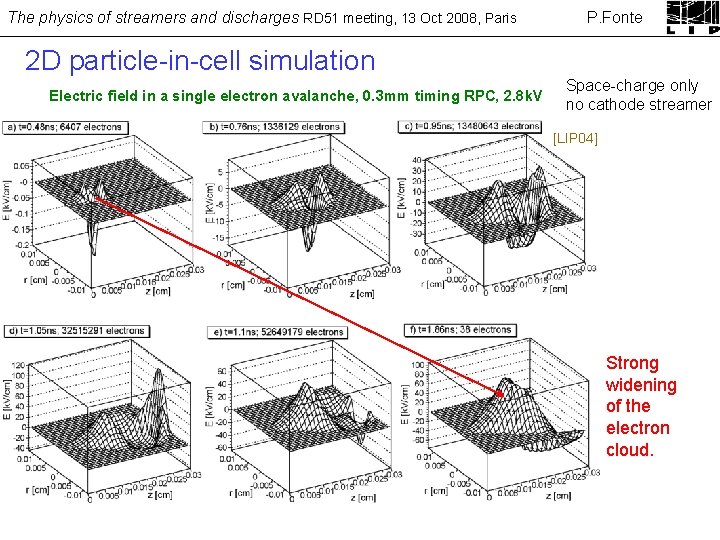
The physics of streamers and discharges RD 51 meeting, 13 Oct 2008, Paris P. Fonte 2 D particle-in-cell simulation Electric field in a single electron avalanche, 0. 3 mm timing RPC, 2. 8 k. V Space-charge only no cathode streamer [LIP 04] Strong widening of the electron cloud.
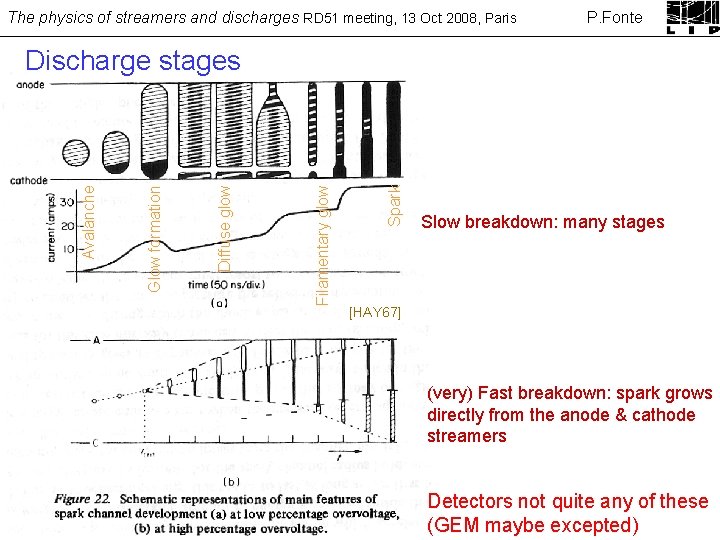
The physics of streamers and discharges RD 51 meeting, 13 Oct 2008, Paris P. Fonte Spark Filamentary glow Diffuse glow Glow formation Avalanche Discharge stages Slow breakdown: many stages [HAY 67] (very) Fast breakdown: spark grows directly from the anode & cathode streamers Detectors not quite any of these (GEM maybe excepted)
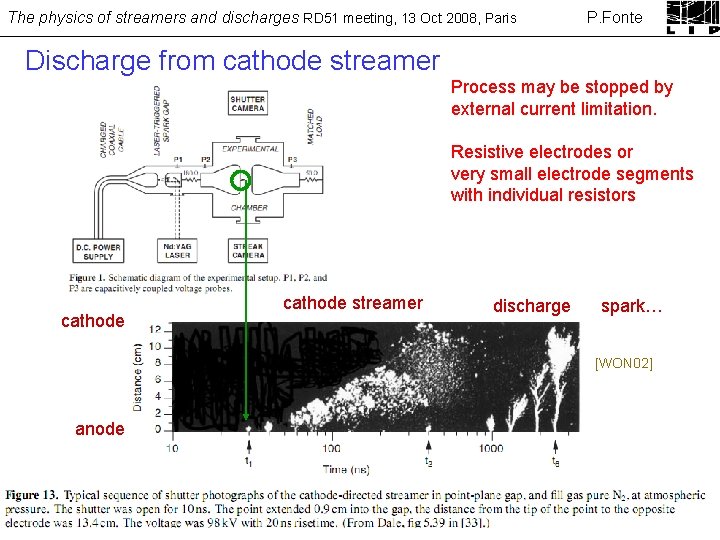
The physics of streamers and discharges RD 51 meeting, 13 Oct 2008, Paris P. Fonte Discharge from cathode streamer Process may be stopped by external current limitation. Resistive electrodes or very small electrode segments with individual resistors cathode streamer discharge spark… [WON 02] anode
The physics of streamers and discharges RD 51 meeting, 13 Oct 2008, Paris Summary P. Fonte My view, not a review. • What causes breakdown • Imperfections (sharp edges, etc) Corona discharge. • In photosensitive detectors: photon feedback. • At low rate mainly the space-charge (“Raether”) limit streamers • by its physical origin, it must depend on • specific geometry of the detector (lower for denser avalanches) • avalanche statistics (lower for low n 0) • number of amplification steps (spreading the charge around) • At high rate: maybe ion-bombardment induced electron jets from cathodes, maybe merely superimposition statistics+Raether limit • Streamer physics and simulation • Subject is pursued since the 60’s. • Several methods and simplification strategies were devised. • There is a good understanding of the process. • Some doubts persist about the cathode-streamer feedback mechanism • Full 3 D solutions still missing. • The discharge (final breakdown stages) • Well studied. (Interesting for electrical engineering. ) • Likely, suppression only by external current limitation.
The physics of streamers and discharges RD 51 meeting, 13 Oct 2008, Paris P. Fonte References [CAR 96] [DUE 94] [FON 91 a] [FON 91 b] [FON 96] [GEO 00] [HAY 67] [HON 96] [IAC 02] [IVA 98] [IVA 99] [KLI 72] [LIP 04] [PES 01] [PES 97] [WON 02] R. Cardarelli et al. , Nucl. Instrum. and Meth. A 382 (1996) 470 I. Duerdoth et al. , Nucl. Instrum. and Meth. A 348 (1994) 303 P. Fonte et. al. , Nucl. Instrum. and Meth. A 305 (1991) 91 P. Fonte et. al. , Nucl. Instrum. and Meth. A 310 (1991) 140 P. Fonte, IEEE Nucl. Sci. 43 n. 3 (1996) 21 G. E. Georghiou et al. , J. Phys. D: Appl. Phys. 33 (2000) 27. S. C. Haydon, in J. A. Rees, “Electrical breakdown of gases”, Macmillan, 1973 C. Hongfang et al. , Nucl. Instrum. and Meth. A 373 ( 1996) 430 C. Iacobaeus et al. , IEEE Trans. Nucl. Sci. 49 (2002) 1622 Yu. Ivaniouchenkov et al. , IEEE Trans. Nucl. Sci. 45 (1998) 258 Yu. Ivaniouchenkov et al. , Nucl. Instrum. and Meth. A 422 (1999) 300 Kline and Siambis, Phys. Rev. A 5 (1972) 794 C. Lippmann, W. Riegler, Nucl. Instrum. and Meth. A 533 (2004) 11 V. Peskov et al. , IEEE Nucl. Sci. 48, 2001, 1070. V. Peskov et al. , Nucl. Instrum. and Meth. A 397 (1997) 243 J. Yi Won et al. , J. Phys. D: Appl. Phys. 35 (2002) 205