
The physics of rockets Learning objectives Know how
The physics of rockets
Learning objectives • Know how pressure builds up in a rocket • Know how increases in pressure cause the rocket to lift off. • Know how Newton’s 3 rd Law and momentum relates to how a rocket works.
Success criteria • Explain how pressure of a gas can be increased, using a particle model. (Grade C) • Explain how equal and opposite forces cause a rocket to launch. (Grade B) • Explain pressure in terms of rate of change momentum of particles. (Grade A)
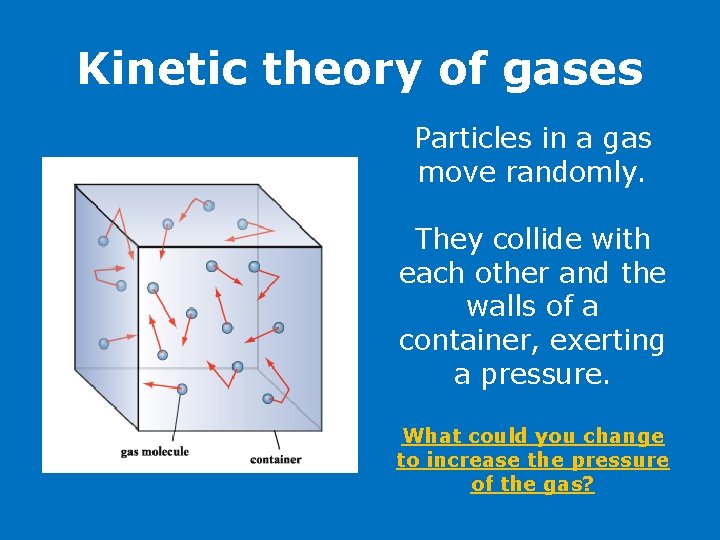
Kinetic theory of gases Particles in a gas move randomly. They collide with each other and the walls of a container, exerting a pressure. What could you change to increase the pressure of the gas?
• Change the volume of the container: • Change the temperature of the gas:
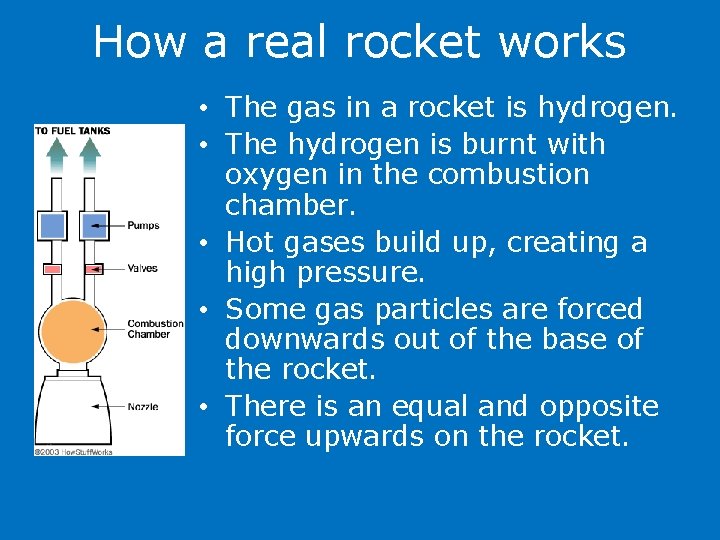
How a real rocket works • The gas in a rocket is hydrogen. • The hydrogen is burnt with oxygen in the combustion chamber. • Hot gases build up, creating a high pressure. • Some gas particles are forced downwards out of the base of the rocket. • There is an equal and opposite force upwards on the rocket.
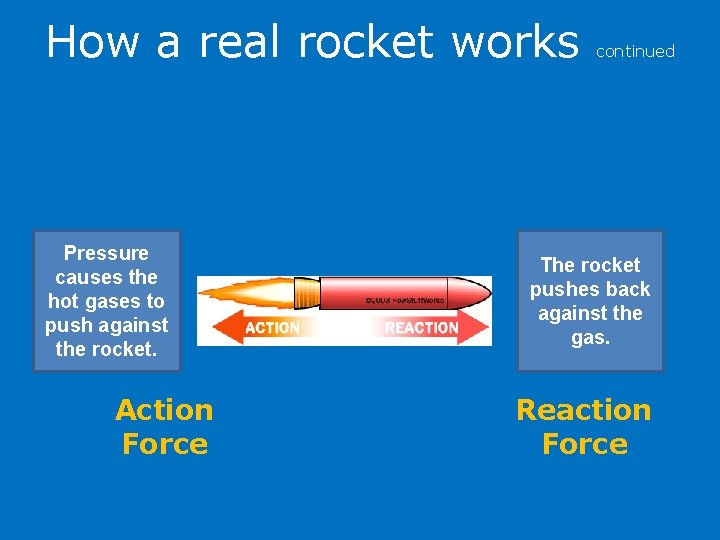
How a real rocket works Pressure causes the hot gases to push against the rocket. Action Force continued The rocket pushes back against the gas. Reaction Force
Plenary • In groups, label the picture to explain how the rocket lifts off. – Use as many key words and ideas from the lesson as you can.
- Slides: 8