
The Physics of Relativistic Heavy Ion Collisions Lecture
- Slides: 64
The Physics of Relativistic Heavy Ion Collisions Lecture #2 18 th National Nuclear Physics Summer School Lectures July 31 -August 3, 2006 Associate Professor Jamie Nagle University of Colorado, Boulder
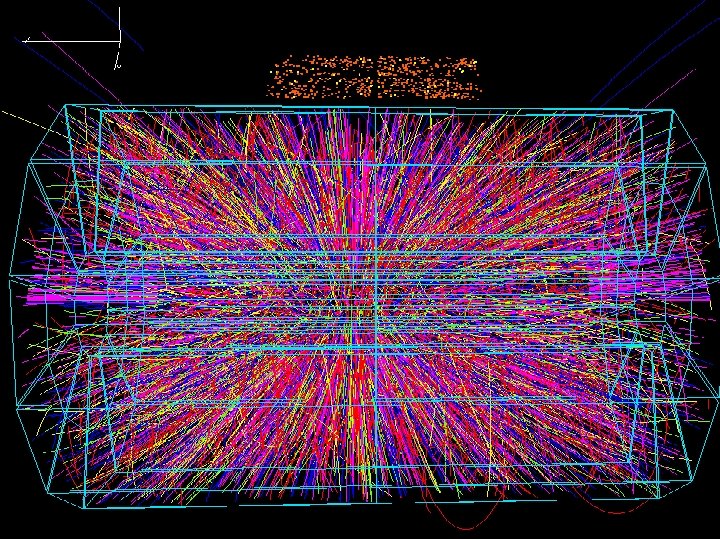
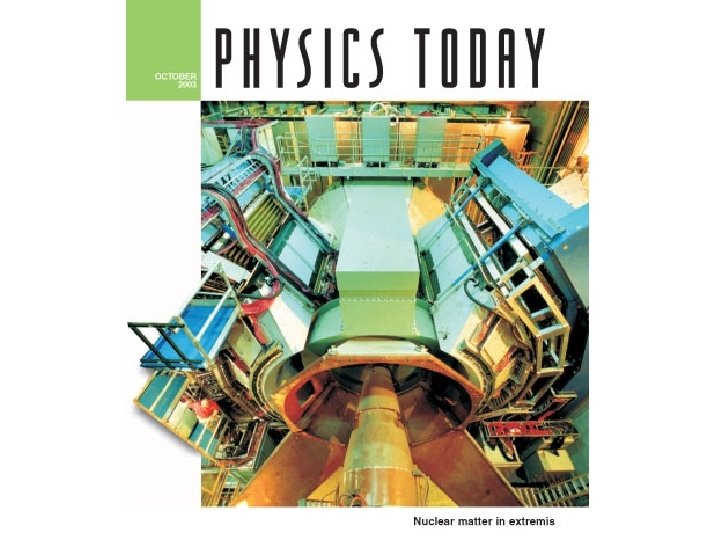
Heavy Ion Experiments
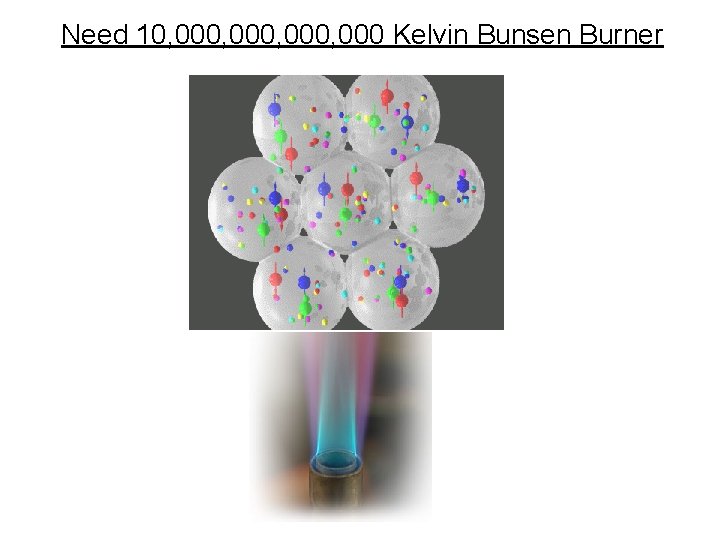
Need 10, 000, 000 Kelvin Bunsen Burner
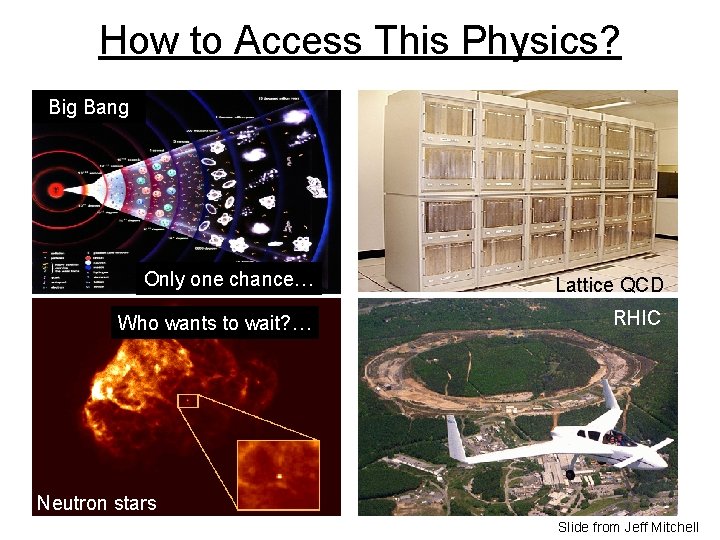
How to Access This Physics? Big Bang Only one chance… Lattice QCD Who wants to wait? … RHIC Neutron stars Slide from Jeff Mitchell
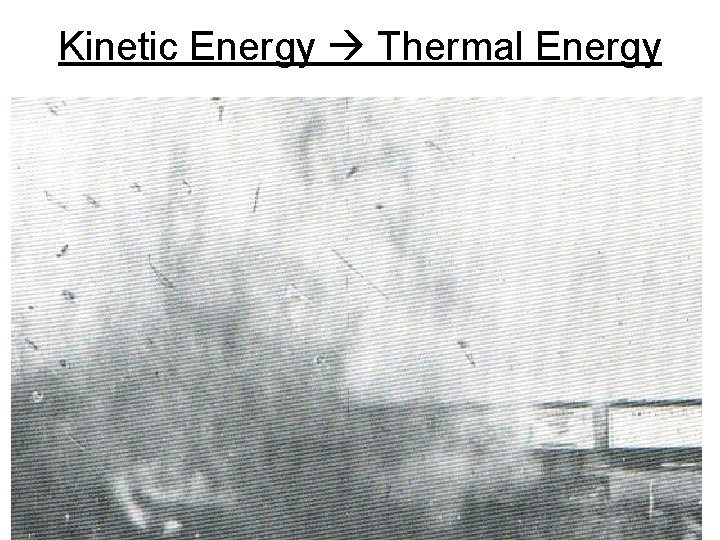
Kinetic Energy Thermal Energy
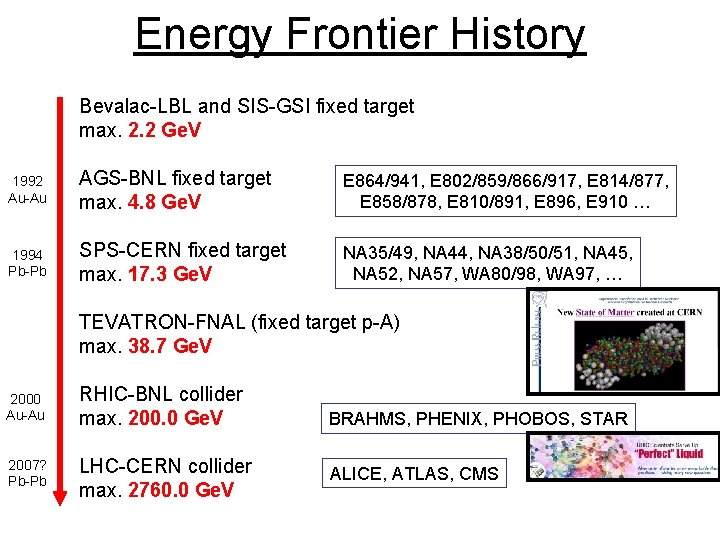
Energy Frontier History Bevalac-LBL and SIS-GSI fixed target max. 2. 2 Ge. V 1992 Au-Au AGS-BNL fixed target max. 4. 8 Ge. V E 864/941, E 802/859/866/917, E 814/877, E 858/878, E 810/891, E 896, E 910 … 1994 Pb-Pb SPS-CERN fixed target max. 17. 3 Ge. V NA 35/49, NA 44, NA 38/50/51, NA 45, NA 52, NA 57, WA 80/98, WA 97, … TEVATRON-FNAL (fixed target p-A) max. 38. 7 Ge. V 2000 Au-Au RHIC-BNL collider max. 200. 0 Ge. V 2007? Pb-Pb LHC-CERN collider max. 2760. 0 Ge. V BRAHMS, PHENIX, PHOBOS, STAR ALICE, ATLAS, CMS
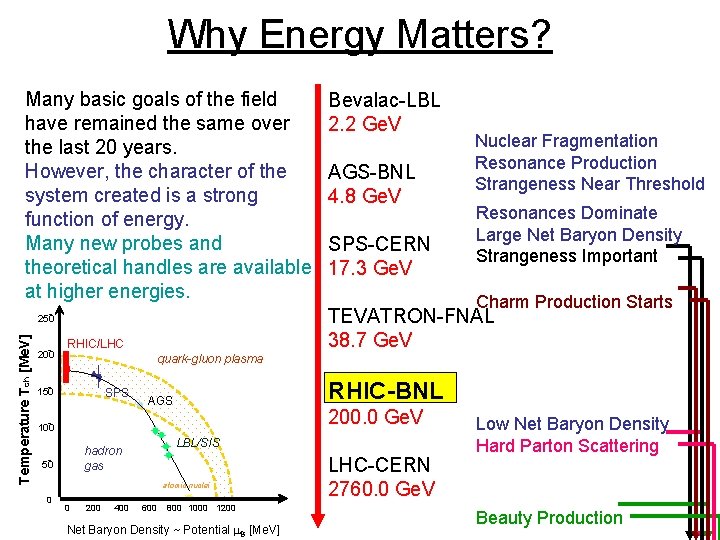
Why Energy Matters? Many basic goals of the field have remained the same over the last 20 years. However, the character of the system created is a strong function of energy. Many new probes and theoretical handles are available at higher energies. Temperature Tch [Me. V] RHIC/LHC SPS-CERN 17. 3 Ge. V Resonances Dominate Large Net Baryon Density Strangeness Important Charm Production Starts quark-gluon plasma 150 SPS RHIC-BNL AGS 200. 0 Ge. V 100 LBL/SIS hadron gas 50 atomic nuclei 0 AGS-BNL 4. 8 Ge. V Nuclear Fragmentation Resonance Production Strangeness Near Threshold TEVATRON-FNAL 38. 7 Ge. V 250 200 Bevalac-LBL 2. 2 Ge. V 0 200 400 600 800 1000 1200 Net Baryon Density ~ Potential B [Me. V] LHC-CERN 2760. 0 Ge. V Low Net Baryon Density Hard Parton Scattering Beauty Production
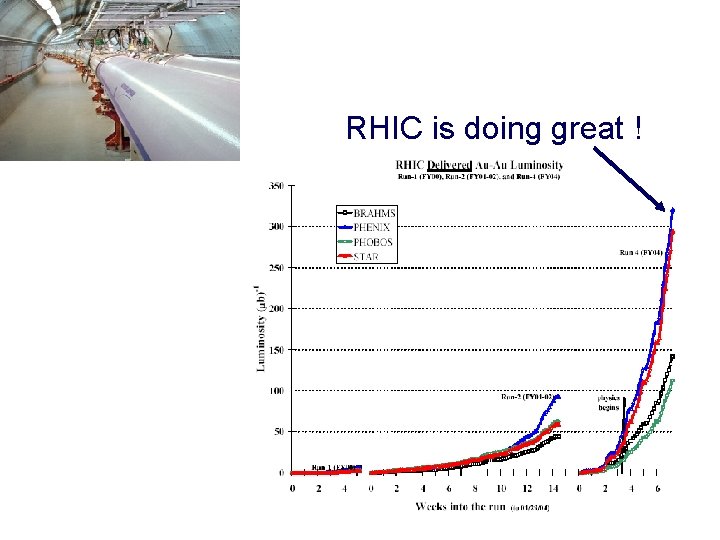
RHIC is doing great !
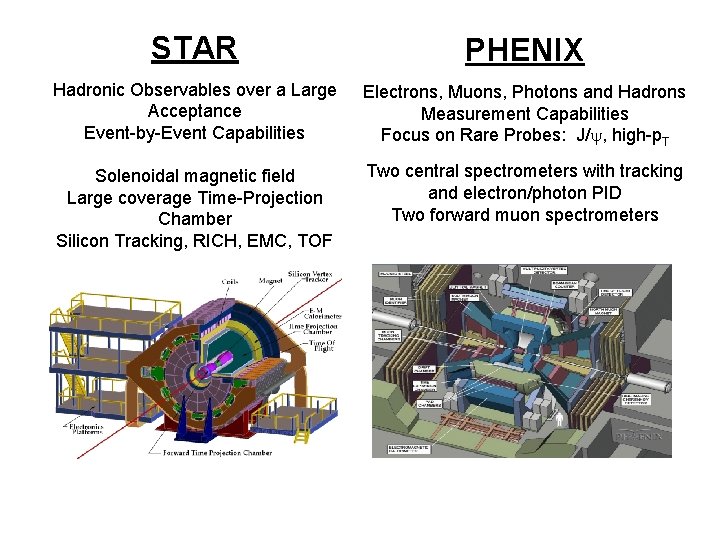
STAR PHENIX Hadronic Observables over a Large Acceptance Event-by-Event Capabilities Electrons, Muons, Photons and Hadrons Measurement Capabilities Focus on Rare Probes: J/y, high-p. T Solenoidal magnetic field Large coverage Time-Projection Chamber Silicon Tracking, RICH, EMC, TOF Two central spectrometers with tracking and electron/photon PID Two forward muon spectrometers
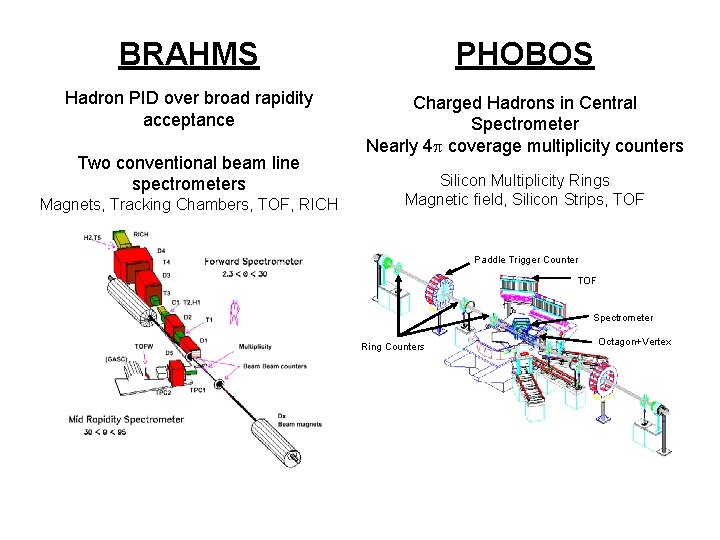
BRAHMS PHOBOS Hadron PID over broad rapidity acceptance Charged Hadrons in Central Spectrometer Nearly 4 coverage multiplicity counters Two conventional beam line spectrometers Magnets, Tracking Chambers, TOF, RICH Silicon Multiplicity Rings Magnetic field, Silicon Strips, TOF Paddle Trigger Counter TOF Spectrometer Ring Counters Octagon+Vertex
What Are Protons and Nuclei?
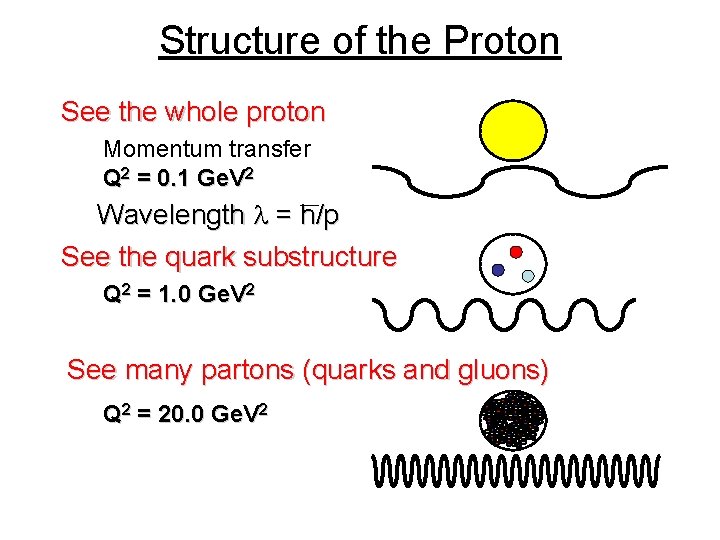
Structure of the Proton See the whole proton Momentum transfer Q 2 = 0. 1 Ge. V 2 Wavelength l = h/p See the quark substructure Q 2 = 1. 0 Ge. V 2 See many partons (quarks and gluons) Q 2 = 20. 0 Ge. V 2
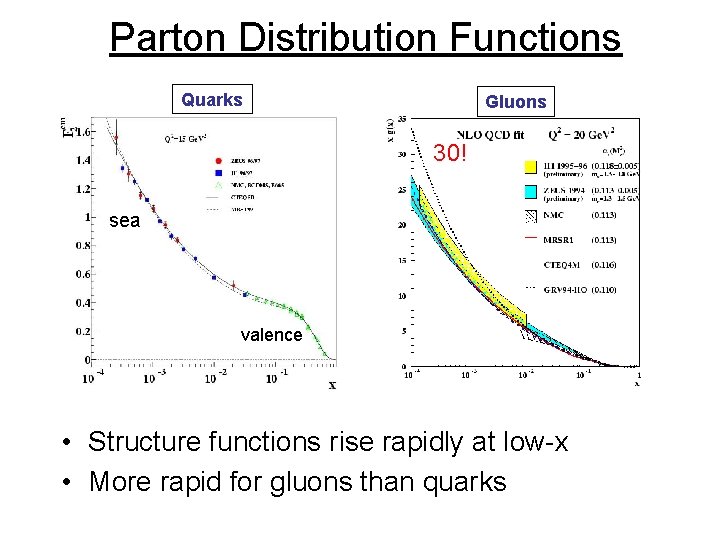
Parton Distribution Functions Quarks Gluons 30! sea valence • Structure functions rise rapidly at low-x • More rapid for gluons than quarks
Limitless Gluons? When protons are viewed at short wavelength, there is a large increase in low x gluons. Is there a limit to the low x gluon density?
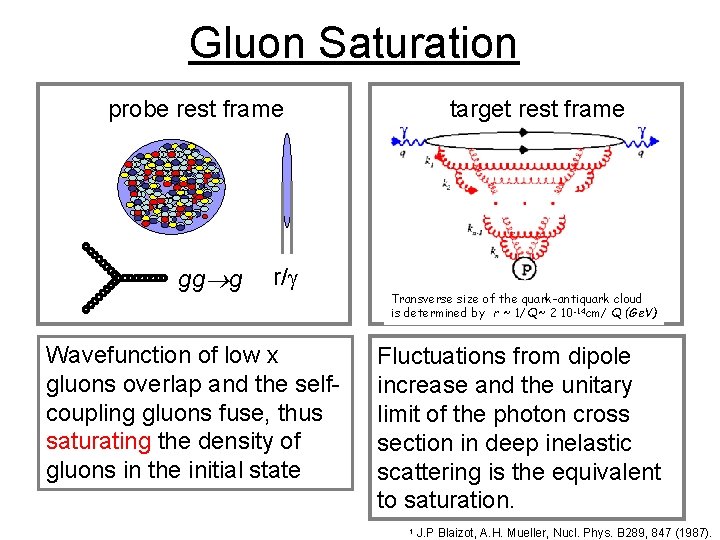
Gluon Saturation probe rest frame gg g r/ Wavefunction of low x gluons overlap and the selfcoupling gluons fuse, thus saturating the density of gluons in the initial state target rest frame l ~1/x Transverse size of the quark-antiquark cloud c ~ 2 10 -14 cm/ Q (Ge. V) is determined by r ~ 1/Q Fluctuations from dipole increase and the unitary limit of the photon cross section in deep inelastic scattering is the equivalent to saturation. 1 J. P Blaizot, A. H. Mueller, Nucl. Phys. B 289, 847 (1987).
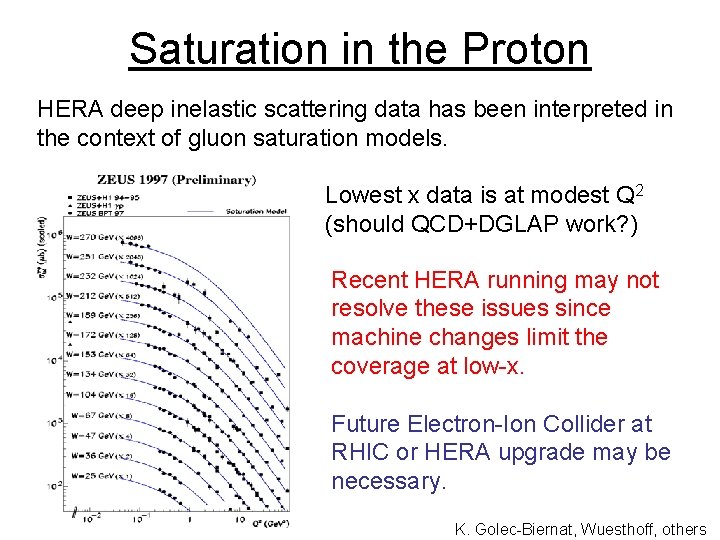
Saturation in the Proton HERA deep inelastic scattering data has been interpreted in the context of gluon saturation models. Lowest x data is at modest Q 2 (should QCD+DGLAP work? ) Recent HERA running may not resolve these issues since machine changes limit the coverage at low-x. Future Electron-Ion Collider at RHIC or HERA upgrade may be necessary. K. Golec-Biernat, Wuesthoff, others
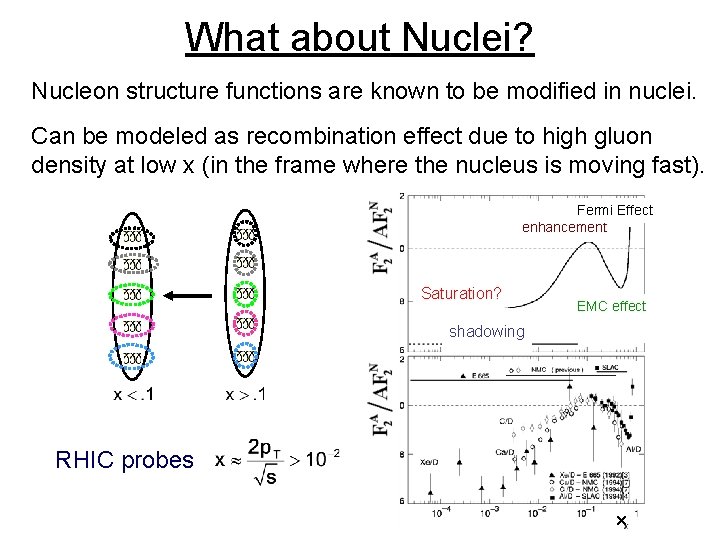
What about Nuclei? Nucleon structure functions are known to be modified in nuclei. Can be modeled as recombination effect due to high gluon density at low x (in the frame where the nucleus is moving fast). Fermi Effect enhancement Saturation? EMC effect shadowing RHIC probes x
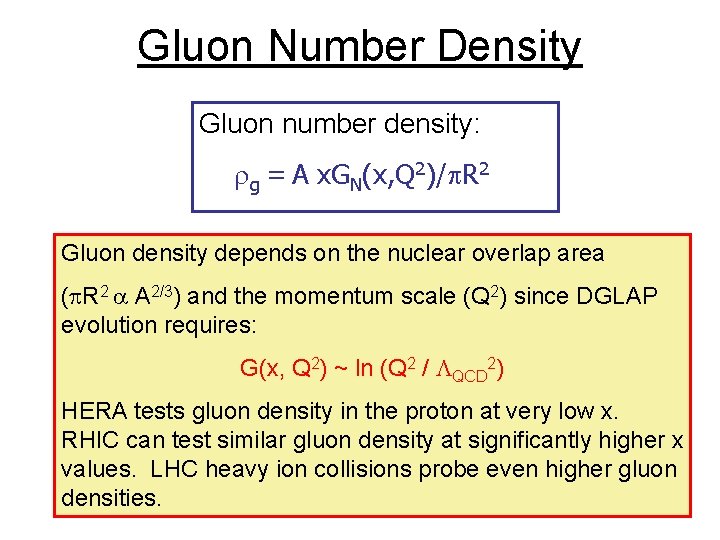
Gluon Number Density Gluon number density: g = A x. GN(x, Q 2)/ R 2 Gluon density depends on the nuclear overlap area ( R 2 a A 2/3) and the momentum scale (Q 2) since DGLAP evolution requires: G(x, Q 2) ~ ln (Q 2 / LQCD 2) HERA tests gluon density in the proton at very low x. RHIC can test similar gluon density at significantly higher x values. LHC heavy ion collisions probe even higher gluon densities.
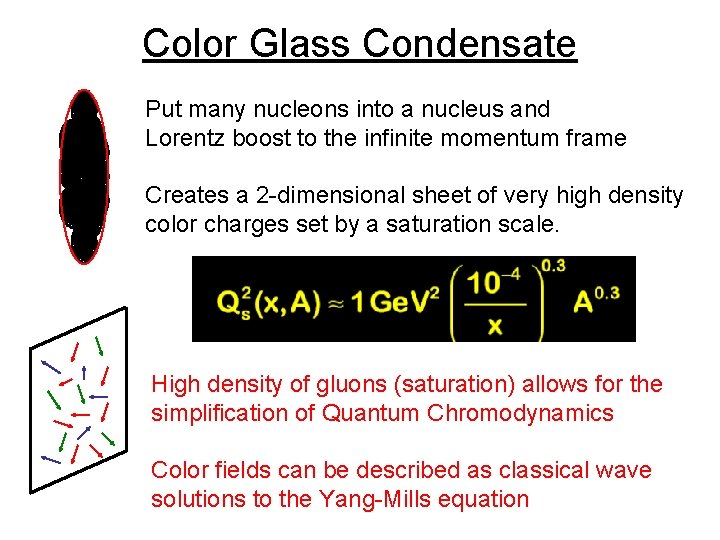
Color Glass Condensate Put many nucleons into a nucleus and Lorentz boost to the infinite momentum frame Creates a 2 -dimensional sheet of very high density color charges set by a saturation scale. High density of gluons (saturation) allows for the simplification of Quantum Chromodynamics Color fields can be described as classical wave solutions to the Yang-Mills equation
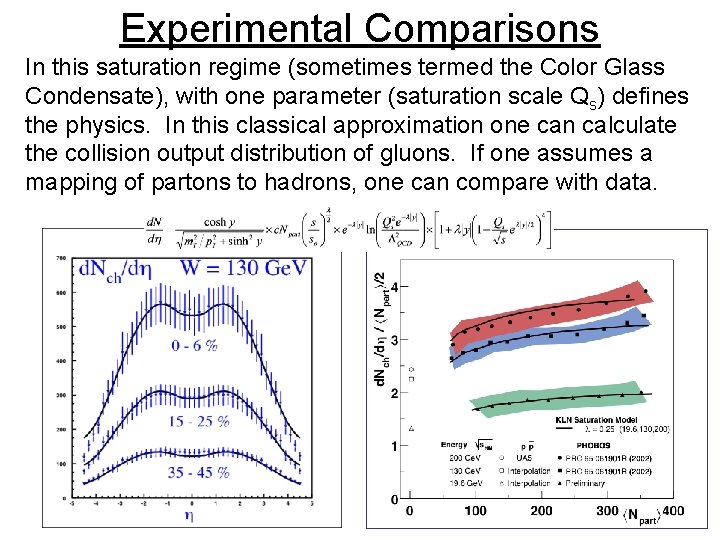
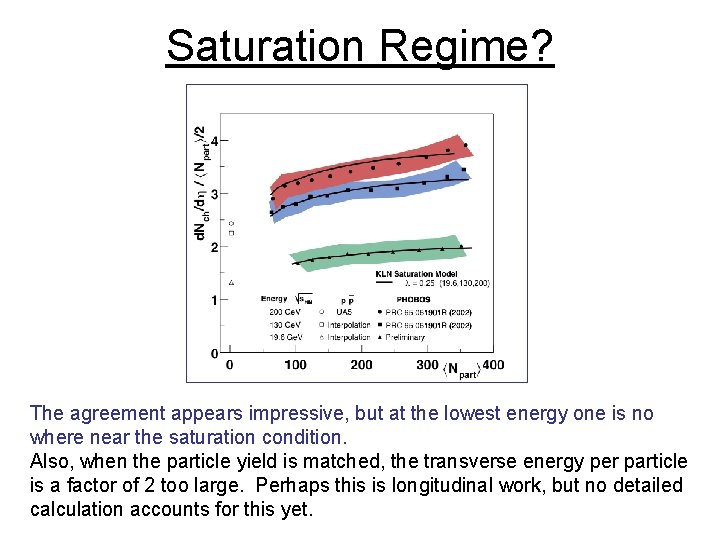
Experimental Comparisons In this saturation regime (sometimes termed the Color Glass Condensate), with one parameter (saturation scale Qs) defines the physics. In this classical approximation one can calculate the collision output distribution of gluons. If one assumes a mapping of partons to hadrons, one can compare with data.
Saturation Regime? The agreement appears impressive, but at the lowest energy one is no where near the saturation condition. Also, when the particle yield is matched, the transverse energy per particle is a factor of 2 too large. Perhaps this is longitudinal work, but no detailed calculation accounts for this yet.
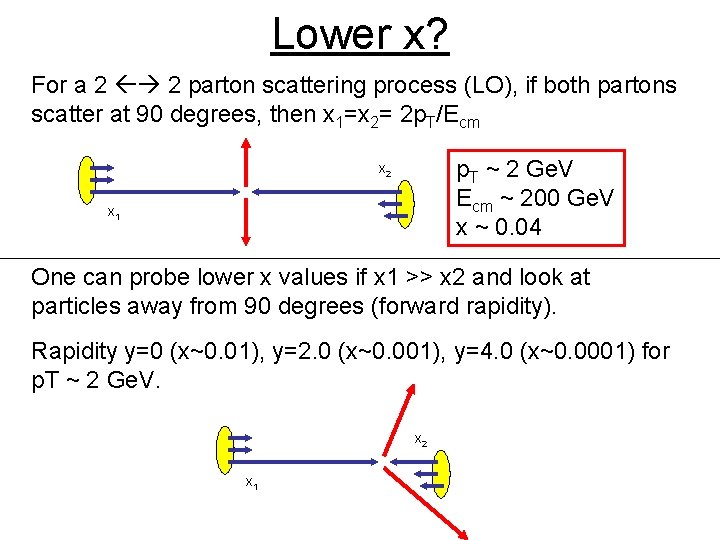
Lower x? For a 2 2 parton scattering process (LO), if both partons scatter at 90 degrees, then x 1=x 2= 2 p. T/Ecm p. T ~ 2 Ge. V Ecm ~ 200 Ge. V x ~ 0. 04 x 2 x 1 One can probe lower x values if x 1 >> x 2 and look at particles away from 90 degrees (forward rapidity). Rapidity y=0 (x~0. 01), y=2. 0 (x~0. 001), y=4. 0 (x~0. 0001) for p. T ~ 2 Ge. V. x 2 x 1
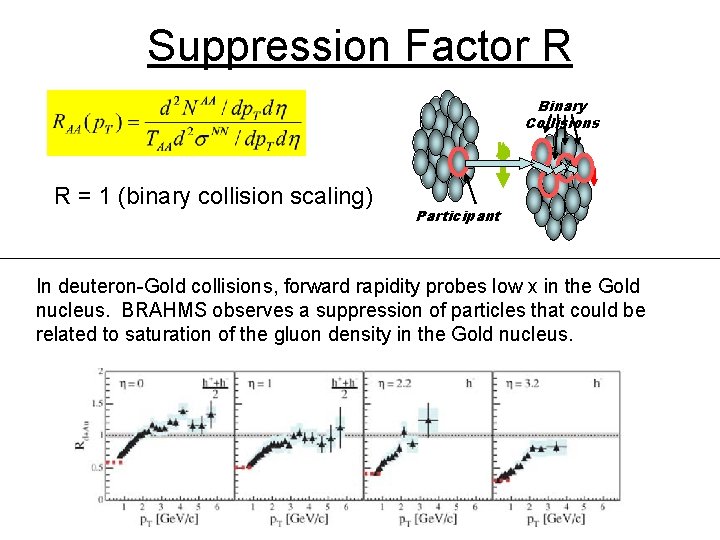
Suppression Factor R Binary Collisions b R = 1 (binary collision scaling) Participant In deuteron-Gold collisions, forward rapidity probes low x in the Gold nucleus. BRAHMS observes a suppression of particles that could be related to saturation of the gluon density in the Gold nucleus.
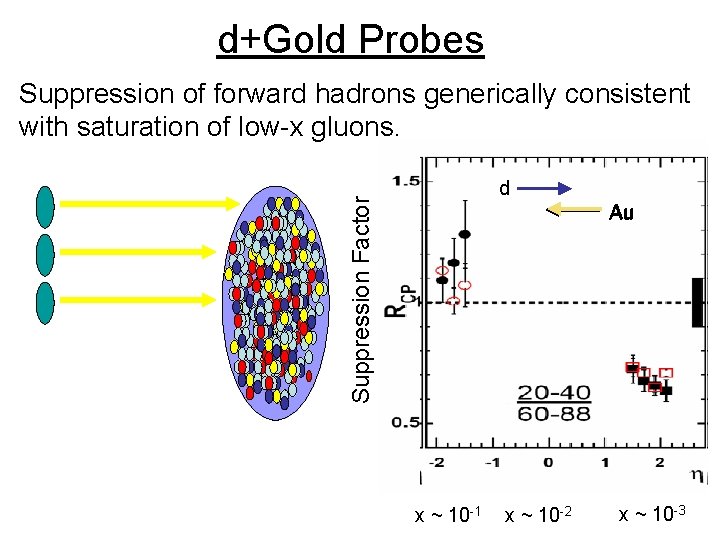
d+Gold Probes Suppression of forward hadrons generically consistent with saturation of low-x gluons. Suppression Factor dd d x ~ 10 -1 x ~ 10 -2 Au Au Au x ~ 10 -3
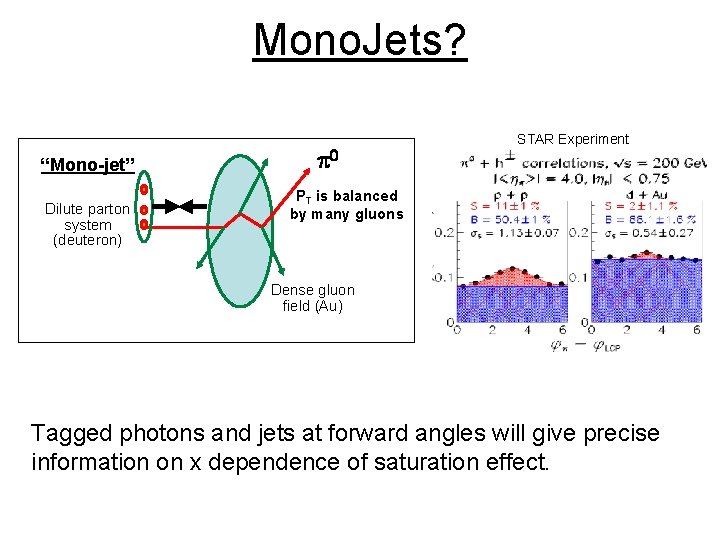
Mono. Jets? “Mono-jet” Dilute parton system (deuteron) p 0 STAR Experiment PT is balanced by many gluons Dense gluon field (Au) Tagged photons and jets at forward angles will give precise information on x dependence of saturation effect.
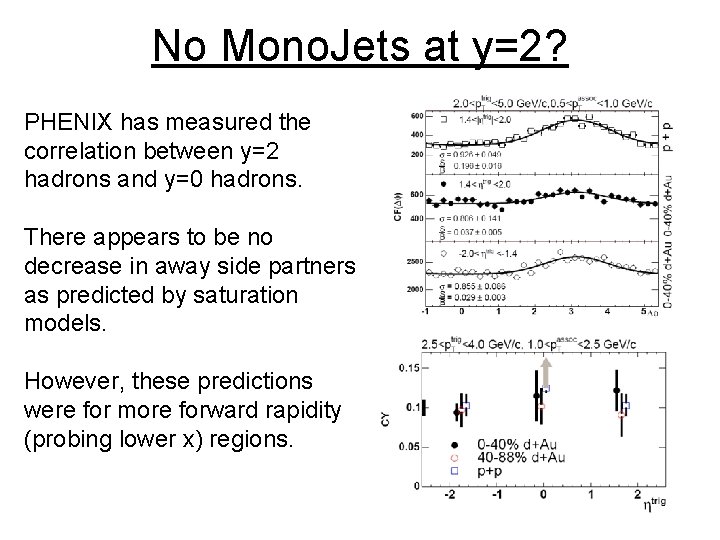
No Mono. Jets at y=2? PHENIX has measured the correlation between y=2 hadrons and y=0 hadrons. There appears to be no decrease in away side partners as predicted by saturation models. However, these predictions were for more forward rapidity (probing lower x) regions.
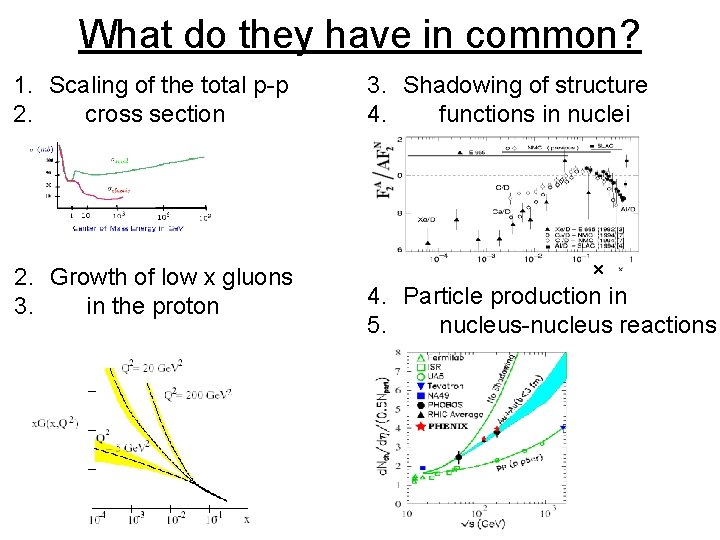
What do they have in common? 1. Scaling of the total p-p 2. cross section 2. Growth of low x gluons 3. in the proton 3. Shadowing of structure 4. functions in nuclei x 4. Particle production in 5. nucleus-nucleus reactions
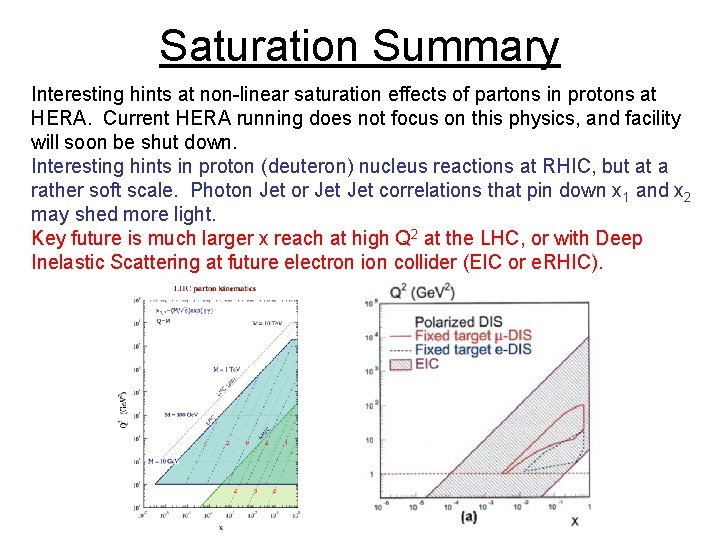
Saturation Summary Interesting hints at non-linear saturation effects of partons in protons at HERA. Current HERA running does not focus on this physics, and facility will soon be shut down. Interesting hints in proton (deuteron) nucleus reactions at RHIC, but at a rather soft scale. Photon Jet or Jet correlations that pin down x 1 and x 2 may shed more light. Key future is much larger x reach at high Q 2 at the LHC, or with Deep Inelastic Scattering at future electron ion collider (EIC or e. RHIC).
Collision Dynamics
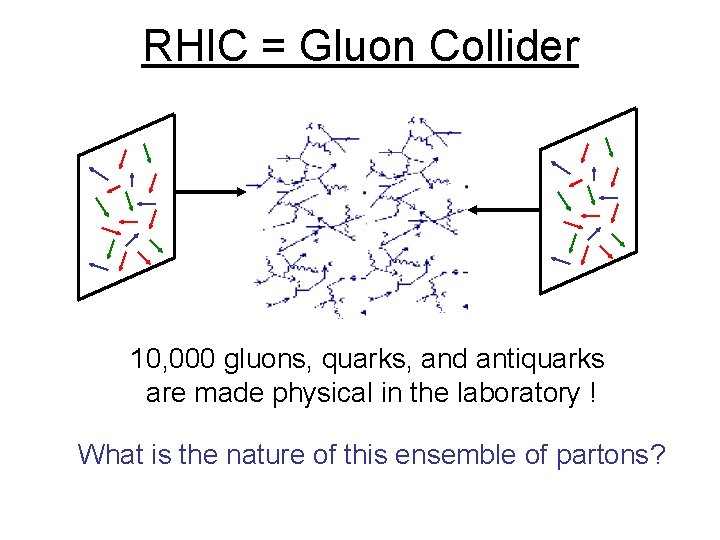
RHIC = Gluon Collider 10, 000 gluons, quarks, and antiquarks are made physical in the laboratory ! What is the nature of this ensemble of partons?
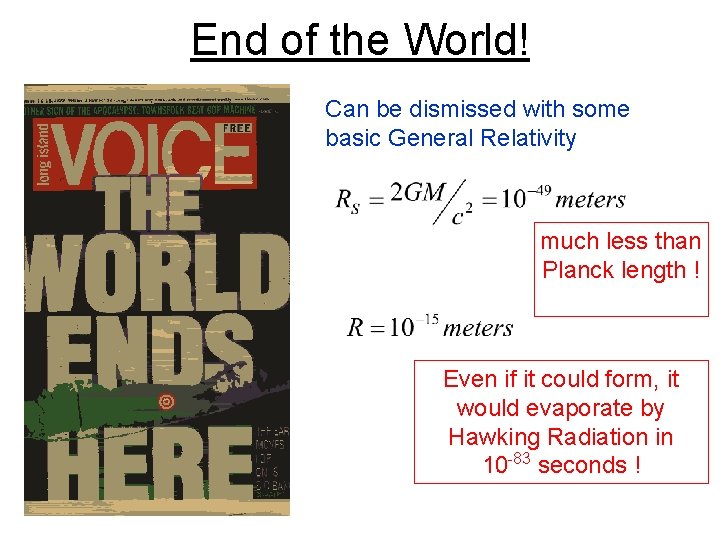
End of the World! Can be dismissed with some basic General Relativity much less than Planck length ! Even if it could form, it would evaporate by Hawking Radiation in 10 -83 seconds !
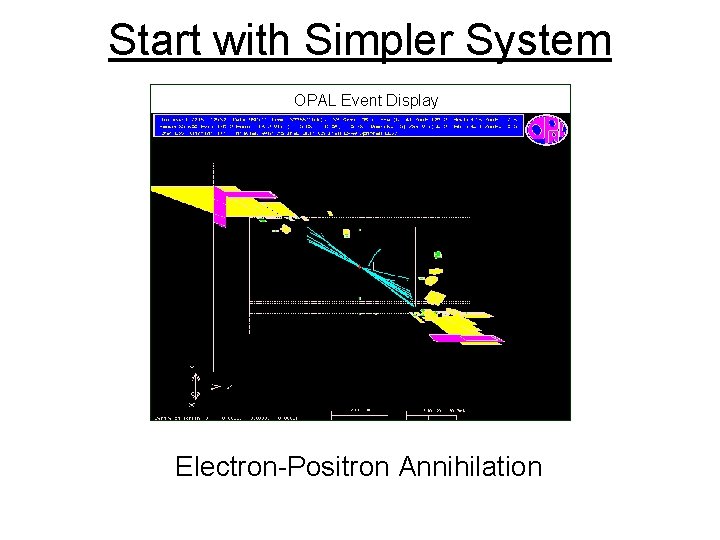
Start with Simpler System OPAL Event Display Electron-Positron Annihilation
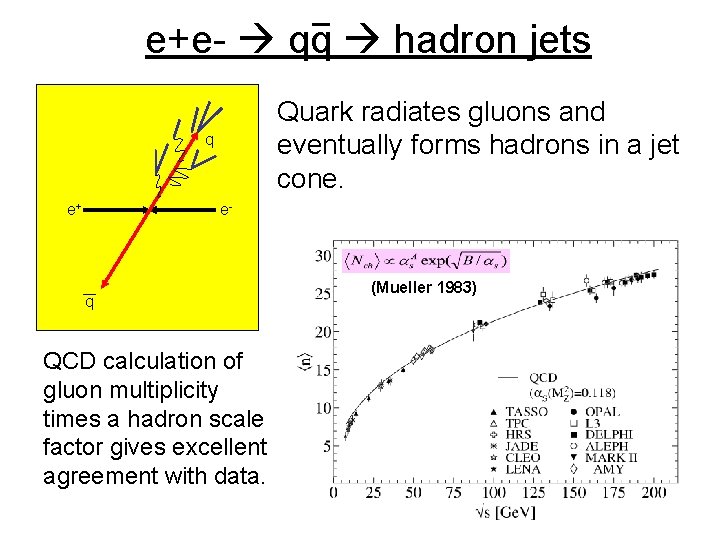
e+e- qq hadron jets Quark radiates gluons and eventually forms hadrons in a jet cone. q e- e+ q QCD calculation of gluon multiplicity times a hadron scale factor gives excellent agreement with data. (Mueller 1983)
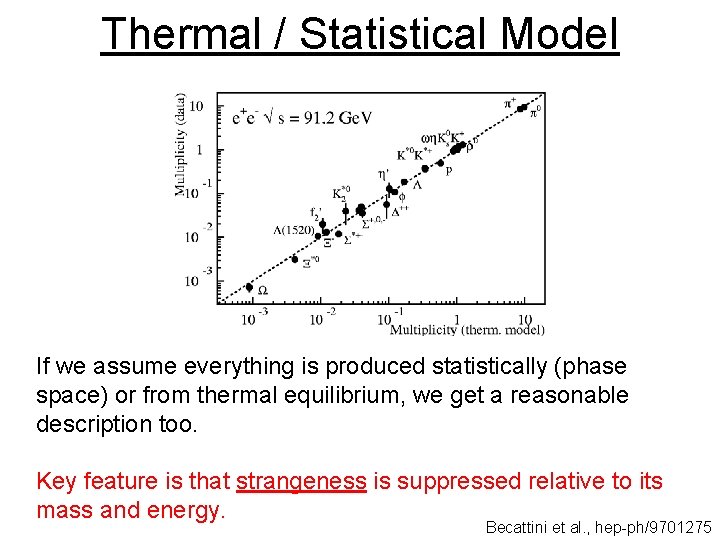
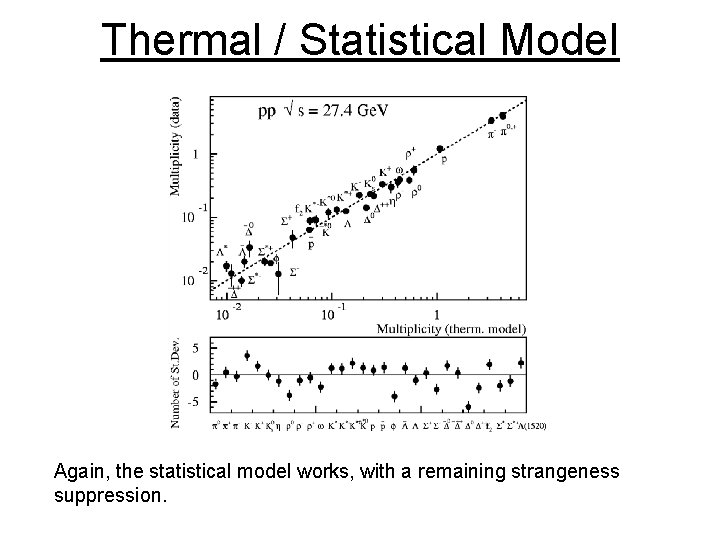
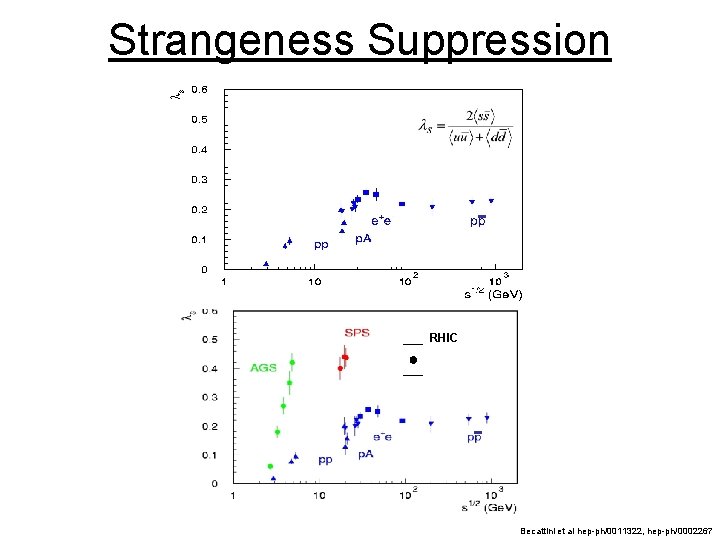
Thermal / Statistical Model If we assume everything is produced statistically (phase space) or from thermal equilibrium, we get a reasonable description too. Key feature is that strangeness is suppressed relative to its mass and energy. Becattini et al. , hep-ph/9701275
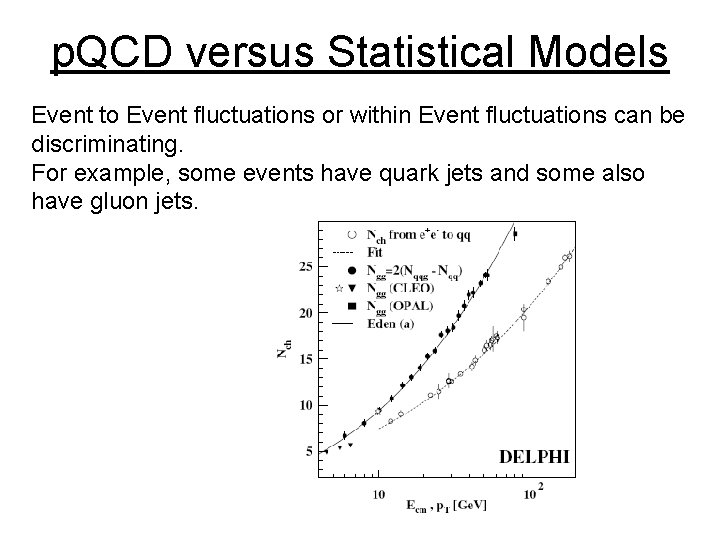
p. QCD versus Statistical Models Event to Event fluctuations or within Event fluctuations can be discriminating. For example, some events have quark jets and some also have gluon jets.
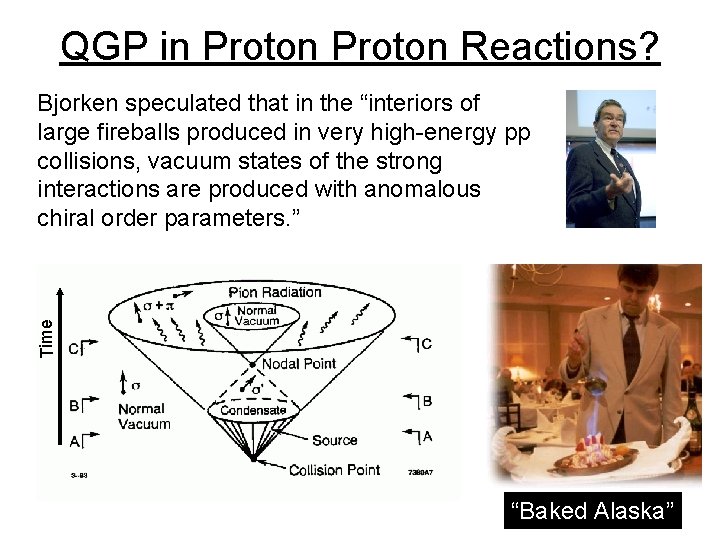
QGP in Proton Reactions? Time Bjorken speculated that in the “interiors of large fireballs produced in very high-energy pp collisions, vacuum states of the strong interactions are produced with anomalous chiral order parameters. ” “Baked Alaska”
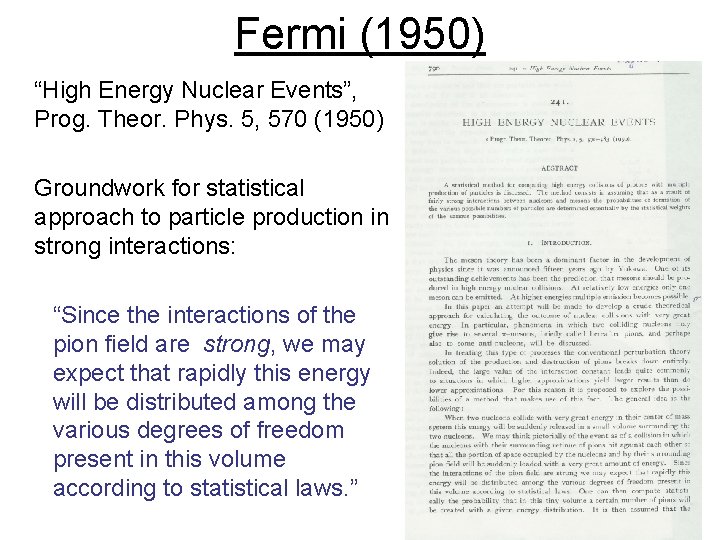
Fermi (1950) “High Energy Nuclear Events”, Prog. Theor. Phys. 5, 570 (1950) Groundwork for statistical approach to particle production in strong interactions: “Since the interactions of the pion field are strong, we may expect that rapidly this energy will be distributed among the various degrees of freedom present in this volume according to statistical laws. ”
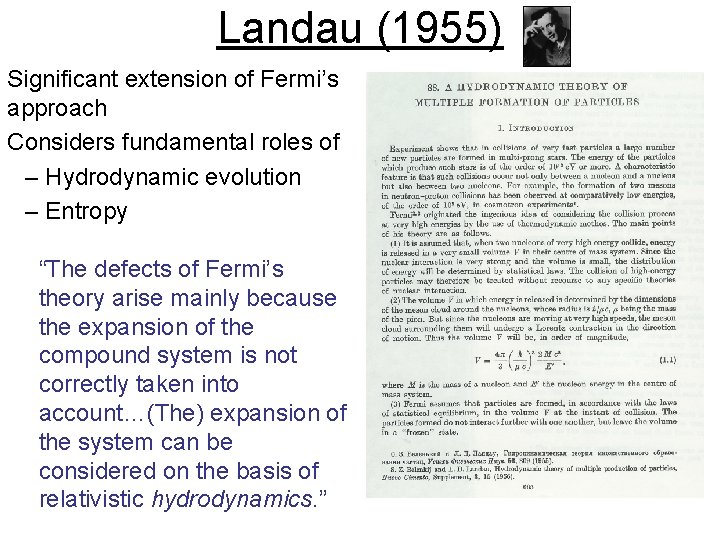
Landau (1955) Significant extension of Fermi’s approach Considers fundamental roles of – Hydrodynamic evolution – Entropy “The defects of Fermi’s theory arise mainly because the expansion of the compound system is not correctly taken into account…(The) expansion of the system can be considered on the basis of relativistic hydrodynamics. ”
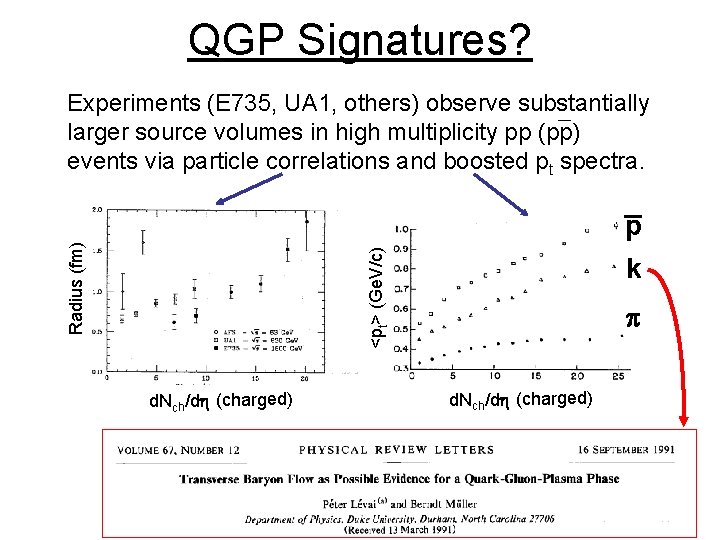
QGP Signatures? Experiments (E 735, UA 1, others) observe substantially larger source volumes in high multiplicity pp (pp) events via particle correlations and boosted pt spectra. <pt> (Ge. V/c) Radius (fm) p d. Nch/dh (charged) k p d. Nch/dh (charged)
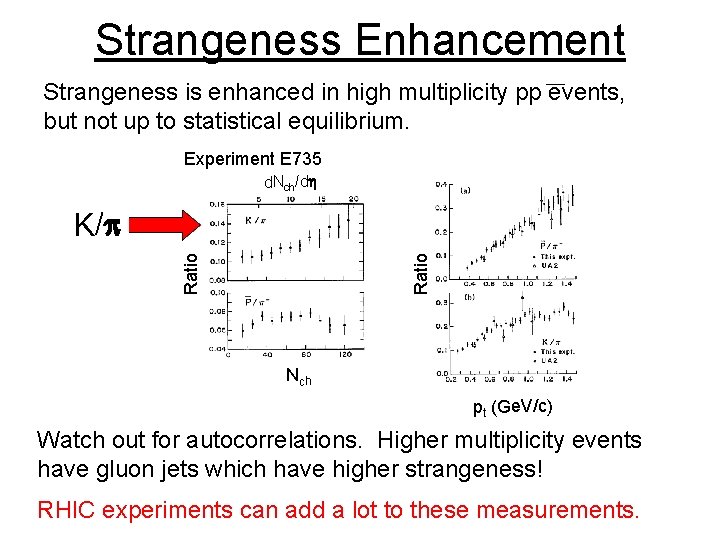
Strangeness Enhancement Strangeness is enhanced in high multiplicity pp events, but not up to statistical equilibrium. Experiment E 735 d. Nch/dh Ratio K/p Nch pt (Ge. V/c) Watch out for autocorrelations. Higher multiplicity events have gluon jets which have higher strangeness! RHIC experiments can add a lot to these measurements.
Thermal / Statistical Model Again, the statistical model works, with a remaining strangeness suppression.
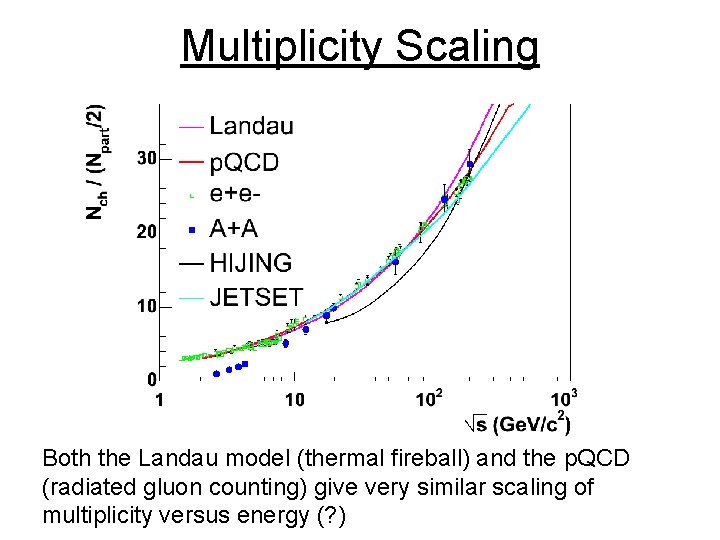
Multiplicity Scaling Both the Landau model (thermal fireball) and the p. QCD (radiated gluon counting) give very similar scaling of multiplicity versus energy (? )
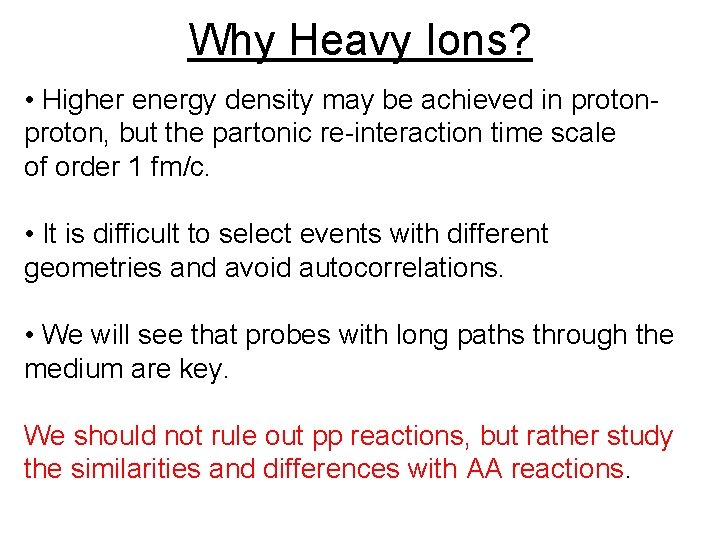
Why Heavy Ions? • Higher energy density may be achieved in proton, but the partonic re-interaction time scale of order 1 fm/c. • It is difficult to select events with different geometries and avoid autocorrelations. • We will see that probes with long paths through the medium are key. We should not rule out pp reactions, but rather study the similarities and differences with AA reactions.
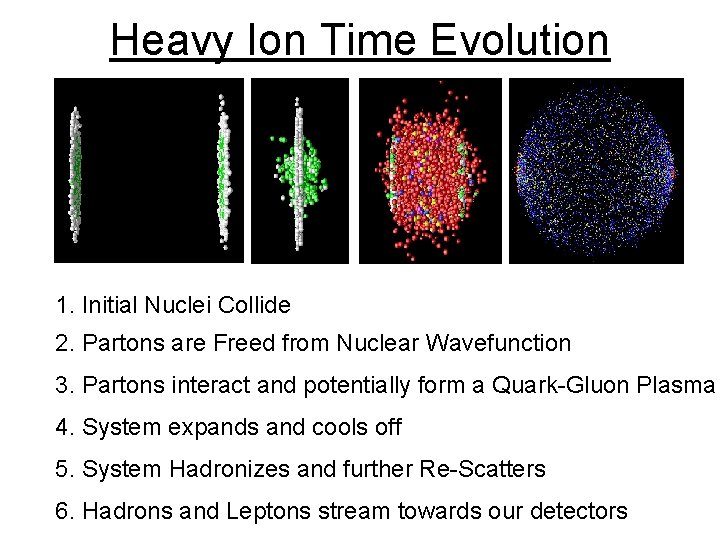
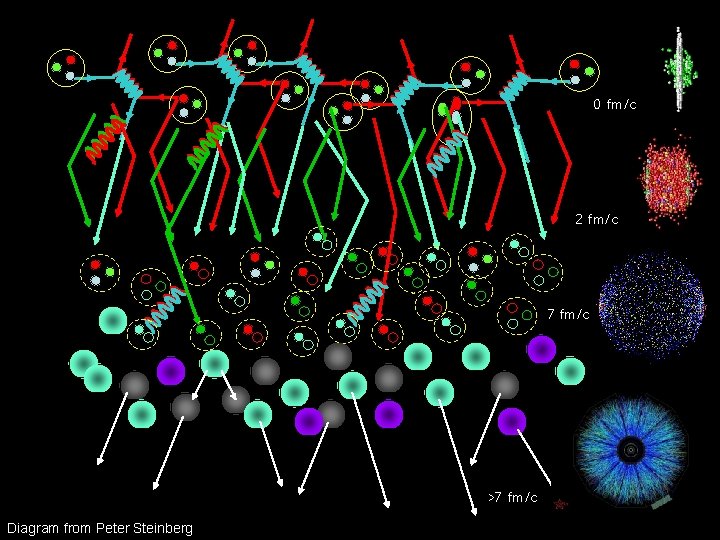
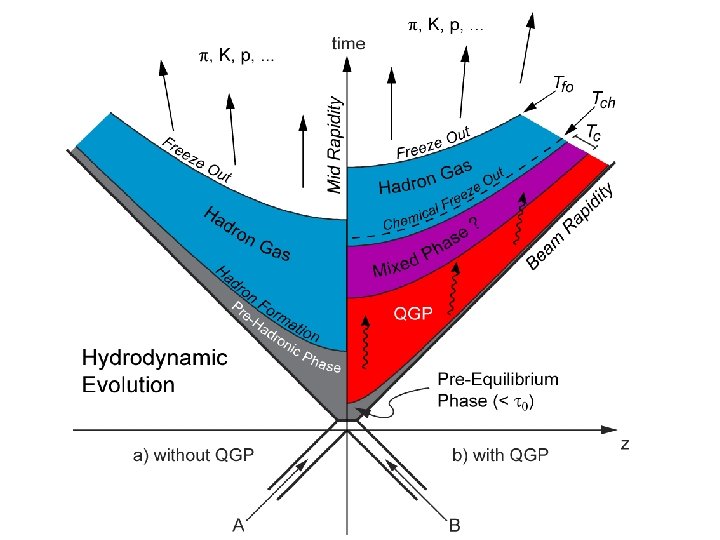
Heavy Ion Time Evolution 1. Initial Nuclei Collide 2. Partons are Freed from Nuclear Wavefunction 3. Partons interact and potentially form a Quark-Gluon Plasma 4. System expands and cools off 5. System Hadronizes and further Re-Scatters 6. Hadrons and Leptons stream towards our detectors
0 fm/c 2 fm/c 7 fm/c >7 fm/c Diagram from Peter Steinberg
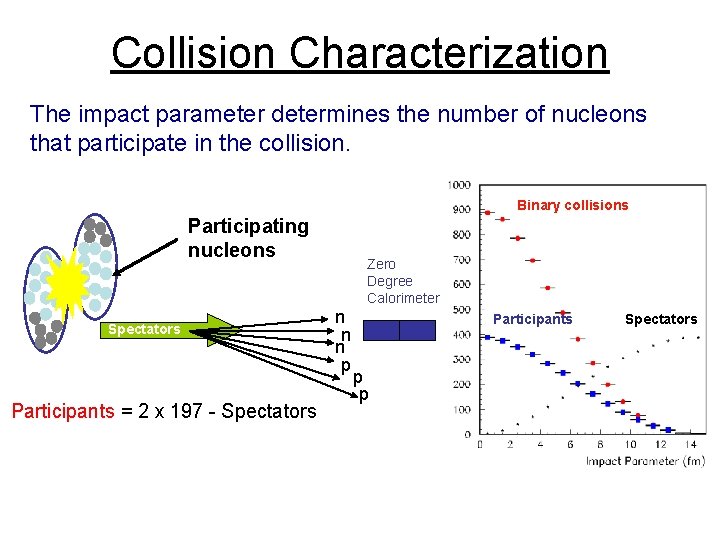
Collision Characterization The impact parameter determines the number of nucleons that participate in the collision. Binary collisions Participating nucleons Spectators Participants = 2 x 197 - Spectators Zero Degree Calorimeter n n n p Participants p p Spectators
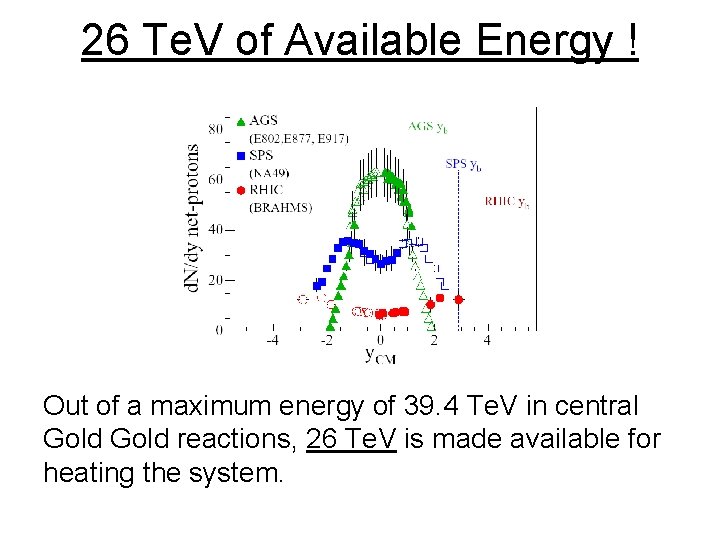
26 Te. V of Available Energy ! Out of a maximum energy of 39. 4 Te. V in central Gold reactions, 26 Te. V is made available for heating the system.
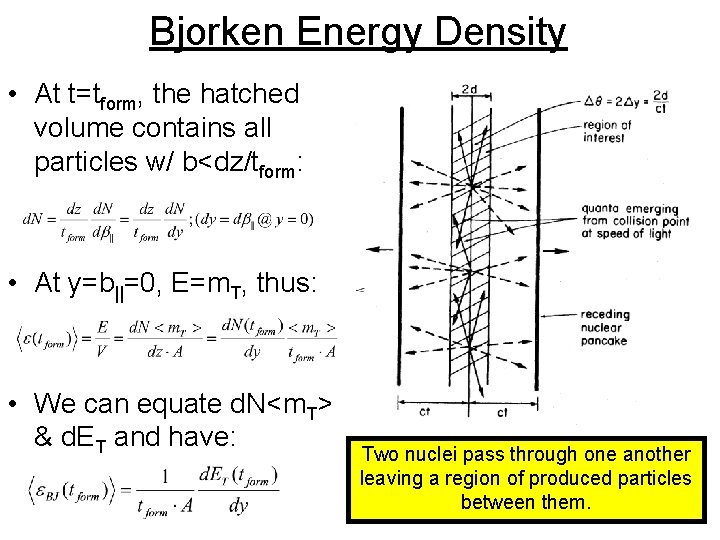
Bjorken Energy Density • At t=tform, the hatched volume contains all particles w/ b<dz/tform: • At y=b||=0, E=m. T, thus: • We can equate d. N<m. T> & d. ET and have: Two nuclei pass through one another leaving a region of produced particles between them.
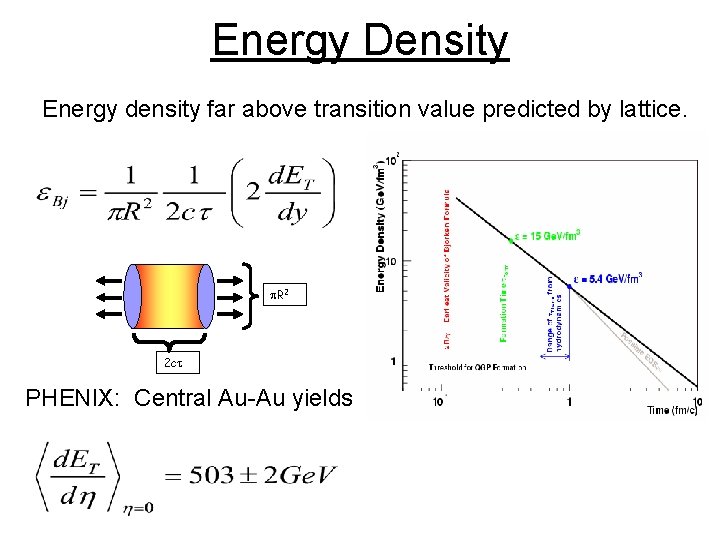
Energy Density Energy density far above transition value predicted by lattice. R 2 2 ct PHENIX: Central Au-Au yields
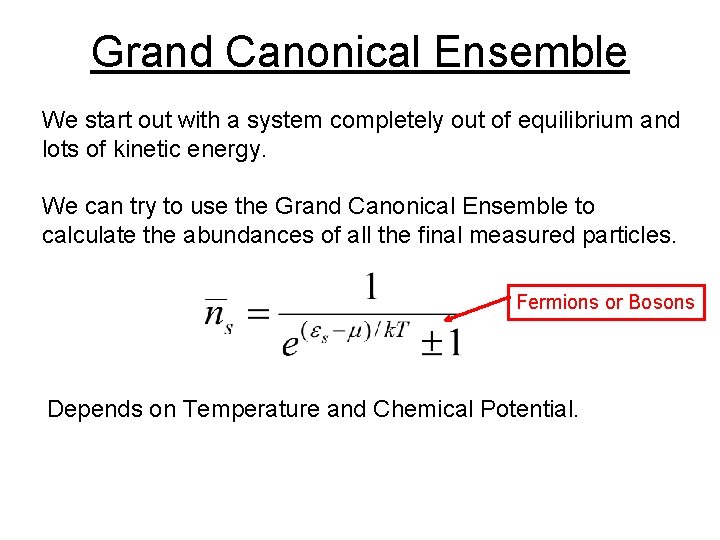
Grand Canonical Ensemble We start out with a system completely out of equilibrium and lots of kinetic energy. We can try to use the Grand Canonical Ensemble to calculate the abundances of all the final measured particles. Fermions or Bosons Depends on Temperature and Chemical Potential.
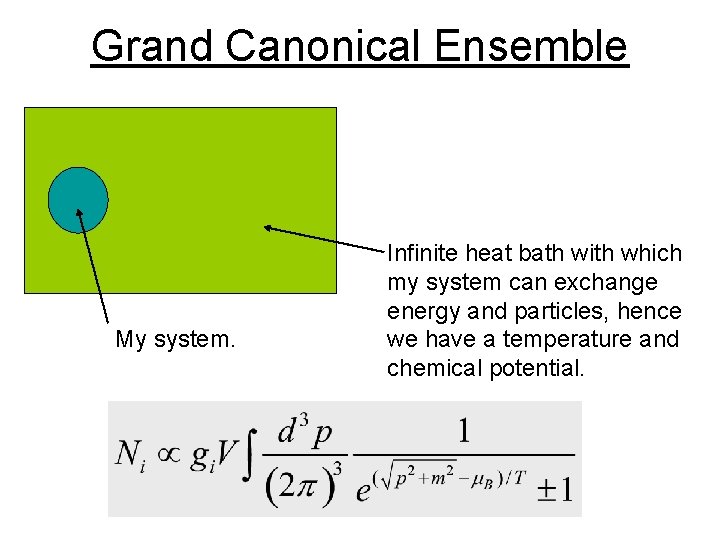
Grand Canonical Ensemble My system. Infinite heat bath with which my system can exchange energy and particles, hence we have a temperature and chemical potential.
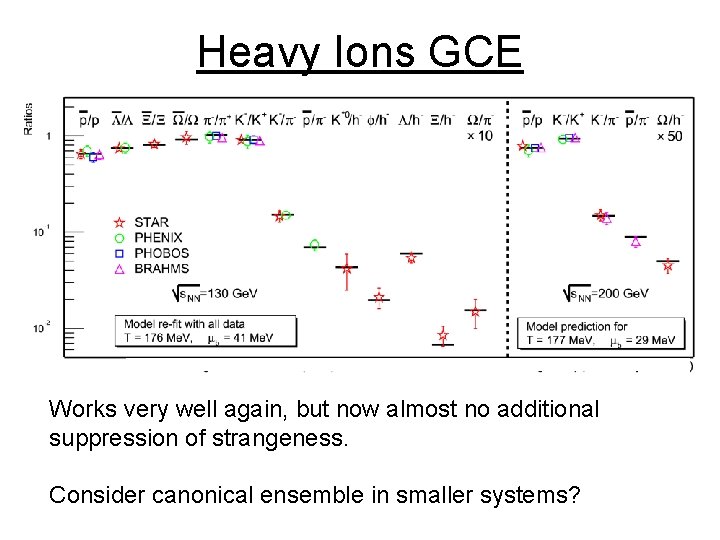
Heavy Ions GCE Works very well again, but now almost no additional suppression of strangeness. Consider canonical ensemble in smaller systems?
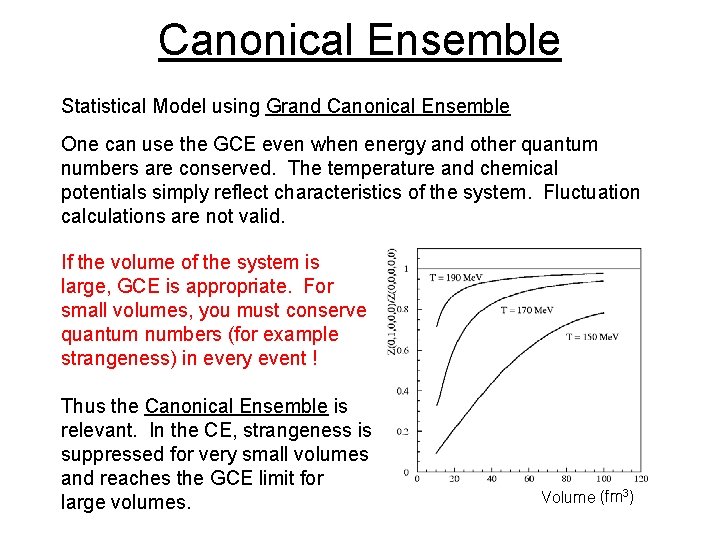
Canonical Ensemble Statistical Model using Grand Canonical Ensemble One can use the GCE even when energy and other quantum numbers are conserved. The temperature and chemical potentials simply reflect characteristics of the system. Fluctuation calculations are not valid. If the volume of the system is large, GCE is appropriate. For small volumes, you must conserve quantum numbers (for example strangeness) in every event ! Thus the Canonical Ensemble is relevant. In the CE, strangeness is suppressed for very small volumes and reaches the GCE limit for large volumes. Volume (fm 3)
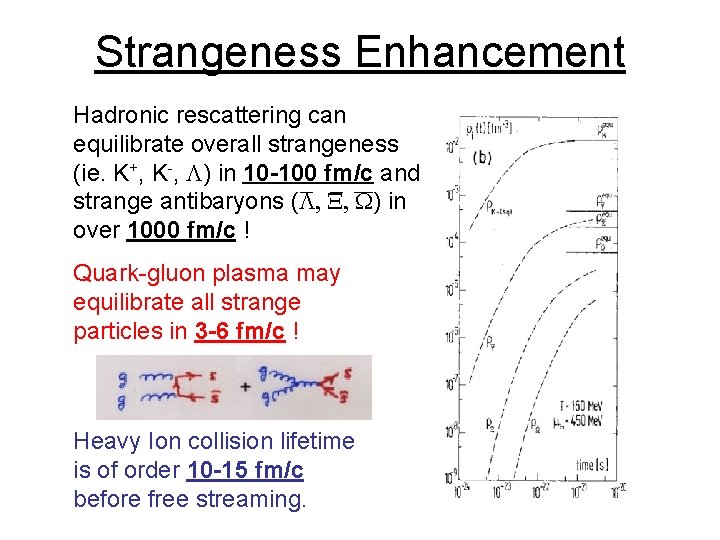
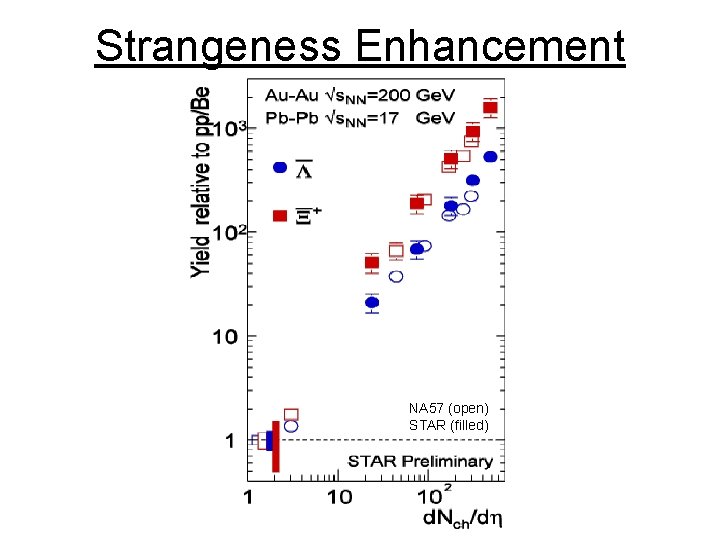
Strangeness Enhancement Hadronic rescattering can equilibrate overall strangeness (ie. K+, K-, L) in 10 -100 fm/c and strange antibaryons (L, X, W) in over 1000 fm/c ! Quark-gluon plasma may equilibrate all strange particles in 3 -6 fm/c ! Heavy Ion collision lifetime is of order 10 -15 fm/c before free streaming.
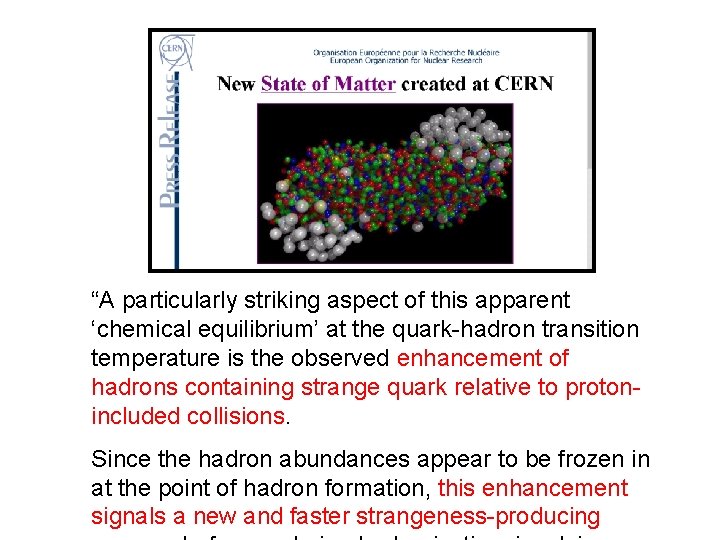
“A particularly striking aspect of this apparent ‘chemical equilibrium’ at the quark-hadron transition temperature is the observed enhancement of hadrons containing strange quark relative to protonincluded collisions. Since the hadron abundances appear to be frozen in at the point of hadron formation, this enhancement signals a new and faster strangeness-producing
Strangeness Suppression factor ~2 RHIC Becattini et al hep-ph/0011322, hep-ph/0002267
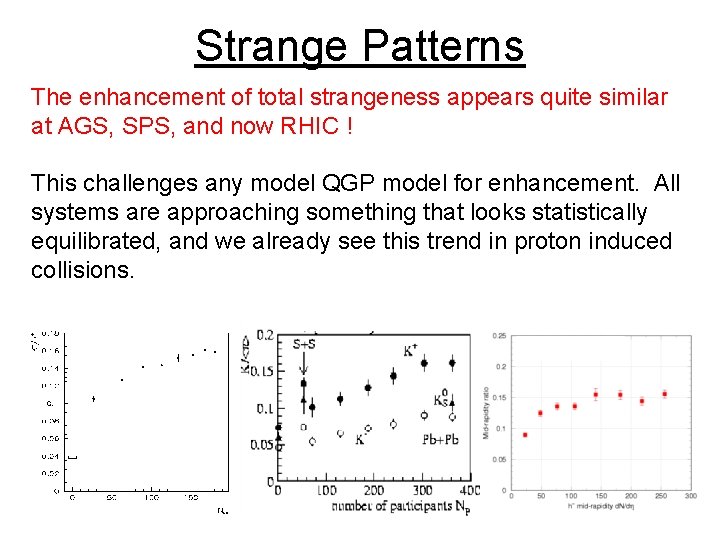
Strange Patterns The enhancement of total strangeness appears quite similar at AGS, SPS, and now RHIC ! This challenges any model QGP model for enhancement. All systems are approaching something that looks statistically equilibrated, and we already see this trend in proton induced collisions.
Strangeness Enhancement NA 57 (open) STAR (filled)
Collision Dynamic Summary - Depositing majority of kinetic energy into new medium - Energy density appears above phase transition value - Energy is distributed into particle production statistically including equivalent strangeness production - No sharp global feature distinct from smaller hadron collisions, but instead gradual changes