
The Physics of Mark Dobbins Mike Grayson Jennifer
The Physics of Mark Dobbins , Mike Grayson, Jennifer Burton www. battlebots. com
What is a Battle. Bot? A remote controlled combat robot • • • Remote control Internal power Movement mechanisms Protective mechanisms Weapons
Weight • Weight is an essential part of the Battle. Bot which defines what other bots it will face. • Every pound counts – – – Power Supply Motors Wheels Armor Weapons Nuts & Bolts Weight Class (lbs) Min Max Lightweight 30 60 Middleweight 60 120 Heavyweight 120 220 Super Heavyweight 220 340
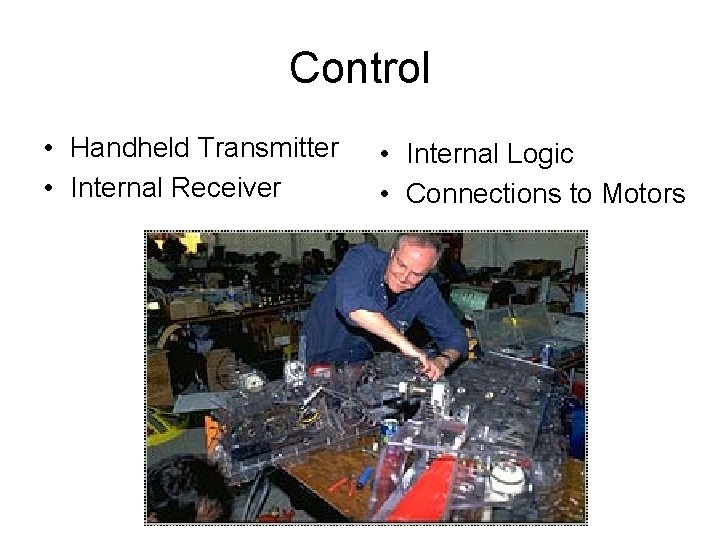
Control • Handheld Transmitter • Internal Receiver • Internal Logic • Connections to Motors

Innovation First, Inc. Robot Controls • Operator Interface – Switches and Joysticks • Radio Modem – 900 MHz radio signal – 19200 bps • FRC Robot Controller – Data from Operator Interface and Onboard Sensors – Internal microcontroller with some user programming capabilities
Power • Internal Batteries – Lead-Acid batteries are required to be “leakproof” • Battery “Hold-Downs” • Wiring and Fuses • Strong wire connections • Fuel-Powered Engines are sometimes used in place of electric motors
Judging Competition • A bot that is immobilized looses the match. • Points are awarded for: – Aggression – Strategy – Damage

Weapons • Inflict maximum damage without selfdestructing – Cut – Smash – Lift – Throw • Weapons can be: – Gasoline powered – Electric – Pneumatic – Hydraulic.
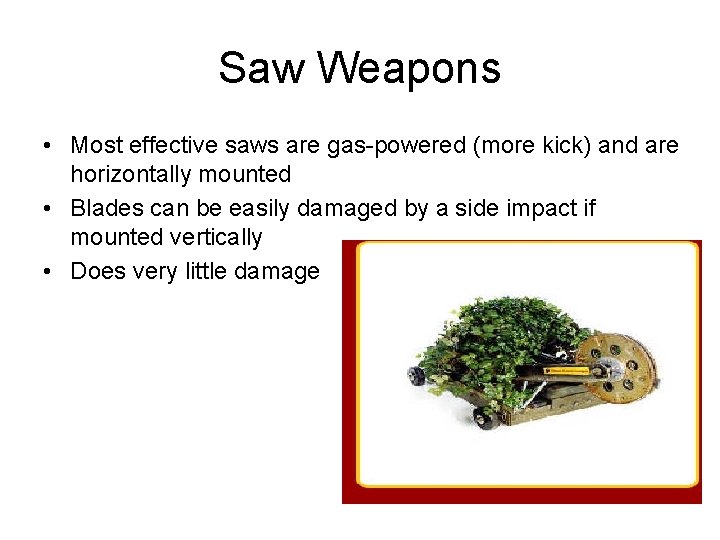
Saw Weapons • Most effective saws are gas-powered (more kick) and are horizontally mounted • Blades can be easily damaged by a side impact if mounted vertically • Does very little damage
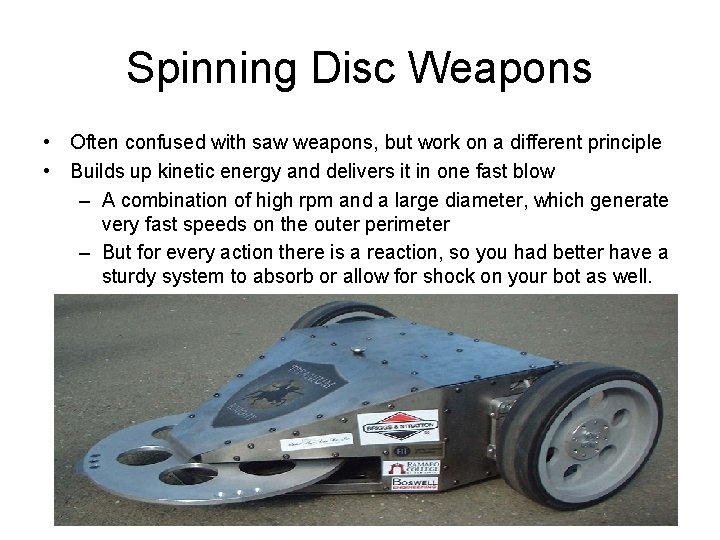
Spinning Disc Weapons • Often confused with saw weapons, but work on a different principle • Builds up kinetic energy and delivers it in one fast blow – A combination of high rpm and a large diameter, which generate very fast speeds on the outer perimeter – But for every action there is a reaction, so you had better have a sturdy system to absorb or allow for shock on your bot as well.
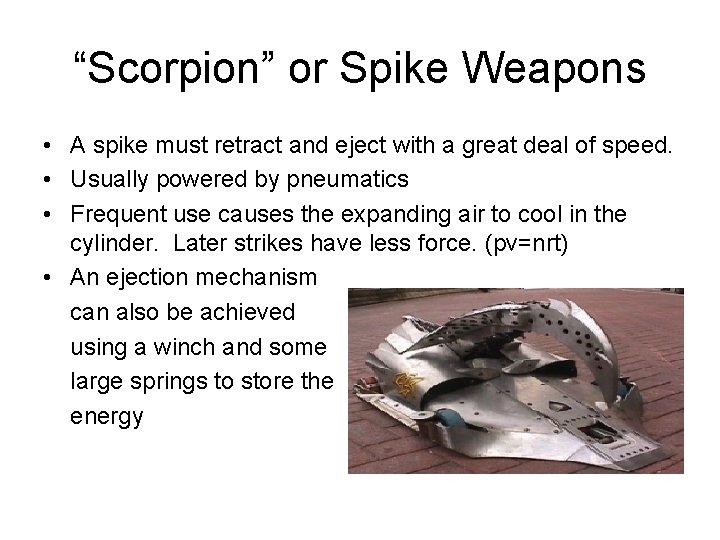
“Scorpion” or Spike Weapons • A spike must retract and eject with a great deal of speed. • Usually powered by pneumatics • Frequent use causes the expanding air to cool in the cylinder. Later strikes have less force. (pv=nrt) • An ejection mechanism can also be achieved using a winch and some large springs to store the energy
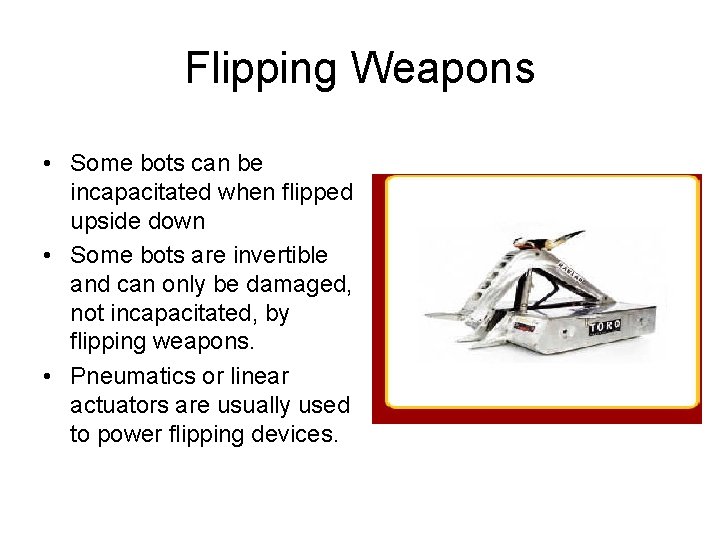
Flipping Weapons • Some bots can be incapacitated when flipped upside down • Some bots are invertible and can only be damaged, not incapacitated, by flipping weapons. • Pneumatics or linear actuators are usually used to power flipping devices.
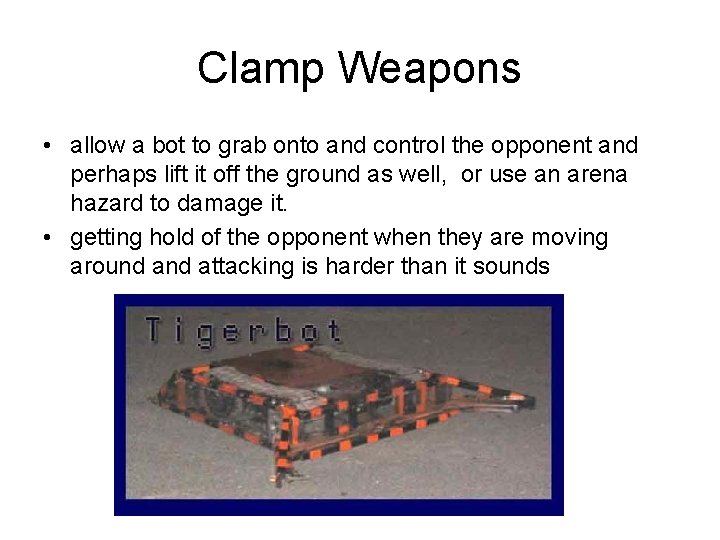
Clamp Weapons • allow a bot to grab onto and control the opponent and perhaps lift it off the ground as well, or use an arena hazard to damage it. • getting hold of the opponent when they are moving around attacking is harder than it sounds
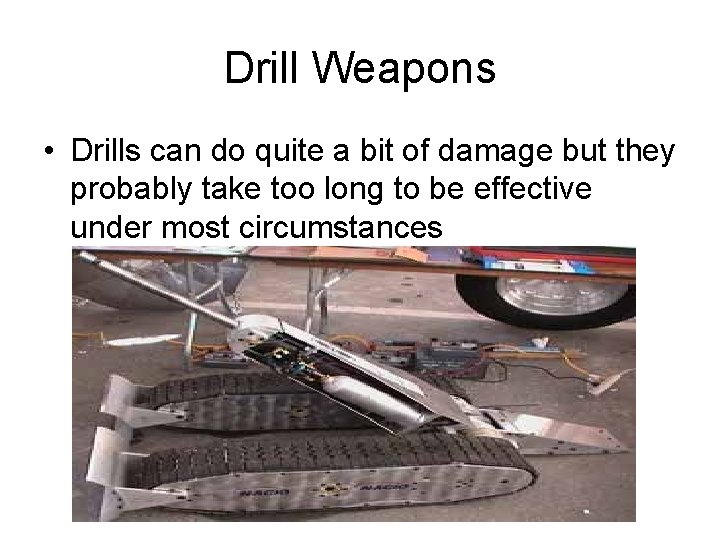
Drill Weapons • Drills can do quite a bit of damage but they probably take too long to be effective under most circumstances
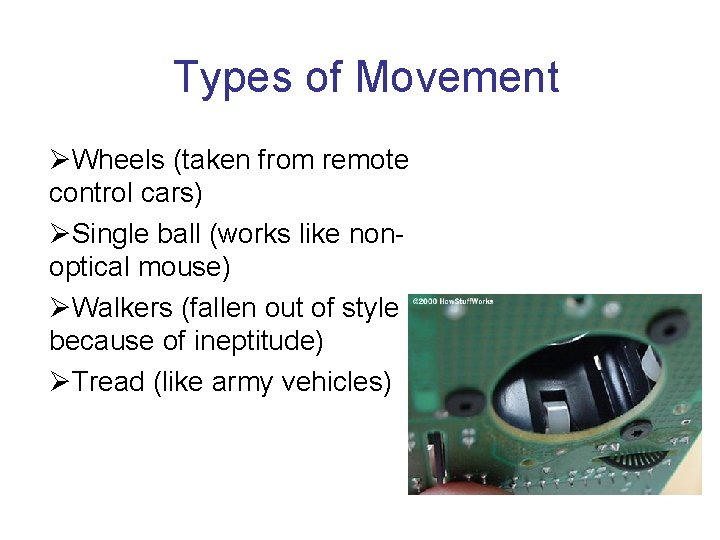
Types of Movement ØWheels (taken from remote control cars) ØSingle ball (works like nonoptical mouse) ØWalkers (fallen out of style because of ineptitude) ØTread (like army vehicles)
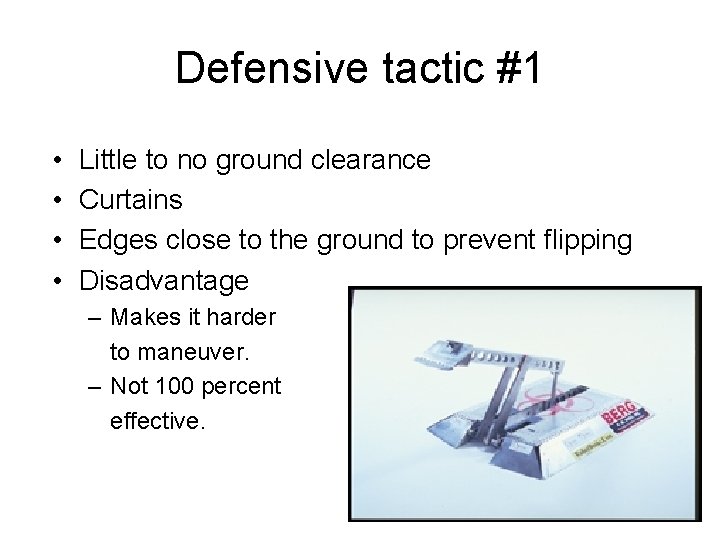
Defensive tactic #1 • • Little to no ground clearance Curtains Edges close to the ground to prevent flipping Disadvantage – Makes it harder to maneuver. – Not 100 percent effective.

Defensive Tactic #2 • Speed or Agility • Advantage: run from competitor and its weapons • Disadvantage: not enough mass for impact with competitor.
Defensive Tactic #3 • Strength: more mass • Advantage: able to overpower the offense • Disadvantage: dynamic stability takes a hit, less agility

Defensive Tactic #4 • • Armor Plating All battlebots have it to some degree Protects the electronics There is an inverse relationship between material used and dynamic stability
Skills • No matter what defensive precautions are taken, skill is what really matters • The best Battle. Bot could lose if run by a bad tactician or uneducated person.
- Slides: 20