
THE PHYSICS OF GRAVITY Theories of Gravity Grade

- Slides: 13
THE PHYSICS OF GRAVITY Theories of Gravity Grade 10 Austin Vestrand 10/15/2012
• What is Gravity? • Gravity and Weight • Theories of Gravity
GRAVITY • What is it? • In general, it is the attractive force between two or more objects based on the mass of the objects and the distance between them. • It is the force that keeps us on the earth, the moon rotating around the Earth, the Earth around the sun, and the sun around the center of our galaxy. • How would you define gravity?
EXAMPLE Http: //highered. mcgrawhill. com/sites/0072482621/student_view 0/interactives. html# • Then click on Escape Velocities Interactive • As you can see from this game, as the rockets speed is increased, and they move farther away from the planet, the less they are slowed down until eventually they stop being slowed down at all meaning they have left the distance at which Earth’s gravity can affect them, showing the distance factor of gravity • http: //library. thinkquest. org/27585/lab/sim_solar. html • This shows how changing the mass and speed of an object changes how it interacts with other objects, try changing the mass of the sun, what happens? Why do you think this occurs?
GRAVITY AND WEIGHT • Gravity is also why we have weight. • Weight is the force of gravity times an objects mass. Change gravity, and you change they objects weight, like going to the moon, one would have less weight, but still have the same mass • http: //library. thinkquest. org/27585/lab/sim_surface. html • Put in your weight, and see how much you would weigh on various objects in our solar system. • As you can see, those planets with higher mass also have higher gravity, thus showing the mass portion of gravity.
THEORIES OF GRAVITY • Newton’s Theory of Gravity • Newton believed gravity to be a force instantly pulling between two or more objects • Newton used the inverse square-law as the basis behind gravity, stating that as one moved away from the center of mass of an object, the less intense the objects gravitational force. So Intensity was proportional to 1 over the distance squared. • I ≈ 1/D^2 • This theory was then used to predict the existence of Neptune based on the orbital motion of Uranus.
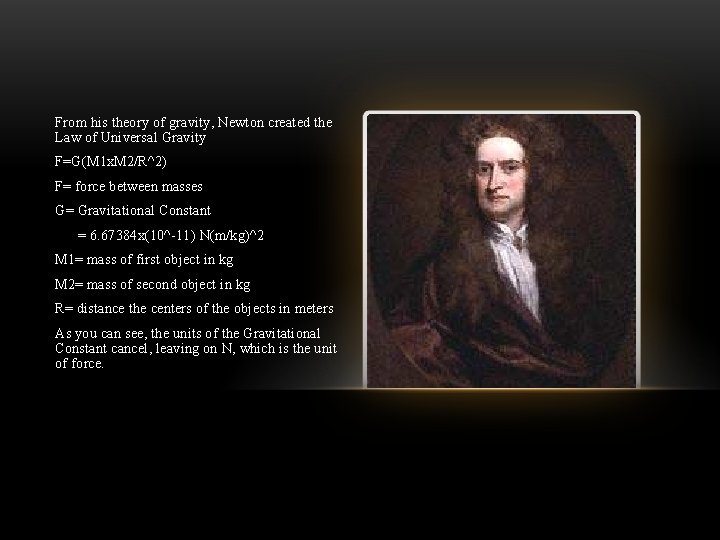
From his theory of gravity, Newton created the Law of Universal Gravity F=G(M 1 x. M 2/R^2) F= force between masses G= Gravitational Constant = 6. 67384 x(10^-11) N(m/kg)^2 M 1= mass of first object in kg M 2= mass of second object in kg R= distance the centers of the objects in meters As you can see, the units of the Gravitational Constant cancel, leaving on N, which is the unit of force.
• There were problems with Newton’s theory and law. For example, it could not explain the irregularities in Mercury's orbit. • Nor could it account for the amount of deflection of light caused by gravity, it showed about half that of the observed deflection. • In addition, he never theorized on the how of gravity, or what caused it. • This leads us to the second theory we will discuss.
EINSTEIN'S THEORY OF GENERAL RELATIVITY • Einstein believed gravity to be a geometric property of the interaction between space and time. What he believed was that objects of large mass caused the spacetime around them to curve and this curve interacted with other objects. Thus he saw gravity as a field, rather than a force. • Think of a sheet stretched over nothing. If you were to put something on the sheet, it would dip down a lot in one spot and gradually increase back to normal as you moved away from the object. Now, if you put a much lighter object on the sheet in a area that is affected by the first object, then the second object will move towards the first, following the curve of the sheet. This is the basics of General Relativity.
• While Einstein’s theory is more accurate, it goes into math that at this point in your education, you have not come across, thus for all problems in this class, we will be using Newton’s equation for Universal Gravity.
EXAMPLE PROBLEM • Two asteroids are 32 meters apart. The first asteroid has a mass of 300000 kg and a radius of 15 meters, while the second asteroid has a mass of 600000 kg and a radius of 21 meters. What is the gravitational force between them? • Answer: . 002598 N, with significant figures it is. 003 N • Now what if these same asteroids were only 5 meters apart, what would the force between them equal? • Answer: . 007146 N, with significant figures it is. 007 N
ADDITIONAL RESOURCES http: //videos. howstuffworks. com/tlc/29805 -understanding-gravity-video. htm A nice, simple explanation for Einstein's Theory of General Relativity http: //www. neok 12. com/php/watch. php? v=z. X 617261655 c 700 f 78777367&t=Gr avitation A look at the difference between Newton and Einstein, as well as a far more in-depth look at General Relativity http: //www-scf. usc. edu/~kallos/gravity. htm A summarized history of gravity and those who have theorized about it.
CREDITS • BBC History. (2012). Painting of Sir Isaac Newton. Retrieved on October 14 th, 2012 from http: //www. bbc. co. uk/history/historic_figures/newton_isaac. shtml • Microsoft Corporation. (n. d. ). Image of Archer. Retrieved on October 15 th, 2012 from MS clipart. • Microsoft Corporation. (n. d. ). Image of Battlefield. Retrieved on October 15 th, 2012 from MS clipart. • Microsoft Corporation. (n. d. ). Image of Old Cannon. Retrieved on October 15 th, 2012 from MS clipart.