
The Physics of Diagnostic Ultrasound FRCR Physics Lectures

- Slides: 39
The Physics of Diagnostic Ultrasound FRCR Physics Lectures Revision Session Carl Horsfield Principal Physicist-Radiotherapy Imaging; HCPC no: CS 18532 phone: 01482 461371 email: carl. horsfield@hey. nhs. uk | website: hullrad. org. uk Radiation Physics Department | The Queen's Centre
The Physics of Diagnostic Ultrasound FRCR Physics Lectures Revision Session Mark Wilson Clinical Scientist (Radiotherapy) mark. wilson@hey. nhs. uk Hull and East Yorkshire Hospitals NHS Trust
Revision Questions Regarding Ultrasound: Clinically the range 3 -15 MHz is commonly used True Remember the rate of attenuation increases with frequency 3 MHz might be used on an abdominal probe 15 MHz might be used for examining an eye Hull and East Yorkshire Hospitals NHS Trust
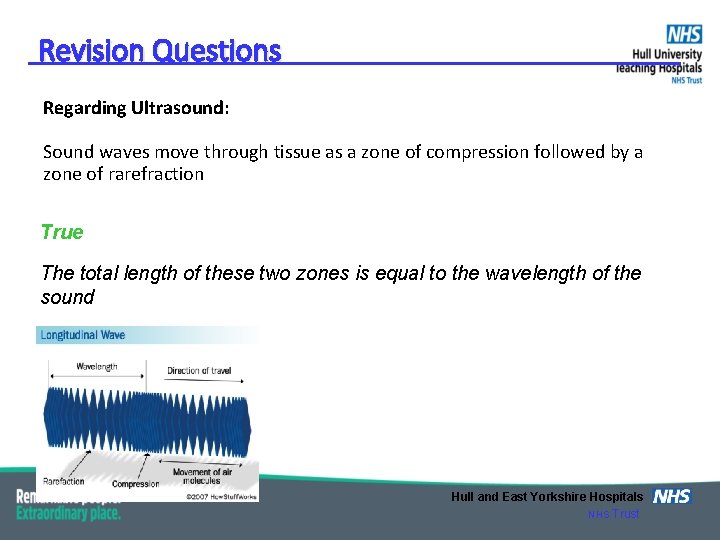
Revision Questions Regarding Ultrasound: Sound waves move through tissue as a zone of compression followed by a zone of rarefraction True The total length of these two zones is equal to the wavelength of the sound Hull and East Yorkshire Hospitals NHS Trust
Revision Questions Regarding Ultrasound: It travels through tissue at 154 m/s False Ultrasound travels through tissue at approximately 1540 m/s Hull and East Yorkshire Hospitals NHS Trust
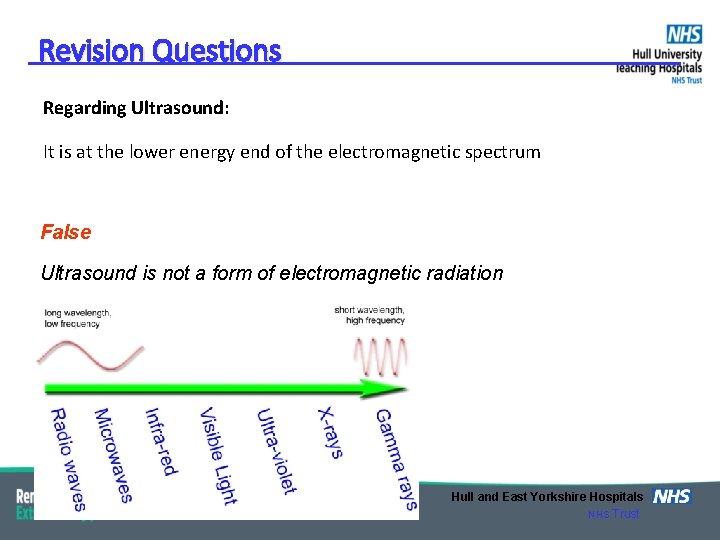
Revision Questions Regarding Ultrasound: It is at the lower energy end of the electromagnetic spectrum False Ultrasound is not a form of electromagnetic radiation Hull and East Yorkshire Hospitals NHS Trust
Revision Questions Regarding Ultrasound: Intensity is proportional to the square of the amplitude True Intensity is the power per unit area Knowing the intensity of the beam is important for issues of safety Hull and East Yorkshire Hospitals NHS Trust
Revision Questions Regarding Ultrasound: 30 decibels (d. B) is a common intensity used clinically False No universal reference intensity exists for ultrasound. Decibels are used to indicate a change in intensity Decibel, d. B = 10 log 10 (I 2 / I 1) Hull and East Yorkshire Hospitals NHS Trust
Revision Questions Regarding Diagnostic Ultrasound: The reflective properties at the interface between tissues are ultilised in image acquisition True Reflection occurs due to differences in acoustic impedance Hull and East Yorkshire Hospitals NHS Trust
Revision Questions Regarding Diagnostic Ultrasound: Sound waves require a medium to travel in True Sound waves can not travel through a vacuum Hull and East Yorkshire Hospitals NHS Trust
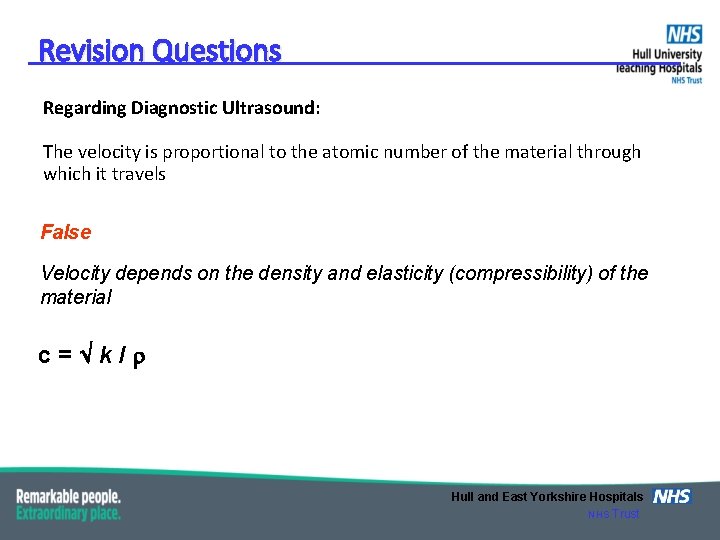
Revision Questions Regarding Diagnostic Ultrasound: The velocity is proportional to the atomic number of the material through which it travels False Velocity depends on the density and elasticity (compressibility) of the material c= k/ Hull and East Yorkshire Hospitals NHS Trust
Revision Questions Regarding Diagnostic Ultrasound: Damage to tissues from ultrasound causes a stochastic risk of cancer False No link between cancer and ultrasound exposure has been made Hull and East Yorkshire Hospitals NHS Trust
Revision Questions Regarding Diagnostic Ultrasound: M-Mode ultrasound is the term used for mobile ultrasound units which ultilise a single multifunctional transducer False M-Mode ultrasound is used to visualise rapidly moving structures (e. g. heart valve) Image shows motion (y-axis) vs time (x-axis) Hull and East Yorkshire Hospitals NHS Trust
Revision Questions Regarding Diagnostic Ultrasound: Ultrasound is a high frequency form of electromagnetic radiation False Ultrasound waves are not electromagnetic waves Ultrasound waves are longitudinal mechanical waves Hull and East Yorkshire Hospitals NHS Trust
Revision Questions Regarding Ultrasound in Tissue: A large difference in acoustic impedance between tissues means more sound is reflected and less is transmitted at their boundary True This is clinically important where the ultrasound beam meets a narrow air gap between the probe and the skin as there is a large mismatch between the two – acoustic coupling is therefore required Hull and East Yorkshire Hospitals NHS Trust
Revision Questions Regarding Ultrasound in Tissue: All tissues attenuate ultrasound equally False Each tissue has its own ultrasonic attenuation coefficient Soft tissues – 0. 5 -1. 0 d. B/cm Bone – 20 d. B/cm Hull and East Yorkshire Hospitals NHS Trust
Revision Questions Regarding Ultrasound in Tissue: An ultrasound beam is attenuated linearly in soft tissue False The attenuation of an ultrasound beam in soft tissue is exponential Hull and East Yorkshire Hospitals NHS Trust
Revision Questions Regarding Ultrasound in Tissue: Over 99% of an ultrasound beam will be reflected at a gas-soft tissue interface True Typical reflection proportions would be 99. 9% air-tissue, 30% bonemuscle, 1% fat-muscle Hull and East Yorkshire Hospitals NHS Trust
Revision Questions The piezoelectric effect: The piezoelectric effect describes the interconversion of electric and mechanical energy in some materials True If a voltage is applied to a piezoelectric material, the material with expand or contract, and if a force is applied to a piezoelectric material which causes it to expand or contract a voltage will be induced in the material Hull and East Yorkshire Hospitals NHS Trust
Revision Questions The piezoelectric effect: The resonant frequency of a transducer depends on the piezoelectric material used True The resonant frequency is that at which a piezoelectric element would naturally reverberate at. This is determined by both the composition and dimensions of the element Hull and East Yorkshire Hospitals NHS Trust
Revision Questions The ultrasound beam: Maintains its dimensions indefinitely False The ultrasound beam diverges at distances beyond the near field zone Hull and East Yorkshire Hospitals NHS Trust
Revision Questions The ultrasound beam: The near field is longer with a higher frequency True The near field length is proportional to: frequency x beam diameter 2 Hull and East Yorkshire Hospitals NHS Trust
Revision Questions The ultrasound beam: There is less near field divergence with an increasing transducer diameter False There is less far field divergence with a larger transducer diameter Hull and East Yorkshire Hospitals NHS Trust
Revision Questions With real-time ultrasound imaging, if all other factors are kept constant: A higher PRF allows a higher number of lines per frame True PRF = lines per frame x frame rate Hull and East Yorkshire Hospitals NHS Trust
Revision Questions With real-time ultrasound imaging, if all other factors are kept constant: To view an object further from the probe the PRF must be increased False The further the object from the probe, the greater the time for an echo to return, and therefore the PRF needs to be lower Hull and East Yorkshire Hospitals NHS Trust
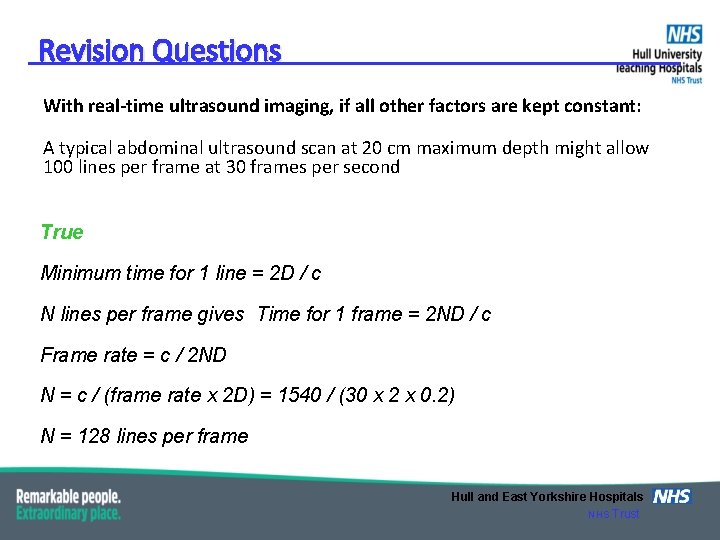
Revision Questions With real-time ultrasound imaging, if all other factors are kept constant: A typical abdominal ultrasound scan at 20 cm maximum depth might allow 100 lines per frame at 30 frames per second True Minimum time for 1 line = 2 D / c N lines per frame gives Time for 1 frame = 2 ND / c Frame rate = c / 2 ND N = c / (frame rate x 2 D) = 1540 / (30 x 2 x 0. 2) N = 128 lines per frame Hull and East Yorkshire Hospitals NHS Trust
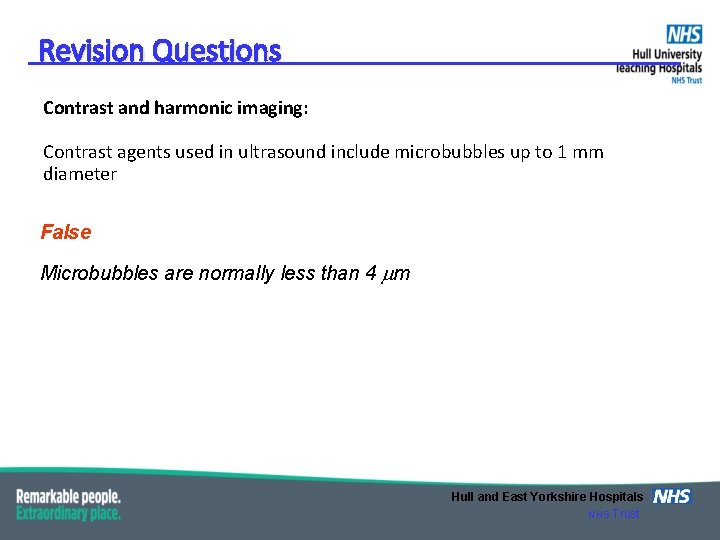
Revision Questions Contrast and harmonic imaging: Contrast agents used in ultrasound include microbubbles up to 1 mm diameter False Microbubbles are normally less than 4 m Hull and East Yorkshire Hospitals NHS Trust
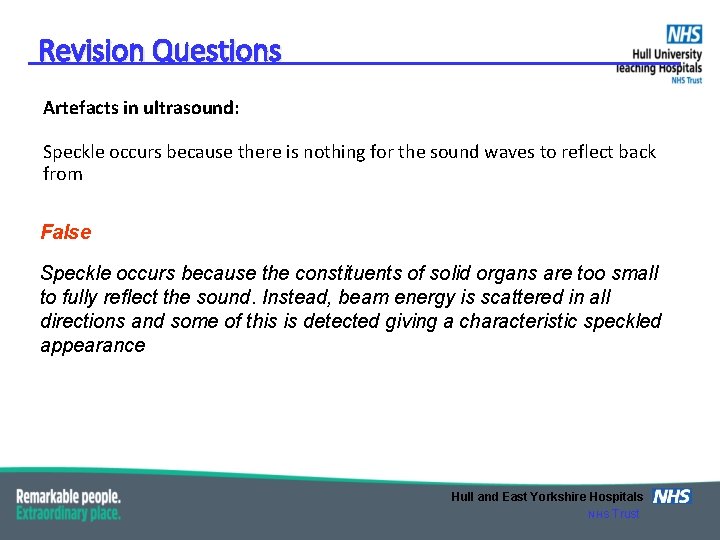
Revision Questions Artefacts in ultrasound: Speckle occurs because there is nothing for the sound waves to reflect back from False Speckle occurs because the constituents of solid organs are too small to fully reflect the sound. Instead, beam energy is scattered in all directions and some of this is detected giving a characteristic speckled appearance Hull and East Yorkshire Hospitals NHS Trust
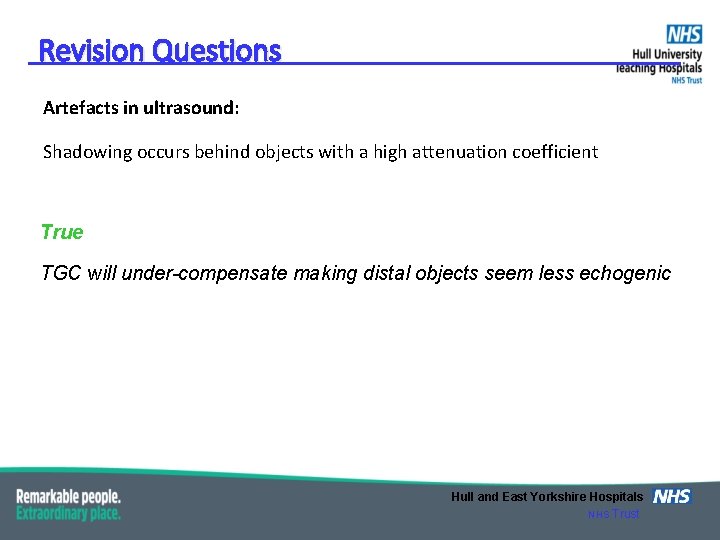
Revision Questions Artefacts in ultrasound: Shadowing occurs behind objects with a high attenuation coefficient True TGC will under-compensate making distal objects seem less echogenic Hull and East Yorkshire Hospitals NHS Trust
Revision Questions Artefacts in ultrasound: Fluid filled structures often cause acoustic enhancement True Fluid is weakly attenuating and thus allows the beam to pass through and a better signal to be received from objects on the far side Hull and East Yorkshire Hospitals NHS Trust
Revision Questions Artefacts in ultrasound: Refraction cause objects to appear in a different location True When ultrasound is transmitted across a tissue boundary it will undergo some refraction. Ultrasound scanners assume travel in straight lines. Hull and East Yorkshire Hospitals NHS Trust
Revision Questions Doppler ultrasound: The Doppler effect is the change in sound wave frequency caused by reflection from a moving surface True Reflection of an ultrasound wave from an object moving towards the wave effectively shortens the wavelength and increases the frequency. Reflection from an object moving away from the wave has the opposite effect Hull and East Yorkshire Hospitals NHS Trust
Revision Questions Doppler ultrasound: The Doppler effect is at a maximum when imaging blood vessels parallel to the beam True The Doppler shift is proportional to cosθ. At θ = 0 (parallel to beam) cosθ = 1 and the Doppler shift will be at a maximum. Hull and East Yorkshire Hospitals NHS Trust
Revision Questions Doppler ultrasound: Aliasing only occurs in continuous wave Doppler False Continuous wave Doppler does not use pulses and therefore the sampling rate is not limited by the pulse repetition frequency. Aliasing is only a concern for pulsed wave Doppler. Hull and East Yorkshire Hospitals NHS Trust
Revision Questions Doppler ultrasound: Range gating is used for depth localisation True If detected, Doppler shift could be occurring anywhere along the line of the ultrasound beam. Range gating means the detector will only accept signal in a short window of time corresponding to a specific depth. Hull and East Yorkshire Hospitals NHS Trust
Revision Questions Ultrasound Safety: Staff using ultrasound should be mindful of the ionising radiation regulations 1999 (IRR 99) False Ultrasound does not use ionising radiation and therefore, does not fall under IRR 99 There is no legislation relating to diagnostic ultrasound. However, the BMUS produce guidelines for safe use and good practice. Hull and East Yorkshire Hospitals NHS Trust
Revision Questions Ultrasound Safety: Thermal Index (TI) is the ratio of the power output divided by the power required to raise the temperature of the tissue by 1 o. C True Guidelines exist on maximum length scan times depending on TI and patient core temperature Hull and East Yorkshire Hospitals NHS Trust
Revision Questions Ultrasound Safety: A Mechanical Index (MI) >0. 7 indicates a potential risk of cavitation True This is a theoretical risk but 0. 7 is the figure published by BMUS The risk is considered to be greater if using contrast media Hull and East Yorkshire Hospitals NHS Trust
The End Hull and East Yorkshire Hospitals NHS Trust