
The Physics of Baseball orJust How Did Mc
The Physics of Baseball (or…Just How Did Mc. Gwire Hit 70? ) Alan M. Nathan University of Illinois February 5, 1999 l Introduction l Hitting the Baseball l The Flight of the Baseball l Pitching the Baseball l Summary Physics of Baseball: Page 1
REFERENCES l The Physics of Baseball, Robert K. Adair (Harper Collins, New York, 1990), ISBN 0 -06 -096461 -8 l The Sporting Life, Davis and Stephens (Henry Holt and Company, New York, 1997), ISBN 0 -8050 -4540 -6 l http: //www. exploratorium. edu/sports l ME! » a-nathan@uiuc. edu » www. npl. uiuc. edu/~nathan Physics of Baseball: Page 2
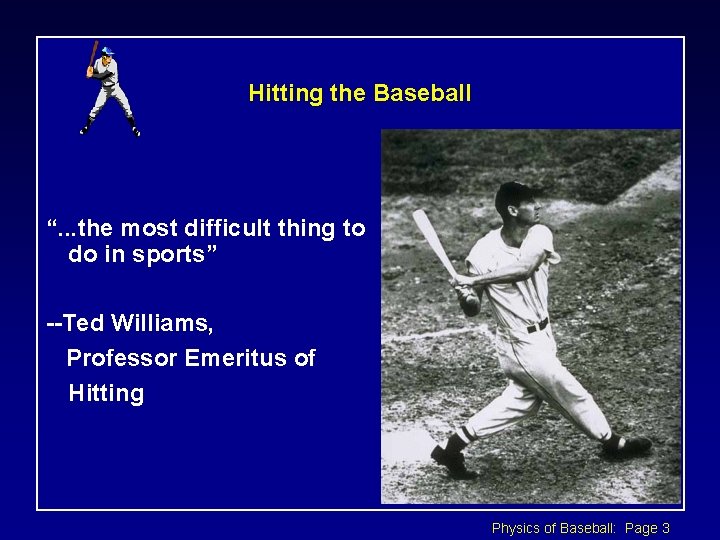
Hitting the Baseball “. . . the most difficult thing to do in sports” --Ted Williams, Professor Emeritus of Hitting Physics of Baseball: Page 3
Speed of Hit Ball: What does it depend on? l Speed is important: ç 105 mph gives 400 ft çeach mph is worth 5 ft l The basic stuff (“kinematics”) çspeed of pitched ball çspeed of bat çweight of bat l The really interesting stuff (“dynamics”) ç“bounciness” of ball and bat çweight distribution of bat çvibrations of bat Physics of Baseball: Page 4
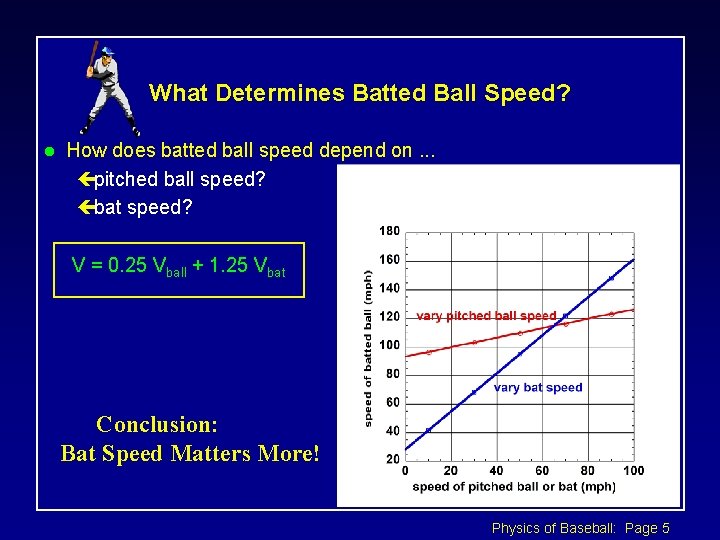
What Determines Batted Ball Speed? l How does batted ball speed depend on. . . çpitched ball speed? çbat speed? V = 0. 25 Vball + 1. 25 Vbat Conclusion: Bat Speed Matters More! Physics of Baseball: Page 5
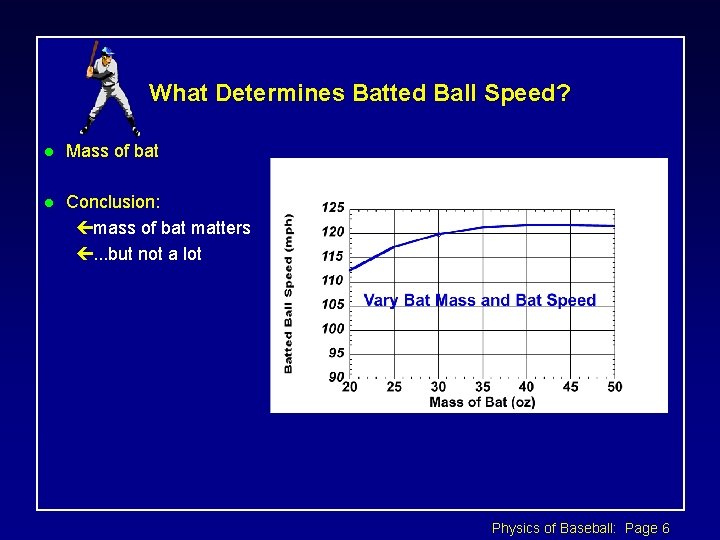
What Determines Batted Ball Speed? l Mass of bat l Conclusion: çmass of bat matters ç. . . but not a lot Physics of Baseball: Page 6

Dynamics of Ball-Bat Collision l Ball compresses çkinetic energy stored in “spring” l Ball expands çkinetic energy restored but. . . ç 70% of energy is lost! (heat, deformation, vibrations, . . . ) l Forces are large (>5000 lbs!) l Time is short (<1/1000 sec!) l The hands don’t matter! Physics of Baseball: Page 7
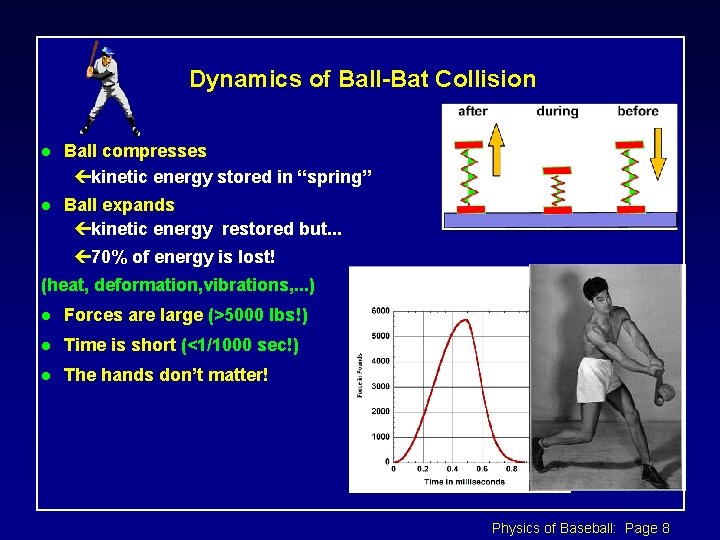
Dynamics of Ball-Bat Collision l Ball compresses çkinetic energy stored in “spring” l Ball expands çkinetic energy restored but. . . ç 70% of energy is lost! (heat, deformation, vibrations, . . . ) l Forces are large (>5000 lbs!) l Time is short (<1/1000 sec!) l The hands don’t matter! Physics of Baseball: Page 8
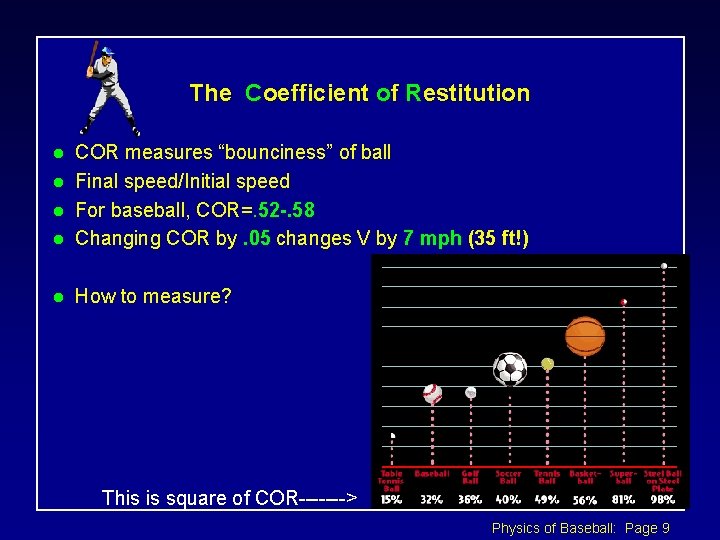
The Coefficient of Restitution l COR measures “bounciness” of ball Final speed/Initial speed For baseball, COR=. 52 -. 58 Changing COR by. 05 changes V by 7 mph (35 ft!) l How to measure? l l l This is square of COR-------> Physics of Baseball: Page 9
What About the Bat? (or, it takes two to tango!) l Wood Bat çEfficiently restores energy çBut only 2% energy stored çBat Performance Factor (BPF) ~1. 02 l Aluminum Bat çStores ~ 20% energy çEfficiently restores energy çResult: “trampoline effect” » BPF ~ 1. 2 » Ball flies off the bat! l A more efficient bat and/or ball Physics of Baseball: Page 10
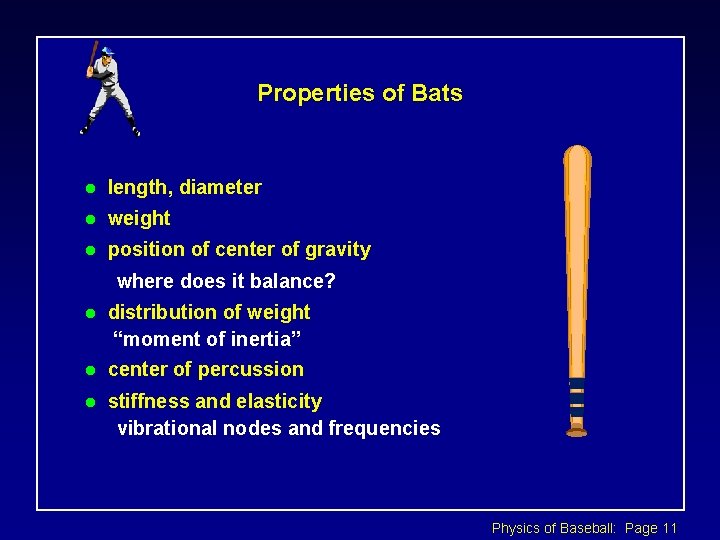
Properties of Bats l length, diameter l weight l position of center of gravity where does it balance? l distribution of weight “moment of inertia” l center of percussion l stiffness and elasticity vibrational nodes and frequencies Physics of Baseball: Page 11
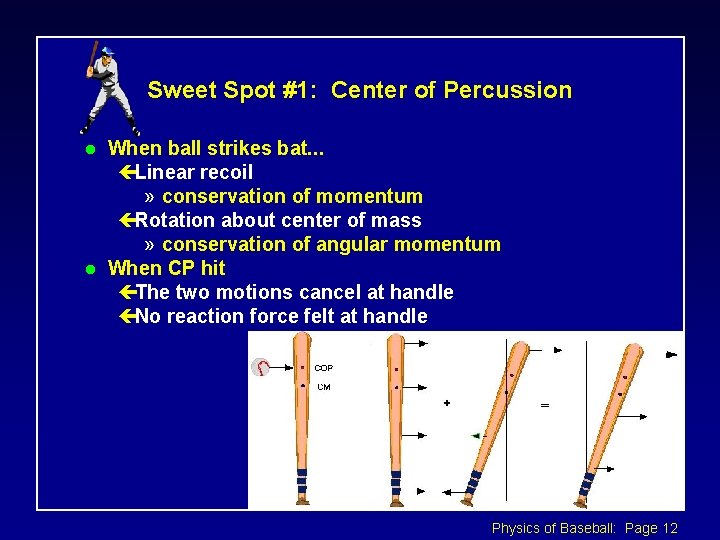
Sweet Spot #1: Center of Percussion l l When ball strikes bat. . . çLinear recoil » conservation of momentum çRotation about center of mass » conservation of angular momentum When CP hit çThe two motions cancel at handle çNo reaction force felt at handle Physics of Baseball: Page 12
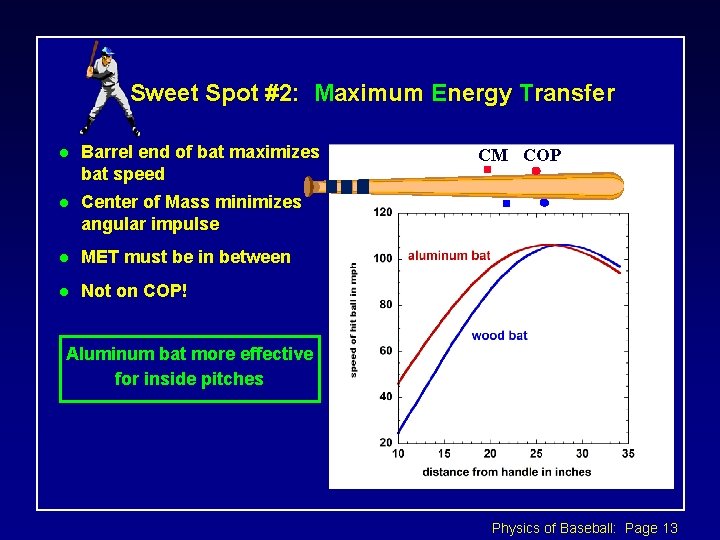
Sweet Spot #2: Maximum Energy Transfer l Barrel end of bat maximizes bat speed l Center of Mass minimizes angular impulse l MET must be in between l Not on COP! CM COP Aluminum bat more effective for inside pitches Physics of Baseball: Page 13
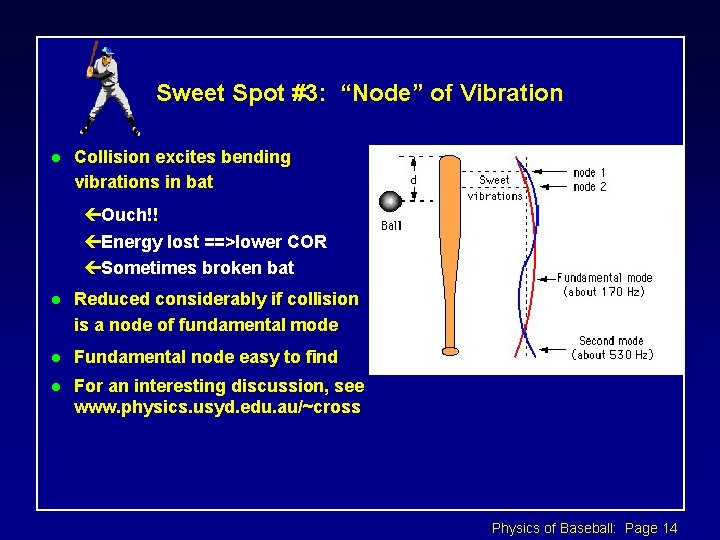
Sweet Spot #3: “Node” of Vibration l Collision excites bending vibrations in bat çOuch!! çEnergy lost ==>lower COR çSometimes broken bat l Reduced considerably if collision is a node of fundamental mode l Fundamental node easy to find l For an interesting discussion, see www. physics. usyd. edu. au/~cross Physics of Baseball: Page 14
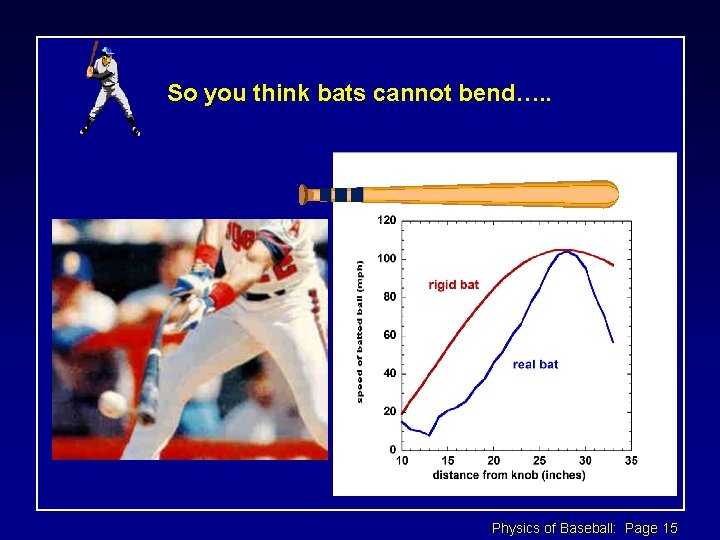
So you think bats cannot bend…. . Physics of Baseball: Page 15
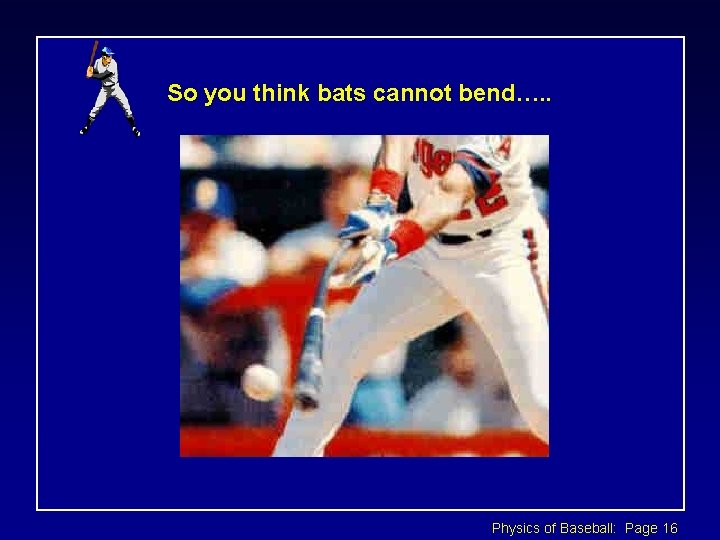
So you think bats cannot bend…. . Physics of Baseball: Page 16
How Would a Physicist Design a Bat? l Wood Bat çalready optimally designed » highly constrained by rules! ça marvel of evolution! l Aluminum Bat çlots of possibilities exist çbut not much scientific research ça great opportunity for. . . » fame » fortune Physics of Baseball: Page 17
Advantages of Aluminum l Length and weight “decoupled” çCan adjust shell thickness l More compressible => “springier” çTrampoline effect l More of weight closer to hands çEasier to swing çLess rotational energy transferred to bat çMore forgiving on inside pitches l Stiffer for bending çLess energy lost due to vibrations Physics of Baseball: Page 18
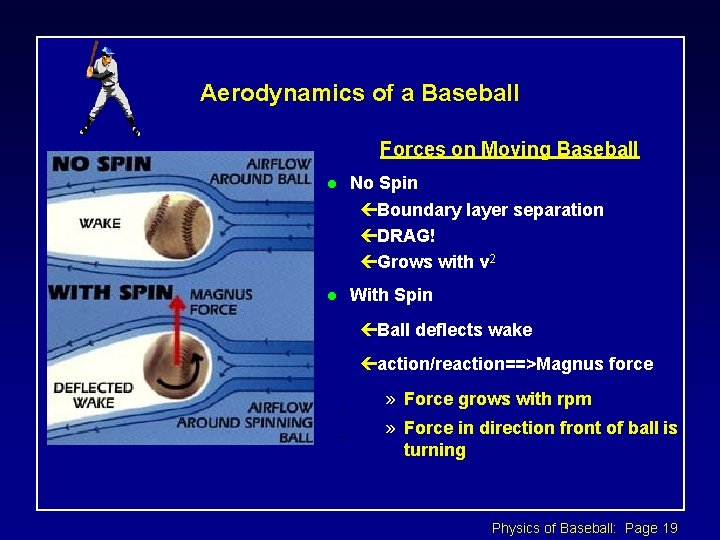
Aerodynamics of a Baseball Forces on Moving Baseball l No Spin çBoundary layer separation çDRAG! çGrows with v 2 l With Spin çBall deflects wake çaction/reaction==>Magnus force » Force grows with rpm » Force in direction front of ball is turning Physics of Baseball: Page 19
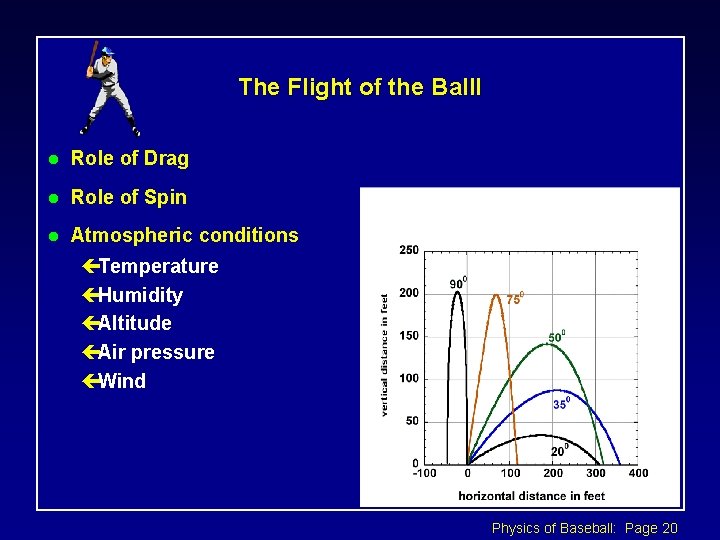
The Flight of the Balll l Role of Drag l Role of Spin l Atmospheric conditions çTemperature çHumidity çAltitude çAir pressure çWind Physics of Baseball: Page 20
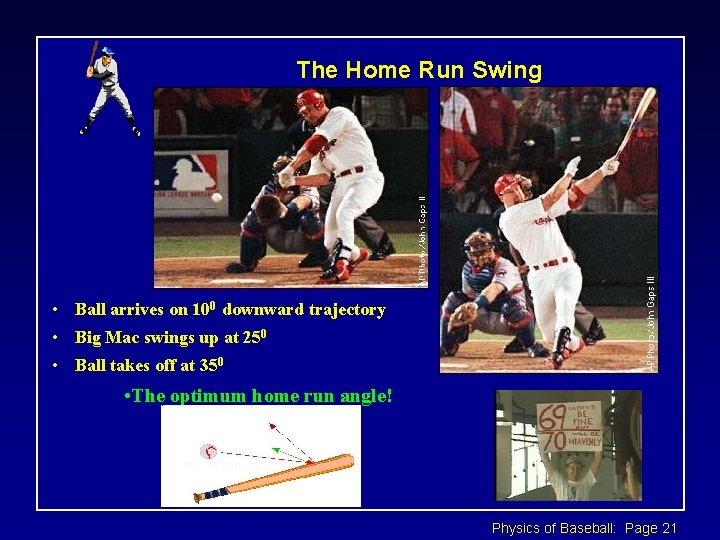
The Home Run Swing • Ball arrives on 100 downward trajectory • Big Mac swings up at 250 • Ball takes off at 350 • The optimum home run angle! Physics of Baseball: Page 21
Physics of Baseball: Page 22
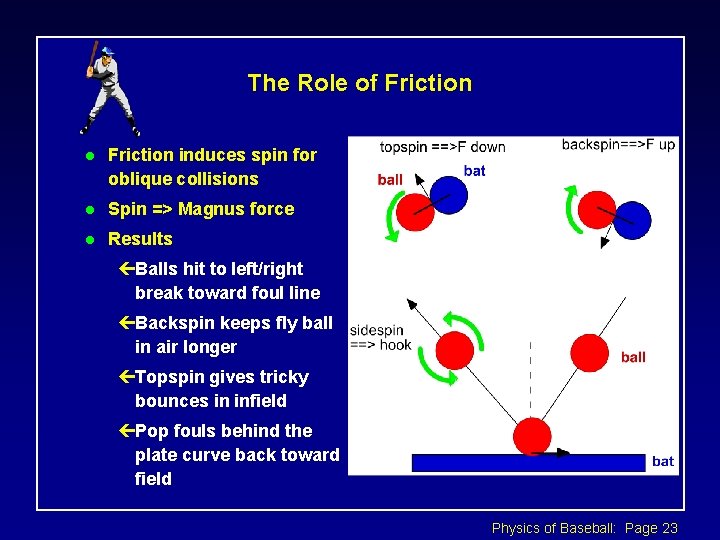
The Role of Friction l Friction induces spin for oblique collisions l Spin => Magnus force l Results çBalls hit to left/right break toward foul line çBackspin keeps fly ball in air longer çTopspin gives tricky bounces in infield çPop fouls behind the plate curve back toward field Physics of Baseball: Page 23
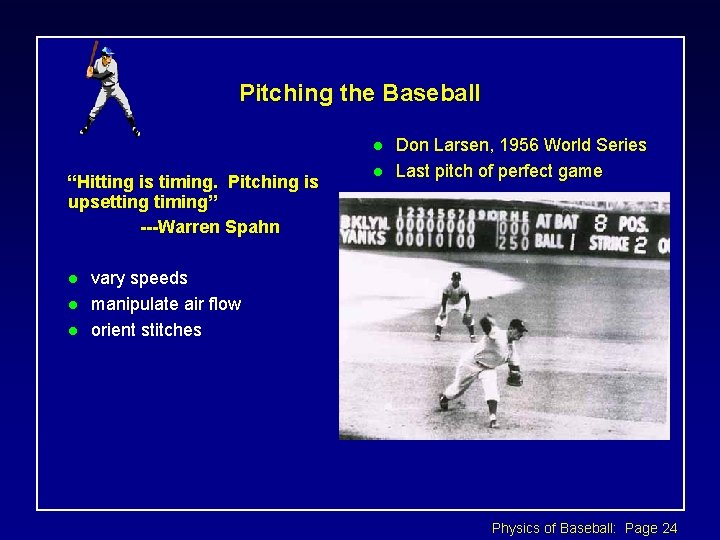
Pitching the Baseball l “Hitting is timing. Pitching is upsetting timing” ---Warren Spahn l l Don Larsen, 1956 World Series Last pitch of perfect game vary speeds manipulate air flow orient stitches Physics of Baseball: Page 24
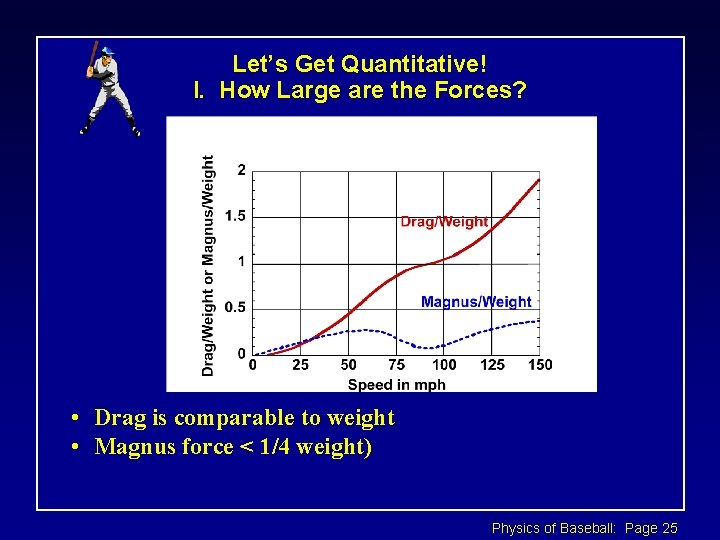
Let’s Get Quantitative! I. How Large are the Forces? • Drag is comparable to weight • Magnus force < 1/4 weight) Physics of Baseball: Page 25
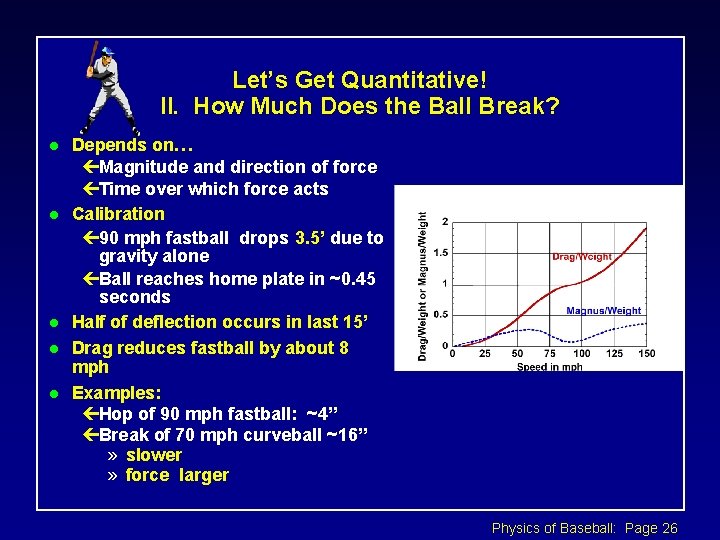
Let’s Get Quantitative! II. How Much Does the Ball Break? l l l Depends on… çMagnitude and direction of force çTime over which force acts Calibration ç 90 mph fastball drops 3. 5’ due to gravity alone çBall reaches home plate in ~0. 45 seconds Half of deflection occurs in last 15’ Drag reduces fastball by about 8 mph Examples: çHop of 90 mph fastball: ~4” çBreak of 70 mph curveball ~16” » slower » force larger Physics of Baseball: Page 26
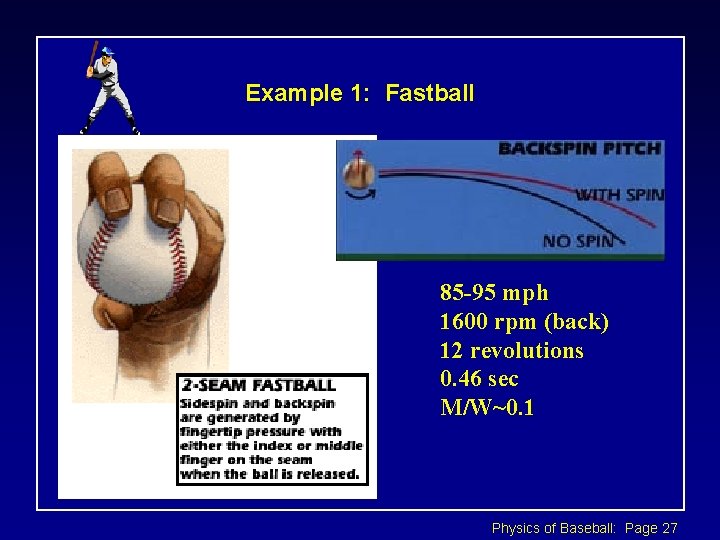
Example 1: Fastball 85 -95 mph 1600 rpm (back) 12 revolutions 0. 46 sec M/W~0. 1 Physics of Baseball: Page 27
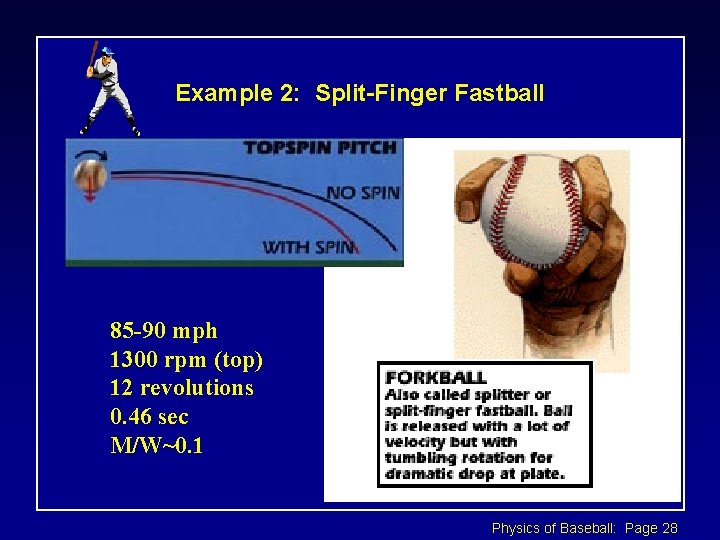
Example 2: Split-Finger Fastball 85 -90 mph 1300 rpm (top) 12 revolutions 0. 46 sec M/W~0. 1 Physics of Baseball: Page 28
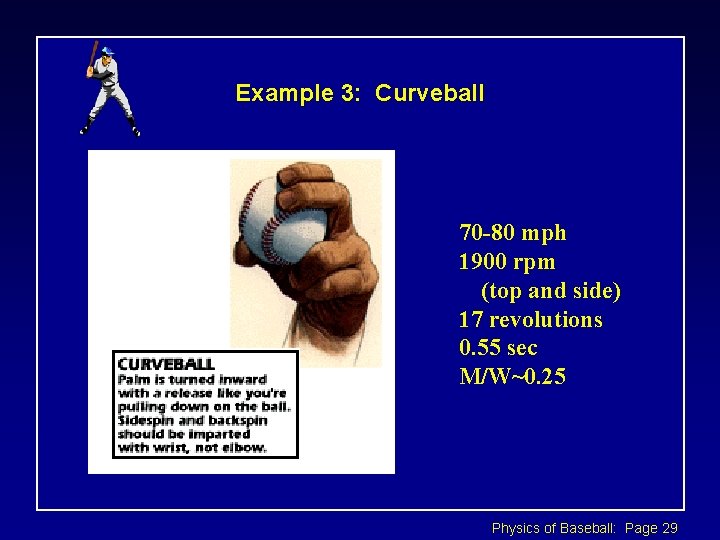
Example 3: Curveball 70 -80 mph 1900 rpm (top and side) 17 revolutions 0. 55 sec M/W~0. 25 Physics of Baseball: Page 29
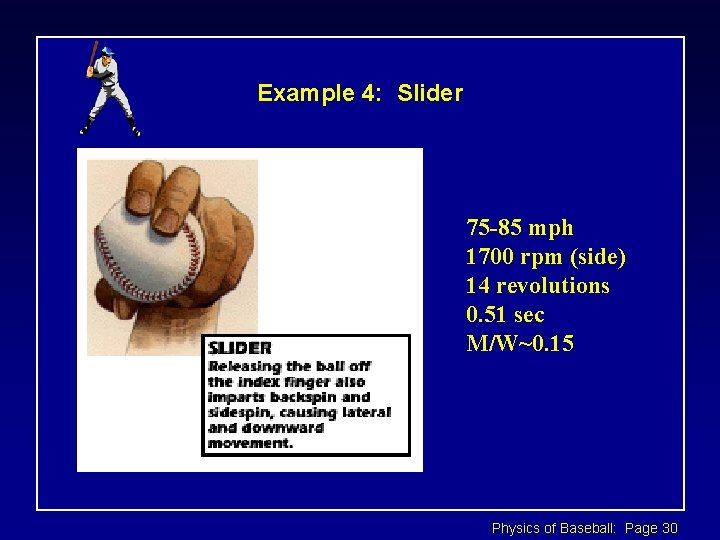
Example 4: Slider 75 -85 mph 1700 rpm (side) 14 revolutions 0. 51 sec M/W~0. 15 Physics of Baseball: Page 30
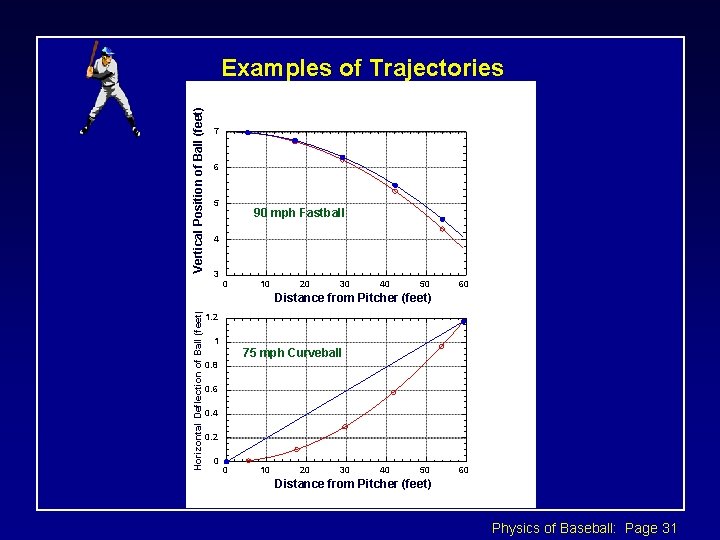
Vertical Position of Ball (feet) Examples of Trajectories 7 6 5 90 mph Fastball 4 3 0 10 20 30 40 50 60 Horizontal Deflection of Ball (feet) Distance from Pitcher (feet) 1. 2 1 75 mph Curveball 0. 8 0. 6 0. 4 0. 2 0 0 10 20 30 40 50 60 Distance from Pitcher (feet) Physics of Baseball: Page 31
Effect of the Stitches l Obstructions cause turbulance l Turbulance reduces drag çDimples on golf ball çStitches on baseball l Asymmetric obstructions çKnuckleball çTwo-seam vs. four-seam delivery çScuffball and “juiced” ball Physics of Baseball: Page 32
Summary l Much of baseball can be understood with basic principles of physics çConservation of momentum, angular momentum, energy çDynamics of collisions çTrajectories under influence of forces » gravity, drag, Magnus, …. l There is probably much more that we don’t understand l Don’t let either of these interfere with your enjoyment of the game! Physics of Baseball: Page 33
- Slides: 33