
The Physical Processes Where does the sand come


- Slides: 5
The Physical Processes
Where does the sand come from? • Plants growing at the back of the beach, together with flotsam and jetsam dropped at the high tide mark, cause the wind speed to drop locally. • Sand being carried by the wind drops out at these points and begins to build small sand piles. This now forms another more substantial wind break, which encourages more and more sand to be deposited. The sand dune is beginning to build. • Depending on wind speed, the dune will either gradually move inland (high wind speeds), or it will remain static. If there is a good supply of sand, new dunes may form to seaward.
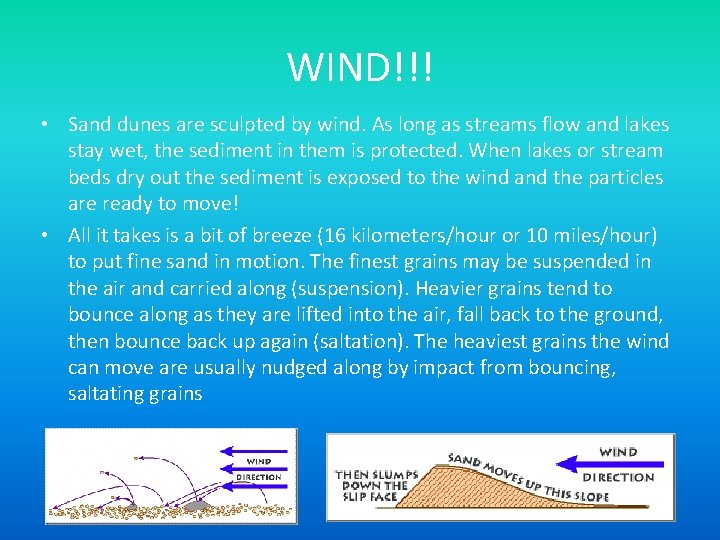
WIND!!! • Sand dunes are sculpted by wind. As long as streams flow and lakes stay wet, the sediment in them is protected. When lakes or stream beds dry out the sediment is exposed to the wind and the particles are ready to move! • All it takes is a bit of breeze (16 kilometers/hour or 10 miles/hour) to put fine sand in motion. The finest grains may be suspended in the air and carried along (suspension). Heavier grains tend to bounce along as they are lifted into the air, fall back to the ground, then bounce back up again (saltation). The heaviest grains the wind can move are usually nudged along by impact from bouncing, saltating grains
What’s the best beach? ! • A Desert: All a sand dune needs is an obstacle like a bush, rock to start forming. In some cases an abandoned car where wind can deposit sand would do. It also needs-of course--lots of sand particles carried in the air around it to get its material from. When wind hits the obstacle and goes from both sides around it, it finds a spot behind the object (leeward) where speed of wind comes down to zero. The wind then drops any sand it was carrying at this leeward side of the obstacle. Now after some short time, the obstacle is completely covered with sand a small and a nice dune is formed. This little dune itself becomes the obstacle and keeps growing and take one of the forms that all dunes must take like Seif (linear) or Barchan (crescent) for example.
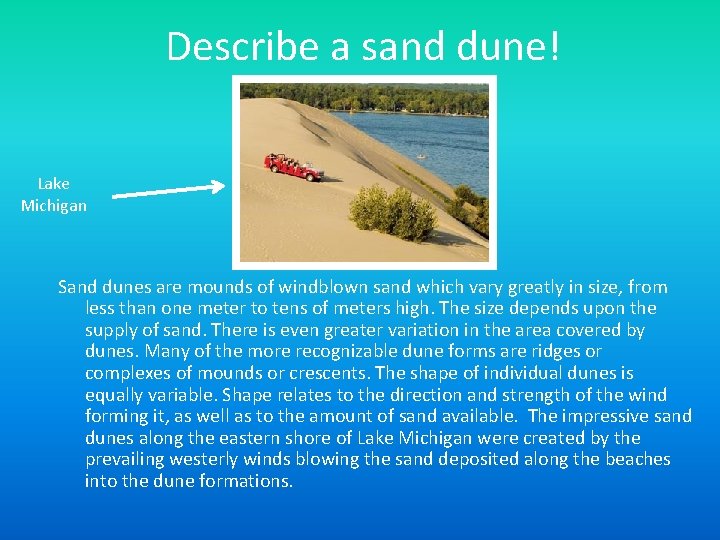
Describe a sand dune! Lake Michigan Sand dunes are mounds of windblown sand which vary greatly in size, from less than one meter to tens of meters high. The size depends upon the supply of sand. There is even greater variation in the area covered by dunes. Many of the more recognizable dune forms are ridges or complexes of mounds or crescents. The shape of individual dunes is equally variable. Shape relates to the direction and strength of the wind forming it, as well as to the amount of sand available. The impressive sand dunes along the eastern shore of Lake Michigan were created by the prevailing westerly winds blowing the sand deposited along the beaches into the dune formations.