
The Phosphorylation Potential Determination and Uses in Disease
![Free Intracellular [Mg 2+] ranges from 0. 2 to 1. 5 m. M and](https://slidetodoc.com/presentation_image_h2/58efc6b3f8e2bb2925a9f996ff5924e7/image-4.jpg "Free Intracellular [Mg 2+] ranges from 0. 2 to 1. 5 m. M and")
![The variation of K’GG-(TPI+LDH) with p. H and free [Mg 2+].](https://slidetodoc.com/presentation_image_h2/58efc6b3f8e2bb2925a9f996ff5924e7/image-5.jpg "The variation of K’GG-(TPI+LDH) with p. H and free [Mg 2+].")
![The Ratio of Free [Co. Q]/[Co. QH 2] Can Be Calculated from the [fumarate]/[succinate]](https://slidetodoc.com/presentation_image_h2/58efc6b3f8e2bb2925a9f996ff5924e7/image-8.jpg "The Ratio of Free [Co. Q]/[Co. QH 2] Can Be Calculated from the [fumarate]/[succinate]")
- Slides: 20
The Phosphorylation Potential Determination and Uses in Disease Richard L Veech, MD DPhil Lab of Metabolic Control, NIH
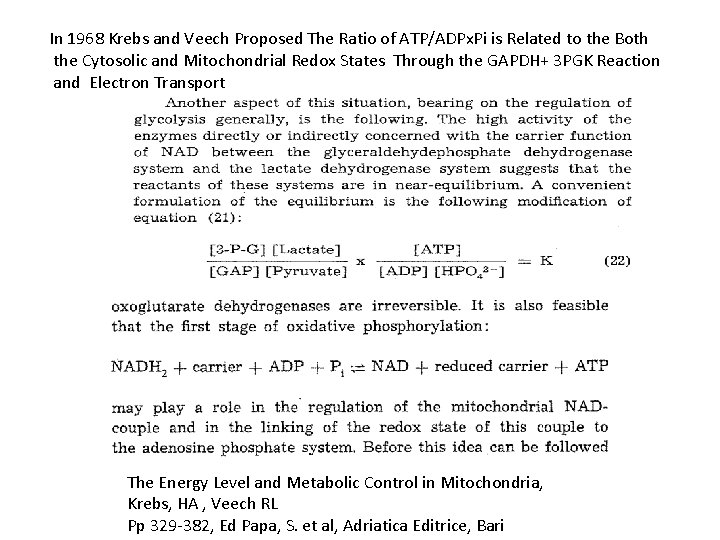
In 1968 Krebs and Veech Proposed The Ratio of ATP/ADPx. Pi is Related to the Both the Cytosolic and Mitochondrial Redox States Through the GAPDH+ 3 PGK Reaction and Electron Transport The Energy Level and Metabolic Control in Mitochondria, Krebs, HA , Veech RL Pp 329 -382, Ed Papa, S. et al, Adriatica Editrice, Bari
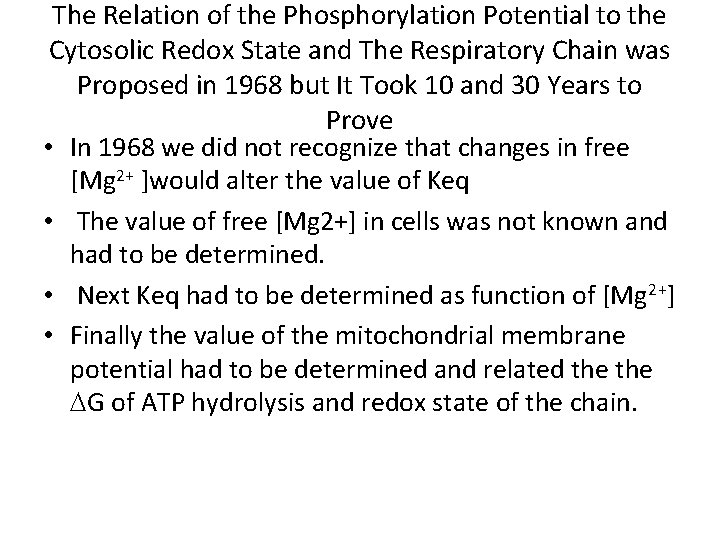
The Relation of the Phosphorylation Potential to the Cytosolic Redox State and The Respiratory Chain was Proposed in 1968 but It Took 10 and 30 Years to Prove • In 1968 we did not recognize that changes in free [Mg 2+ ]would alter the value of Keq • The value of free [Mg 2+] in cells was not known and had to be determined. • Next Keq had to be determined as function of [Mg 2+] • Finally the value of the mitochondrial membrane potential had to be determined and related the DG of ATP hydrolysis and redox state of the chain.
Free Intracellular [Mg 2+] ranges from 0. 2 to 1. 5 m. M and is Reflected by the [Citrate]/[Isocitrate] Ratio
The variation of K’GG-(TPI+LDH) with p. H and free [Mg 2+].
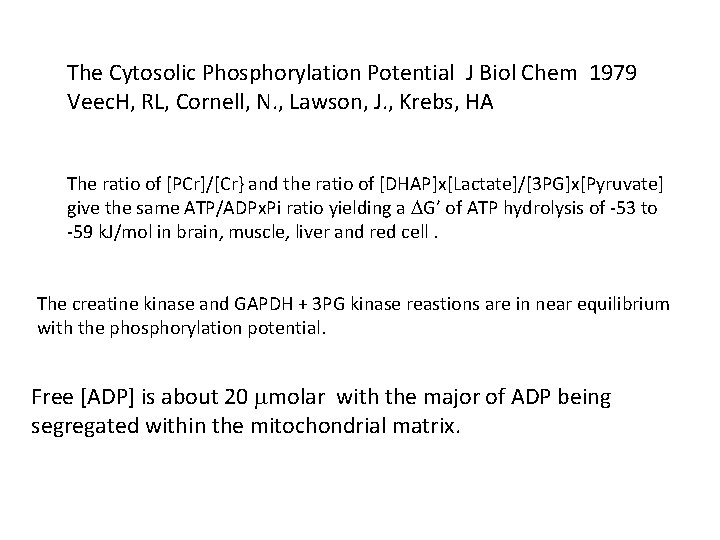
The Cytosolic Phosphorylation Potential J Biol Chem 1979 Veec. H, RL, Cornell, N. , Lawson, J. , Krebs, HA The ratio of [PCr]/[Cr} and the ratio of [DHAP]x[Lactate]/[3 PG]x[Pyruvate] give the same ATP/ADPx. Pi ratio yielding a DG’ of ATP hydrolysis of -53 to -59 k. J/mol in brain, muscle, liver and red cell. The creatine kinase and GAPDH + 3 PG kinase reastions are in near equilibrium with the phosphorylation potential. Free [ADP] is about 20 mmolar with the major of ADP being segregated within the mitochondrial matrix.
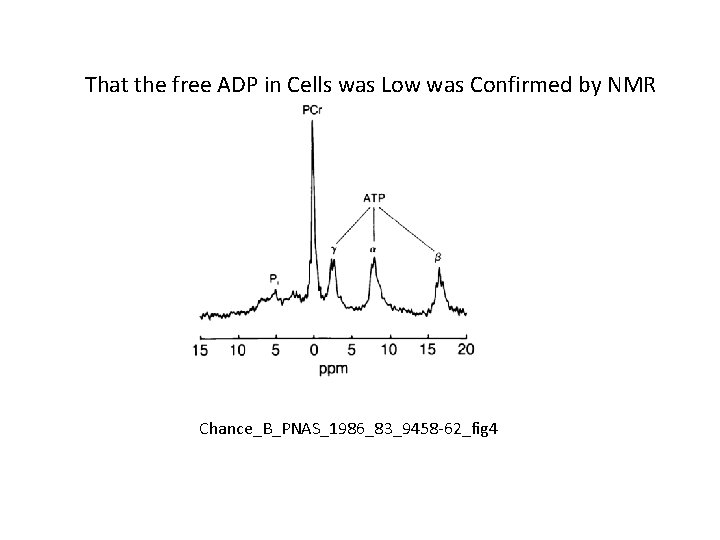
That the free ADP in Cells was Low was Confirmed by NMR Chance_B_PNAS_1986_83_9458 -62_fig 4
The Ratio of Free [Co. Q]/[Co. QH 2] Can Be Calculated from the [fumarate]/[succinate] Ratio And with that the DG ATP between site I and II Bergman C. et al, JPhys. Chem. B 114: 16137, 2010 Sato K. et al, FASEB J 9: 651, , 1995
In Perfused Heart, Ketone Metabolism Increased DG ATP and Mimicked Insulin FASEB J 9: 651 -8, 1995
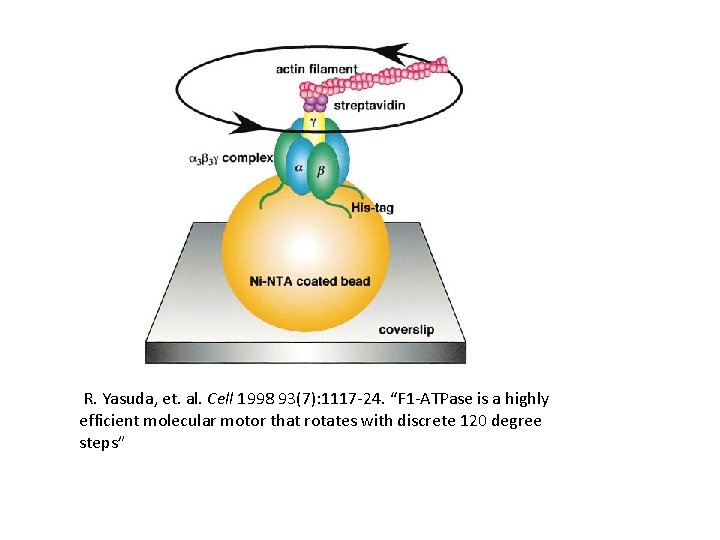
R. Yasuda, et. al. Cell 1998 93(7): 1117 -24. “F 1 -ATPase is a highly efficient molecular motor that rotates with discrete 120 degree steps”
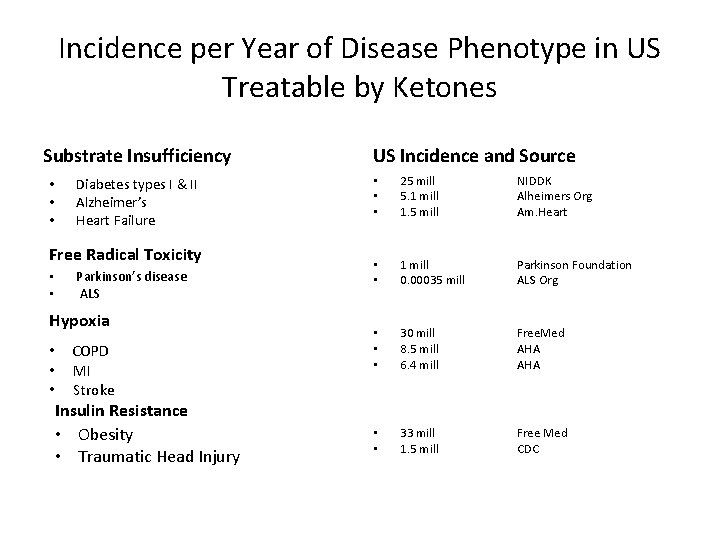
Incidence per Year of Disease Phenotype in US Treatable by Ketones Substrate Insufficiency • • • Diabetes types I & II Alzheimer’s Heart Failure Free Radical Toxicity • • Parkinson’s disease ALS Hypoxia • COPD • • MI Stroke Insulin Resistance • Obesity • Traumatic Head Injury US Incidence and Source • • • 25 mill 5. 1 mill 1. 5 mill NIDDK Alheimers Org Am. Heart • • 1 mill 0. 00035 mill Parkinson Foundation ALS Org • • • 30 mill 8. 5 mill 6. 4 mill Free. Med AHA • • 33 mill 1. 5 mill Free Med CDC
IP Injection of Short Chain Fatty Acids to Starved Rats Increases Ca. Mg. PPi in Liver Mitochondria • Injecting 2 ml of 2 M salts of short chain fatty acids in starved animals increases vasopressin and increased Ca. Mg PPi to about 4 mmole/g which was NMR invisible. The increase in Ca. Mg. PPi was accompanied by a drop in the [ATP]/[ADP][Pi] and the DG’ of ATP. Veech RL et al, Adv. Exp. Biol. Med 1986, 194: 617 -46 • The metabolism of acetate in rat brain decreases the DG’ of ATP in rat brain Pawlosky, R. et al, Alc. Clin. Exp. Res 2010, 34: 1 -7 • The metabolism of D-b-hydroxybutyrate in rat brain increases the DG’ of ATP. Kashiwaya Y. et al, JBiol. Chem 2010, 285: 25950 -6.
Traumatic Brain Injury Afflicates 1. 5 million Americans per Year and Accounts for 20% of Troop Casualties • Brain Damage in Traumatic brain injury can be Limited by administration of Cyclosporin which closes the mitochondrial permiability transition pore. Buki A. J Neurotrauma 1999, 16: 511 -21 Crompton, M. Biochem J. 1999, 341: (pt 2) 233 -49 • But cyclosporin A also causes impaired immune function, limiting its therapeutic use.
Traumatic Brain Injury is Associated with A Low Brain DG of ATP • TBI is associated with a decrease in brain O 2 consumption, increased brain [Lactate]/[pyruvate] and increase brain [creatine], all indicative of a decrease in DG ATP Casey, PA et al, J Neurotrauma 2008, 25: 603 -14 • TBI is associated with a decrease in pyruvate dehydrogenase activity Sharma, P, J Emerg Trauma Shock, 2009, 2: 67 -72
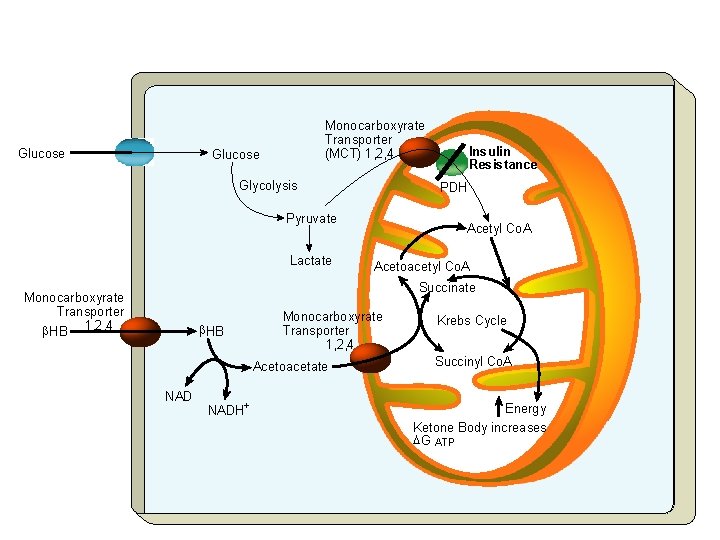
Ketogenic Diets Can Treat TBI and Increase DG of ATP • A ketogenic diet limits brain damage after TBI Prins, ML. J Cereb. Bld. Flow. Metab 2008 28: 1 -16 • Metabolism of ketone bodies can by pass the block in PDH and increase DG of ATP Sato K. FASEB J 1995 9: 651 -8
Glucose Monocarboxyrate Transporter (MCT) 1, 2, 4 Glucose Glycolysis PDH Pyruvate Lactate Insulin Resistance Acetyl Co. A Acetoacetyl Co. A Succinate Monocarboxyrate Transporter b. HB 1, 2, 4 b. HB Monocarboxyrate Transporter 1, 2, 4 Acetoacetate NADH+ Krebs Cycle Succinyl Co. A Energy Ketone Body increases DG ATP
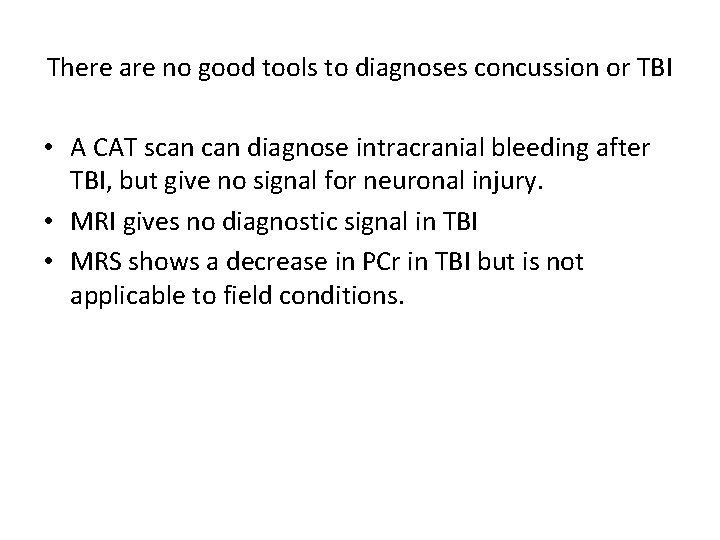
There are no good tools to diagnoses concussion or TBI • A CAT scan diagnose intracranial bleeding after TBI, but give no signal for neuronal injury. • MRI gives no diagnostic signal in TBI • MRS shows a decrease in PCr in TBI but is not applicable to field conditions.
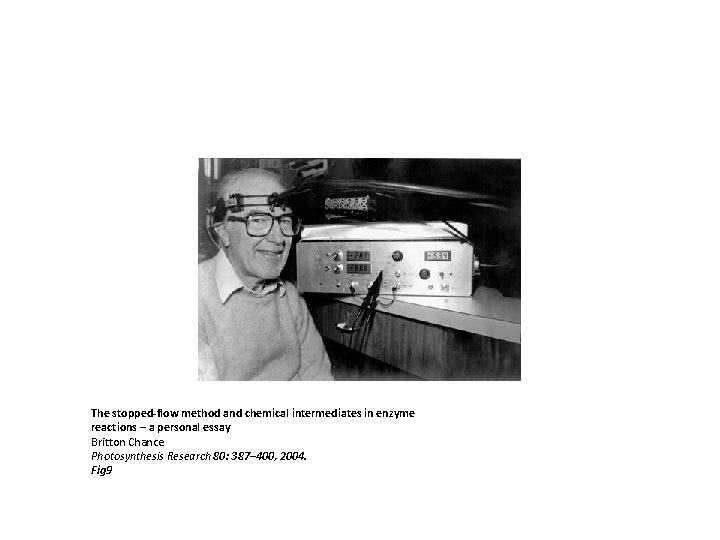
The stopped-flow method and chemical intermediates in enzyme reactions – a personal essay Britton Chance Photosynthesis Research 80: 387– 400, 2004. Fig 9
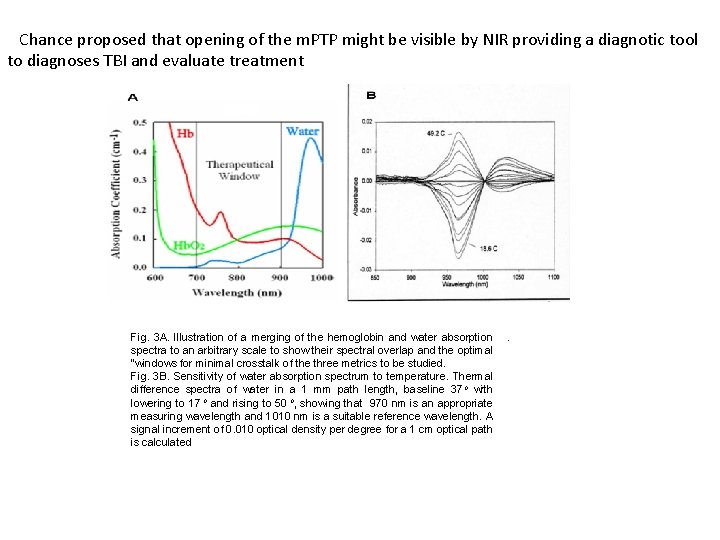
Chance proposed that opening of the m. PTP might be visible by NIR providing a diagnotic tool to diagnoses TBI and evaluate treatment Fig. 3 A. Illustration of a merging of the hemoglobin and water absorption spectra to an arbitrary scale to show their spectral overlap and the optimal “windows for minimal crosstalk of the three metrics to be studied. Fig. 3 B. Sensitivity of water absorption spectrum to temperature. Thermal difference spectra of water in a 1 mm path length, baseline 37 o with lowering to 17 o and rising to 50 o, showing that 970 nm is an appropriate measuring wavelength and 1010 nm is a suitable reference wavelength. A signal increment of 0. 010 optical density per degree for a 1 cm optical path is calculated .
The stopped-flow method and chemical intermediates in enzyme reactions – a personal essay Britton Chance Photosynthesis Research 80: 387– 400, 2004. Fig 9