
The Phoenix Mars Landing An Initial Look Presented
- Slides: 22
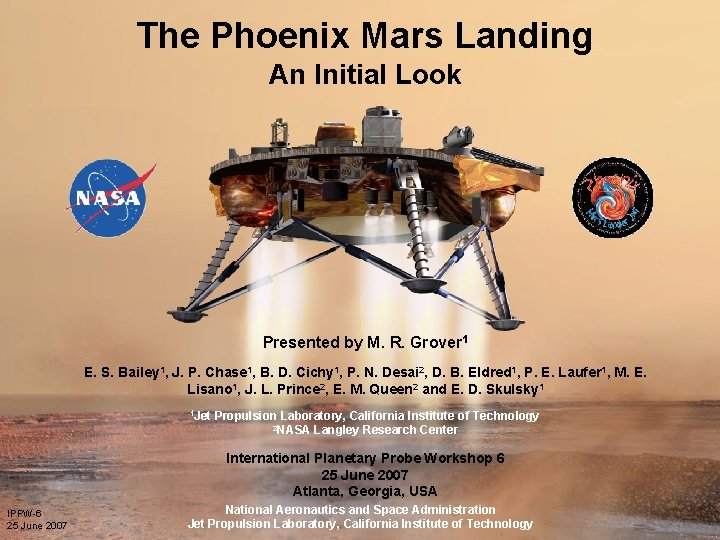
The Phoenix Mars Landing An Initial Look Presented by M. R. Grover 1 E. S. Bailey 1, J. P. Chase 1, B. D. Cichy 1, P. N. Desai 2, D. B. Eldred 1, P. E. Laufer 1, M. E. Lisano 1, J. L. Prince 2, E. M. Queen 2 and E. D. Skulsky 1 1 Jet Propulsion Laboratory, California Institute of Technology 2 NASA Langley Research Center International Planetary Probe Workshop 6 25 June 2007 Atlanta, Georgia, USA IPPW-6 25 June 2007 National Aeronautics and Space Administration Jet Propulsion Laboratory, California Institute of Technology
Acknowledgements Special Acknowledgement: Lockheed Martin Phoenix Entry Descent & Landing Team T. D. Gasparrini B. R. Haack M. A. Johnson T. M. Linn T. A. Priser J. A. St. Pierre And the entire Lockheed Martin Phoenix Team IPPW-6 25 June 2007
Landing Analysis Maturity The contents of this presentation represents present understanding of the Phoenix landing. A rigorous analysis of the Phoenix landing is currently underway and a more complete and thorough assessment will be available in coming months. IPPW-6 25 June 2007
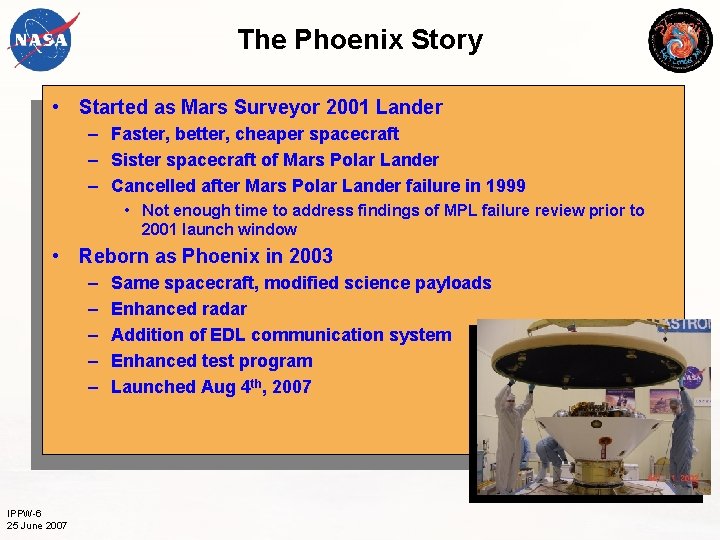
The Phoenix Story • Started as Mars Surveyor 2001 Lander – Faster, better, cheaper spacecraft – Sister spacecraft of Mars Polar Lander – Cancelled after Mars Polar Lander failure in 1999 • Not enough time to address findings of MPL failure review prior to 2001 launch window • Reborn as Phoenix in 2003 – – – IPPW-6 25 June 2007 Same spacecraft, modified science payloads Enhanced radar Addition of EDL communication system Enhanced test program Launched Aug 4 th, 2007
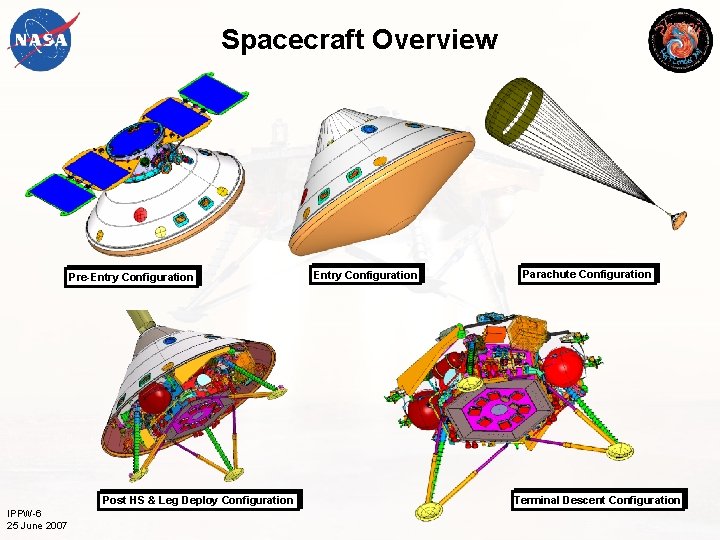
Spacecraft Overview Pre-Entry Configuration Post HS & Leg Deploy Configuration IPPW-6 25 June 2007 Entry Configuration Parachute Configuration Terminal Descent Configuration
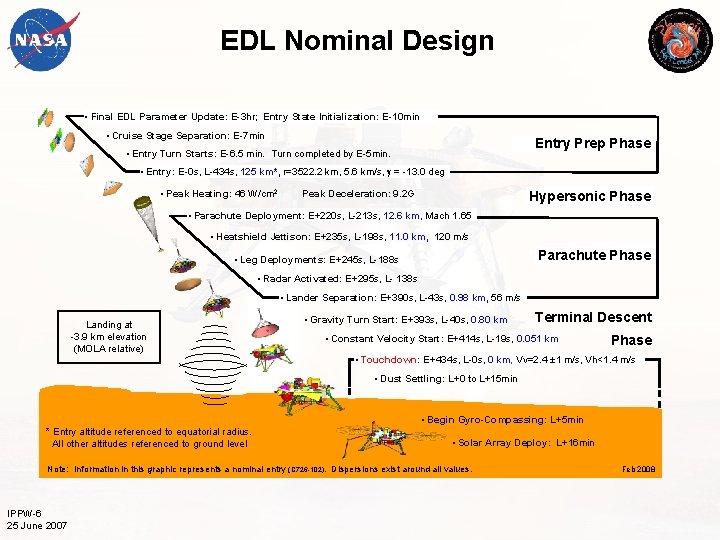
EDL Nominal Design • Final EDL Parameter Update: E-3 hr; Entry State Initialization: E-10 min • Cruise Stage Separation: E-7 min Entry Prep Phase • Entry Turn Starts: E-6. 5 min. Turn completed by E-5 min. • Entry: E-0 s, L-434 s, 125 km*, r=3522. 2 km, 5. 6 km/s, g = -13. 0 deg • Peak Heating: 46 W/cm 2 Peak Deceleration: 9. 2 G Hypersonic Phase • Parachute Deployment: E+220 s, L-213 s, 12. 6 km, Mach 1. 65 • Heatshield Jettison: E+235 s, L-198 s, 11. 0 km, 120 m/s Parachute Phase • Leg Deployments: E+245 s, L-188 s • Radar Activated: E+295 s, L- 138 s • Lander Separation: E+390 s, L-43 s, 0. 98 km, 56 m/s Landing at -3. 9 km elevation (MOLA relative) • Gravity Turn Start: E+393 s, L-40 s, 0. 80 km Terminal Descent • Constant Velocity Start: E+414 s, L-19 s, 0. 051 km Phase • Touchdown: E+434 s, L-0 s, 0 km, Vv=2. 4 ± 1 m/s, Vh<1. 4 m/s • Dust Settling: L+0 to L+15 min • Begin Gyro-Compassing: L+5 min * Entry altitude referenced to equatorial radius. All other altitudes referenced to ground level • Solar Array Deploy: L+16 min Note: Information in this graphic represents a nominal entry (C 726 -102). Dispersions exist around all values. IPPW-6 25 June 2007 Feb 2008
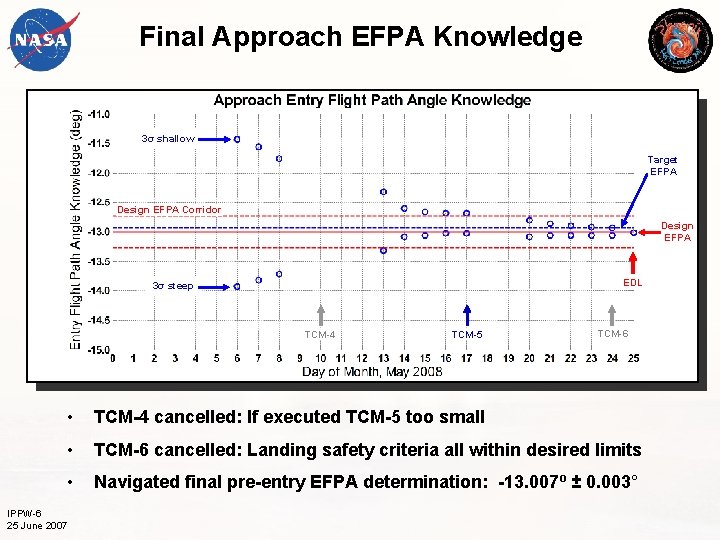
Final Approach EFPA Knowledge 3σ shallow Target EFPA Design EFPA Corridor Design EFPA EDL 3σ steep TCM-4 TCM-5 TCM-6 • TCM-4 cancelled: If executed TCM-5 too small • TCM-6 cancelled: Landing safety criteria all within desired limits • Navigated final pre-entry EFPA determination: -13. 007º ± 0. 003° IPPW-6 25 June 2007
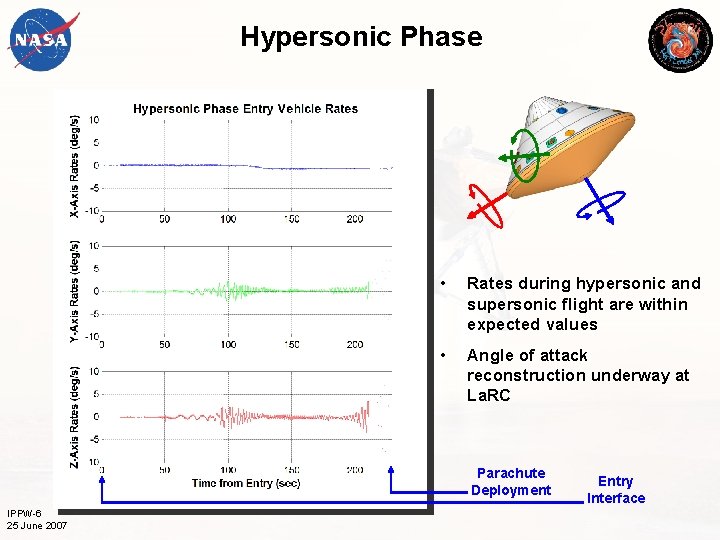
Hypersonic Phase • Rates during hypersonic and supersonic flight are within expected values • Angle of attack reconstruction underway at La. RC Parachute Deployment IPPW-6 25 June 2007 Entry Interface
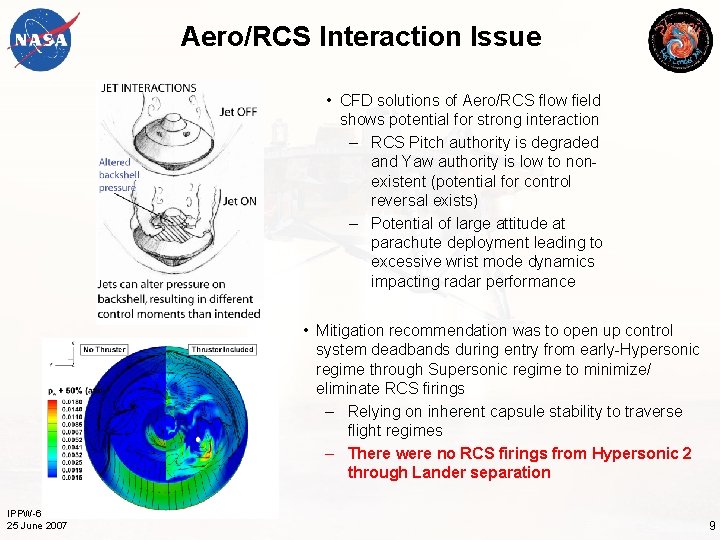
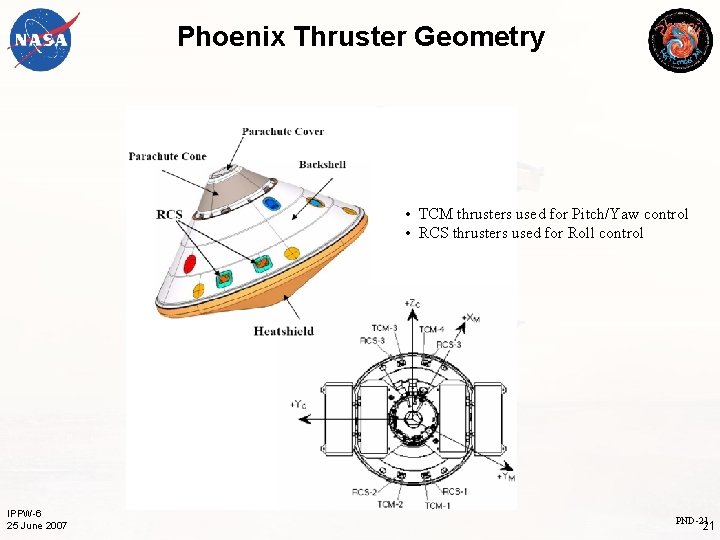
Aero/RCS Interaction Issue • CFD solutions of Aero/RCS flow field shows potential for strong interaction – RCS Pitch authority is degraded and Yaw authority is low to nonexistent (potential for control reversal exists) – Potential of large attitude at parachute deployment leading to excessive wrist mode dynamics impacting radar performance • Mitigation recommendation was to open up control system deadbands during entry from early-Hypersonic regime through Supersonic regime to minimize/ eliminate RCS firings – Relying on inherent capsule stability to traverse flight regimes – There were no RCS firings from Hypersonic 2 through Lander separation IPPW-6 25 June 2007 9
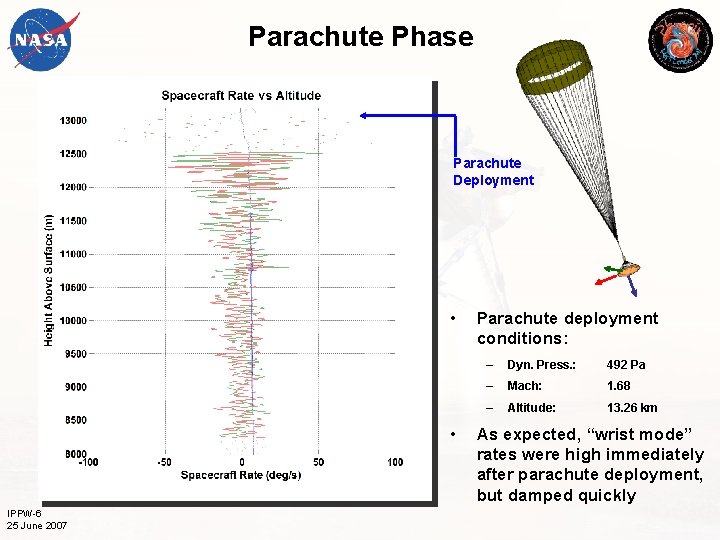
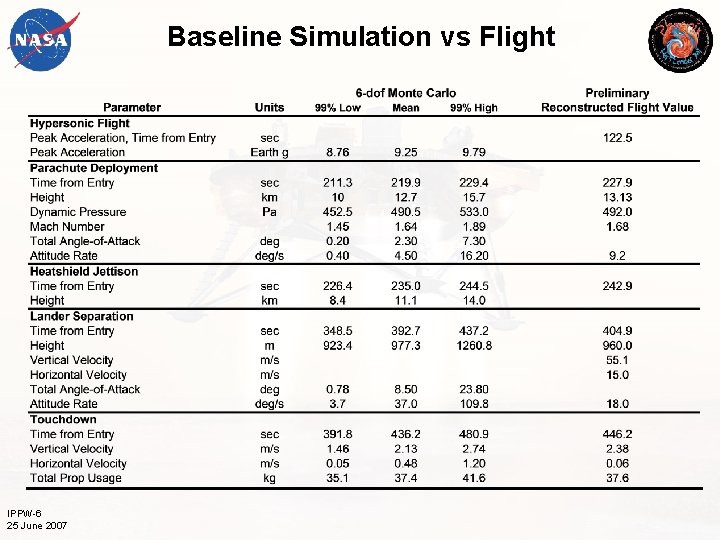
Parachute Phase Parachute Deployment • • IPPW-6 25 June 2007 Parachute deployment conditions: – Dyn. Press. : 492 Pa – Mach: 1. 68 – Altitude: 13. 26 km As expected, “wrist mode” rates were high immediately after parachute deployment, but damped quickly
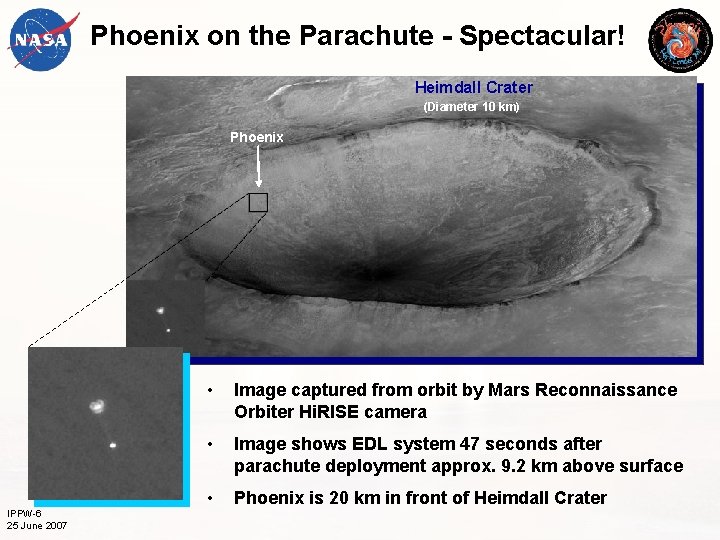
Phoenix on the Parachute - Spectacular! Heimdall Crater (Diameter 10 km) Phoenix IPPW-6 25 June 2007 • Image captured from orbit by Mars Reconnaissance Orbiter Hi. RISE camera • Image shows EDL system 47 seconds after parachute deployment approx. 9. 2 km above surface • Phoenix is 20 km in front of Heimdall Crater
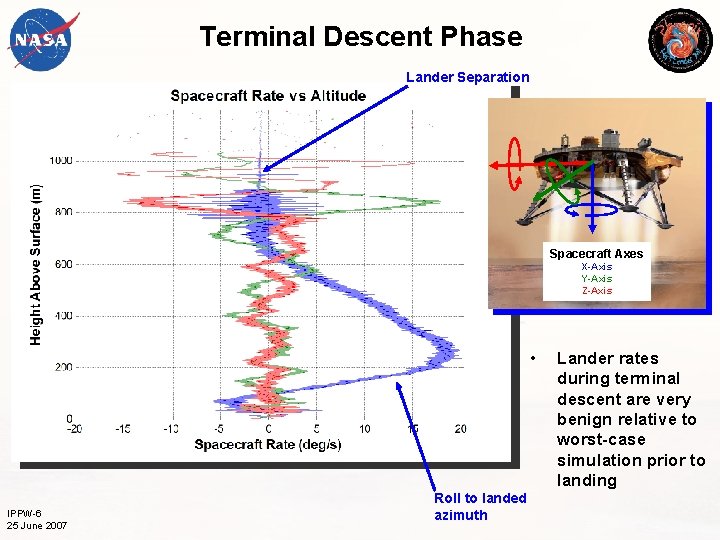
Terminal Descent Phase Lander Separation Spacecraft Axes X-Axis Y-Axis Z-Axis • IPPW-6 25 June 2007 Roll to landed azimuth Lander rates during terminal descent are very benign relative to worst-case simulation prior to landing
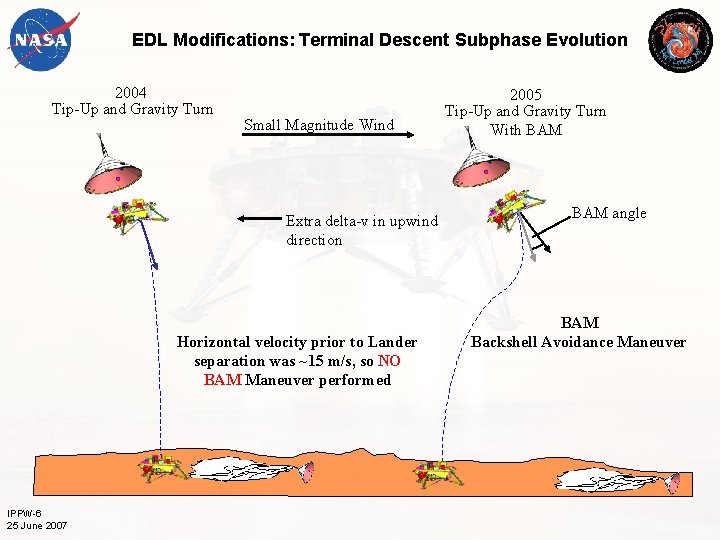
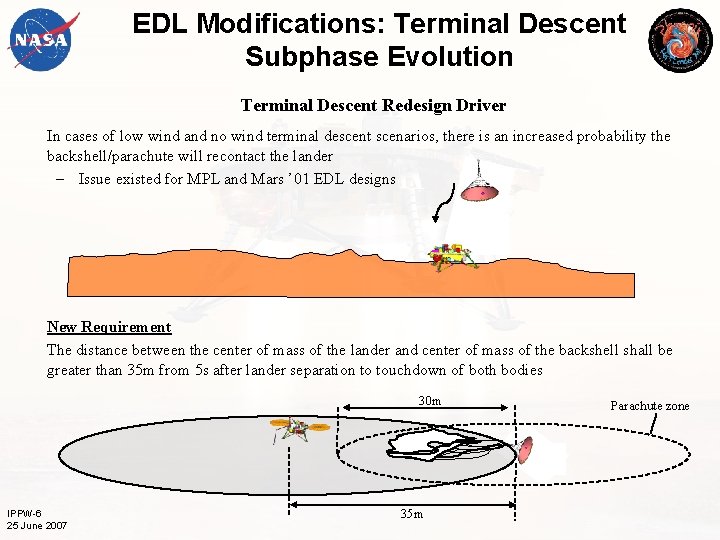
EDL Modifications: Terminal Descent Subphase Evolution 2004 Tip-Up and Gravity Turn Small Magnitude Wind Extra delta-v in upwind direction Horizontal velocity prior to Lander separation was ~15 m/s, so NO BAM Maneuver performed IPPW-6 25 June 2007 2005 Tip-Up and Gravity Turn With BAM angle BAM Backshell Avoidance Maneuver
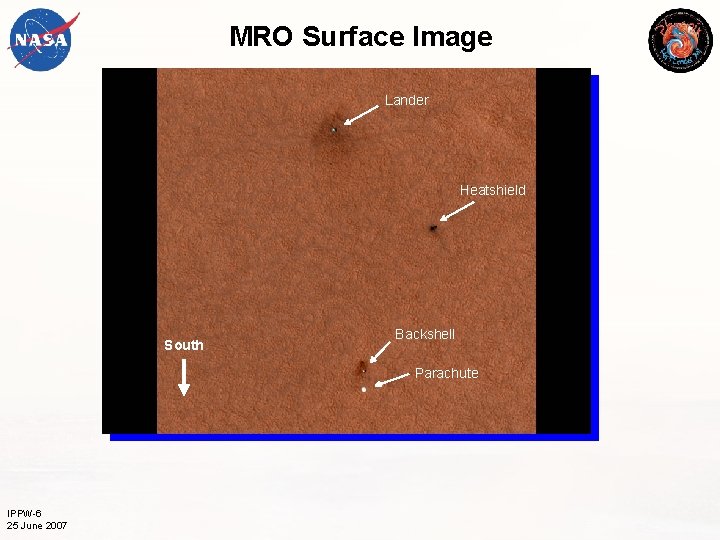
MRO Surface Image Lander Heatshield South Backshell Parachute IPPW-6 25 June 2007
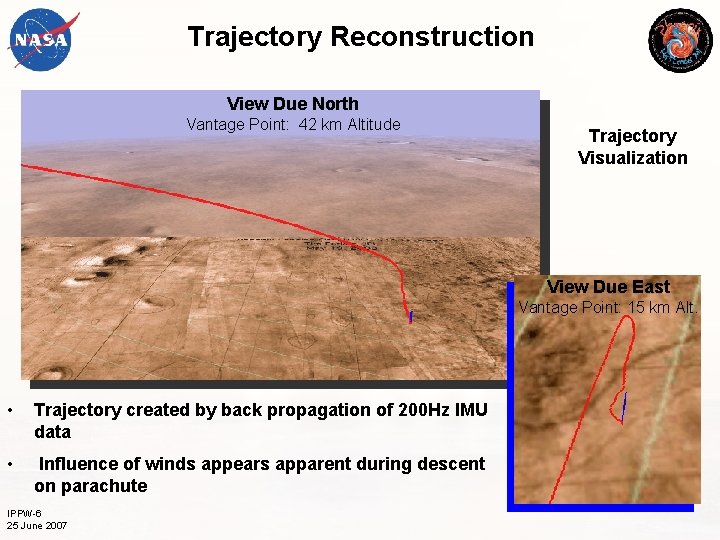
Trajectory Reconstruction View Due North Vantage Point: 42 km Altitude Trajectory Visualization View Due East Vantage Point: 15 km Alt. • Trajectory created by back propagation of 200 Hz IMU data • Influence of winds appears apparent during descent on parachute IPPW-6 25 June 2007
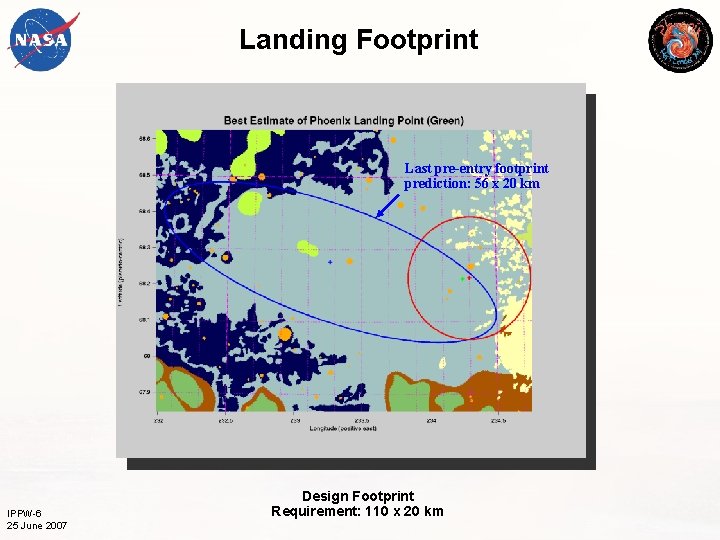
Landing Footprint Last pre-entry footprint prediction: 56 x 20 km IPPW-6 25 June 2007 Design Footprint Requirement: 110 x 20 km
Baseline Simulation vs Flight IPPW-6 25 June 2007
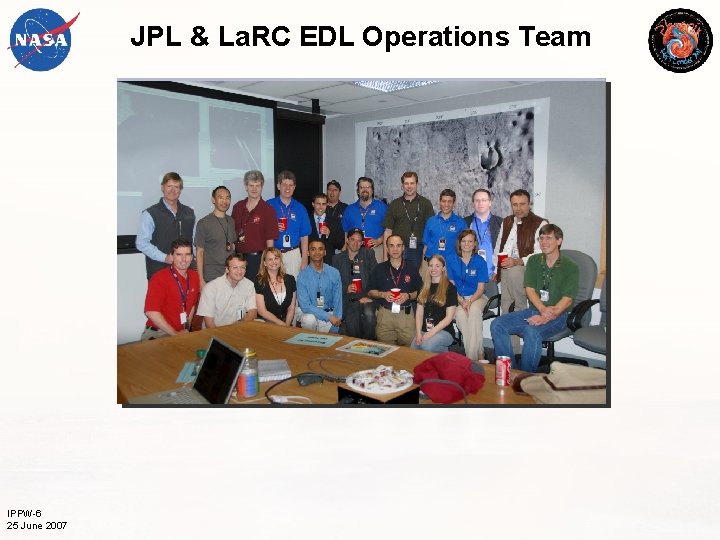
JPL & La. RC EDL Operations Team IPPW-6 25 June 2007
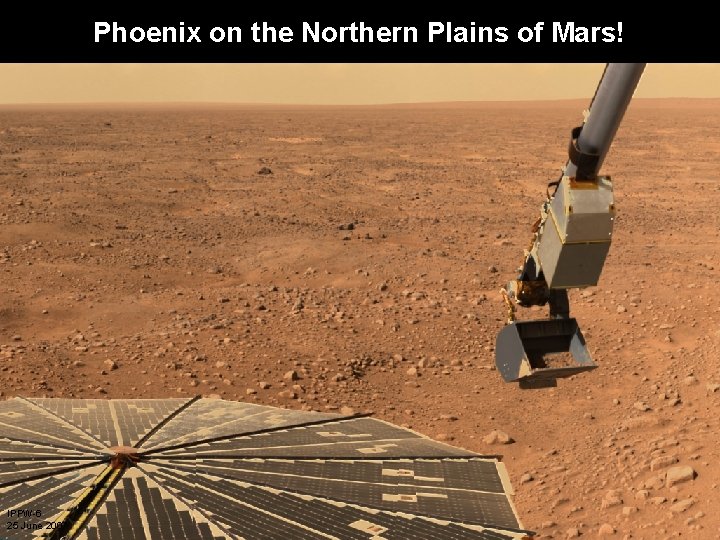
Phoenix on the Northern Plains of Mars! IPPW-6 25 June 2007
Back-Up Slides IPPW-6 25 June 2007
Phoenix Thruster Geometry • TCM thrusters used for Pitch/Yaw control • RCS thrusters used for Roll control IPPW-6 25 June 2007 PND-21 21
EDL Modifications: Terminal Descent Subphase Evolution Terminal Descent Redesign Driver In cases of low wind and no wind terminal descent scenarios, there is an increased probability the backshell/parachute will recontact the lander – Issue existed for MPL and Mars ’ 01 EDL designs New Requirement The distance between the center of mass of the lander and center of mass of the backshell shall be greater than 35 m from 5 s after lander separation to touchdown of both bodies 30 m IPPW-6 25 June 2007 35 m Parachute zone