
The Philosophers Way A Text with Readings FIFTH
- Slides: 33
The Philosopher's Way A Text with Readings FIFTH EDITION CHAPTER 5 how can we know the nature of reality? Philosophical Foundations Copyright © 2016, 2013, 2011 by Pearson Education, Inc. All Rights Reserved
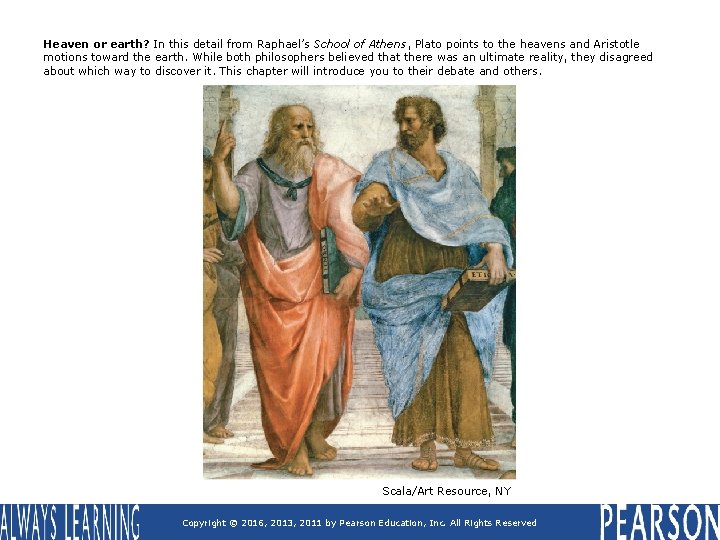
Heaven or earth? In this detail from Raphael’s School of Athens, Plato points to the heavens and Aristotle motions toward the earth. While both philosophers believed that there was an ultimate reality, they disagreed about which way to discover it. This chapter will introduce you to their debate and others. Scala/Art Resource, NY Copyright © 2016, 2013, 2011 by Pearson Education, Inc. All Rights Reserved
Learning Objectives 5. 1 Define the words reality and truth. 5. 2 Explain Plato's idea of "Two Worlds. " Copyright © 2016, 2013, 2011 by Pearson Education, Inc. All Rights Reserved
Learning Objectives 5. 3 Describe Aristotle's view that reality consists of the natural world and that this natural world follows orderly principles and laws. 5. 4 Explain that Descartes was a rationalist, believing that true knowledge is produced by thinking that is reflective, logical and analytical. Copyright © 2016, 2013, 2011 by Pearson Education, Inc. All Rights Reserved
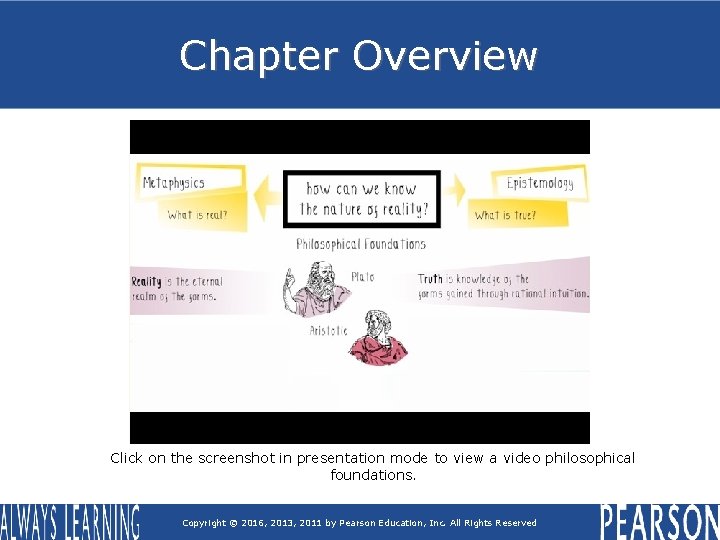
Chapter Overview Click on the screenshot in presentation mode to view a video philosophical foundations. Copyright © 2016, 2013, 2011 by Pearson Education, Inc. All Rights Reserved
5. 1 What is the Nature of Reality? • Reality refers to things the way they really are. • Truth refers to those statements that are one hundred percent accurate. • Metaphysics • Epistemology Copyright © 2016, 2013, 2011 by Pearson Education, Inc. All Rights Reserved
5. 1 What is the Nature of Reality? • The Milesians § Thales § Anaximander § Anaximenes • Xenophanes and Heraclitus Copyright © 2016, 2013, 2011 by Pearson Education, Inc. All Rights Reserved
5. 1 What is the Nature of Reality? • Parmenides • Leucippus and Democritus • Legacy of the Pre-Socratic philosophers Copyright © 2016, 2013, 2011 by Pearson Education, Inc. All Rights Reserved
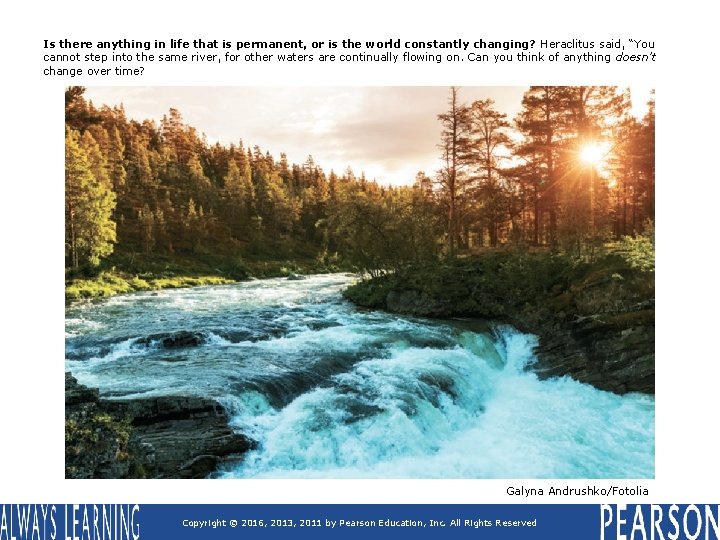
Is there anything in life that is permanent, or is the world constantly changing? Heraclitus said, “You cannot step into the same river, for other waters are continually flowing on. Can you think of anything doesn’t change over time? Galyna Andrushko/Fotolia Copyright © 2016, 2013, 2011 by Pearson Education, Inc. All Rights Reserved
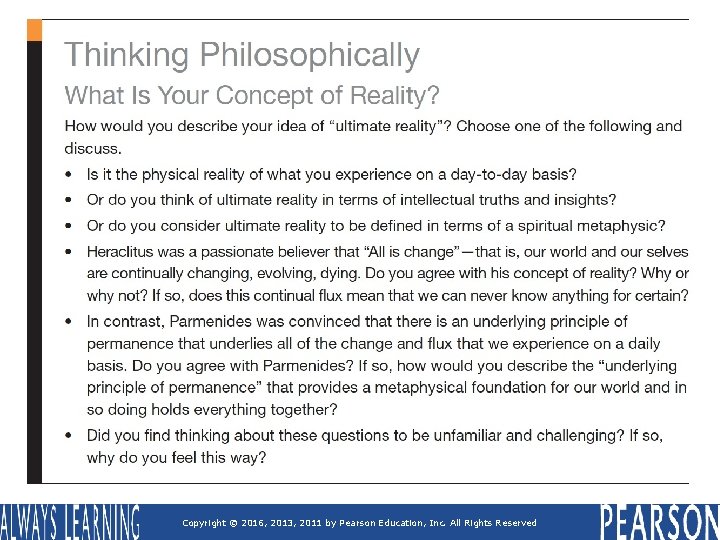
Copyright © 2016, 2013, 2011 by Pearson Education, Inc. All Rights Reserved
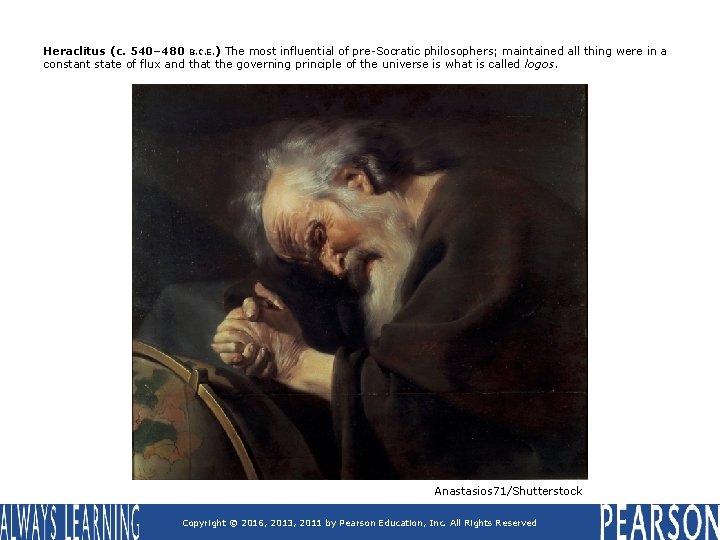
Heraclitus (c. 540– 480 B. C. E. ) The most influential of pre-Socratic philosophers; maintained all thing were in a constant state of flux and that the governing principle of the universe is what is called logos. Anastasios 71/Shutterstock Copyright © 2016, 2013, 2011 by Pearson Education, Inc. All Rights Reserved
5. 2 Reality is the Eternal Realm of the Forms: Plato • • • Two worlds What precisely are forms? What are examples of ideal forms? The divided line The theory of innate ideas § Rationalism § Empiricism Copyright © 2016, 2013, 2011 by Pearson Education, Inc. All Rights Reserved
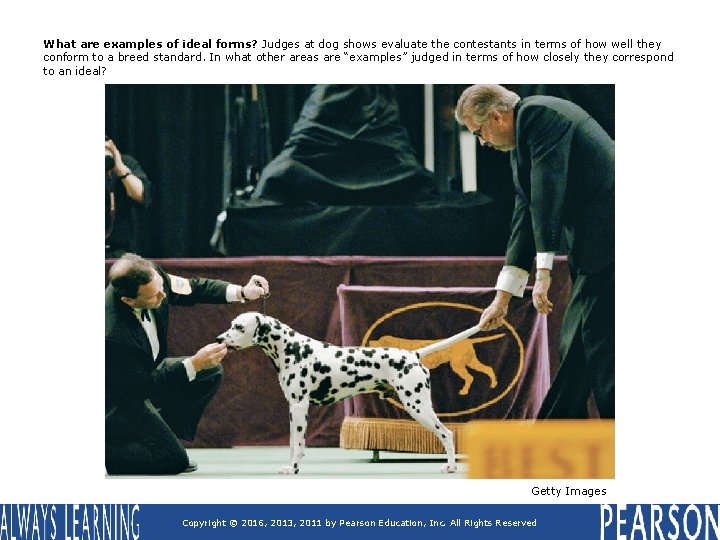
What are examples of ideal forms? Judges at dog shows evaluate the contestants in terms of how well they conform to a breed standard. In what other areas are “examples” judged in terms of how closely they correspond to an ideal? Getty Images Copyright © 2016, 2013, 2011 by Pearson Education, Inc. All Rights Reserved
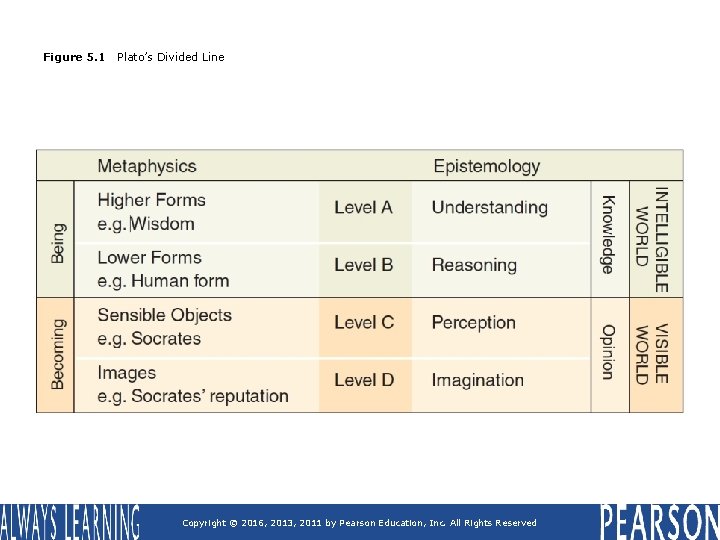
Figure 5. 1 Plato’s Divided Line Copyright © 2016, 2013, 2011 by Pearson Education, Inc. All Rights Reserved
5. 2 Reality is the Eternal Realm of the Forms: Plato • Plato, from Meno • Analyzing Plato's theory of innate ideas • The path to knowledge of reality: the Cave allegory Copyright © 2016, 2013, 2011 by Pearson Education, Inc. All Rights Reserved
5. 2 Reality is the Eternal Realm of the Forms: Plato • Plato, from The Republic • Analyzing Plato's "Allegory of the Cave" Copyright © 2016, 2013, 2011 by Pearson Education, Inc. All Rights Reserved
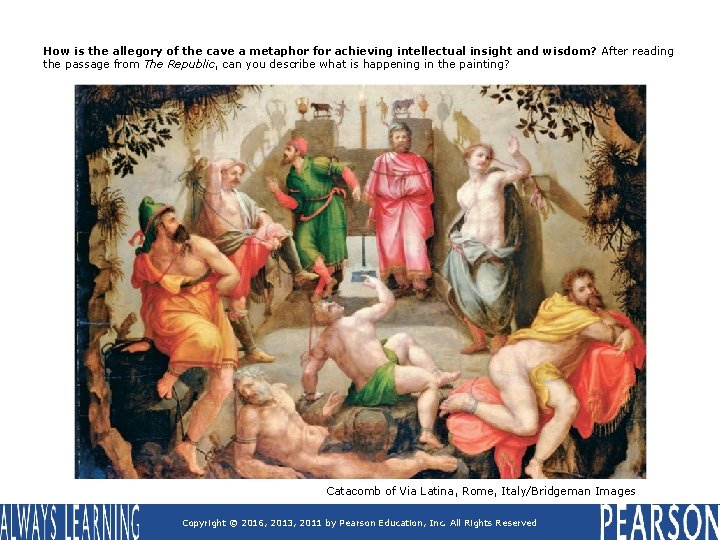
How is the allegory of the cave a metaphor for achieving intellectual insight and wisdom? After reading the passage from The Republic, can you describe what is happening in the painting? Catacomb of Via Latina, Rome, Italy/Bridgeman Images Copyright © 2016, 2013, 2011 by Pearson Education, Inc. All Rights Reserved
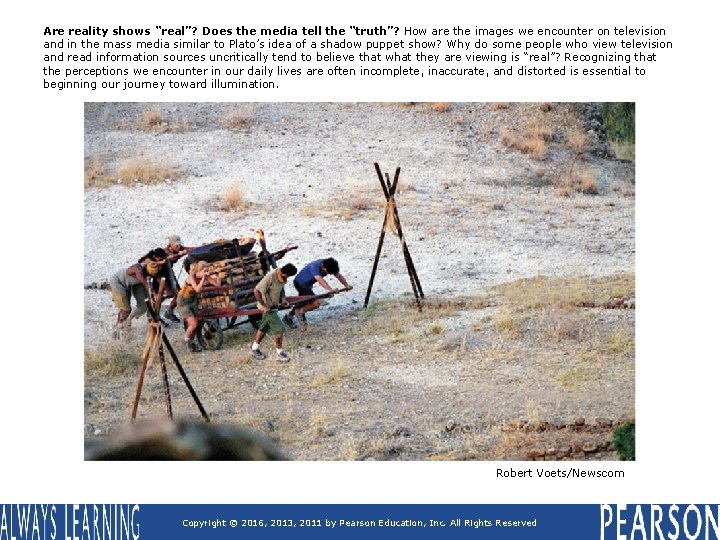
Are reality shows “real”? Does the media tell the “truth”? How are the images we encounter on television and in the mass media similar to Plato’s idea of a shadow puppet show? Why do some people who view television and read information sources uncritically tend to believe that what they are viewing is “real”? Recognizing that the perceptions we encounter in our daily lives are often incomplete, inaccurate, and distorted is essential to beginning our journey toward illumination. Robert Voets/Newscom Copyright © 2016, 2013, 2011 by Pearson Education, Inc. All Rights Reserved
5. 2 Reality is the Eternal Realm of the Forms: Plato • Inspiring ascent to the forms: the ladder of love § Plato, from Symposium § Analyzing Plato's Ladder of Love Copyright © 2016, 2013, 2011 by Pearson Education, Inc. All Rights Reserved
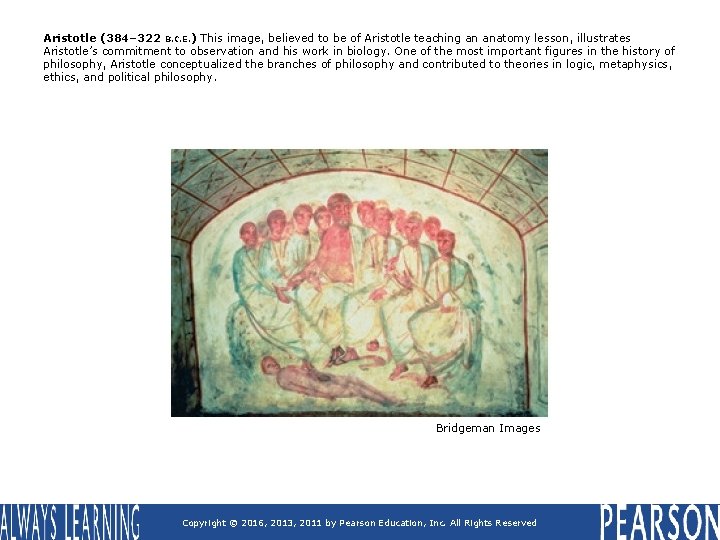
Aristotle (384– 322 B. C. E. ) This image, believed to be of Aristotle teaching an anatomy lesson, illustrates Aristotle’s commitment to observation and his work in biology. One of the most important figures in the history of philosophy, Aristotle conceptualized the branches of philosophy and contributed to theories in logic, metaphysics, ethics, and political philosophy. Bridgeman Images Copyright © 2016, 2013, 2011 by Pearson Education, Inc. All Rights Reserved
5. 3: Reality is the Natural World: Aristotle • Aristotle's view of Plato's metaphysical dualism • Aristotle as philosophical naturalist • Genuine knowledge • The human soul cannot be separated from the body. • We are unique because of our ability to reason. Copyright © 2016, 2013, 2011 by Pearson Education, Inc. All Rights Reserved
5. 3: Reality is the Natural World: Aristotle • Aristotle's two categories § Matter § Form • Hylomorphism Copyright © 2016, 2013, 2011 by Pearson Education, Inc. All Rights Reserved
5. 3: Reality is the Natural World: Aristotle • Entelechy § One of core concepts of Aristotle's entire philosophy § Everything in the universe has its own unique purpose to fill. § The formal element of people is the soul. Copyright © 2016, 2013, 2011 by Pearson Education, Inc. All Rights Reserved
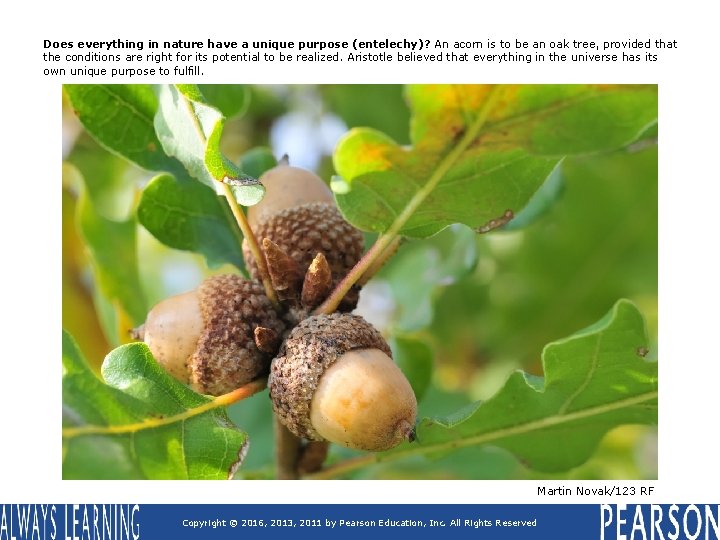
Does everything in nature have a unique purpose (entelechy)? An acorn is to be an oak tree, provided that the conditions are right for its potential to be realized. Aristotle believed that everything in the universe has its own unique purpose to fulfill. Martin Novak/123 RF Copyright © 2016, 2013, 2011 by Pearson Education, Inc. All Rights Reserved
5. 3: Reality is the Natural World: Aristotle • The Four Causes § § Material Formal Efficient Final • Aristotle, from Metaphysics Copyright © 2016, 2013, 2011 by Pearson Education, Inc. All Rights Reserved
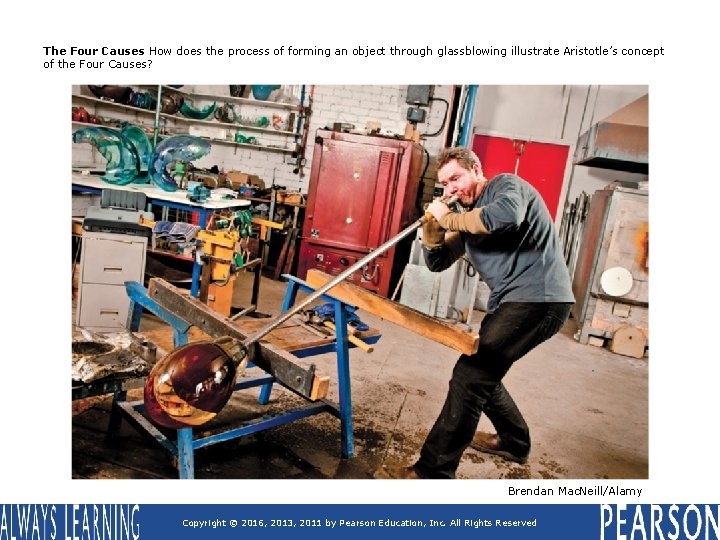
The Four Causes How does the process of forming an object through glassblowing illustrate Aristotle’s concept of the Four Causes? Brendan Mac. Neill/Alamy Copyright © 2016, 2013, 2011 by Pearson Education, Inc. All Rights Reserved
5. 4: Can Reality Be Known? Descartes • René Descartes, from Meditations on First Philosophy § § Meditation I II IV • Analyzing Descartes' radical doubt Copyright © 2016, 2013, 2011 by Pearson Education, Inc. All Rights Reserved
Making Connections: Your Beliefs About the World • You do have a theory of knowledge, your own epistemology. • Critical thinking abilities enable you to develop the most informed beliefs and construct the most enlightened knowledge. Copyright © 2016, 2013, 2011 by Pearson Education, Inc. All Rights Reserved
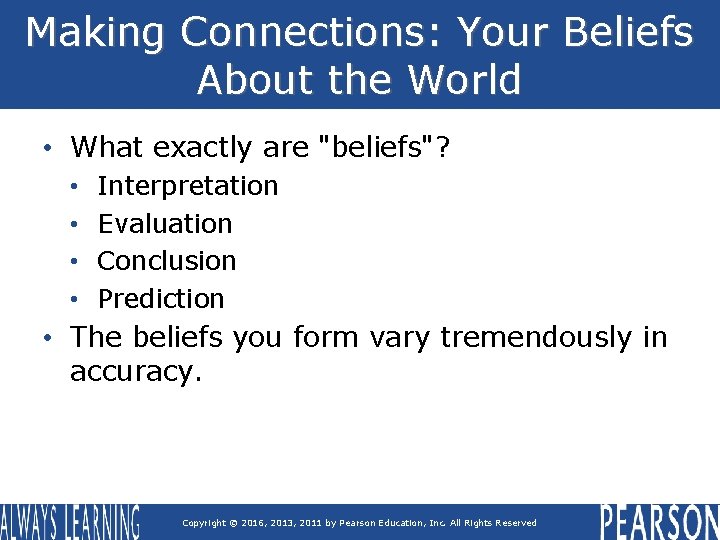
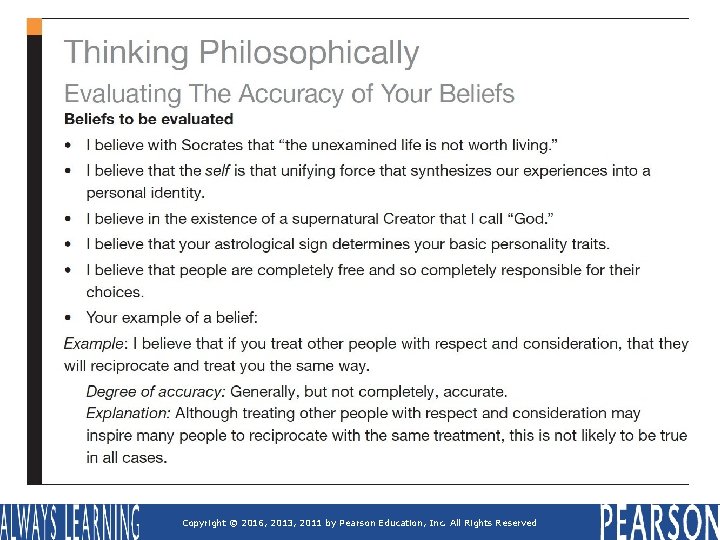
Making Connections: Your Beliefs About the World • What exactly are "beliefs"? • • Interpretation Evaluation Conclusion Prediction • The beliefs you form vary tremendously in accuracy. Copyright © 2016, 2013, 2011 by Pearson Education, Inc. All Rights Reserved
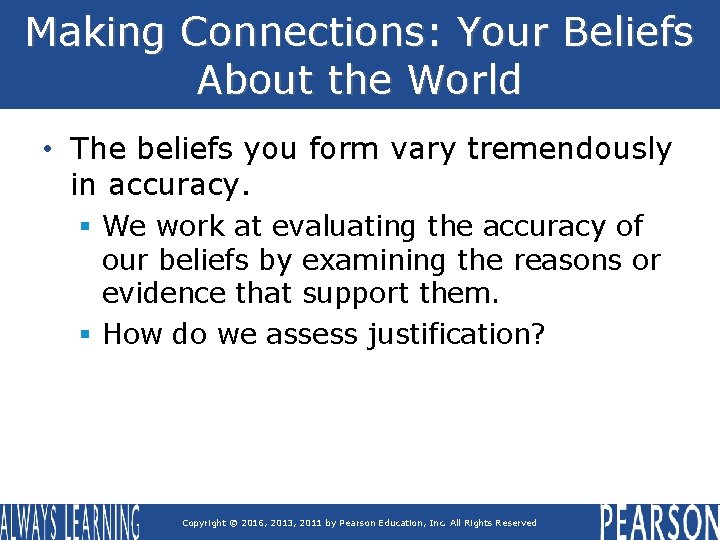
Making Connections: Your Beliefs About the World • The beliefs you form vary tremendously in accuracy. § We work at evaluating the accuracy of our beliefs by examining the reasons or evidence that support them. § How do we assess justification? Copyright © 2016, 2013, 2011 by Pearson Education, Inc. All Rights Reserved
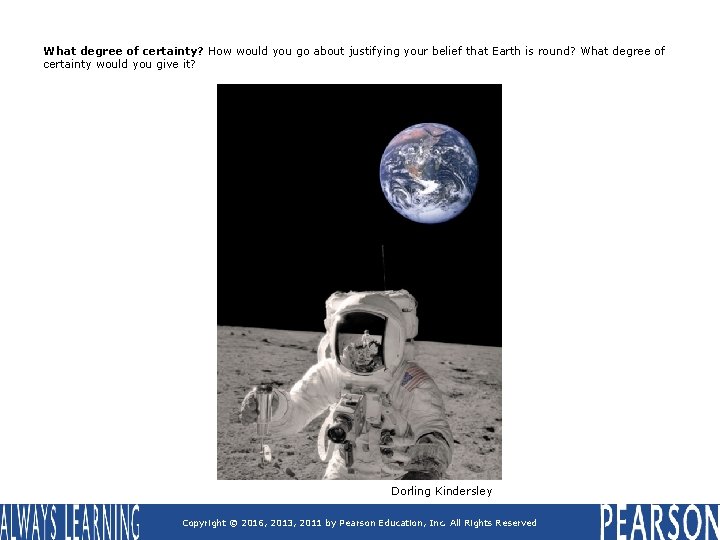
What degree of certainty? How would you go about justifying your belief that Earth is round? What degree of certainty would you give it? Dorling Kindersley Copyright © 2016, 2013, 2011 by Pearson Education, Inc. All Rights Reserved
Copyright © 2016, 2013, 2011 by Pearson Education, Inc. All Rights Reserved
Copyright © 2016, 2013, 2011 by Pearson Education, Inc. All Rights Reserved