
The Philippines Debt Trade Policy and Institutions Oscar
The Philippines Debt, Trade, Policy, and Institutions Oscar Manuel Velazquez
General Info $2899. 38 GDP per capita Industrialization level: 425. 57 kg of oil equivalent, 11, 32% agriculture value added % of GDP Education level: 95. 6% literacy, Primary completion rate of 93. 73% Urbanization level: Urban population, % of total 44. 4% According to the Economist Intelligence unit’s Democracy Index, they range from 6. 12 lowest to 6. 94 highest on a scale of 1 to 10 from 2006 to 2016, 10 being a full democracy; the Philippines is considered a flawed democracy.
Trade Policy 1950 s-1970 s, Import Substitution Phase and Restrictive Investment Policy Tariffs, import quotas, restricted foreign ownership, complicated investment incentive system Marcos Regime 1980 s-1990 s, Trade, Investment, and Multilateral/Regional Trade Liberalization Reducing tariffs through the Trade Reform Program (TRP), 1987 Omnibus Investment Act, 1991 Foreign Investment Act, GATT-WTO (1995) 2000 s, Trade Facilitation and Regionalism/Bilateralism through Free Trade Agreements
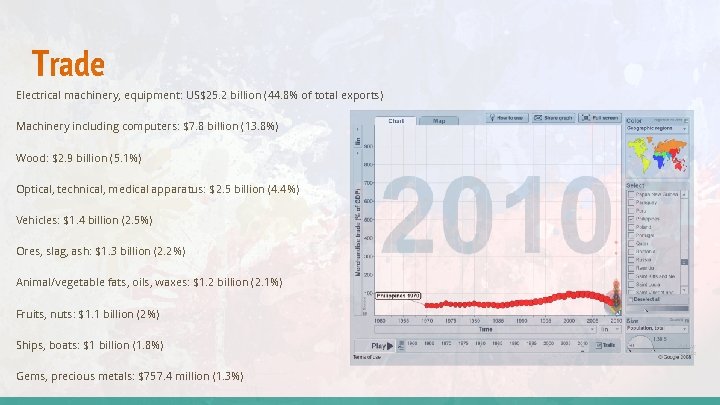
Trade Electrical machinery, equipment: US$25. 2 billion (44. 8% of total exports) Machinery including computers: $7. 8 billion (13. 8%) Wood: $2. 9 billion (5. 1%) Optical, technical, medical apparatus: $2. 5 billion (4. 4%) Vehicles: $1. 4 billion (2. 5%) Ores, slag, ash: $1. 3 billion (2. 2%) Animal/vegetable fats, oils, waxes: $1. 2 billion (2. 1%) Fruits, nuts: $1. 1 billion (2%) Ships, boats: $1 billion (1. 8%) Gems, precious metals: $757. 4 million (1. 3%)
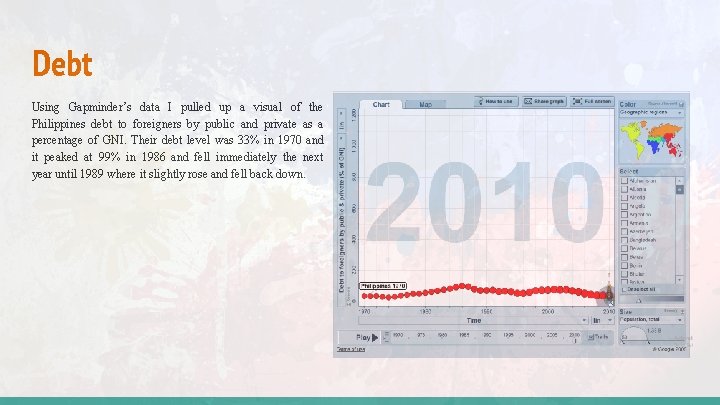
Debt Using Gapminder’s data I pulled up a visual of the Philippines debt to foreigners by public and private as a percentage of GNI. Their debt level was 33% in 1970 and it peaked at 99% in 1986 and fell immediately the next year until 1989 where it slightly rose and fell back down.
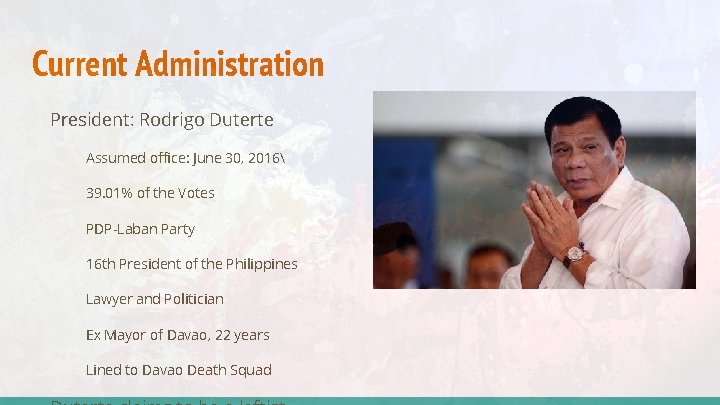
Current Administration President: Rodrigo Duterte Assumed office: June 30, 2016 39. 01% of the Votes PDP-Laban Party 16 th President of the Philippines Lawyer and Politician Ex Mayor of Davao, 22 years Lined to Davao Death Squad
Policies 10 Point Socio Economic Agenda “Institute progressive tax reform and more effective tax collection, indexing taxes to inflation. ” “Increase competitiveness and the ease of doing business. This effort will draw upon successful models used to attract business to local cities (e. g. , Davao) and pursue the relaxation of the Constitutional restrictions on foreign ownership, except as regards land ownership, in order to attract foreign direct investment. ” “Accelerate annual infrastructure spending to account for 5% of GDP, with Public-Private Partnerships playing a key role. ” “Invest in human capital development, including health and education systems, and match skills and training to meet the demand of businesses and the private sector. ” “Promote science, technology, and the creative arts to enhance innovation and creative capacity towards self-sustaining, inclusive development. ”
Related Readings Colonial Legacy, factor endowments, and institutions Sokoloff and Engerman (2000) Englebert, Pierre (2000) State-led development Waterbury, John (1999)
Keep your eyes on Long term effects of the war in drugs. Possible outside intervention. Outside sanctions. Foreign investor's trust in Duterte regime. How far will the ISIS conflict will go in the Philippines.
- Slides: 9