
The Phenomenology of Being Rogerian Personality Theory Phenomenological
The Phenomenology of Being Rogerian Personality Theory
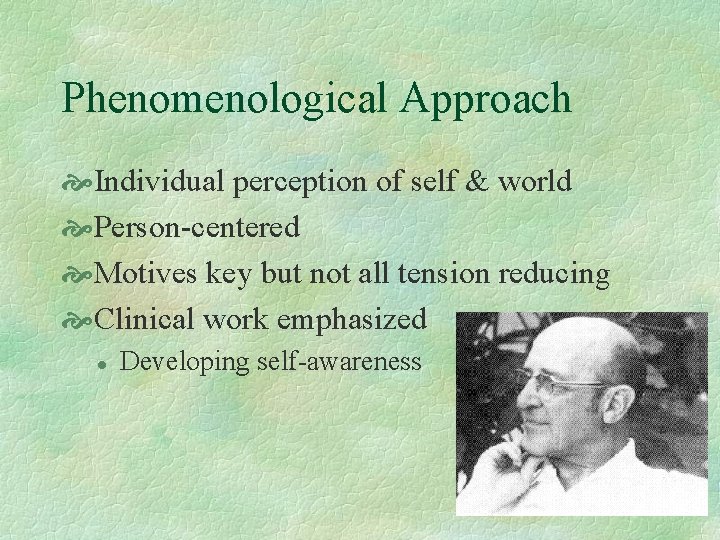
Phenomenological Approach Individual perception of self & world Person-centered Motives key but not all tension reducing Clinical work emphasized l Developing self-awareness
Carl Rogers Humans are inherently good, rational l Underlying motive is to self-actualize Research approach was phenomenological l Unique (conscious), subjective perceptions key • idiographic l Clinical observations valuable but not sufficient • Objective experimentation & observation
Structure The self l Self-concept: Conscious, organized, consistent patterns of perceptions & meanings • Develops through interactions w/ others & the world • Changes but always organized & integrated: Me • Ideal v. actual l Measured using Q-sort, self-report scales World viewed through the self-concept
Process Change emphasized Motivated to seek self-actualization (ideal) l l Simple to complex Dependence to independence Rigidity to flexibility & freedom Reduce tension & enhance pleasure/satisfaction Differences come from inherent potential & strategies used to seek potential

Rogers and Self Actualization
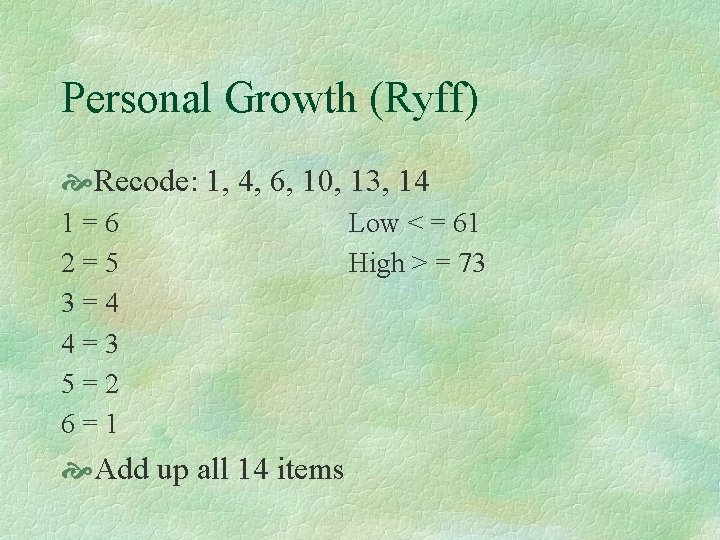
Personal Growth (Ryff) Recode: 1, 4, 6, 10, 13, 14 1=6 2=5 3=4 4=3 5=2 6=1 Add up all 14 items Low < = 61 High > = 73
Personal Growth High Scorer: Has a feeling of continued development; sees self as growing and expanding; is open to new experiences; has sense of realizing one's potential; sees improvement in self and behavior over time; is changing in ways that reflect more self knowledge and effectiveness. Low Scorer: Has a sense of personal stagnation; lacks sense of improvement or expansion over time; feels bored and uninterested with life; feels unable to develop new attitudes or behaviors.
Self-Consistency Motivated for l l Consistency w/in self-concept Congruence between self-concept & experiences (ideal & actual) Incongruence produces anxiety l Distortion & denial
Self-Verification Theory (Swann) Seek experiences that confirm self-concept l Maintain sense of control & predictability • Interpersonal interactions (spousal abuse) • Affect • Cognition (attention, memory)
Reaction paper 11: Self. Consistency Do you think you seek consistencies between your self-concept and behavior or experiences? In your life have you ever behaved in ways that were harmful to you but were consistent with your self-concept?
Growth Positive regard l Condition v. unconditional Health associated w/ unconditional l l Congruence between ideal & actual self Move towards potential (& not conditions of worth)
Strengths & Limitations Strengths Important aspects Holistic emphasis Subjective + objective change Limitations Excludes key Vs Few objective measures Observational bias
Baumeister What is crystallization of discontent (COD)? l Have you ever experienced COD? How are commitments made? l How is this relevant to COD and change? Empirical evidence to support COD as causing change? l l How might this work? How might change be maintained?
Baumeister Do you think COD causes personality changes? l What might be most likely to change?
- Slides: 15