
The PHENIX detection and analysis of electron signals
![RHIC: some numbers Species SNN [Ge. V] L [1/cm 2 s] Polarization # Bunches](https://slidetodoc.com/presentation_image_h2/3a82e3537d75a1ad62f299181d13ee83/image-5.jpg "RHIC: some numbers Species SNN [Ge. V] L [1/cm 2 s] Polarization # Bunches")

- Slides: 28
The PHENIX detection and analysis of electron signals Marco Leite (USP) For the PHENIX collaboration II Latin American Workshop on High Energy Phenomenology Marco Leite - USP São Miguel das Missões – RS 03 – 07 December 2007 1
Outline • • • Marco Leite Motivation The Relativistic Heavy Ion Collider Detector overview Measuring electrons in PHENIX Efficiency considerations Single (heavy quarks) and di-electron (quarkonia) signals Accounting for other electron sources (background) Nuclear modification factor RAA Shadowing and absorption: cold nuclear matter effects Prospects and conclusions II LAWHEP – S. Miguel das Missões – RS Dec. 2007 2
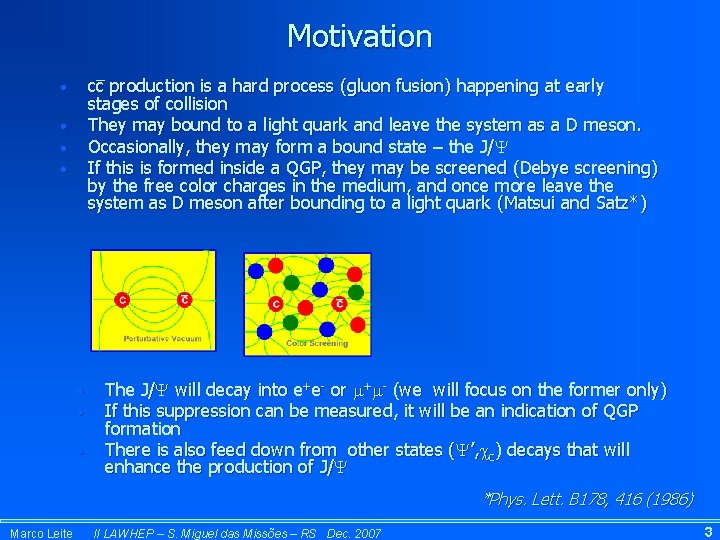
Motivation cc production is a hard process (gluon fusion) happening at early stages of collision They may bound to a light quark and leave the system as a D meson. Occasionally, they may form a bound state – the J/ If this is formed inside a QGP, they may be screened (Debye screening) by the free color charges in the medium, and once more leave the system as D meson after bounding to a light quark (Matsui and Satz* ) • • The J/ will decay into e+e- or + - (we will focus on the former only) If this suppression can be measured, it will be an indication of QGP formation There is also feed down from other states ( ’, c) decays that will enhance the production of J/ *Phys. Lett. B 178, 416 (1986) Marco Leite II LAWHEP – S. Miguel das Missões – RS Dec. 2007 3
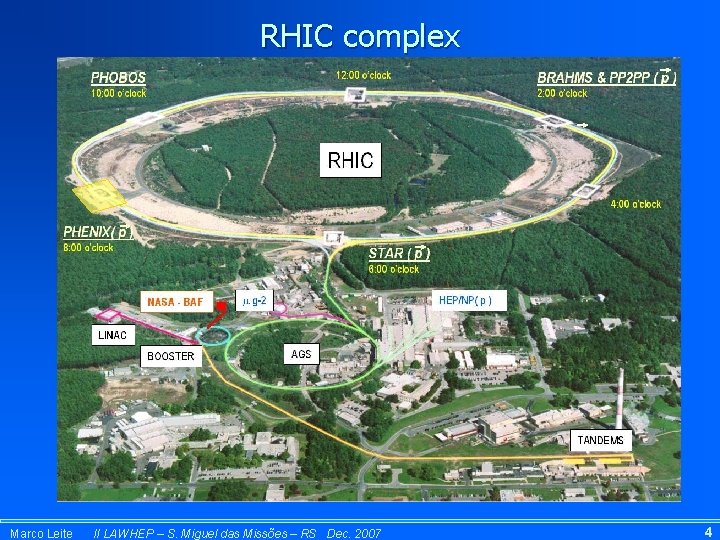
RHIC complex Marco Leite II LAWHEP – S. Miguel das Missões – RS Dec. 2007 4
RHIC: some numbers Species SNN [Ge. V] L [1/cm 2 s] Polarization # Bunches Au + Au 62 ~ 200 8 1026 - 111 Cu + Cu 62 ~ 200 80 1026 - 37 p+p 62~200* 60 1030 70% 111 d+A 200 2 1028 - 55 *500 Ge. V under machine development. Marco Leite II LAWHEP – S. Miguel das Missões – RS Dec. 2007 5
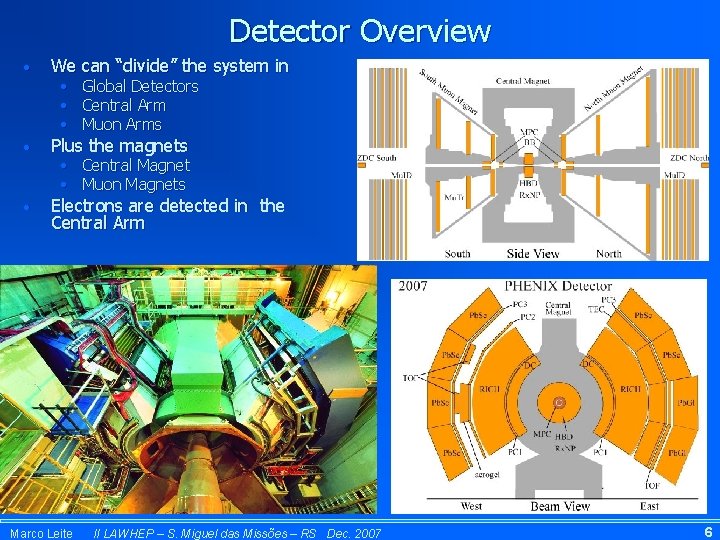
Detector Overview • We can “divide” the system in • • • Global Detectors Central Arm Muon Arms • Plus the magnets • Electrons are detected in the Central Arm • Central Magnet • Muon Magnets Marco Leite II LAWHEP – S. Miguel das Missões – RS Dec. 2007 6
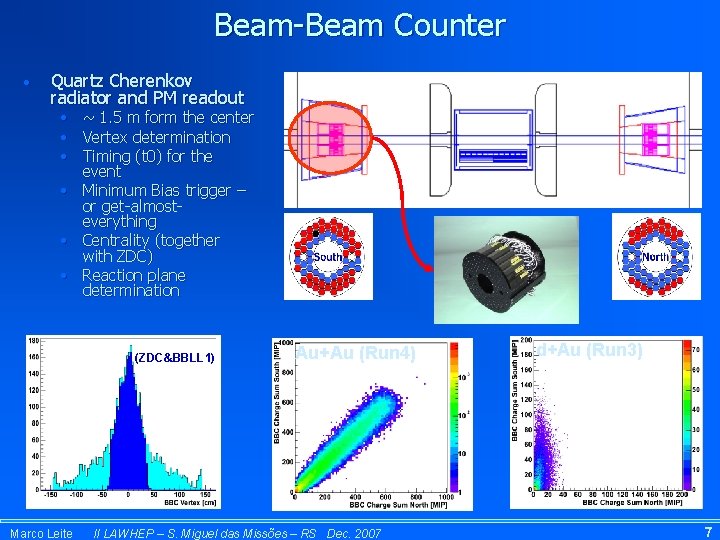
Beam-Beam Counter • Quartz Cherenkov radiator and PM readout • • • ~ 1. 5 m form the center Vertex determination Timing (t 0) for the event • Minimum Bias trigger – or get-almosteverything • Centrality (together with ZDC) • Reaction plane determination (ZDC&BBLL 1) Marco Leite Au+Au (Run 4) II LAWHEP – S. Miguel das Missões – RS Dec. 2007 d+Au (Run 3) 7
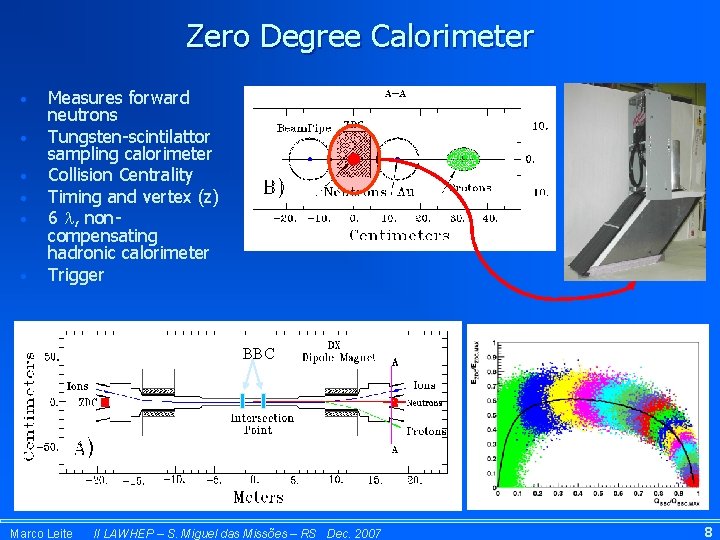
Zero Degree Calorimeter • • • Measures forward neutrons Tungsten-scintilattor sampling calorimeter Collision Centrality Timing and vertex (z) 6 , noncompensating hadronic calorimeter Trigger BBC Marco Leite II LAWHEP – S. Miguel das Missões – RS Dec. 2007 8
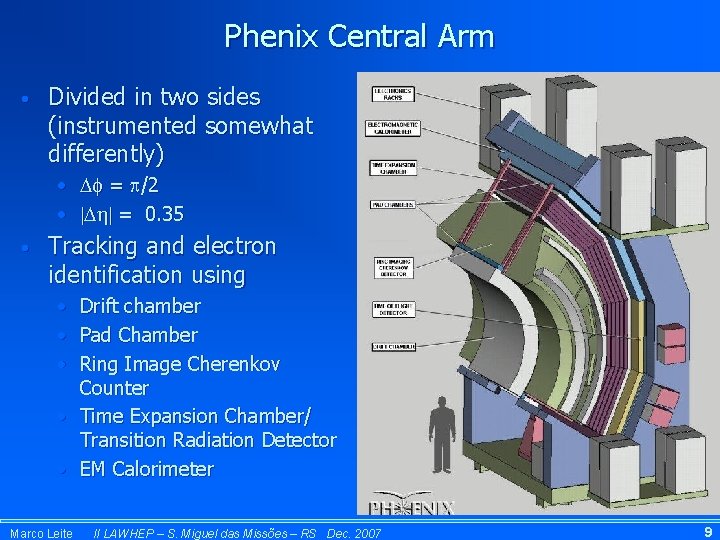
Phenix Central Arm • Divided in two sides (instrumented somewhat differently) • = /2 • = 0. 35 • Tracking and electron identification using • Drift chamber • Pad Chamber • Ring Image Cherenkov Counter • Time Expansion Chamber/ Transition Radiation Detector • EM Calorimeter Marco Leite II LAWHEP – S. Miguel das Missões – RS Dec. 2007 9
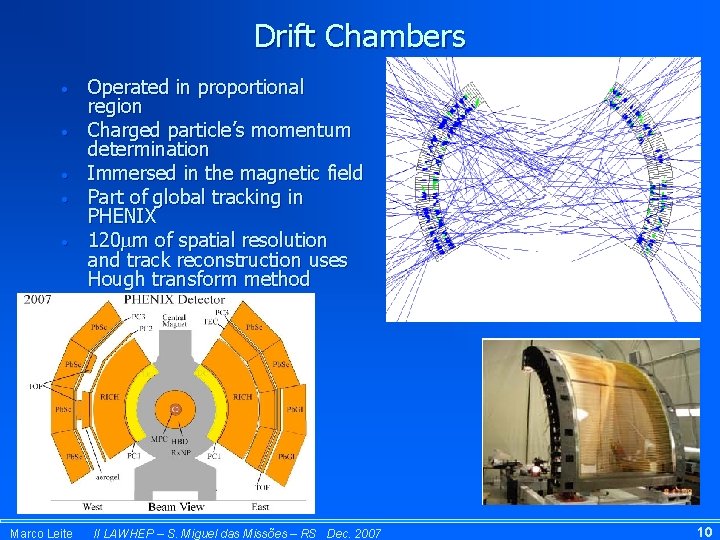
Drift Chambers • • • Marco Leite Operated in proportional region Charged particle’s momentum determination Immersed in the magnetic field Part of global tracking in PHENIX 120 m of spatial resolution and track reconstruction uses Hough transform method II LAWHEP – S. Miguel das Missões – RS Dec. 2007 10
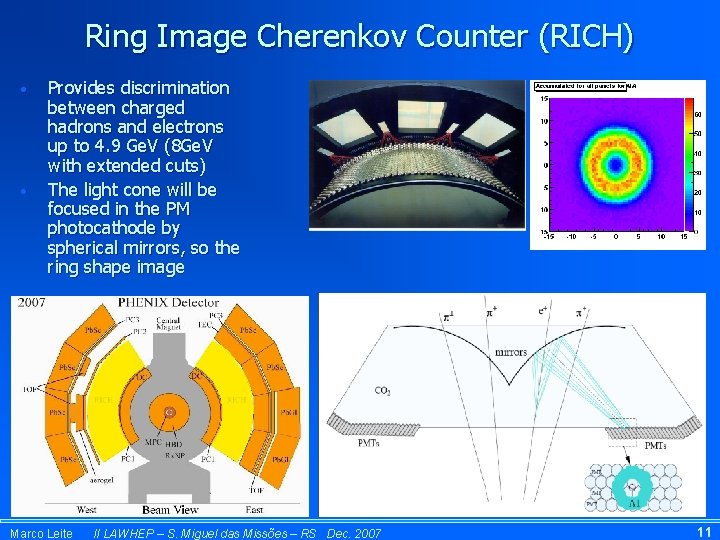
Ring Image Cherenkov Counter (RICH) • • Provides discrimination between charged hadrons and electrons up to 4. 9 Ge. V (8 Ge. V with extended cuts) The light cone will be focused in the PM photocathode by spherical mirrors, so the ring shape image Marco Leite II LAWHEP – S. Miguel das Missões – RS Dec. 2007 11
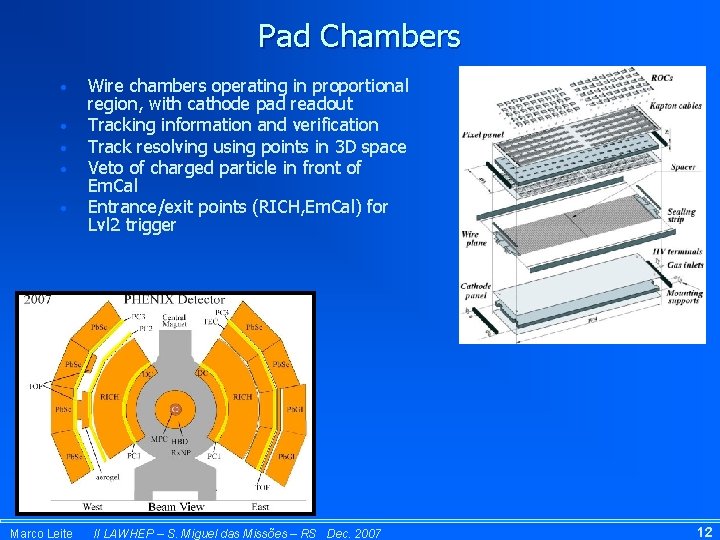
Pad Chambers • • • Marco Leite Wire chambers operating in proportional region, with cathode pad readout Tracking information and verification Track resolving using points in 3 D space Veto of charged particle in front of Em. Cal Entrance/exit points (RICH, Em. Cal) for Lvl 2 trigger II LAWHEP – S. Miguel das Missões – RS Dec. 2007 12
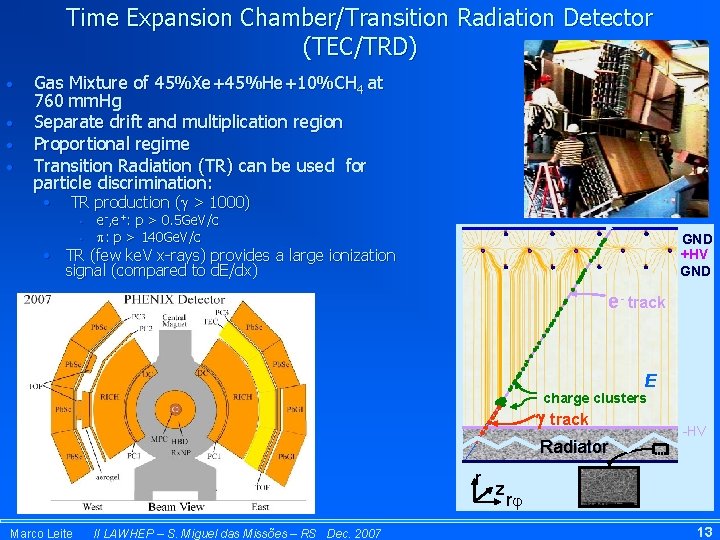
Time Expansion Chamber/Transition Radiation Detector (TEC/TRD) • • Gas Mixture of 45%Xe+45%He+10%CH 4 at 760 mm. Hg Separate drift and multiplication region Proportional regime Transition Radiation (TR) can be used for particle discrimination: • TR production ( > 1000) • • e-, e+: p > 0. 5 Ge. V/c : p > 140 Ge. V/c GND +HV GND • TR (few ke. V x-rays) provides a large ionization signal (compared to d. E/dx) e- track E charge clusters track Radiator r Marco Leite II LAWHEP – S. Miguel das Missões – RS Dec. 2007 z -HV r 13
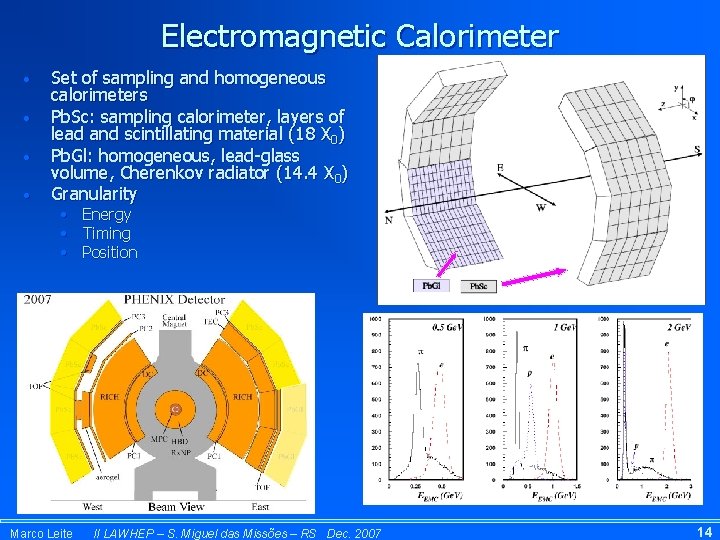
Electromagnetic Calorimeter • • Set of sampling and homogeneous calorimeters Pb. Sc: sampling calorimeter, layers of lead and scintillating material (18 X 0) Pb. Gl: homogeneous, lead-glass volume, Cherenkov radiator (14. 4 X 0) Granularity • • • Marco Leite Energy Timing Position II LAWHEP – S. Miguel das Missões – RS Dec. 2007 14
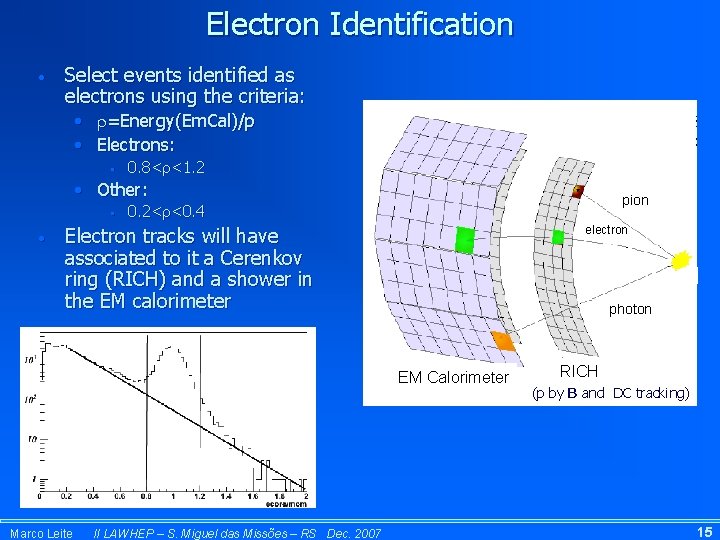
Electron Identification • Select events identified as electrons using the criteria: • • =Energy(Em. Cal)/p Electrons: • 0. 8< <1. 2 • Other: • • pion 0. 2< <0. 4 Electron tracks will have associated to it a Cerenkov ring (RICH) and a shower in the EM calorimeter electron photon EM Calorimeter Marco Leite II LAWHEP – S. Miguel das Missões – RS Dec. 2007 RICH (p by B and DC tracking) 15
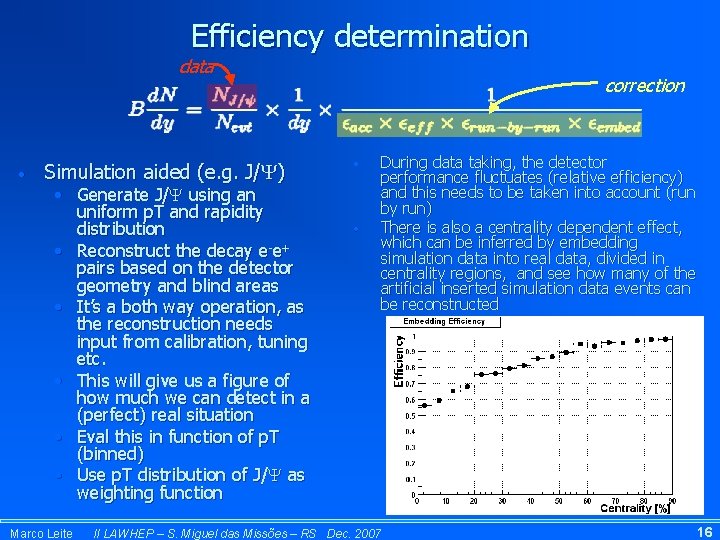
Efficiency determination data • Simulation aided (e. g. J/ ) • Generate J/ using an uniform p. T and rapidity distribution • Reconstruct the decay e-e+ pairs based on the detector geometry and blind areas • It’s a both way operation, as the reconstruction needs input from calibration, tuning etc. • This will give us a figure of how much we can detect in a (perfect) real situation • Eval this in function of p. T (binned) • Use p. T distribution of J/ as weighting function Marco Leite correction • • During data taking, the detector performance fluctuates (relative efficiency) and this needs to be taken into account (run by run) There is also a centrality dependent effect, which can be inferred by embedding simulation data into real data, divided in centrality regions, and see how many of the artificial inserted simulation data events can be reconstructed II LAWHEP – S. Miguel das Missões – RS Dec. 2007 16
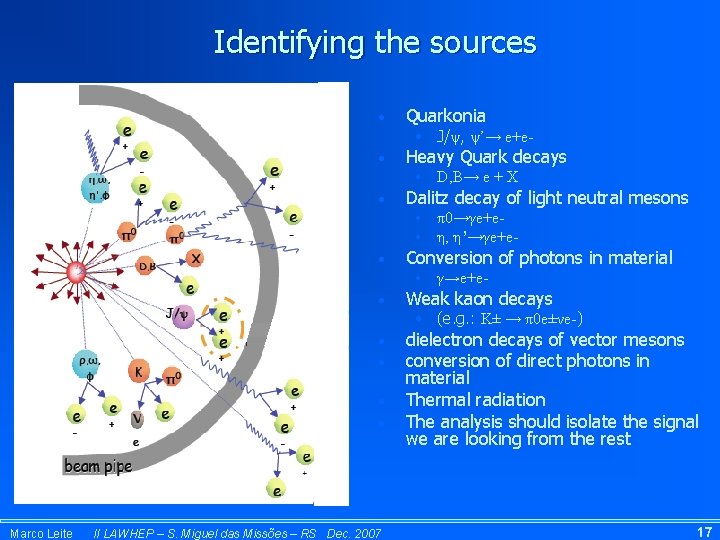
Identifying the sources • Quarkonia • Heavy Quark decays • J/ψ, ψ’→ e+e • • Dalitz decay of light neutral mesons • • • π0→γe+eη, η’→γe+e- Conversion of photons in material • γ→e+e- • Weak kaon decays • dielectron decays of vector mesons conversion of direct photons in material Thermal radiation The analysis should isolate the signal we are looking from the rest • • • Marco Leite D, B→ e + X II LAWHEP – S. Miguel das Missões – RS Dec. 2007 • (e. g. : K± → π0 e±νe-) 17
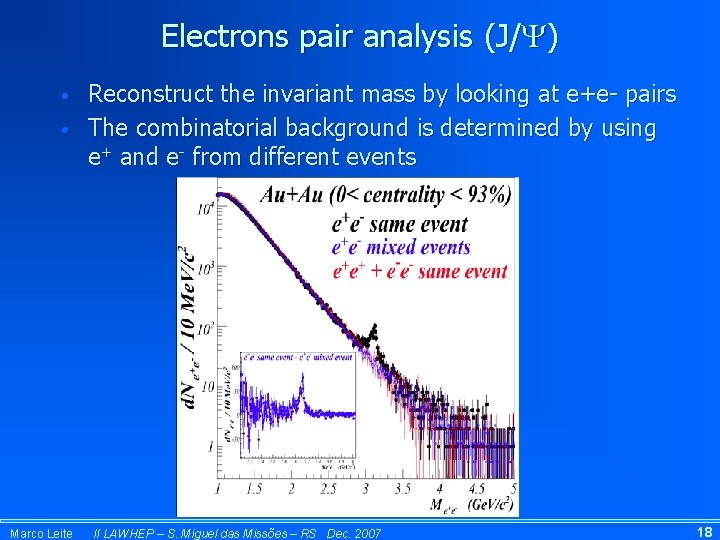
Electrons pair analysis (J/ ) • • Marco Leite Reconstruct the invariant mass by looking at e+e- pairs The combinatorial background is determined by using e+ and e- from different events II LAWHEP – S. Miguel das Missões – RS Dec. 2007 18
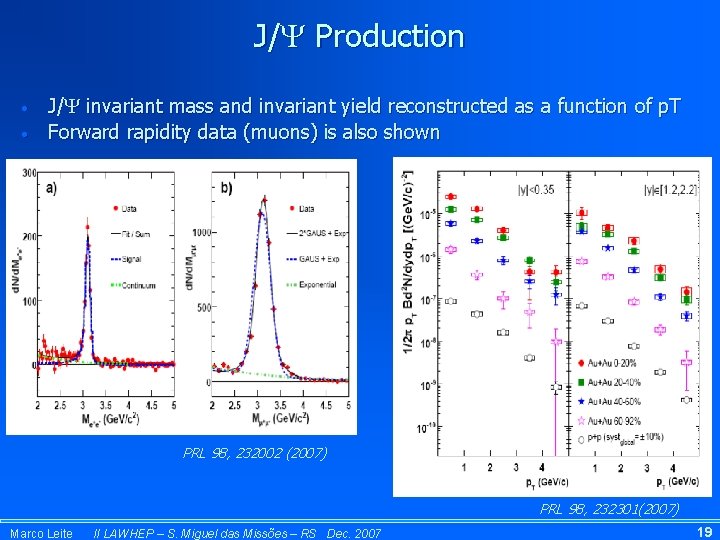
J/ Production • • J/ invariant mass and invariant yield reconstructed as a function of p. T Forward rapidity data (muons) is also shown PRL 98, 232002 (2007) PRL 98, 232301(2007) Marco Leite II LAWHEP – S. Miguel das Missões – RS Dec. 2007 19
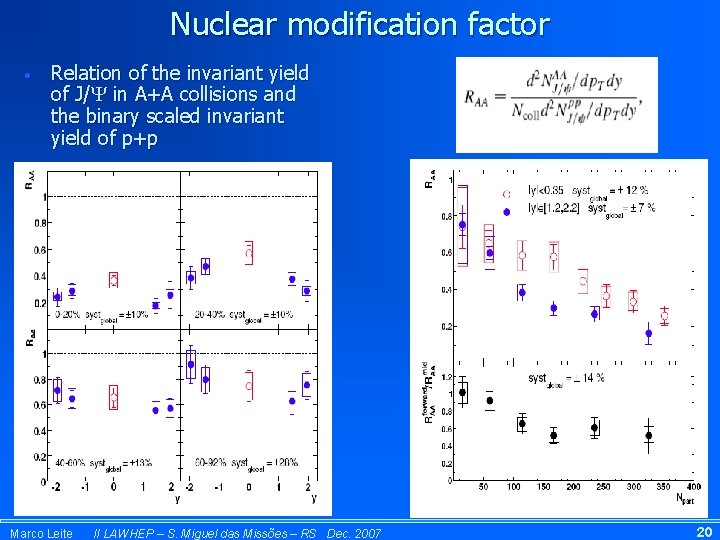
Nuclear modification factor • Relation of the invariant yield of J/ in A+A collisions and the binary scaled invariant yield of p+p Marco Leite II LAWHEP – S. Miguel das Missões – RS Dec. 2007 20
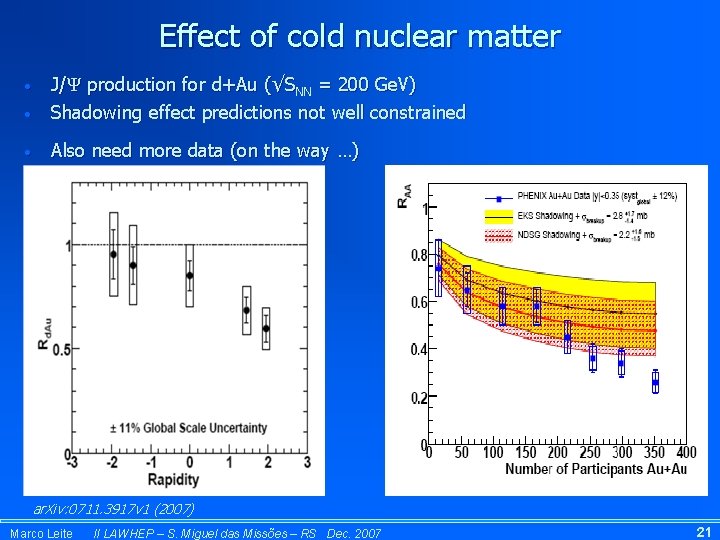
Effect of cold nuclear matter • J/ production for d+Au (√SNN = 200 Ge. V) Shadowing effect predictions not well constrained • Also need more data (on the way …) • ar. Xiv: 0711. 3917 v 1 (2007) Marco Leite II LAWHEP – S. Miguel das Missões – RS Dec. 2007 21
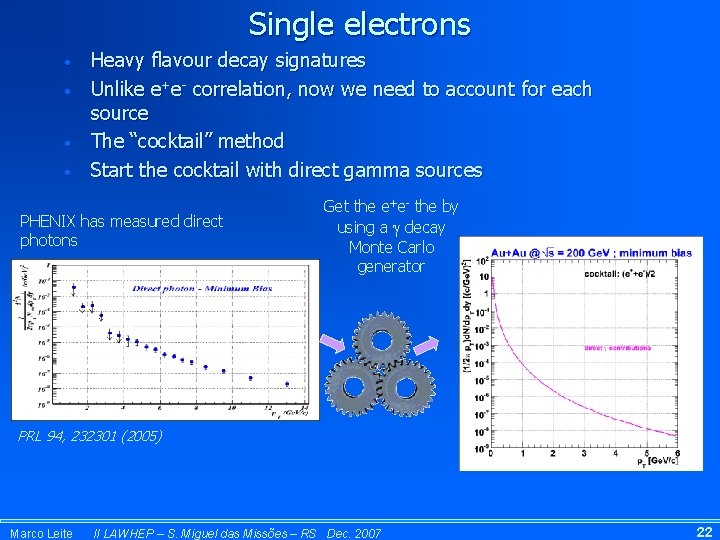
Single electrons • • Heavy flavour decay signatures Unlike e+e- correlation, now we need to account for each source The “cocktail” method Start the cocktail with direct gamma sources PHENIX has measured direct photons Get the e+e- the by using a decay Monte Carlo generator PRL 94, 232301 (2005) Marco Leite II LAWHEP – S. Miguel das Missões – RS Dec. 2007 22
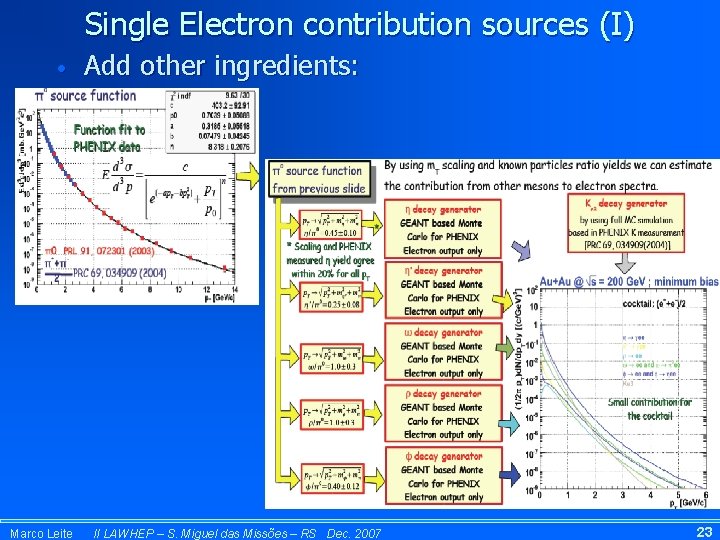
Single Electron contribution sources (I) • Marco Leite Add other ingredients: II LAWHEP – S. Miguel das Missões – RS Dec. 2007 23
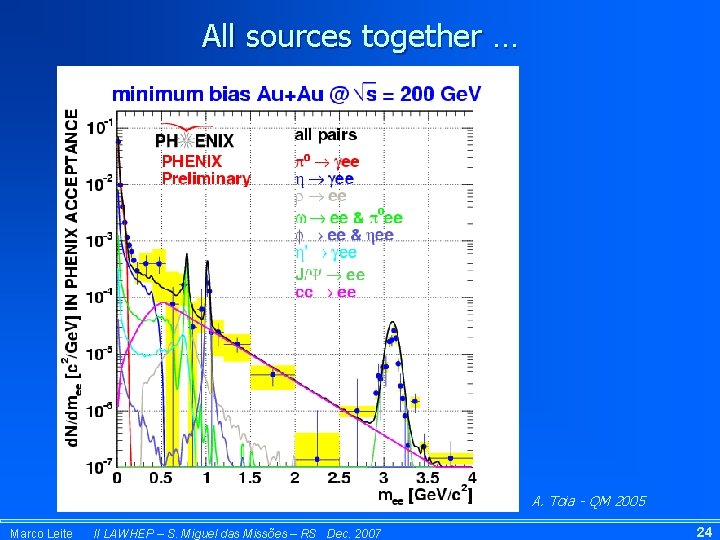
All sources together … A. Toia - QM 2005 Marco Leite II LAWHEP – S. Miguel das Missões – RS Dec. 2007 24
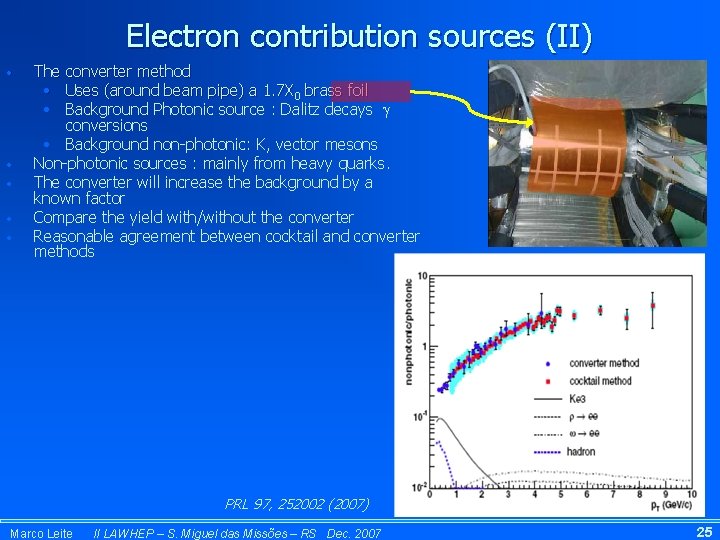
Electron contribution sources (II) • • • The converter method • Uses (around beam pipe) a 1. 7 X 0 brass foil • Background Photonic source : Dalitz decays conversions • Background non-photonic: K, vector mesons Non-photonic sources : mainly from heavy quarks. The converter will increase the background by a known factor Compare the yield with/without the converter Reasonable agreement between cocktail and converter methods PRL 97, 252002 (2007) Marco Leite II LAWHEP – S. Miguel das Missões – RS Dec. 2007 25
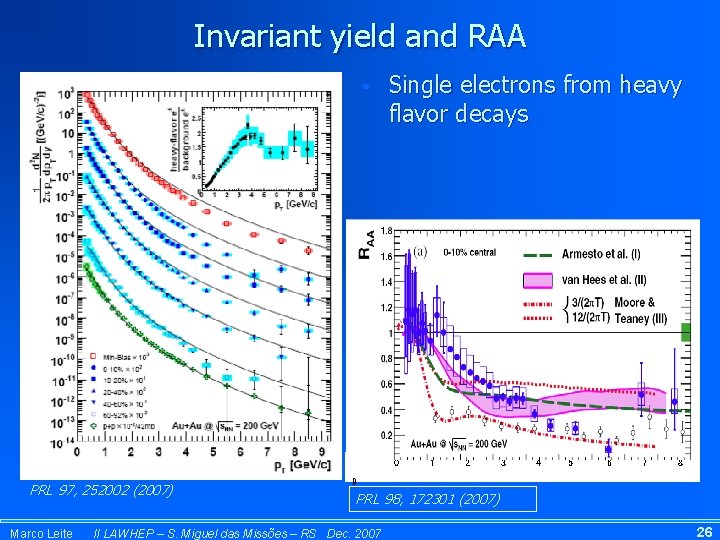
Invariant yield and RAA • Single electrons from heavy flavor decays 0 PRL 97, 252002 (2007) Marco Leite 1 2 3 4 5 6 7 8 9 PRL 98, 172301 (2007) II LAWHEP – S. Miguel das Missões – RS Dec. 2007 26
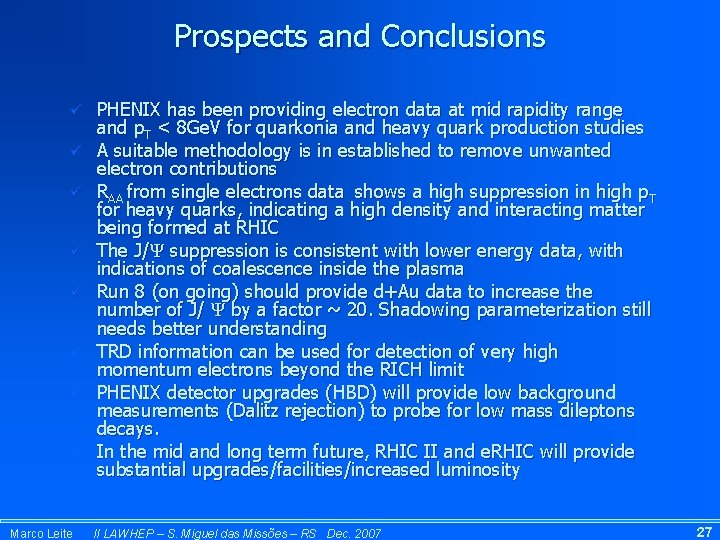
Prospects and Conclusions ü ü ü ü Marco Leite PHENIX has been providing electron data at mid rapidity range and p. T < 8 Ge. V for quarkonia and heavy quark production studies A suitable methodology is in established to remove unwanted electron contributions RAA from single electrons data shows a high suppression in high p. T for heavy quarks, indicating a high density and interacting matter being formed at RHIC The J/ suppression is consistent with lower energy data, with indications of coalescence inside the plasma Run 8 (on going) should provide d+Au data to increase the number of J/ by a factor ~ 20. Shadowing parameterization still needs better understanding TRD information can be used for detection of very high momentum electrons beyond the RICH limit PHENIX detector upgrades (HBD) will provide low background measurements (Dalitz rejection) to probe for low mass dileptons decays. In the mid and long term future, RHIC II and e. RHIC will provide substantial upgrades/facilities/increased luminosity II LAWHEP – S. Miguel das Missões – RS Dec. 2007 27
Extra Stuff Marco Leite II LAWHEP – S. Miguel das Missões – RS Dec. 2007 28