
The pharmacokinetics of Risperdal and its weight gaining
- Slides: 1
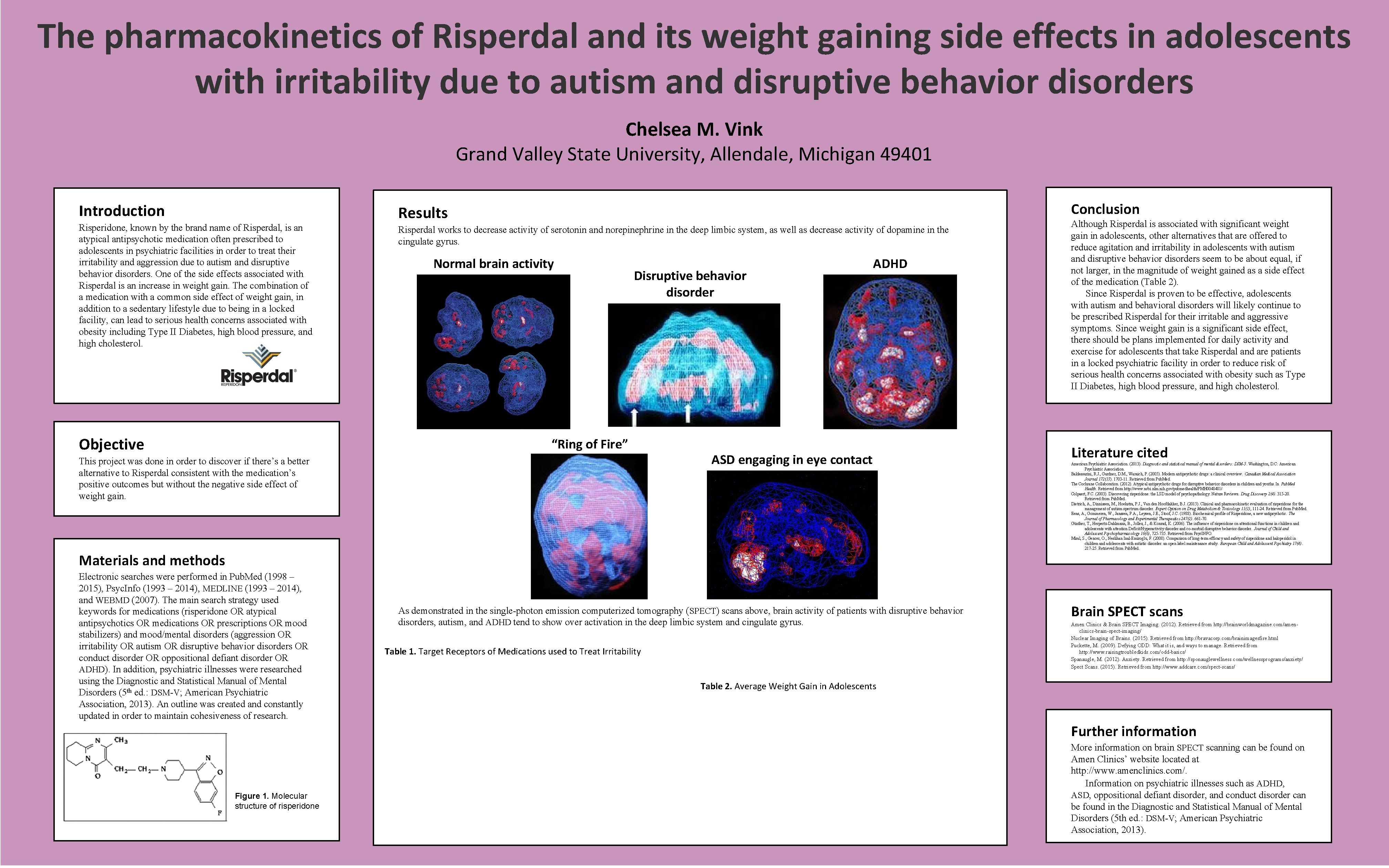
The pharmacokinetics of Risperdal and its weight gaining side effects in adolescents with irritability due to autism and disruptive behavior disorders Chelsea M. Vink Grand Valley State University, Allendale, Michigan 49401 Introduction Risperidone, known by the brand name of Risperdal, is an atypical antipsychotic medication often prescribed to adolescents in psychiatric facilities in order to treat their irritability and aggression due to autism and disruptive behavior disorders. One of the side effects associated with Risperdal is an increase in weight gain. The combination of a medication with a common side effect of weight gain, in addition to a sedentary lifestyle due to being in a locked facility, can lead to serious health concerns associated with obesity including Type II Diabetes, high blood pressure, and high cholesterol. Objective Conclusion Results Risperdal works to decrease activity of serotonin and norepinephrine in the deep limbic system, as well as decrease activity of dopamine in the cingulate gyrus. Normal brain activity Disruptive behavior disorder “Ring of Fire” This project was done in order to discover if there’s a better alternative to Risperdal consistent with the medication’s positive outcomes but without the negative side effect of weight gain. ADHD ASD engaging in eye contact Although Risperdal is associated with significant weight gain in adolescents, other alternatives that are offered to reduce agitation and irritability in adolescents with autism and disruptive behavior disorders seem to be about equal, if not larger, in the magnitude of weight gained as a side effect of the medication (Table 2). Since Risperdal is proven to be effective, adolescents with autism and behavioral disorders will likely continue to be prescribed Risperdal for their irritable and aggressive symptoms. Since weight gain is a significant side effect, there should be plans implemented for daily activity and exercise for adolescents that take Risperdal and are patients in a locked psychiatric facility in order to reduce risk of serious health concerns associated with obesity such as Type II Diabetes, high blood pressure, and high cholesterol. Literature cited American Psychiatric Association. (2013). Diagnostic and statistical manual of mental disorders: DSM-5. Washington, D. C: American Psychiatric Association. Baldessarini, R. J. , Gardner, D. M. , Waraich, P. (2005). Modern antipsychotic drugs: a clinical overview. Canadian Medical Association Journal 172(13). 1703 -11. Retrieved from Pub. Med. The Cochrane Collaboration. (2012). Atypical antipsychotic drugs for disruptive behavior disorders in children and youths. In Pub. Med Health. Retrieved from http: //www. ncbi. nlm. nih. gov/pubmedhealth/PMH 0048481/ Colpaert, F. C. (2003). Discovering risperidone: the LSD model of psychopathology. Nature Reviews. Drug Discovery 2(4). 315 -20. Retrieved from Pub. Med. Dietrich, A. , Dinnissen, M. , Hoekstra, P. J. , Van den Hoofdakker, B. J. (2015). Clinical and pharmacokinetic evaluation of risperidone for the management of autism spectrum disorder. Expert Opinion on Drug Metabolism & Toxicology 11(1), 111 -24. Retrieved from Pub. Med. Eens, A. , Gommeren, W. , Janssen, P. A. , Leysen, J. E. , Stoof, J. C. (1988). Biochemical profile of Risperidone, a new antipsychotic. The Journal of Pharmacology and Experimental Therapeutics 247(2). 661 -70. Günther, T. , Herpertz-Dahlmann, B. , Jolles, J. , & Konrad, K. (2006). The influence of risperidone on attentional functions in children and adolescents with attention Deficit/Hyperactivity disorder and co-morbid disruptive behavior disorder. Journal of Child and Adolescent Psychopharmacology 16(6), 725 -735. Retrieved from Psyc. INFO. Miral, S. , Gencer, O. , Neslihan Inal-Emiroglu, F. (2008). Comparison of long-term efficacy and safety of risperidone and haloperidol in children and adolescents with autistic disorder: an open label maintenance study. European Child and Adolescent Psychiatry 17(4). 217 -25. Retrieved from Pub. Med. Materials and methods Electronic searches were performed in Pub. Med (1998 – 2015), Psyc. Info (1993 – 2014), MEDLINE (1993 – 2014), and WEBMD (2007). The main search strategy used keywords for medications (risperidone OR atypical antipsychotics OR medications OR prescriptions OR mood stabilizers) and mood/mental disorders (aggression OR irritability OR autism OR disruptive behavior disorders OR conduct disorder OR oppositional defiant disorder OR ADHD). In addition, psychiatric illnesses were researched using the Diagnostic and Statistical Manual of Mental Disorders (5 th ed. : DSM-V; American Psychiatric Association, 2013). An outline was created and constantly updated in order to maintain cohesiveness of research. As demonstrated in the single-photon emission computerized tomography (SPECT) scans above, brain activity of patients with disruptive behavior disorders, autism, and ADHD tend to show over activation in the deep limbic system and cingulate gyrus. Table 1. Target Receptors of Medications used to Treat Irritability Brain SPECT scans Amen Clinics & Brain SPECT Imaging. (2012). Retrieved from http: //brainworldmagazine. com/amenclinics-brain-spect-imaging/ Nuclear Imaging of Brains. (2015). Retrieved from http: //bravacorp. com/brainimagesfire. html Puckette, M. (2009). Defying ODD: What it is, and ways to manage. Retrieved from http: //www. raisingtroubledkids. com/odd-basics/ Spanaugle, M. (2012). Anxiety. Retrieved from http: //sponauglewellness. com/wellnessprograms/anxiety/ Spect Scans. (2015). Retrieved from http: //www. addcare. com/spect-scans/ Table 2. Average Weight Gain in Adolescents Further information Figure 1. Molecular structure of risperidone More information on brain SPECT scanning can be found on Amen Clinics’ website located at http: //www. amenclinics. com/. Information on psychiatric illnesses such as ADHD, ASD, oppositional defiant disorder, and conduct disorder can be found in the Diagnostic and Statistical Manual of Mental Disorders (5 th ed. : DSM-V; American Psychiatric Association, 2013).